

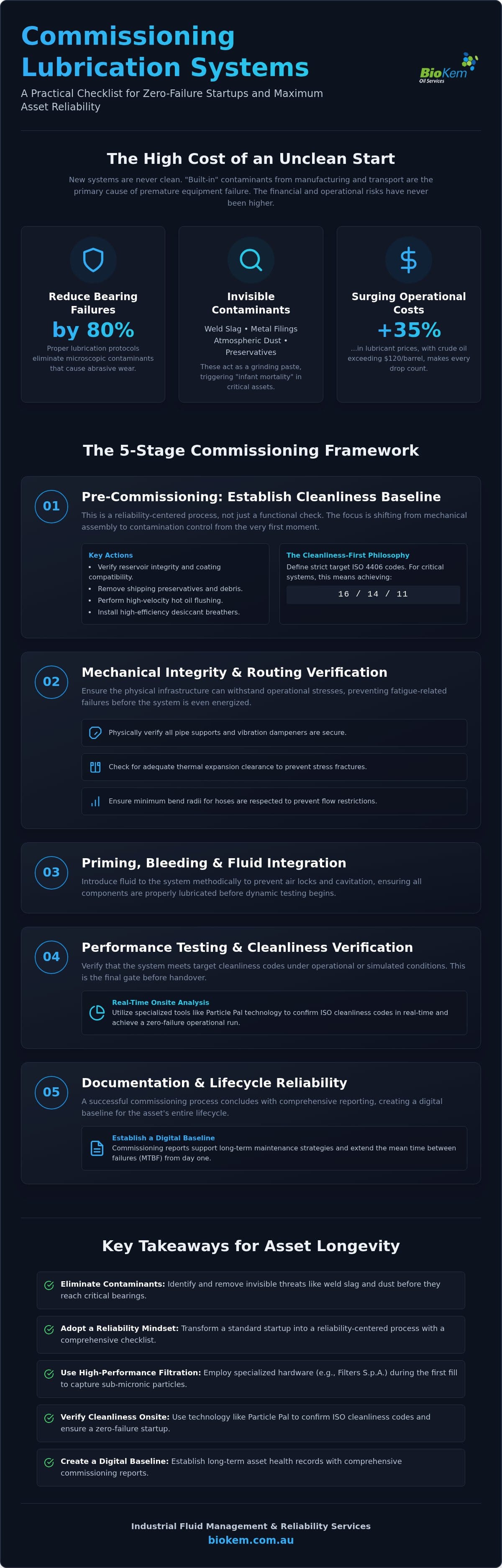
Did you know that properly implemented lubrication protocols can reduce bearing failures by up to 80%, yet many systems are sabotaged by built-in debris before they even begin their first operational run? With industrial lubricant prices surging by as much as 35% in 2026 and crude oil exceeding $120 per barrel, the financial stakes of a failed startup have never been higher. Following Commissioning Lubrication Systems: A Practical Checklist is no longer just a recommendation; it is a technical necessity for any site manager balancing tight deadlines with the fear that microscopic contaminants will trigger infant mortality in critical assets.
We understand that verifying oil cleanliness onsite can feel like a moving target under pressure. This guide provides a comprehensive, cleanliness-first framework to ensure your industrial assets start up without risk. By following these technical steps, you can achieve a zero-failure startup and maintain compliance with strict ISO standards from day one. We will preview the essential stages of a successful commissioning programme, including high-velocity hot oil flushing and real-time analysis using specialised Particle Pal technology to extend your mean time between failures (MTBF) from the very first hour of operation.
Key Takeaways
- Identify and eliminate invisible contaminants like weld slag and dust before they reach critical bearings and compromise asset longevity.
- Use Commissioning Lubrication Systems: A Practical Checklist to transform a standard mechanical startup into a reliability-centred process.
- Learn why external filtration and high-performance Filters S.p.A. hardware are essential during the first fill to prevent introducing new particles into the circuit.
- Discover how to verify ISO cleanliness codes onsite using Particle Pal technology to achieve a zero-failure operational run.
- Establish a digital baseline for your assets through comprehensive commissioning reports that support long-term maintenance and lifecycle health.
Pre-Commissioning: Establishing a Cleanliness Baseline
Commissioning is often misunderstood as a mere functional check. In reality, it’s a rigorous, reliability-centred process designed to protect high-value assets from their very first hour of operation. When following Commissioning Lubrication Systems: A Practical Checklist, the focus shifts from mechanical assembly to contamination control. This transition is vital because new systems are rarely clean when they arrive on site. They carry a legacy of “built-in” contaminants, including weld slag, metal filings, and atmospheric dust. If these aren’t removed before the first operational cycle, they act as a grinding paste, causing immediate abrasive wear on precision components.
Verifying reservoir integrity is a crucial first step in this framework. You must ensure that internal coatings are fully compatible with the intended lubricant to prevent chemical reactions or premature peeling. Many operators overlook the invisible threat posed by preservative coatings applied during shipping; if left unaddressed, these substances can interfere with oil chemistry and foam suppression. Integrating a comprehensive Ultimate Guide to Hot Oil Flushing programme at this stage ensures these contaminants are suspended and removed before they reach sensitive bearings or valves.
The Cleanliness-First Philosophy
Accepting a “clean enough” standard is a primary driver of infant mortality in industrial bearings. Reliability begins with defining strict target ISO 4406 codes based on the specific criticality of the asset. For high-pressure hydraulic systems or turbine bearings, this often means achieving codes as low as 16/14/11. To maintain these levels during the initial system protection phase, we recommend utilising high-performance Filters S.p.A. products. These specialised filters provide the high beta ratios required to capture sub-micronic particles that standard construction-grade filters often miss.
System Inspection and Debris Removal
A physical audit of the system is non-negotiable. This involves a manual inspection of the reservoir and all accessible piping runs to identify moisture or manufacturing debris. It’s a simple but effective way to prevent catastrophic pump failure. Unlike basic cleaning methods, a professional inspection targets the removal of scale and weld slag that can hide in elbows and dead-legs.
- Vacuum out any standing water or grit from the tank floor using specialised equipment.
- Verify that all pipe supports are secure to prevent vibration-induced fatigue during high-velocity flushing.
- Install high-efficiency desiccant breathers immediately to prevent the ingress of moisture.
Breather caps prevent the ingress of moisture and particulate during the setup phase, ensuring the system remains a closed loop. By addressing these factors within the framework of Commissioning Lubrication Systems: A Practical Checklist, you establish a baseline of operational health that supports long-term ecological and mechanical sustainability.
Mechanical Integrity and Routing Verification
Mechanical integrity serves as the physical foundation for any high-performance fluid circuit. While the initial cleanliness baseline focuses on removing contaminants, this stage of Commissioning Lubrication Systems: A Practical Checklist ensures the infrastructure can withstand operational stresses. Physical verification of all pipe supports and vibration dampening is critical; industrial systems often experience harmonic frequencies that can loosen fittings over time. You must walk every line to confirm that all fasteners and brackets are secure, preventing fatigue-related failures before the system is even energised.
Thermal expansion clearance is a frequently overlooked factor in larger industrial plants. High-temperature systems, such as those used in power generation or heavy manufacturing, require specific tolerances for pipe movement. If piping is restrained too rigidly, the resulting stress can lead to hairline fractures or seal failures at pump interfaces. Every fitting must be torqued to manufacturer specifications, and multi-point distributors require a visual check to eliminate cross-contamination risks. BioKem offers specialist oil filters and hardware to support these critical verification stages and ensure long-term system stability.
Piping and Hose Routing Standards
Ensuring that minimum bend radii are respected is essential to prevent flow restriction and premature hose degradation. Tight bends create turbulence, which can increase the local temperature of the lubricant and accelerate oxidation. During your inspection, identify potential “dead legs” where stagnant oil and debris might accumulate. These areas are notorious for harbouring the very contaminants identified in the pre-commissioning phase. Additionally, verify that drip loops are present on all hose runs that transition near electrical connections to protect sensitive control systems from potential leaks.
Hardware and Instrumentation Checks
A lubrication system is only as reliable as the data it provides. Calibration verification for pressure transducers and flow meters must be completed before the first fill. If these instruments provide inaccurate readings, the entire commissioning report becomes unreliable. Testing the functionality of low-level and high-temperature alarms ensures the system’s “self-preservation” mechanisms are active. Finally, confirm that all bypass valves are in the correct operational position; a valve left in the wrong state can starve a bearing of oil or bypass critical filtration stages entirely.
Integrating these physical verification steps within your Commissioning Lubrication Systems: A Practical Checklist establishes a robust mechanical framework. This attention to detail prevents the small oversights that often lead to costly downtime during the initial startup phase.
Priming, Bleeding, and Fluid Integration
Once the mechanical framework is secure, the transition to fluid integration begins. This is a high-risk phase where improper handling can introduce more contaminants than were removed during pre-commissioning. Utilizing Commissioning Lubrication Systems: A Practical Checklist ensures that the first fill is treated as a filtration event rather than a simple transfer. You should never assume that oil delivered in drums or tankers meets your target ISO codes. It’s essential to use external filtration units to scrub the fluid as it enters the reservoir, preventing the introduction of moisture and particulate from the very start.
During this stage, choosing the right preparation method is vital for the long-term health of the fluid. If your system has significant internal oxidation or residual preservative coatings, you might need to evaluate the benefits of Hot Oil Flushing vs. Chemical Cleaning to ensure the substrate is ready for the new lubricant. Once the reservoir is filled, the first circulation cycle requires incremental pressure increases. This measured approach allows you to monitor for aeration and foaming before the system reaches full load, preventing catastrophic cavitation in pumps and ensuring the fluid remains stable.
The Correct Priming Sequence
A systematic priming sequence protects precision components from dry-start damage. First, pre-fill the main pump housing manually to provide immediate lubrication upon startup. Second, initiate low-pressure circulation; this controlled flow makes it easier to identify immediate leaks at fittings or seals without risking a high-pressure spray. Finally, perform a systematic bleeding of air from the highest points in the circuit. Air trapped in high-elevation loops or dead-legs will eventually migrate, causing erratic pressure readings and flow instability that can trigger false alarms.
Managing Air Entrainment
Trapped air isn’t just a mechanical nuisance. It’s a chemical threat to the lubricant’s lifespan. When air bubbles are subjected to rapid pressure changes within the system, they undergo adiabatic compression, a process known as micro-dieseling. This generates localised high temperatures that scorch the oil, leading to rapid fluid degradation and varnish formation. Visual indicators in sight glasses, such as a milky or cloudy appearance, signal significant aeration. Techniques for burping the system involve opening bleed valves at low flow rates to release air until a solid stream of lubricant appears, ensuring no external contaminants enter during the process.
Performance Testing and Cleanliness Verification
Performance testing represents the final gate between a commissioned system and full-scale production. While previous stages ensure the system is mechanically sound and primed, this phase provides the empirical proof that the lubricant is reaching every critical interface. A fundamental component of Commissioning Lubrication Systems: A Practical Checklist is the “crack and confirm” method. This involves briefly loosening the fittings at each lubrication point while the system is under low pressure to verify solid oil delivery. This manual verification eliminates the risk of air locks or blockages that might not be detected by electronic sensors alone.
Once point-by-point delivery is confirmed, the system must undergo a full-load test to monitor thermal stability. Operating at design capacity allows you to observe how the lubricant handles heat rejection and pressure fluctuations. If temperatures rise beyond predicted limits, it may indicate internal friction or inadequate flow in specific branches. Skipping these rigorous verification steps often leads to premature wear, which is why integrated hot oil flushing services are essential to ensure no residual debris compromises these tests. Achieving a stable thermal profile is a primary indicator that the system is ready for handover.
Verifying Point-by-Point Delivery
Confirming flow at the furthest bearing or actuator is the most critical part of the verification process. These distal points are the most susceptible to pressure drops and debris accumulation. To ensure total system integrity, we recommend using paddle flushing screens during the final circulation. These specialised screens capture any bypass debris that may have been dislodged during the transition to full pressure. Recording baseline flow rates at this stage provides a vital reference point for your future preventative maintenance programme, allowing you to detect gradual performance declines before they lead to asset failure.
Fluid Health and ISO Handover
Formal handover requires more than a visual inspection; it demands hard data. Taking a representative oil sample from the return line ensures you are measuring the true state of the fluid as it leaves the work zone. To achieve immediate results without waiting for laboratory turnaround, the Particle Pal range provides onsite ISO code verification. This technology allows you to interpret particle counts in real-time, confirming if the system has reached the target ISO 4406 cleanliness levels required for full production. For a quick visual backup, patch test kits can be used to identify the nature of any remaining particulate, providing a clear narrative of the system’s internal health.
To ensure your next startup meets these rigorous standards, consider utilising the Particle Pal range for onsite analysis to verify your cleanliness codes in real-time.
Documentation and Lifecycle Reliability
The final phase of Commissioning Lubrication Systems: A Practical Checklist involves transforming technical data into a roadmap for long-term reliability. A commissioning report is more than a formality; it serves as a vital baseline for the asset’s digital twin, recording the “as-new” state against which all future performance is measured. This documentation ensures that when the system transitions to full operational status, maintenance teams have a clear understanding of the initial cleanliness levels, pressure settings, and flow characteristics. Without this data, troubleshooting future failures becomes an exercise in guesswork.
In new turbine setups, establishing this baseline includes addressing the immediate risk of varnish formation. Integrating Varnish Removal Systems from day one prevents the accumulation of soft contaminants that often plague high-temperature bearings during the first few months of service. The final handover must also include training for site operators on sensory indicators. While digital sensors provide precise data, the ability of a technician to identify subtle changes in sight glass clarity or audible pump resonance remains a critical layer of system health monitoring that technology cannot fully replace.
The Commissioning Report
A comprehensive report must capture essential data points that define the system’s success. These include the final ISO 4406 codes achieved through flushing, initial pressure baselines, and filter differential pressures across the system. It’s equally important to record the exact lubricant batch and manufacturer data to trace any future chemical anomalies. Any “as-built” changes to the lubrication piping made during installation must be documented to ensure the system’s technical drawings remain accurate for future maintenance or system upgrades.
Partnering for Long-Term Health
Successful commissioning is the first step in a proactive maintenance strategy. This transition involves establishing a routine sampling schedule based on the commissioning results. We recommend scheduling the first Filter Ferrogram Analysis within the first 500 hours of operation. This specialised testing detects early-stage wear patterns that standard particle counting might miss, allowing for intervention before a minor issue becomes a catastrophic failure. By leveraging BioKem’s national Australian expertise, sites can ensure their fluid purification remains at the highest standards, extending mean time between failures (MTBF) from the very start.
By completing Commissioning Lubrication Systems: A Practical Checklist with rigorous documentation, you protect your investment and ensure that the sustainability goals of your facility are supported by reliable, efficient machinery.
Securing Long-Term Asset Reliability through Technical Precision
A successful startup is defined by the absence of invisible contaminants that trigger infant mortality in precision bearings. By adhering to Commissioning Lubrication Systems: A Practical Checklist, you move beyond basic functional checks to a reliability-centred framework. This process ensures that every lubrication point is verified, air entrainment is eliminated, and ISO cleanliness codes are met before full-scale production begins. The result is a robust mechanical baseline that supports extended mean time between failures and protects your significant capital investment from day one.
BioKem brings proven expertise to the Australian mining and power generation sectors, providing specialised onsite oil analysis and purification services. As the sole Australian distributor for Filters S.p.A., we utilise high-performance hardware to achieve strict cleanliness standards during the critical initial fill and flushing phases. We invite you to contact BioKem for professional Hot Oil Flushing and Commissioning support across Australia to ensure your industrial assets operate with peak efficiency. Taking these proactive steps today secures the operational health and ecological sustainability of your facility for years to come.
Frequently Asked Questions
Why is hot oil flushing necessary during commissioning?
Hot oil flushing removes built-in contaminants like weld slag and manufacturing debris that standard circulation cannot dislodge. High-velocity flow creates the turbulence required to lift particles from pipe walls. This is a critical step in the Commissioning Lubrication Systems: A Practical Checklist to prevent abrasive wear on precision bearings. Without it, these contaminants act as a grinding paste, leading to infant mortality failures in high-value industrial assets.
What ISO 4406 code should I target for a new hydraulic system?
Target codes depend on the operating pressure and component sensitivity, but a typical standard for new high-pressure hydraulic systems is ISO 16/14/11. Achieving this ensures that the fluid is clean enough to protect sensitive valves and actuators from silt-sized particles. Since new lubricants often arrive at ISO 20/18/15 or higher, pre-filtering and high-velocity flushing are required to meet these rigorous reliability requirements.
Can I commission a system using the machine’s internal filters?
Internal filters are generally designed for maintenance, not for capturing the massive volume of debris present during initial startup. Using them risks premature bypass or media collapse, allowing contaminants to reach critical components. High-performance Filters S.p.A. hardware or external flushing rigs should be used instead. These specialised units have the dirt-holding capacity and high beta ratios needed to scrub the system clean without risking the machine’s own filtration circuit.
How do I remove air pockets from a newly installed lubrication line?
Use a systematic bleeding process starting from the lowest point and moving to the highest elevation in the circuit. Open bleed valves or loosen fittings slightly until a solid stream of lubricant appears without bubbles. This prevents micro-dieseling and erratic pressure readings. It’s essential to perform this at low pressure to avoid safety hazards and to ensure no external dust enters the system through the open ports.
What are the signs of a failed commissioning process?
Visual indicators include cloudy oil, which signals aeration or moisture, and rapid filter differential pressure rises. Mechanically, you might notice audible pump cavitation or inconsistent flow rates at distal lubrication points. If your Commissioning Lubrication Systems: A Practical Checklist isn’t followed, the most definitive sign is the presence of metallic particulate in the first oil sample, indicating that built-in debris is already causing abrasive wear on internal surfaces.
Is onsite oil analysis accurate enough for system handover?
Modern onsite technology like the Particle Pal range provides laboratory-grade accuracy for ISO 4406 particle counting. These units allow for immediate verification of cleanliness codes, enabling instant decisions during the flushing process. While laboratory analysis remains valuable for long-term trending, onsite analysis is the gold standard for commissioning handovers because it eliminates the risk of sample degradation during transport and provides real-time results for site managers.
How often should I sample oil after the initial commissioning?
We recommend taking the first sample within the first 100 to 500 hours of operation to establish a post-startup trend. Following this, a monthly or quarterly schedule should be established based on the criticality of the asset. Regular sampling allows you to detect early-stage wear or ingress issues before they escalate. This proactive approach ensures that the cleanliness levels achieved during commissioning are maintained throughout the equipment’s lifecycle.
What is the risk of using a “generic” flushing oil?
Generic oils may contain additives that are incompatible with your system’s operational lubricant, leading to foaming or seal degradation. They often lack the specific solvency required to lift preservative coatings or varnish precursors from internal surfaces. It’s safer to use the same lubricant intended for operation, filtered to a higher standard, or a specialised flushing fluid that is chemically matched to the final oil to prevent cross-contamination risks.