


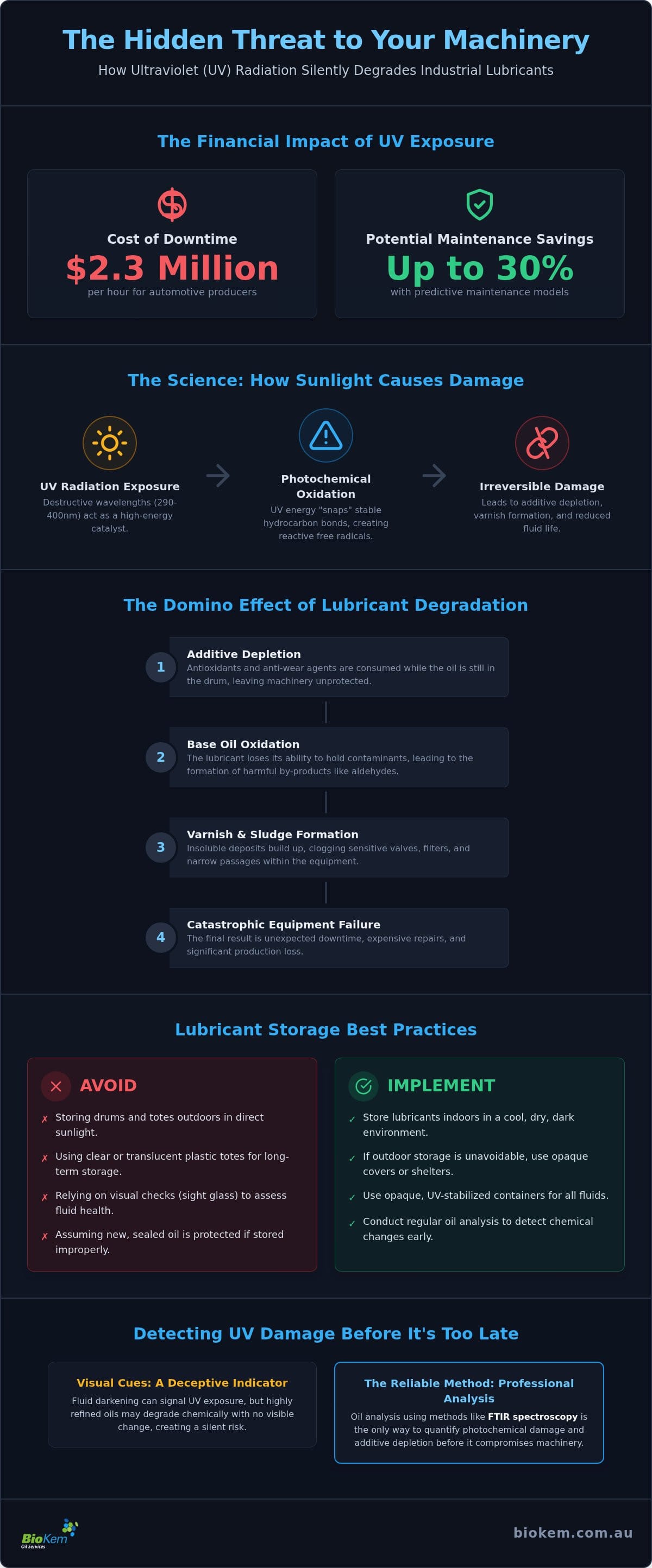
Could the sun be the single most expensive threat to your machinery’s reliability? While most maintenance protocols prioritize moisture and particulate control, the silent chemical breakdown caused by ultraviolet radiation often goes unnoticed until it’s too late. When investigating the question, Can UV affect lubricants – storage considerations often focus on temperature while overlooking the chemical impact of light. Leaving drums exposed to direct sunlight can trigger rapid oxidation, leading to varnish-clogged valves and unexpected downtime that can cost automotive producers up to $2.3 million per hour.
You likely recognize that maintaining oil purity is essential for avoiding high replacement costs and equipment failure. This article details how UV exposure degrades lubricant integrity and outlines the professional storage protocols required to prevent premature additive depletion. We’ll provide a clear framework for indoor versus outdoor storage and explain the specific metrics to look for in your oil analysis reports. By adopting these predictive maintenance models, organizations can reduce overall maintenance costs by up to 30% while ensuring compliance with evolving standards like ISO 12940:2026 and ECHA regulations regarding UV stabilizers.
Key Takeaways
- Understand how ultraviolet radiation at wavelengths below 400nm initiates free radical chain reactions that prematurely age your industrial fluids.
- Learn why the question “Can UV affect lubricants – storage considerations” is critical for operational ROI, specifically regarding the risks of clear plastic totes and unshielded outdoor drums.
- Identify the direct link between additive dropout and the formation of varnish that clogs sensitive valves and increases equipment downtime.
- Discover how professional oil analysis and FTIR spectroscopy quantify photochemical damage before it compromises your machinery.
- Explore proactive management strategies, including varnish mitigation and equipment hire, to restore fluid integrity and extend service life.
Does Sunlight Damage Oil? Understanding UV Degradation
Industrial lubricants are far from inert substances. They are sophisticated chemical formulations designed to perform under specific mechanical stresses, but they remain highly sensitive to environmental energy inputs. While maintenance teams often focus on moisture and heat, ultraviolet (UV) radiation carries significantly higher energy than visible light. This energy is sufficient to initiate free radical chain reactions that compromise the fluid’s structural integrity. When facility managers ask, Can UV affect lubricants – storage considerations should be at the forefront of their maintenance strategy. UV-induced oxidation is the photochemical reaction between hydrocarbons and oxygen catalyzed by solar radiation.
The primary impact of this exposure is accelerated oxidation, which occurs even at ambient temperatures. Unlike traditional oxidation that typically requires high operating heat to progress, UV energy provides the necessary activation energy to break molecular bonds instantly. This process turns a stable lubricant into a source of potential system contamination before it ever reaches the machine. BioKem’s experience with Australian industrial environments shows that unshielded storage can lead to premature fluid failure, necessitating early hot oil flushing to clear the resulting debris.
The Visual Indicators of UV Exposure
Sunlight exposure typically results in a noticeable darkening of the fluid, a phenomenon driven by the formation of chromophores. These light-absorbing molecules are byproducts of the chemical breakdown occurring within the oil. It’s vital to distinguish this from thermal darkening; while heat-induced oxidation requires high operating temperatures, photochemical darkening happens in as little as a few days of direct exposure. Relying on a sight glass for clarity can be deceptive. A lubricant may appear clear but already contain the precursors for varnish. This eventually leads to clogged valves and system inefficiency, requiring professional varnish mitigation to resolve.
Critical Wavelengths and Lubricant Sensitivity
The most destructive wavelengths for industrial fluids reside in the 290nm to 400nm range. This spectrum possesses enough energy to “snap” hydrocarbon bonds. To understand what are lubricants and why they fail, one must look at the base oil group. Group I base oils, containing higher levels of aromatics and sulfur, often show faster visual changes. Highly refined Group II and III oils may degrade chemically without immediate visual cues, making them a “silent” risk. Additives are the first line of defense, but they are sacrificial. UV exposure forces these antioxidants to deplete while the oil is still in the drum. This leaves the machinery unprotected once the fluid is finally put into service. Using onsite oil analysis is the only reliable method to confirm if a batch has been compromised by these specific wavelengths.
The Chemistry of Failure: Oxidation and Additive Dropout
UV radiation acts as a high-energy catalyst that initiates free radical chain reactions within the lubricant’s molecular structure. This process literally “snaps” stable hydrocarbon chains, creating highly reactive fragments that bond with oxygen. When maintenance managers ask, Can UV affect lubricants – storage considerations should focus on this invisible chemical shift. Once the base oil is oxidized, its solubility characteristics change fundamentally. The fluid loses its ability to hold polar contaminants in suspension, which leads to the premature formation of sludge and varnish. Extensive studies on UV degradation and varnish formation confirm that these reactions can occur in unopened containers if they are exposed to the sun’s rays. This phenomenon of light-induced degradation is common to many high-quality oils; for example, the experts at Muskoka Olive Oil Co. apply similar principles of UV protection to preserve the integrity of their specialty culinary products.
Additive Depletion and Its Consequences
Antioxidants and anti-wear agents like Zinc Dialkyldithiophosphate (ZDDP) are the primary defenders of your machinery. However, UV exposure forces these additives to “sacrifice” themselves to neutralize free radicals while the oil is still in the drum. This depletion significantly reduces the lubricant’s remaining useful life (RUL) before it even reaches the sump. Beyond anti-wear protection, this premature chemical activity compromises demulsibility and air release properties. When these characteristics fail, the oil cannot effectively separate from water or air, increasing the risk of cavitation and internal corrosion during operation.
Oxidation By-products: Aldehydes and Ketones
The chemical transition from healthy hydrocarbons to degraded fluid involves the creation of aldehydes and ketones. These polar by-products are the precursors to organic acids, which directly increase the Total Acid Number (TAN) of the lubricant. A rising TAN is a clear indicator that the fluid is becoming corrosive to sensitive system components like yellow metal bushings and elastomeric seals. As these oxidation by-products continue to react and polymerize, the fluid’s viscosity begins to rise. This thickening makes the oil harder to circulate and reduces its ability to carry heat away from critical friction points. If your oil analysis reports show rising acid levels or viscosity, integrating a varnish removal system can help stabilize the fluid and protect your assets.
Lubricant Storage Best Practices to Prevent UV Damage
Indoor storage remains the gold standard for maintaining the chemical stability of industrial fluids. By eliminating direct solar contact, facility managers significantly reduce the risk of photochemical reactions that lead to additive dropout. When assessing Can UV affect lubricants – storage considerations must prioritize physical barriers that block the full solar spectrum. It’s standard practice to Protect the lubricant from light sensitivity and UV radiation by utilizing opaque vessels or dedicated climate-controlled enclosures. While indoor space is often limited, the ROI of proper storage is realized through extended oil life and reduced equipment downtime.
Material selection for storage vessels is a critical factor in fluid preservation. Clear plastic Intermediate Bulk Containers (IBCs) or polyethylene totes represent the highest-risk storage medium because they allow UV rays to penetrate the fluid deeply. In contrast, opaque steel drums or UV-stabilized plastic containers provide a necessary shield. Implementing a strict First-In, First-Out (FIFO) inventory management system is also essential. This practice ensures that no single batch of lubricant sits in a storage area long enough to accumulate significant radiation damage, effectively minimizing the total exposure time for your entire inventory.
Container Selection and Shielding Protocols
Drums and totes stored outside require specific shielding protocols to remain viable. Standard PET and polyethylene bottles are particularly vulnerable in outdoor environments; they offer almost no resistance to the 290nm to 400nm wavelength range. Using heavy-duty, UV-stabilized covers or opaque tarpaulins can block nearly 100% of incoming radiation. Secondary containment systems should be designed not only for leak prevention but also to provide shade. If you are procuring new storage infrastructure, consulting the BioKem range of specialized products can help identify components that meet these rigorous environmental standards.
Outdoor Storage Infrastructure
Designing a dedicated lubricant shed is the most effective way to manage outdoor stocks in the harsh Australian climate. While industrial sites have different needs than the residential settings explored by Bakyard Australia, both require a focus on shielding materials from the intense local sun. These structures should be oriented to minimize solar gain, typically with openings facing away from the direct afternoon sun. In regions with a high UV index, even a simple roof structure can reduce fluid temperatures and radiation exposure significantly. For high-value synthetic stocks, climate-controlled containers provide the ultimate protection against both UV degradation and thermal cycling. Monitoring local UV levels helps maintenance teams adjust their inspection frequencies, ensuring that shielding remains intact and effective throughout the year.
Identifying photochemical degradation requires a data-driven approach. While visual changes like darkening provide an initial warning, significant chemical shifts often occur before the oil changes color. When investigating the question, Can UV affect lubricants – storage considerations must include a robust testing regimen to identify invisible molecular shifts. Professional oil analysis services serve as the primary diagnostic tool for determining if stored inventory remains fit for service or if the chemical bonds have already begun to fail.
The decision to purify or dispose of a lubricant depends on the extent of additive depletion and base oil oxidation. If analysis shows minor oxidation but stable additive levels, purification through specialized filtration may be viable. However, if the antioxidants are exhausted, the fluid can no longer protect machinery, making disposal the only safe option. This cost-benefit analysis is essential for maintaining large-scale industrial assets where premature fluid failure could lead to catastrophic component wear.
The Role of Oil Analysis in Storage Quality Control
Fourier Transform Infrared (FTIR) spectroscopy is the most effective method for detecting UV damage. It identifies specific oxidation peaks in the infrared spectrum, allowing technicians to quantify the level of degradation. Alongside FTIR, the Rotating Pressure Vessel Oxidation Test (RPVOT) measures the remaining oxidative stability of the fluid. These metrics reveal how much “life” is left in the oil’s additive package. Establishing a baseline sample from the moment of delivery is critical; without it, determining the exact rate of storage-related decay becomes difficult. Regular testing ensures the lubricant still meets OEM specifications before it enters a critical system.
Varnish Mitigation and Hot Oil Flushing for Exposed Systems
UV-induced oxidation is a direct precursor to varnish formation, particularly in hydraulic systems. When oxidized oil enters a machine, the polar by-products quickly settle on cooler surfaces, creating sticky deposits that seize valves and overheat bearings. If a system is already contaminated by UV-damaged oil, a simple oil change is insufficient. You must utilize hot oil flushing to physically remove established varnish layers from the internal pipework. Integrating varnish removal systems can then restore the fluid’s solubility, preventing new deposits from forming. This proactive remediation is the only way to ensure long-term reliability after an exposure event. To protect your equipment from the hidden costs of storage-related degradation, schedule a professional oil analysis with BioKem today.
Strategic Fluid Management: The BioKem Approach
BioKem advocates for a fundamental shift from reactive disposal to proactive fluid life extension. When facility managers ask, Can UV affect lubricants – storage considerations should involve more than just shielding; they require a comprehensive strategy to manage the fluid’s chemical health throughout its lifecycle. Instead of discarding oil that shows early signs of photochemical degradation, we provide the technical expertise to restore its performance. This approach is particularly vital in the Australian industrial sector, where high UV indices and remote locations make fluid replacement both expensive and logistically challenging. The ROI is clear.
For short-term remediation projects where a permanent installation isn’t feasible, our equipment hire service allows teams to purify compromised batches onsite. This ensures long-term asset reliability by integrating proactive maintenance strategies that address oxidation before it manifests as system-wide varnish. By treating the lubricant as a critical asset rather than a consumable, businesses can avoid the high costs associated with unscheduled downtime and premature component wear.
Onsite Solutions for Bulk Lubricant Integrity
Maintaining bulk lubricant integrity requires active intervention. We deploy vacuum dehydration to remove moisture and light oxidation by-products that accumulate during storage. This process is particularly effective at stripping volatile polar compounds from the oil, which helps restore its original demulsibility. As the sole Australian distributor, we utilize high-performance Filters S.p.A. products to maintain the ultra-cleanliness levels required by modern machinery. Regular onsite auditing of storage facilities further identifies environmental risks, such as degraded tarpaulins or poorly positioned sheds, before they lead to fluid failure. These audits anchor global scientific standards in a dependable, localized context.
The Environmental and Economic Impact of Proper Storage
The benefits of proper storage and remediation extend beyond mechanical reliability. By extending the service life of industrial oils, organizations significantly reduce their hazardous waste output. This directly lowers the carbon footprint of your lubrication program, aligning operational goals with environmental responsibility. The economic impact is equally compelling. Preventing a single varnish-related turbine trip can save a facility hundreds of thousands of dollars in lost production and repair costs. Organizations that transition to predictive maintenance models typically reduce overall maintenance costs by 25% to 30%, making the BioKem approach a cornerstone of sustainable industrial practice.
Securing Your Fluid Assets for Long-Term Reliability
The chemical stability of your industrial lubricants is the foundation of system uptime. Ultraviolet radiation acts as a silent catalyst for oxidation, initiating free radical chain reactions that lead to varnish and premature fluid failure. When addressing the question, Can UV affect lubricants – storage considerations must extend beyond simple temperature control to include total radiation shielding and proactive inventory rotation. By implementing opaque storage vessels and climate-controlled environments, facilities can effectively neutralize the risk of additive dropout and maintain the original performance specifications of their fluid stocks.
BioKem is the sole Australian distributor for Filters S.p.A. and provides national onsite support to help you manage these complex environmental challenges. Our team of expert varnish mitigation specialists can diagnose storage-related degradation through advanced laboratory testing and onsite audits. Don’t wait for a varnish-clogged valve to signal a problem. Contact BioKem for a Comprehensive Oil Analysis and Storage Audit to ensure your lubricants remain a high-performance asset rather than a liability. Protecting your fluids today ensures the continued health and efficiency of your critical machinery tomorrow.
Frequently Asked Questions
Can UV light really penetrate industrial oil drums?
No, opaque steel drums block UV radiation entirely. However, the risk arises when oil is stored in translucent or clear plastic containers like IBCs or polyethylene totes. UV rays below 400nm can penetrate these materials, initiating photochemical reactions within the fluid. For those wondering, Can UV affect lubricants – storage considerations must prioritize the material of the vessel to ensure complete radiation shielding and prevent the silent degradation of your bulk inventory.
How quickly does UV radiation affect lubricant quality?
Photochemical degradation can begin within hours of direct exposure to high-intensity sunlight. While visual darkening might take several days, the chemical breakdown of hydrocarbon bonds and additive depletion starts almost immediately. In extreme climates like the Australian outback, unshielded lubricants can show measurable oxidation within a single week. Regular oil analysis is the only way to quantify this rapid shift before the compromised fluid is introduced into your machinery.
What are the first signs that my oil has been damaged by sunlight?
The most common visual indicator is a distinct darkening of the fluid, often shifting from a light amber to a deep brown. This occurs due to the formation of chromophores during the oxidation process. You might also notice a slight increase in viscosity or the appearance of a faint, acrid odor. However, chemical damage often precedes these visual cues, making Fourier Transform Infrared (FTIR) spectroscopy essential for detecting oxidation before it reaches critical levels.
Is synthetic oil more resistant to UV damage than mineral oil?
Synthetic lubricants, particularly those using Group III or PAO base oils, generally offer better oxidative stability than traditional mineral oils. Their highly refined molecular structure contains fewer impurities that act as catalysts for UV-induced reactions. Despite this inherent resistance, they still contain sensitive additive packages that deplete when exposed to radiation. High-performance synthetics require the same rigorous storage protocols as mineral oils to protect their long-term performance and ensure a high ROI.
Can I still use oil that has darkened due to sun exposure?
You shouldn’t use darkened oil without first performing a comprehensive oil analysis. Darkening indicates that oxidation has occurred, which may have depleted critical antioxidants and anti-wear additives. If the analysis confirms that the base oil remains stable and additive levels are within OEM specifications, the fluid might be salvageable through purification. If the Total Acid Number (TAN) has risen significantly, the oil is likely corrosive and requires professional disposal to protect system components.
Does temperature or UV light cause more damage during storage?
Both factors contribute to degradation, but they act through different mechanisms. High temperatures accelerate the rate of general oxidation and can cause thermal expansion that draws moisture into drums. UV light provides high-energy radiation that directly breaks chemical bonds at the molecular level, even at ambient temperatures. When evaluating if Can UV affect lubricants – storage considerations should focus on both shielding from light and maintaining a stable, cool environment to protect fluid integrity.
What is the best way to shield outdoor oil totes from the sun?
The most effective method is using heavy-duty, UV-stabilized opaque covers that block 100% of the solar spectrum. Simply placing totes in the shade of a building is often insufficient due to reflected radiation. Best practices include:
- Utilizing dedicated lubricant sheds with a roof and three sides.
- Applying opaque, form-fitting IBC covers.
- Ensuring proper ventilation to prevent heat buildup beneath shielding materials.
How does UV-damaged oil lead to varnish in my hydraulic system?
UV-induced oxidation creates polar by-products, such as aldehydes and ketones, which are less soluble in the base oil. As these contaminants accumulate, they eventually precipitate out of the fluid and settle on cooler internal surfaces like valve spools and heat exchangers. These sticky deposits polymerize into a hard varnish layer. This varnish increases friction, seizing sensitive components and leading to the unexpected equipment downtime that can plague industrial operations without proactive fluid management.