

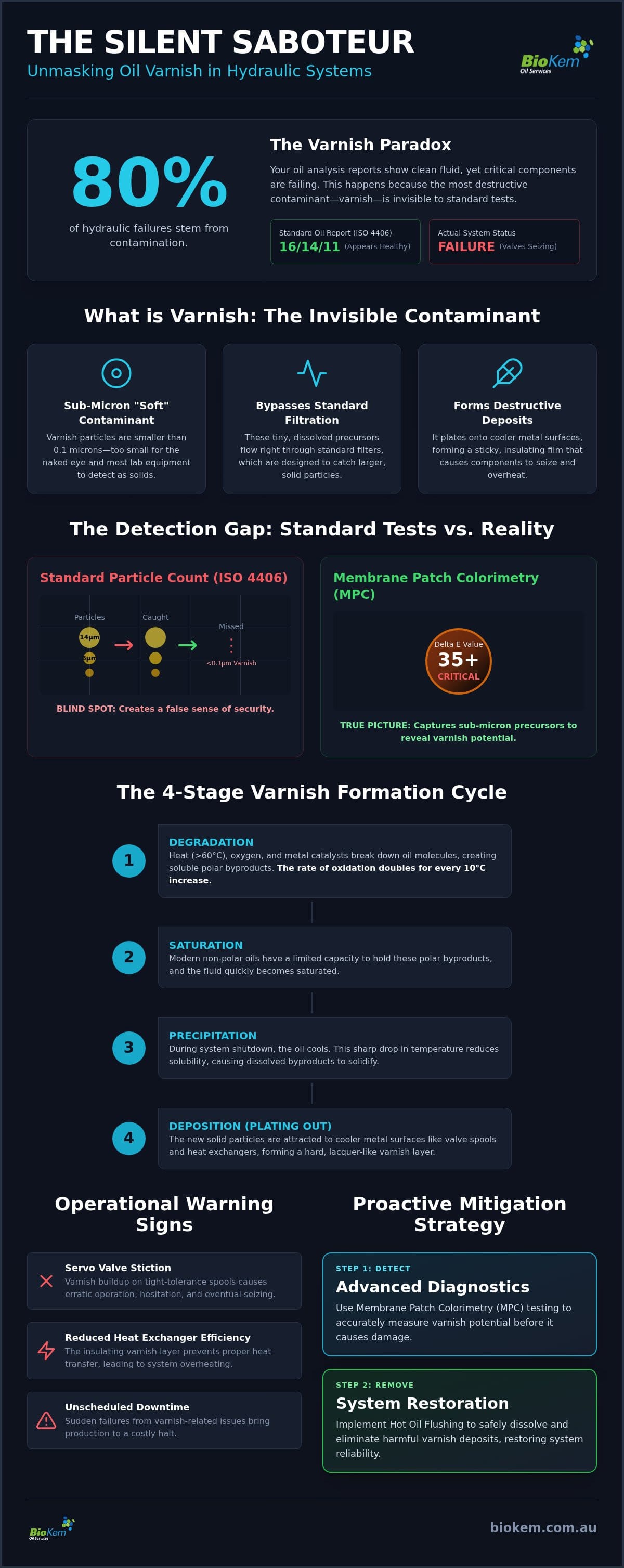
Your oil analysis report shows an ISO 4406 cleanliness code of 16/14/11, yet your servo valves are seizing and heat exchangers are losing efficiency. This paradox occurs because the most destructive causes of oil varnish in hydraulic systems often exist below the detection threshold of standard particle counters. While industry data confirms that 80% of hydraulic failures stem from contamination, varnish represents a chemical phase change that standard filters simply aren’t designed to catch.
It’s frustrating to face unscheduled downtime due to valve stiction when your reports indicate normal fluid health. We understand that maintaining system reliability requires more than just meeting a cleanliness number; it requires a deep dive into the solubility cycle. In this guide, you’ll discover the specific chemical and mechanical triggers behind hydraulic varnish and learn how to prevent costly system failure. We will examine why standard filtration isn’t catching these deposits and provide a logical path toward implementing a proactive mitigation strategy that protects your equipment’s long-term operational health.
Key Takeaways
- Define varnish as a sub-micron “soft” contaminant that bypasses standard filtration and remains invisible to traditional particle counting methods.
- Identify the chemical and thermal triggers that serve as the primary causes of oil varnish in hydraulic systems, including the destructive role of oxidation and metal catalysts.
- Explore the solubility cycle to understand how temperature fluctuations during system shutdowns cause dissolved precursors to plate out on sensitive internal surfaces.
- Recognize the operational warning signs of varnish, such as servo valve stiction and reduced heat exchanger efficiency, even when oil analysis reports appear normal.
- Learn how to implement a proactive mitigation strategy using Membrane Patch Colorimetry (MPC) testing and hot oil flushing to restore system reliability.
Understanding Hydraulic Oil Varnish: The Invisible Contaminant
Varnish isn’t a typical solid contaminant like the abrasive silica or metal shavings that reliability engineers usually track. Instead, it’s a thin, insoluble film of resinous matter that coats internal system components. While traditional “hard” particles damage systems through mechanical wear, varnish operates as a “soft” contaminant. These deposits are sub-micron in size, often smaller than 0.1 microns, making them effectively invisible to the naked eye and standard filtration systems. Because hydraulic fluid is the lifeblood of industrial machinery, the presence of these soft contaminants signals a fundamental chemical shift in the lubricant’s health.
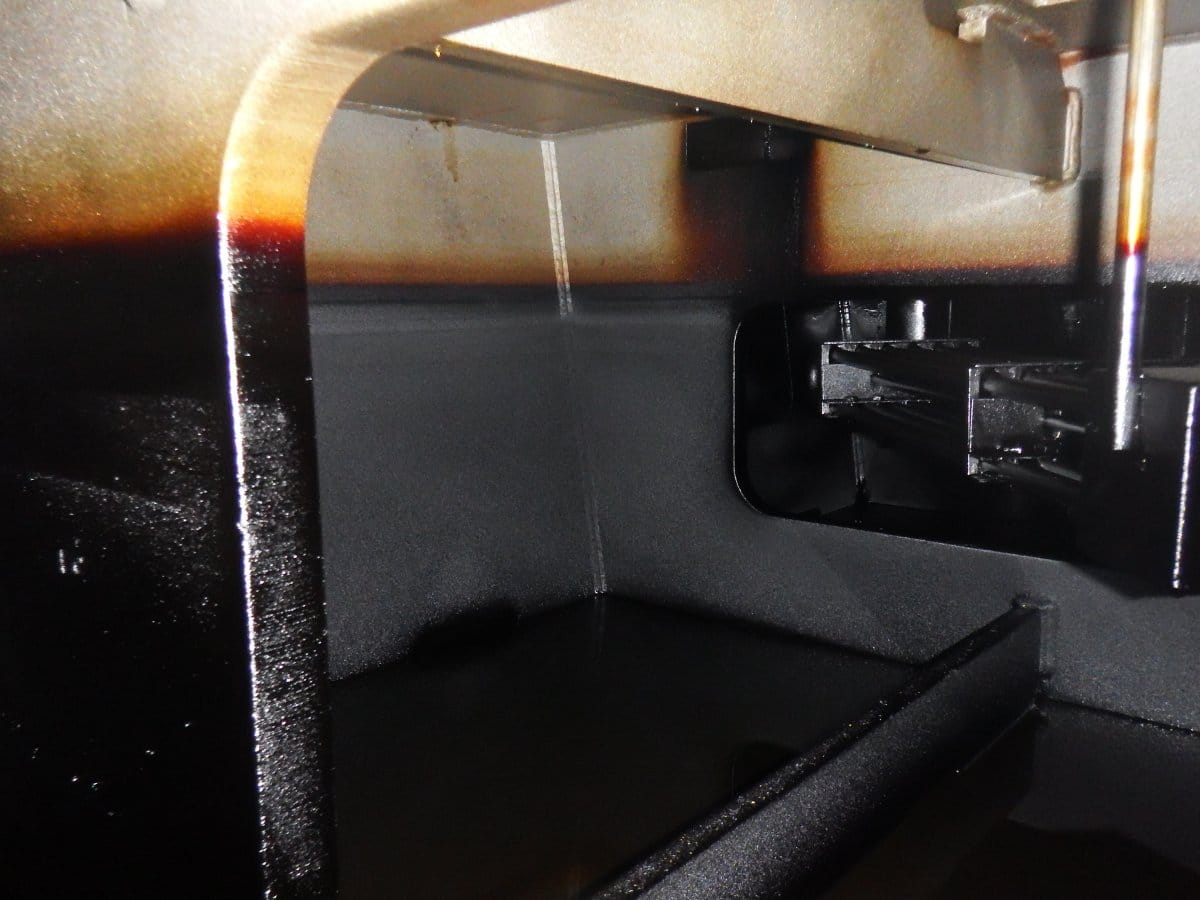
The danger of varnish lies in its ability to “plate out” on metal surfaces. As the fluid circulates, these degraded molecules seek out cooler areas or zones of high pressure drop, such as valve spools and heat exchanger tubes. Once they attach, they form a sticky, brown or black layer that traps other debris, eventually hardening into a lacquer. This process is one of the primary causes of oil varnish in hydraulic systems, leading to restricted flow and critical component failure.
To better understand this concept, watch this helpful video:
Why Standard ISO 4406 Particle Counts Fail
Many maintenance professionals rely on ISO 4406 cleanliness codes to judge oil health, but this standard is blind to varnish. Standard particle counters typically measure particles at the 4, 6, and 14-micron levels. Since varnish precursors are significantly smaller than 0.1 microns, an oil sample can meet a target cleanliness of 16/14/11 while being completely saturated with degradation products. This creates a false sense of security. To detect these invisible threats before they plate out, specialized analysis like Membrane Patch Colorimetry (MPC) is required. MPC testing captures these sub-micron contaminants on a patch and measures the color intensity, providing a “Delta E” value that accurately reflects varnish potential.
The Lifecycle of Varnish: From Liquid to Solid
The transition from a healthy lubricant to a varnished system is a multi-stage chemical process. It begins with the formation of soluble degradation products, which are polar molecules generated by heat and oxygen. Modern Group II and Group III base oils are non-polar, meaning they have a limited capacity to hold these polar byproducts in suspension. When the oil becomes saturated, these soluble precursors undergo a phase change, turning into insoluble solid deposits. This shift is a core component among the causes of oil varnish in hydraulic systems, as the fluid’s chemistry can no longer support the level of degradation. Ultimately, varnish is the end-stage result of chemical lubricant degradation, moving from a dissolved state in the liquid to a permanent solid coating on your machinery’s internal surfaces. To address these deposits once they have formed, specialized methods like hot oil flushing are often the only effective solution.
The Primary Chemical Triggers: Oxidation and Thermal Stress
Oxidation is a fundamental driver among the causes of oil varnish in hydraulic systems. It’s a chemical reaction where oxygen molecules interact with the hydrocarbon chains of the fluid. This process is highly sensitive to temperature; for every 10°C increase in operating temperature above 60°C, the rate of oxidation effectively doubles. Catalysts such as water and wear metals like copper or iron significantly accelerate this degradation. These contaminants act as a bridge for oxygen, turning a slow chemical shift into a rapid, self-sustaining chain reaction that consumes the fluid’s protective additives.
Thermal degradation differs from oxidation because it doesn’t require oxygen to occur. It happens when oil is exposed to extreme localized heat, often referred to as “hot spots.” These temperatures can exceed the fluid’s thermal stability limit, causing the molecular bonds to crack. As additives like antioxidants are depleted while fighting these stressors, the base oil remains unprotected, leading to the rapid formation of the resinous precursors mentioned in the previous section. Once the antioxidant package is exhausted, the rate of varnish formation tends to accelerate exponentially.
Micro-Dieseling: Pressure-Induced Degradation
Micro-dieseling is a violent form of thermal degradation specific to high-pressure hydraulic systems. When air becomes entrained in the fluid due to leaky suction-side seals or low reservoir levels, these bubbles travel into high-pressure zones. The bubbles undergo adiabatic compression, where the sudden pressure increase causes the temperature inside the bubble to spike instantaneously to over 1,000°C. This result is a localized “explosion” that chars the surrounding oil molecules, creating carbonaceous soot and varnish precursors. Identifying and fixing air ingress points is a critical step in comprehensive varnish mitigation to prevent this internal combustion.
Electrostatic Spark Discharge (ESD)
Modern hydraulic systems often utilize high-purity Group II and Group III base oils, which possess low electrical conductivity. When these fluids flow at high velocities through tight, non-conductive filter media, static electricity builds up. Eventually, this energy releases as a high-temperature spark, or “internal lightning,” within the system. These sparks reach temperatures high enough to instantly crack oil molecules, creating free radicals and contributing to the overall causes of oil varnish in hydraulic systems. This phenomenon is particularly prevalent in systems with high flow rates and high-efficiency filtration, where the friction between the fluid and the media is greatest. These micro-sparks create a steady stream of insoluble degradation products that eventually plate out on cooler metal surfaces.
The Solubility Factor: Why Temperature Fluctuations Matter
Think of hydraulic oil as a chemical sponge. When the fluid is hot, the “pores” of this sponge expand, allowing it to hold a significant volume of dissolved degradation products in a liquid state. As the system operates at peak temperature, these precursors remain invisible and suspended. However, the primary causes of oil varnish in hydraulic systems often manifest when the “sponge” is squeezed during a cooling phase. As the temperature drops, the oil’s capacity to hold these polar molecules diminishes rapidly.
During system shutdowns or periods of low demand, the oil cools, and the dissolved contaminants reach their limit of solubility. They precipitate out of the liquid phase and transform into solid, sticky deposits. These resins naturally migrate toward the nearest cool metal surfaces to “plate out.” This is why you will often find the first signs of varnish on reservoir walls and inside heat exchanger tubes. The danger compounds during the next restart; as the oil heats up, some varnish may soften or re-solubilise, moving further downstream to seize sensitive components like servo valves before the oil reaches full operating temperature.
The Saturation Point of Hydraulic Fluids
The saturation point is the specific threshold where a lubricant can no longer hold any additional degradation products in suspension. This limit is heavily dictated by the base oil chemistry. Older Group I oils, which contain more aromatic compounds, possess a higher natural solvency and can hold more contaminants before they precipitate. In contrast, modern Group II and Group III base oils are highly refined and non-polar. While these fluids offer better oxidative stability, they have a much lower saturation point, meaning they “drop” varnish much sooner than their predecessors. Varnish precipitation is often triggered by the cooling of saturated oil.
Varnish as a Thermal Insulator
Varnish acts as a highly effective thermal insulator, which creates a critical operational “death spiral.” When resinous films coat the internal surfaces of heat exchangers, they create a barrier that prevents the efficient transfer of heat from the oil to the cooling medium. As the heat exchanger loses efficiency, the bulk oil temperature rises across the entire system. These elevated temperatures accelerate the oxidation and thermal stress mentioned earlier, which are the fundamental causes of oil varnish in hydraulic systems. This increased degradation creates more varnish, which further coats the cooling surfaces, pushing temperatures even higher. Breaking this destructive cycle requires the implementation of specialized varnish removal systems that can strip these insulating layers and restore the system’s thermal equilibrium.
Operational Consequences of Varnish in Hydraulic Systems
The transition from chemical degradation to mechanical failure is often swift and unforgiving. While previous sections detailed the molecular causes of oil varnish in hydraulic systems, the operational reality is defined by lost production and damaged hardware. One of the first physical symptoms is premature filter plugging. Varnish doesn’t just fill the “dirt holding” capacity of a filter; it “blinds” the media. The sticky resin coats the fibers of high-efficiency filter elements, drastically reducing the effective surface area. This leads to frequent filter changes and increased differential pressure, even when the oil’s ISO particle count remains within acceptable limits.
Beyond the filters, the internal tolerances of high-pressure pumps are particularly vulnerable. When varnish plates out on the rotating groups or piston shoes, it interferes with the thin lubricating film required to prevent metal-to-metal contact. This can result in catastrophic mechanical seizure or severe cavitation. In many cases, the resulting repair costs far exceed the price of a robust fluid maintenance program. Ignoring these subtle signs of degradation often leads to a total system breakdown that could have been avoided with specialized analysis.
When sourcing replacement parts to ensure system integrity, explore Sprzedaż detaliczna i hurtowa komponentów hydrauliki siłowej from JTW Teper for a comprehensive selection of hydraulic solutions.
Valve Sticking and Production Loss
Precision control relies on the smooth movement of servo and proportional valves, which often feature clearances as tight as 1 to 4 microns. As discussed in the solubility cycle, cooling oil drops its resinous load directly into these narrow gaps. This creates “stiction,” a condition where the valve spool requires excessive force to move or becomes completely seized. The result is erratic machine behavior, such as fluctuating pressures or inconsistent cycle times, which compromises both product quality and operator safety. To understand this mechanism more deeply, you can read about How Varnish Causes Sticking Valves in our comprehensive guide.
The Impact on Lubrication Reliability
Varnish fundamentally degrades the oil’s ability to protect internal surfaces. Because varnish is polar, it has a high affinity for metal, often displacing the protective oil film. This leaves components vulnerable to increased friction and heat. Worse, the sticky nature of the film acts as an adhesive for “hard” contaminants like silica or metal wear particles. Instead of these particles flowing freely to the filters, they become embedded in the varnish layer, creating a “sandpaper” effect that accelerates abrasive wear. Implementing a proactive varnish mitigation strategy is the only way to break this cycle and restore the long-term reliability of your hydraulic assets.
Mitigation and Prevention: The BioKem Oil Services Approach
Understanding the primary causes of oil varnish in hydraulic systems allows BioKem Oil Services to move beyond simple filtration toward a scientifically driven mitigation strategy. Standard maintenance practices often focus on “hard” particles, yet the sub-micron “soft” contaminants are what truly compromise system reliability. BioKem Oil Services addresses this invisible threat by utilizing advanced condition monitoring that goes beyond the blind spots of ISO 4406 counts. By employing Membrane Patch Colorimetry (MPC) and RULER testing, we can quantify the varnish potential and the remaining antioxidant life of your fluid before failures occur.
When varnish has already plated out on internal surfaces, a standard oil change is insufficient. BioKem Oil Services utilizes hot oil flushing as a definitive solution to restore system cleanliness. This process uses high-velocity, turbulent flow at elevated temperatures to mechanically and chemically strip deposits from valve nests, heat exchangers, and long pipe runs. To maintain this level of purity, BioKem Oil Services also deploys mobile Varnish Mitigation Units (VMUs) that continuously remove precursors from the oil. We further optimize system performance using high-performance Filters S.p.A. products.
Why Oil Changes Aren’t Enough
Standard oil changes are often a cosmetic fix for a deep-seated chemical problem. When a system is drained, approximately 15% to 20% of the old, degraded oil remains trapped in cylinders, dead legs, and pump housings. This residual fluid is heavily saturated with the very precursors that represent the core causes of oil varnish in hydraulic systems. When fresh oil is introduced, its high solvency immediately begins to strip old varnish from the metal surfaces. This “solvent effect” means your new, expensive oil becomes chemically compromised and saturated almost instantly. BioKem Oil Services provides a true “clean slate” through the chemical removal of these deposits using flushing or specialized mitigation equipment.
Implementing a Proactive Varnish Strategy
A reliable hydraulic system is the result of a structured, three-step approach to fluid health. BioKem Oil Services helps partners move away from reactive “firefighting” by establishing a baseline of operational health. This strategy ensures long-term ecological and mechanical sustainability by extending the life of both the fluid and the hardware.
- Step 1: Conduct a baseline analysis using MPC testing to determine the current Delta E value and varnish potential.
- Step 2: Deployment of onsite varnish mitigation equipment to strip soluble and insoluble precursors from the circulating oil.
- Step 3: Install high-performance filtration and implement continuous monitoring to prevent the re-accumulation of degradation products.
If your systems are experiencing erratic valve behavior or unexplained heat spikes, it’s time to look beyond the standard oil report. Contact BioKem Oil Services for a comprehensive varnish audit to protect your assets from the silent threat of chemical degradation.
Mastering the Chemistry of System Reliability
Transitioning from reactive maintenance to a reliability-centered approach requires a fundamental shift in how we interpret fluid health. As established throughout this guide, the most destructive causes of oil varnish in hydraulic systems occur at the molecular level, existing far below the detection limits of standard particle counters. By addressing the solubility cycle and the chemical triggers of degradation, engineers can prevent the catastrophic “death spiral” of heat and wear that compromises precision machinery and leads to unscheduled downtime.
BioKem Oil Services provides the specialized diagnostic and remediation tools necessary to maintain this critical chemical equilibrium. As the sole Australian distributor for Filters S.p.A. and a leader in onsite hot oil flushing, BioKem Oil Services delivers advanced laboratory oil analysis reports that provide a true baseline of varnish potential. Our commitment to sustainability ensures that your operational goals align with long-term ecological health by extending the functional life of your lubricants and reducing waste.
Protect your assets with BioKem’s specialised Varnish Mitigation services and secure a future of uninterrupted productivity. By identifying the invisible threats today, you ensure the sustained reliability of your hydraulic infrastructure for years to come. Let our team of experts help you implement a proactive strategy that moves beyond simple filtration to achieve true fluid excellence.
Frequently Asked Questions
What is the difference between oil sludge and oil varnish?
Sludge is a soft, semi-solid accumulation of oil, water, and debris, whereas varnish is a hard, resinous film that chemically bonds to metal surfaces. While sludge typically settles in low-flow areas like reservoirs, varnish “plates out” on high-heat or high-pressure components. Both are results of fluid degradation, but varnish is significantly harder to remove and more disruptive to precision valve tolerances.
Can standard hydraulic filters remove varnish?
Standard hydraulic filters cannot remove varnish because the precursors are sub-micron in size. Most industrial filters are rated for particles 4 microns or larger, but varnish molecules are frequently smaller than 0.1 microns. These “soft” contaminants pass through standard media and only become problematic when they precipitate out of the fluid. Specialist varnish mitigation units are required to strip these molecules from the oil effectively.
How do I know if my hydraulic system has varnish if the oil looks clear?
Clear oil isn’t a reliable indicator of fluid health because varnish precursors remain dissolved in the lubricant at operating temperatures. You won’t see these contaminants until they reach a saturation point and begin to plate out on cooler surfaces. To confirm their presence, you must use Membrane Patch Colorimetry (MPC) or inspect internal components for the characteristic “lacquer” coating that indicates the causes of oil varnish in hydraulic systems are active.
Is varnish more common in certain types of hydraulic oil?
Varnish is more prevalent in modern Group II and Group III base oils due to their lower solvency. These highly refined oils are non-polar, meaning they have a limited capacity to hold polar degradation products in suspension. While these fluids offer superior oxidative stability, they reach their saturation point much faster than older Group I oils, leading to earlier varnish precipitation during cooling cycles.
What is an MPC test and how does it measure varnish?
Membrane Patch Colorimetry (MPC) is a specialized test that isolates insoluble varnish precursors on a 0.45-micron filter patch. By measuring the color intensity of the patch using a spectrophotometer, laboratory technicians assign a “Delta E” value. This value provides a quantitative measurement of the oil’s varnish potential, allowing reliability engineers to identify the causes of oil varnish in hydraulic systems before mechanical failure occurs.
Can I just add a chemical cleaner to my hydraulic system to remove varnish?
Adding chemical cleaners is generally discouraged because they can destabilize the fluid’s existing additive package. These chemicals often act as aggressive solvents that may release large “slugs” of varnish all at once, leading to immediate valve seizure or filter blinding. A controlled hot oil flushing process is a more effective and safer method for restoring internal system cleanliness without risking the chemical integrity of the lubricant.
How often should I test for varnish in high-pressure hydraulic systems?
High-pressure hydraulic systems should undergo MPC testing at least quarterly to establish a reliable trend. If your equipment operates in extreme environments or has a history of thermal stress, monthly testing is a more prudent approach. Regular monitoring allows you to catch the early stages of degradation before the fluid reaches its saturation point and begins the destructive cycle of plating out on sensitive valve spools.
Does overheating always lead to varnish formation?
Overheating is a primary driver of degradation, but it isn’t the only trigger for varnish formation. Other factors like electrostatic spark discharge and micro-dieseling can create localized “hot spots” that crack oil molecules, even if the bulk oil temperature remains within safe limits. Relying solely on temperature gauges can be misleading; chemical analysis is the only way to confirm if the oil is actually breaking down.

Article by
James McAllister
James McAllister is an industry professional with BioKem Oil Services, specialising in lubrication reliability, oil filtration, contamination control and asset performance. Drawing on BioKem's extensive field experience across turbines, compressors, hydraulic systems and critical rotating equipment, James writes practical, insight-driven articles that help maintenance and reliability teams improve equipment performance, extend asset life and reduce operational risk.