

Your most expensive industrial asset isn’t the turbine or the hydraulic press; it’s the invisible contamination currently eroding those systems from the inside out. Many maintenance managers struggle with the high costs of premature oil changes and the constant threat of unscheduled downtime, often finding it difficult to translate complex lab reports into meaningful operational changes. Professional oil sample testing services bridge this gap by transforming microscopic data into a strategic maintenance roadmap. We understand that reliability isn’t just about changing filters; it’s about making informed, data-driven decisions that protect your bottom line and the environment.
This guide explores how professional analysis delivers clear diagnostic insights and extends equipment life while ensuring your facility remains compliant with Australian safety standards. You’ll learn how to leverage the "Analysis to Action" workflow and stay ahead of the latest industry shifts, including the 2026 updates to EN ISO 20815 for reliability management. We’ll preview how specialized tools like Filter Ferrograms and onsite patch tests provide the immediate clarity required to maintain peak operational health in an increasingly demanding industrial climate.
Key Takeaways
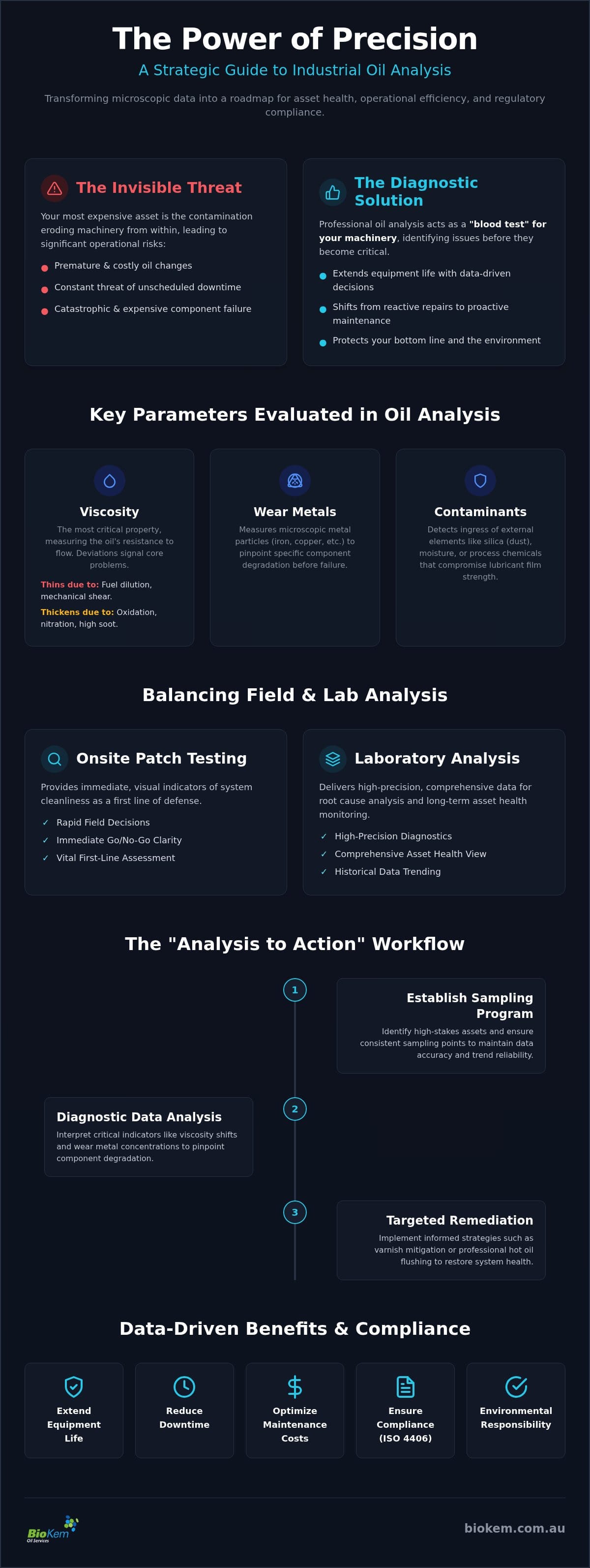
- Understand how professional oil sample testing services act as a diagnostic “blood test” for your machinery, identifying internal wear and contamination before catastrophic failure occurs.
- Learn to interpret critical indicators such as viscosity shifts and wear metal concentrations to pinpoint specific component degradation and maintain optimal lubricant performance.
- Discover how to balance rapid onsite patch testing for immediate field decisions with high-precision laboratory analysis for comprehensive asset health monitoring.
- Establish a robust sampling program by identifying high-stakes assets and ensuring consistent sampling points to maintain the accuracy of your historical data trends.
- Adopt an “Analysis to Action” workflow where diagnostic data directly informs targeted remediation strategies like varnish mitigation and professional hot oil flushing.
What are Oil Sample Testing Services and Why Do They Matter?
Professional oil analysis represents the scientific evaluation of a lubricant’s chemical properties, suspended contaminants, and wear debris. Think of it as a medical blood test for your machinery. Just as a physician uses blood work to detect internal health issues before symptoms manifest, oil sample testing services identify microscopic indicators of component failure long before a catastrophic breakdown occurs. This diagnostic window allows maintenance teams to transition from expensive, reactive repairs to a strategic, data-driven approach that prioritises asset health and operational continuity.
To better understand how these diagnostic variables impact your equipment, watch this helpful explanation:
In 2026, Australian industrial sectors are rapidly moving away from calendar-based maintenance. This shift is driven by the need for greater operational efficiency and a firm commitment to environmental responsibility. By monitoring the actual condition of the fluid, facilities can safely extend oil drain intervals, reducing both lubricant procurement costs and the ecological footprint associated with used oil disposal. This data-driven approach is increasingly adopted by global facilities management leaders like Farnek Services LLC, who integrate technical insights into comprehensive MEP maintenance strategies. It’s a precise method that ensures critical assets like turbines and compressors remain in peak condition without unnecessary, synthetic interventions.
The Role of Analysis in Proactive Maintenance
Proactive maintenance relies on identifying the root causes of wear rather than just treating the symptoms. Through comprehensive oil sample testing services, technicians detect the ingress of external contaminants such as silica dust, moisture, or process chemicals that compromise film strength. Monitoring these variables protects high-value assets and maximises ROI. For immediate field assessments, patch test kits offer a rapid visual indicator of system cleanliness, serving as a vital first line of defence before deeper laboratory investigation.
Meeting Australian Industrial Standards
Compliance with regional and international standards is non-negotiable for modern Australian operations. Adhering to ISO 4406 cleanliness codes ensures that hydraulic and lubrication systems operate within strict manufacturer specifications. Utilising NATA-accredited or equivalent professional laboratories provides the technical rigour required for regulatory reporting and safety audits. BioKem Oil Services integrates this structured approach with remediation services such as hot oil flushing and filtering to restore fluid health. For more complex wear scenarios, a Filter Ferrogram provides a sophisticated visual analysis of wear particles, anchoring global scientific standards in a practical, local context.
Key Parameters Evaluated in Professional Oil Analysis
Effective oil sample testing services rely on a suite of standardized laboratory procedures to quantify the physical and chemical state of the lubricant. These parameters provide a clear picture of how the fluid is interacting with the machine’s internal surfaces. By measuring specific indicators, technicians can determine if the oil is still capable of protecting the asset or if it has reached the end of its functional life.
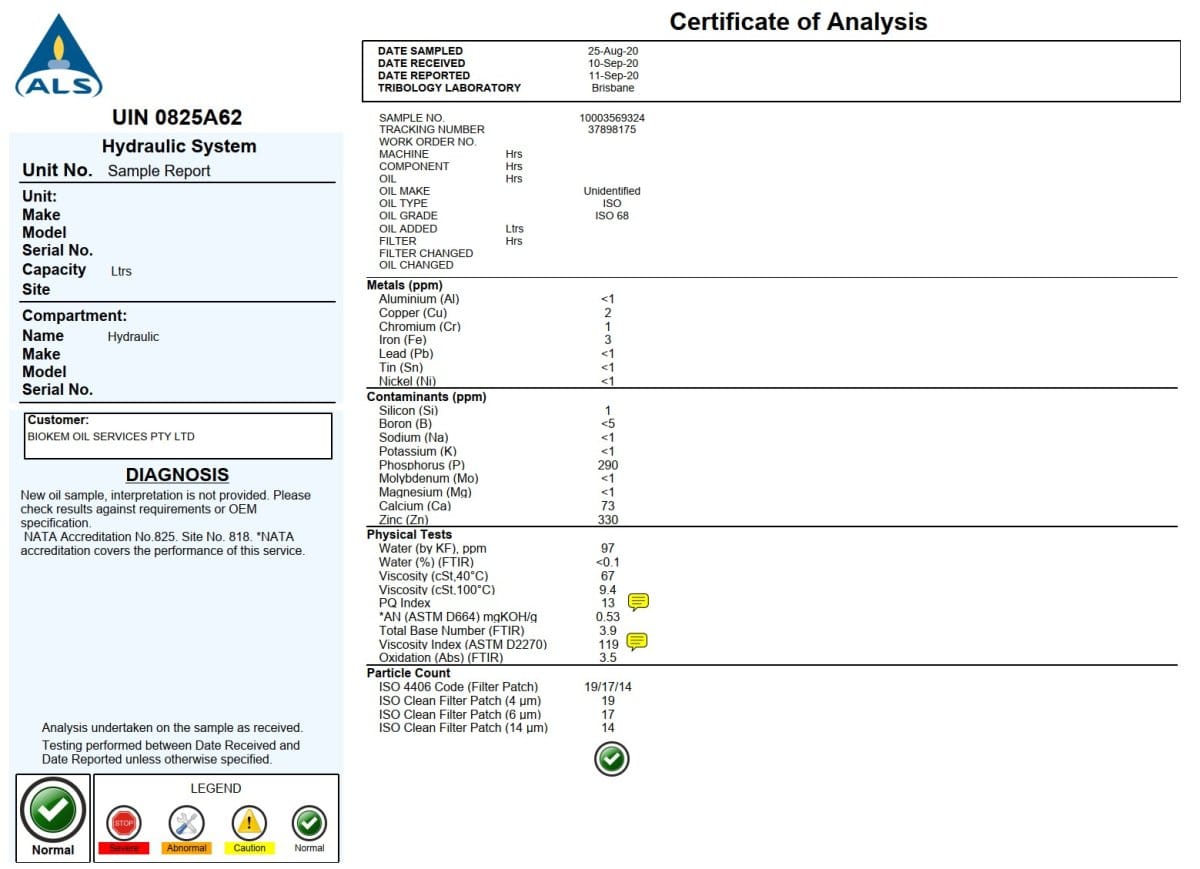
Viscosity stands as the most critical physical property. It measures the fluid’s resistance to flow at specific temperatures, typically 40°C and 100°C. If the oil thins, it’s often due to fuel dilution or mechanical shear. If it thickens, oxidation, nitration, or high soot levels are likely the cause. Maintaining the correct viscosity is essential for ensuring a stable hydrodynamic film remains between moving parts, preventing metal-to-metal contact.
Wear metal analysis uses spectroscopy to identify elements like iron, copper, and lead. Each metal acts as a diagnostic fingerprint for specific components. Iron often signals gear or cylinder wear, while copper and lead typically point to bearing degradation. By tracking these concentrations over time, you can predict component failures before they result in a total system shutdown. This data turns reactive maintenance into a planned, orderly process.
Contamination tracking and additive health monitoring complete the diagnostic profile. Measuring water content through Karl Fischer titration identifies seal failures or cooling system leaks that can lead to corrosion. Simultaneously, monitoring the depletion of anti-wear and antioxidant packages ensures the lubricant’s chemical shield is still intact. When these additives fall below a critical threshold, the base oil becomes vulnerable to rapid thermal degradation and sludge formation.
Understanding ISO 4406 Particle Counting
The ISO 4406 standard uses a three-number code, such as 18/16/13, to represent the quantity of solid particles per millilitre of fluid at 4, 6, and 14 microns. Microscopic particles that are invisible to the human eye cause the most significant damage to precision components like servo valves. These silt-sized contaminants act as an abrasive grinding paste, leading to internal leakage and valve sticking. Maintaining low ISO codes is vital for the longevity of high-pressure hydraulic systems.
Chemical Stability and Varnish Potential
Traditional tests often miss the "invisible" precursors to varnish. The Membrane Patch Colorimetry (MPC) test is the specialized method used to detect these sub-micron oxidation products. Varnish settles on cool surfaces, causing restricted flow in heat exchangers and critical valve sticking. If your MPC results indicate a high potential for deposits, implementing varnish removal systems is a necessary step to restore operational stability. For a more granular view of wear patterns, you might consider a Filter Ferrogram to visualize the exact morphology of wear debris.
Onsite vs. Laboratory Oil Sample Testing: Which is Right?
Choosing between onsite and laboratory-based oil sample testing services involves balancing the need for immediate data against the requirement for scientific depth. While laboratory analysis offers a comprehensive profile of fluid health using sophisticated instrumentation like Inductively Coupled Plasma (ICP) spectrometers, onsite testing provides the rapid response necessary for operational safety in high-stakes environments. A strategic maintenance program typically employs a hybrid approach, using portable diagnostic tools for daily monitoring while relying on offsite laboratories for detailed quarterly audits and compliance verification.
Laboratory testing is indispensable when precision is the primary objective. These facilities operate under strict standards to ensure measurement precision and data integrity meet global benchmarks. Conversely, onsite testing serves as a vital screening tool. It allows maintenance teams to make "go/no-go" decisions regarding equipment operation without the delays associated with sample transport and lab turnaround times. This immediate feedback loop is essential for preventing catastrophic failures during critical production cycles where every hour of downtime carries a significant financial penalty.
When to Choose Laboratory Analysis
Deep-dive laboratory analysis is required when standard parameters indicate an anomaly that needs further investigation. For instance, a Filter Ferrogram is essential for identifying large wear particles that are often too significant for standard spectrometers to quantify accurately. Laboratory reports also provide the official documentation necessary for validating warranty claims or meeting specific insurance compliance mandates. Beyond immediate fixes, the historical data trending provided by professional labs allows for sophisticated asset health management over the entire lifecycle of the machinery.
The Power of Onsite Diagnostic Tools
Onsite tools empower local teams to maintain strict contamination control without external reliance. Utilizing Patch Test Kits offers a rapid visual assessment of particulate and varnish levels, providing a transparent look at oil condition in minutes. For real-time digital monitoring, the Particle Pal Range delivers precise ISO 4406 cleanliness codes and water-in-oil percentages directly at the asset. These tools are critical in emergency situations where waiting for a lab report isn’t an option. They anchor your maintenance strategy in a localized context, ensuring immediate operational results and long-term ecological health through reduced waste.
How to Implement an Effective Oil Sampling Program
Establishing a structured program is the only way to ensure oil sample testing services provide a genuine return on investment. You must first identify your most critical assets; those where failure results in significant production loss or safety risks. High-stakes equipment such as main steam turbines, large-scale hydraulic power units, and critical gearboxes require more frequent monitoring than auxiliary systems. Once these assets are prioritized, you must set "Alarm" and "Critical" limits. These thresholds should align with original equipment manufacturer (OEM) specifications while accounting for the unique historical data of your specific operational environment.
Training your personnel in precise oil sampling techniques is the next non-negotiable step. Inaccurate sampling is the leading cause of "false positives" in lab reports. If a sample is contaminated by external dust or residual fluid from a previous test, the resulting data is useless. Proper procedures ensure that the fluid captured is truly representative of the oil circulating through the machine’s internal components, anchoring your maintenance decisions in reality rather than error.
Consistency is Key to Trending
Data is most valuable when it shows a trend over time. To achieve this, you must take samples from the same location every single time. Sampling from "live zones", such as a primary return line before the filter, provides a snapshot of the contaminants currently being generated by the system. Avoid stagnant sumps or the very bottom of reservoirs where debris naturally settles; these areas don’t reflect the active health of the lubricant. Always document machine hours and the age of the oil at the time of the sample. This context allows the laboratory to distinguish between normal additive depletion and accelerated thermal breakdown.
Interpreting the Results: From Data to Action
A lab report is only as good as the action it inspires. When a report returns with a "Caution" or "Critical" status, you must investigate the root cause immediately. Does the presence of moisture suggest a failing seal, or does a spike in iron indicate gear misalignment? You must evaluate if the fluid requires purification via vacuum dehydration or if it’s time for a full change. Integrating these findings with broader proactive maintenance strategies ensures that you aren’t just reacting to problems, but actively preventing them. To move beyond simple data and start protecting your assets with precision, consider implementing advanced wear analysis as part of your routine audit.
BioKem Oil Services’ Comprehensive Analysis and Remediation Solutions
BioKem Oil Services positions itself as a strategic partner rather than a mere service provider by bridging the gap between scientific analysis and industrial execution. In the demanding environments of Australian mining and heavy industry, simply receiving a laboratory report isn’t enough to maintain operational continuity. Our oil sample testing services are designed to be the foundational stage of an "Analysis to Action" workflow. This methodology ensures that every data point captured in the lab leads to a specific, justifiable maintenance decision in the field. Whether you’re managing a remote site in the Pilbara or a manufacturing facility in a metropolitan hub, our national service delivery brings specialized expertise directly to your critical assets.
We specialize in the seamless integration of diagnostic testing with high-impact remediation services. When analysis reveals critical contamination or fluid degradation, BioKem Oil Services provides the technical mechanism for recovery through Hot Oil Flushing and Filtering. This end-to-end capability transforms raw data into a tangible increase in asset longevity and reliability. By aligning our testing protocols with regional regulatory standards, we help your business maintain compliance while pursuing long-term ecological health through reduced fluid waste and improved energy efficiency.
More Than Just a Lab Report
The true value of BioKem Oil Services’ expertise lies in the expert interpretation of complex diagnostic results. Our technicians provide technical recommendations based on decades of field experience, moving beyond basic numbers to provide clear maintenance roadmaps. We understand the nuances of various industrial sectors and customize testing schedules to match your specific asset criticality and environmental conditions. As the Australian distributor for Filters S.p.A., we ensure our clients have access to world-class filtration hardware that meets the most stringent ISO cleanliness requirements.
Ready to Optimise Your Asset Health?
Implementing a robust lubrication management program starts with a detailed consultation to assess your current fleet and operational challenges. BioKem Oil Services offers flexible solutions, including customized equipment hire for onsite purification and vacuum dehydration based on your specific test results. This ensures you don’t have to invest in permanent hardware for temporary contamination issues. Contact our national team today to discover how our professional oil sample testing services can secure the future of your industrial infrastructure and enhance your proactive maintenance culture.
Securing the Future of Industrial Reliability
Securing long-term asset reliability in 2026 requires more than occasional data collection; it demands a shift toward a comprehensive, condition-based philosophy. Throughout this guide, we’ve explored how professional oil sample testing services act as the primary diagnostic tool for identifying sub-micron contaminants and additive depletion before they compromise your machinery. By moving beyond the calendar-based mindset, industrial operators can reduce unnecessary lubricant waste and ensure their systems operate within strict NATA-aligned reporting standards.
BioKem Oil Services provides the necessary bridge between laboratory insights and onsite remediation. With specialized expertise in both laboratory diagnostics and onsite filtration, we help you translate complex reports into actionable maintenance roadmaps. As the Australian distributor for Filters S.p.A., we empower national sites with the hardware needed to maintain peak fluid cleanliness in even the most remote environments. Protecting your critical infrastructure is a commitment to both operational efficiency and ecological responsibility. Contact BioKem Oil Services for Professional Oil Analysis and Testing Services to secure your machinery’s future today.
Frequently Asked Questions
How often should I use oil sample testing services for my machinery?
Frequency depends on asset criticality and operating conditions, typically ranging from monthly to quarterly intervals. High-stakes systems like main steam turbines usually require monthly checks, while auxiliary gearboxes might only need quarterly monitoring. Establishing a consistent schedule allows for historical trend analysis, which is significantly more valuable for predicting failure than any single, isolated data point.
Can oil analysis really predict a catastrophic equipment failure?
Yes, oil analysis identifies microscopic wear debris and chemical changes that precede mechanical breakdown. By detecting abnormal concentrations of wear metals like iron or copper, technicians can pinpoint failing components before they seize. This early warning system provides the necessary window to schedule repairs during planned outages rather than reacting to an emergency failure that halts production.
What is the difference between a standard oil test and a ferrogram?
A standard test quantifies elemental concentrations, while a ferrogram provides a visual analysis of the size and shape of wear particles. Standard spectroscopy often misses particles larger than 10 microns in size. A Specialized Filter Ferrogram uses microscopic examination to determine the exact wear mechanism, such as fatigue or abrasion, providing deeper diagnostic clarity for your most critical assets.
How long does it typically take to receive a laboratory oil analysis report?
Standard laboratory turnaround times in 2026 typically range from 24 to 72 hours from the moment the sample reaches the facility. While high-precision tests like RPVOT or MPC may take longer due to their technical complexity, most routine diagnostic reports are delivered within three business days. Digital reporting platforms ensure these results are accessible to maintenance teams immediately upon completion.
Do I need to stop my machine to take an effective oil sample?
No, it’s actually preferable to take samples while the machine is running at its normal operating temperature. This ensures that contaminants and wear particles are thoroughly mixed and representative of the circulating fluid. Sampling from a stagnant sump while the machine is cold often leads to inaccurate data because debris settles at the bottom of the reservoir when flow stops.
What are the most common contaminants found in industrial oil samples?
The most frequent contaminants include moisture, silica dust, and sub-micron oxidation products known as varnish precursors. In Australian industrial environments, ambient dust ingress remains a significant challenge for hydraulic systems. Identifying these pollutants through oil sample testing services allows for targeted remediation, such as improved sealing or the installation of specialized desiccant breathers to protect the fluid’s integrity.
Is onsite oil testing as accurate as laboratory-based testing?
Onsite testing provides rapid, reliable screening for specific parameters like ISO cleanliness codes, but it doesn’t replace the scientific depth of a full laboratory audit. Tools like the Particle Pal Range offer high accuracy for immediate field decisions. However, laboratory environments use calibrated spectrometers and titration equipment that provide the elemental precision required for long-term health trending and warranty compliance.
How much oil is actually required for a standard diagnostic sample?
A standard diagnostic sample usually requires approximately 100 to 120 millilitres of fluid to ensure a comprehensive evaluation. This volume provides sufficient oil for multiple laboratory tests, including viscosity, elemental analysis, and particle counting. When utilizing oil sample testing services, it’s vital to use clean, laboratory-grade bottles and to flush the sampling valve thoroughly before capturing the final volume to prevent data contamination.