

With synthetic lubricant prices climbing by as much as 35% in the first quarter of 2026, can your facility afford to treat high-performance oil as a disposable asset? Most maintenance professionals recognize the frustration of discarding large volumes of fluid simply because the viscosity has drifted outside of tight OEM specifications. It’s a costly cycle that often feels unavoidable to prevent film failure and protect critical machinery. However, the Viscosity Correction of lubricants provides a scientifically sound alternative to the traditional drain and fill method. By precisely adjusting the fluid properties of your existing stock, you can maintain the protective film strength required by updated standards like SAE J300_202405 without the expense of a total oil change.
BioKem Oil Services views fluid health as a matter of operational resilience and environmental responsibility. This article outlines how you can restore oil to its optimal state to prevent unscheduled downtime and eliminate unnecessary disposal costs. You’ll learn the technical mechanisms behind viscosity restoration and how a circular management approach helps your business meet the stringent 2026 environmental regulations while ensuring stable equipment performance. By treating oil as a managed asset, you reduce your environmental footprint and secure your equipment against the rising costs of raw materials.
Key Takeaways
- Identify the primary drivers of viscosity drift, such as thermal stress and molecular shearing, to better predict when your lubricant profile will deviate from its ISO VG grade.
- Discover how the precise Viscosity Correction of lubricants allows you to calculate specific blend ratios that restore target centistoke (cSt) values, extending oil life.
- Apply a logical decision framework to determine when correcting an in-service fluid is more cost-effective and sustainable than a full system replacement.
- Learn the essential steps for integrating correction into your maintenance schedule, starting with comprehensive oil analysis to establish a technical baseline.
- Reduce your environmental footprint and operational costs by shifting from a traditional consumable oil model to a circular fluid management strategy.
Understanding Viscosity Drift: Why Lubricants Lose Their Profile
Every industrial lubricant is formulated to maintain a specific thickness, or ISO VG grade, to protect components under load. Viscosity drift occurs when the fluid’s internal resistance to flow deviates from this laboratory-defined profile during service. This isn’t just a minor technicality; it signals a fundamental change in the oil’s chemistry. High temperatures, heavy loads, and environmental ingress constantly challenge the fluid’s integrity. Without the Viscosity Correction of lubricants, this drift eventually leads to mechanical failure or the costly disposal of thousands of liters of otherwise viable base oil.
Contaminants like water, fuel, or solid particulates act as catalysts for these changes. Water ingress often leads to emulsification, which can artificially increase viscosity readings and lead to structural instability in the fluid. Fuel dilution, conversely, thins the oil and reduces its load-carrying capacity. Managing these variables is essential for maintaining the hydrodynamic lubrication film that keeps moving parts separated. When these contaminants are present, the Viscosity Correction of lubricants should be paired with purification methods like vacuum dehydration to ensure the corrected fluid remains stable.
To better understand how fluid age and temperature affect flow behavior, watch this oil viscosity test:
The Chemistry of Thickening and Thinning
Oxidation is a primary driver of fluid thickening. When oil reacts with oxygen at elevated temperatures, it undergoes polymerisation. This process creates larger, heavier molecules that eventually form sludge and varnish, which can clog specialist oil filters and restrict flow. On the opposite end, molecular shearing occurs when mechanical forces physically tear apart long-chain molecules. This is particularly common with Viscosity Index (VI) improvers, which are additives designed to stabilize the fluid. Understanding Viscosity Index is vital because it determines how well an oil resists these changes across a temperature spectrum. Kinematic viscosity is the measure of a fluid’s internal resistance to flow under gravity, measured by the time a volume of oil takes to pass through a calibrated viscometer per ISO 3104.
Impact on Critical Machinery Components
The consequences of out-of-spec viscosity are severe and immediate. If the fluid is too thin, the hydrodynamic film collapses. This results in metal-to-metal contact in high-pressure areas like bearings and gear sets, leading to rapid wear and catastrophic failure. Conversely, oil that is too thick increases internal fluid friction. This generates excessive heat and forces the system to work harder, which reduces energy efficiency and accelerates further thermal degradation. In hydraulic control systems, viscosity drift causes sluggish response times, erratic valve movement, or cavitation in pumps. Regular oil analysis is the first step in identifying these deviations before they impact your bottom line.
The Mechanics of Viscosity Correction and Blending
Technical precision is the cornerstone of successful Viscosity Correction of lubricants. It involves calculating the exact volume of a correction fluid required to shift the kinematic viscosity of a base stock to a predefined target. This isn’t a simple linear calculation. Because viscosity is a logarithmic property, engineers must use specialized blending equations to predict the final centistoke (cSt) value accurately. If an ISO 46 hydraulic oil has thinned to 40 cSt due to shear or contamination, we determine the precise ratio of a higher-viscosity concentrate needed to restore it to its original specification.
Standard ISO grades like 32, 46, or 68 are often insufficient for the extreme environmental gradients found in Australia. A fluid that performs well in a controlled factory setting may fail in the intense heat of the Pilbara or the overnight freezes of the Southern Highlands. Viscosity Correction of lubricants allows for the creation of site-specific blends that offer a more stable lubricating film across these temperature swings. Achieving this requires ensuring homogeneity in the final mixture. Whether blending occurs onsite via high-velocity circulation or offsite in a controlled facility, the goal is a stable, non-stratified fluid that won’t separate during periods of equipment inactivity.
Achieving “In-Between” Viscosity Grades
Certain high-precision applications benefit from custom viscosity targets that don’t fit into standard ISO buckets. For instance, a system might require a 38 cSt blend to balance energy efficiency with film thickness. BioKem Oil Services works directly with lubricant suppliers to engineer and certify these specialized blends, ensuring they remain within the manufacturer’s performance envelope. We utilize ASTM D341 temperature-viscosity charts to model these fluids, providing a clear map of how the lubricant will behave from cold-start to peak operating temperature.
Maintaining Additive Package Integrity
A significant concern during blending is the potential dilution of the additive package. Anti-wear (AW) and extreme pressure (EP) additives must stay at specific concentrations to protect metal surfaces. Introducing an incompatible correction fluid can trigger “additive dropout,” where these critical components precipitate out of the oil as sediment. This not only leaves the machinery unprotected but can also lead to blockages in specialist oil filters. Professional laboratory verification is mandatory after any correction to confirm that both the physical viscosity and the chemical additive balance meet the required standards.
If you’re managing large volumes of aged oil, performing a detailed oil analysis is the first step toward a successful correction strategy.
Correction vs. Replacement: A Decision Framework
Deciding whether to drain a system or attempt a correction is a strategic choice based on volume and fluid health. For small reservoirs, a total change is often the path of least resistance. However, in large-scale industrial systems containing 5,000 liters or more, the Viscosity Correction of lubricants becomes the most viable financial and ecological path. The decision hinges on identifying the “Point of No Return.” If oil analysis reveals that the base oil has oxidized to the point of severe varnish formation or extreme Acid Number (AN) elevation, the fluid’s molecular structure may be too compromised for salvage. In these cases, correction is no longer a responsible option.
In large-scale turbine systems, we’ve seen facilities avoid the disposal of 20,000 liters of synthetic oil through precision correction. By treating the fluid as a managed asset rather than a consumable, these operations eliminate the logistics of transporting new oil to remote sites and the regulatory burden of hazardous waste disposal. When paired with a varnish removal system, correction restores the fluid to a “like-new” state, extending its service life by years. This approach transforms a significant environmental liability into a stable operational asset.
Economic Indicators for Oil Salvage
The financial argument for correction extends beyond the purchase price of the oil. You must account for the current Australian waste levy regulations, which have increased the cost of hazardous liquid waste disposal significantly in recent years. A full oil change also requires extensive downtime, including draining, hot oil flushing to remove residual contaminants, and refilling. In contrast, Viscosity Correction of lubricants can often be performed as a side-stream process. This allows the equipment to remain operational or requires only a brief outage, significantly reducing the cost of unscheduled downtime.
Environmental and ESG Benefits
Shifting toward correction aligns maintenance protocols with the “Circular Economy” principles now demanded by global ESG standards. By extending the life of existing stock, you reduce the carbon footprint associated with the manufacturing and long-distance transport of synthetic base oils. This approach minimizes the logistics chain and the environmental risks inherent in transporting large volumes of waste oil across regional Australia. It represents a transition from a linear “take-make-dispose” model to a sophisticated, life-science-oriented management strategy that prioritizes long-term ecological health alongside equipment reliability.
Implementation: Integrating Correction into Maintenance
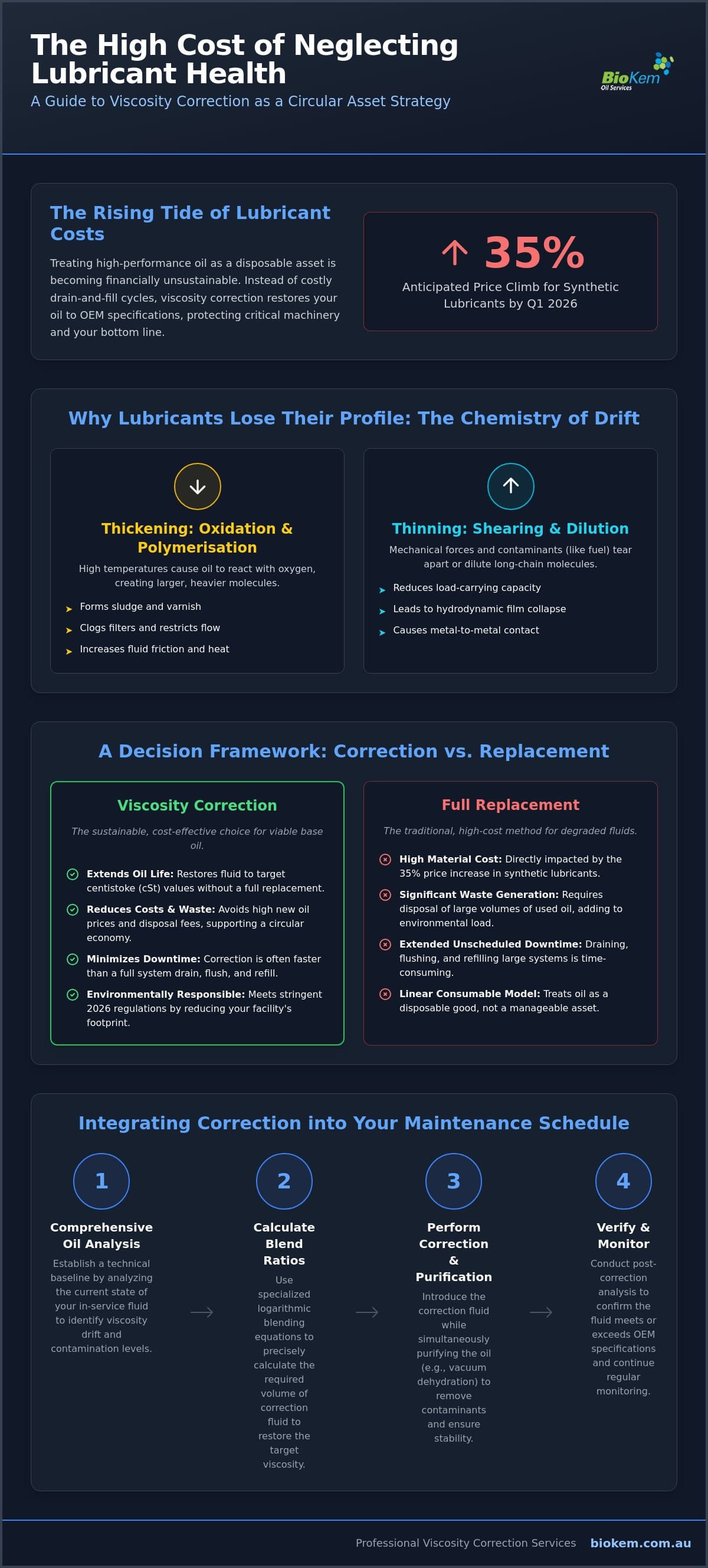
Integrating Viscosity Correction of lubricants into a site’s maintenance schedule requires a transition from volume-based disposal to precision fluid engineering. This shift ensures that every liter of oil remains within its performance window for the maximum possible duration. The process begins with a technical audit of the current fluid state and follows a structured four-step implementation sequence:
- Step 1: Baseline Establishment. Detailed laboratory testing confirms the fluid’s current chemical health and identifies the exact degree of drift.
- Step 2: Engineering. Engineers calculate the correction ratio based on the specific centistoke gap and additive requirements identified in the analysis.
- Step 3: Execution. The blend is performed using high-velocity circulation equipment to ensure a homogenous mixture throughout the entire reservoir.
- Step 4: Validation. Post-correction testing certifies that the fluid meets the required ISO cleanliness and kinematic viscosity standards.
The Vital Role of Oil Analysis
A professional Oil Analysis is the non-negotiable prerequisite for any correction attempt. We don’t just look at viscosity; we monitor the Remaining Useful Life Evaluation Routine (RULER) to assess antioxidant levels and Membrane Patch Colorimetry (MPC) to detect potential varnish precursors. It’s essential to distinguish between true viscosity drift and underlying issues like Varnish in Lube Oil, which can sometimes mimic drift by altering fluid flow characteristics. Without this data, any correction attempt is guesswork that risks equipment safety and financial loss.
Equipment and Filtration Requirements
Execution requires specialized hardware to maintain system integrity during the blending process. We often utilize Hot Oil Flushing to ensure that any particulates or sludge loosened during the correction are immediately captured. This process relies on high-precision Filters S.p.A. Products to achieve the strict ISO cleanliness codes required by modern OEMs. If moisture ingress is detected during the initial analysis, Vacuum Dehydration is integrated into the loop to strip dissolved and emulsified water before the Viscosity Correction of lubricants is completed. This holistic approach ensures the final fluid is not just the right thickness, but also chemically pure and dry.
Contact BioKem to arrange a technical consultation and determine if your current fluid stock is eligible for a comprehensive oil analysis and correction program.
BioKem Oil Services’ Professional Viscosity Correction Services
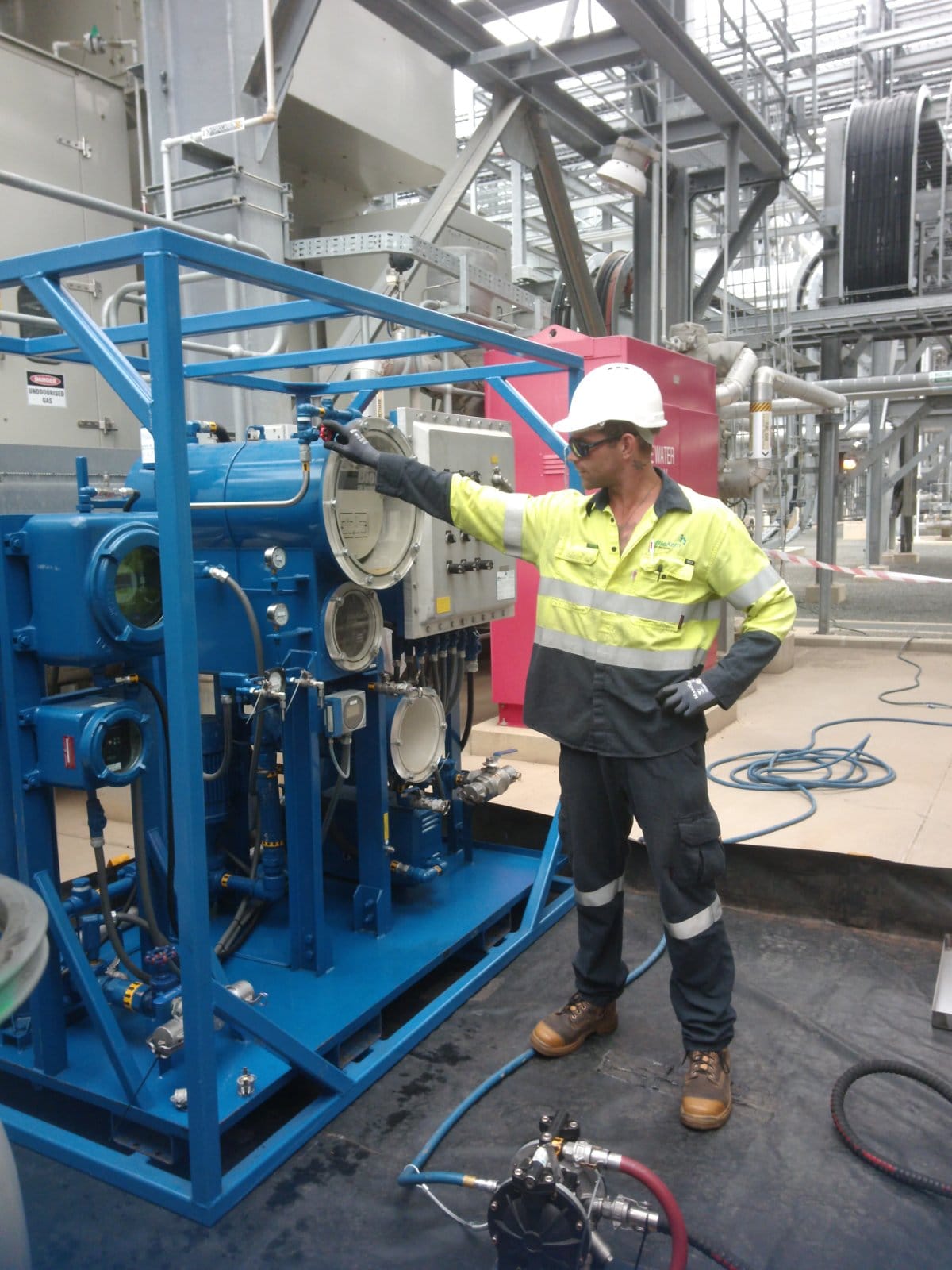
BioKem Oil Services provides a specialized service that bridges the gap between laboratory science and onsite industrial application. While many providers focus solely on basic filtration, our expertise in the Viscosity Correction of lubricants allows us to modify the physical properties of in-service fluids within strictly defined OEM limits. This capability is vital for industries managing massive volumes of high-value synthetic oil, where a simple “drain and fill” represents a significant financial and environmental burden. We don’t just supply oil; we manage its entire lifecycle to ensure maximum uptime and minimal waste.
Every correction project undertaken by BioKem Oil Services is a collaborative effort. We work closely with your lubricant suppliers and onsite engineering teams to ensure that any adjustments maintain the fluid’s original performance warranty and additive balance. Our commitment to delivering “certified clean” lubricants post-correction means your equipment receives fluid that often exceeds the cleanliness standards of new, drum-delivered oil. By focusing on the Viscosity Correction of lubricants as part of a broader circular management strategy, we help facilities significantly reduce their annual oil disposal requirements and logistics costs.
Why Partner with BioKem Oil Services?
We offer national Australian coverage with technical teams ready to deploy to remote mining and power generation sites. Our personnel specialize in the most critical industrial assets, including large-scale turbines, centrifugal compressors, and high-pressure EHC systems where fluid precision is non-negotiable. As the Australian distributor for Filters S.p.A. Products, BioKem Oil Services provides our clients with access to world-class hardware that ensures the success of every blending and correction project. This local expertise, backed by global scientific standards, ensures your facility remains compliant with regional regulatory expectations while optimizing asset health.
Beyond Correction: Holistic Fluid Management
A successful fluid management program looks beyond just the thickness of the oil. Integrating correction with Varnish Mitigation creates a complete reliability solution that addresses both physical viscosity drift and the underlying chemical degradation that leads to varnish formation. For facilities looking to manage short-term correction projects or specific maintenance outages, our Equipment Hire services provide the necessary high-flow infrastructure without the capital expenditure of a permanent installation. This flexibility allows your team to respond to fluid health issues immediately, preventing the long-term damage associated with out-of-spec lubricants.
Contact BioKem Oil Services today for a technical consultation on your system and discover how a professional correction program can transform your operational and environmental outcomes.
Advancing Toward Circular Fluid Management
Transitioning from a traditional disposal model to a proactive fluid restoration strategy is no longer just an environmental preference; it’s a financial necessity in a volatile market. By understanding the mechanisms of drift and applying the technical precision required for the Viscosity Correction of lubricants, facilities can significantly extend the service life of their critical assets. We’ve explored how identifying the “Point of No Return” through rigorous testing prevents equipment failure while ensuring that viable oil stays in the system rather than entering the waste stream.
BioKem provides the specialized expertise and hardware necessary to execute these complex corrections. As the sole Australian distributor for Filters S.p.A. and specialists in turbine and EHC fluid maintenance, we deliver onsite laboratory-grade oil analysis and reporting that you can trust. Our team is ready to help you transform your lubricant management from a recurring expense into a sustainable operational advantage. Consult with a BioKem Specialist on Viscosity Correction to begin optimizing your fluid health today. Your machinery and your bottom line will benefit from this shift toward technical resilience.
Frequently Asked Questions
Is viscosity correction safe for my machine?
Yes, viscosity correction is safe when performed by specialists using laboratory-verified blend ratios. The process restores the fluid to its original OEM-specified kinematic viscosity range, ensuring the hydrodynamic film remains stable. This protects critical components like bearings and gear sets from the premature wear associated with out-of-spec lubricants.
Can any oil be corrected, or are there limits?
Most mineral and synthetic industrial oils are candidates for restoration, but chemical limits do exist. If a fluid has reached a point of extreme oxidation or total additive depletion, the base stock may be too compromised for salvage. We utilize RULER and MPC testing to determine if the fluid’s molecular structure is still viable for the Viscosity Correction of lubricants.
How do I know if my oil needs viscosity correction?
Routine oil analysis is the only reliable method to identify viscosity drift before it causes damage. If your reports show a deviation of more than 10% from the ISO VG grade, such as an ISO 46 oil dropping below 41.4 cSt, correction is necessary. These shifts often indicate molecular shearing or contamination that requires immediate technical intervention.
Will correcting the viscosity also remove varnish and sludge?
No, correcting the viscosity only adjusts the fluid’s internal resistance to flow. To remove existing varnish and sludge, we integrate the correction process with Varnish Mitigation and Hot Oil Flushing. This holistic approach ensures the newly balanced fluid doesn’t immediately degrade by reacting with residual deposits left in the system pipework.
How long does the viscosity correction process take?
The timeline depends on the total system volume and the degree of correction required. A typical project for a large turbine reservoir can often be completed within 24 to 48 hours. Because we utilize high-velocity circulation equipment, many corrections can be executed as a side-stream process while the machinery remains operational.
Does BioKem provide a warranty or certification for corrected oil?
BioKem provides a detailed technical certification for every corrected batch. This includes a post-correction laboratory report verifying the kinematic viscosity, additive concentrations, and ISO cleanliness codes. We certify that the final fluid meets the specific technical performance standards required for your critical assets.
What industries benefit most from viscosity correction?
Industries with large-volume, high-value assets see the most significant return on investment. This includes power generation, mining, and heavy manufacturing. Facilities using specialized EHC fluids or large turbine systems benefit most from the Viscosity Correction of lubricants due to the high cost of replacement and the environmental burden of disposal.
Is it cheaper to correct oil or replace it entirely?
Correction is significantly more cost-effective for systems containing 5,000 liters or more. When you calculate the purchase price of new synthetic oil, the logistics of transport, and the rising costs of hazardous waste disposal, correction represents a fraction of the total expense of a full replacement.