

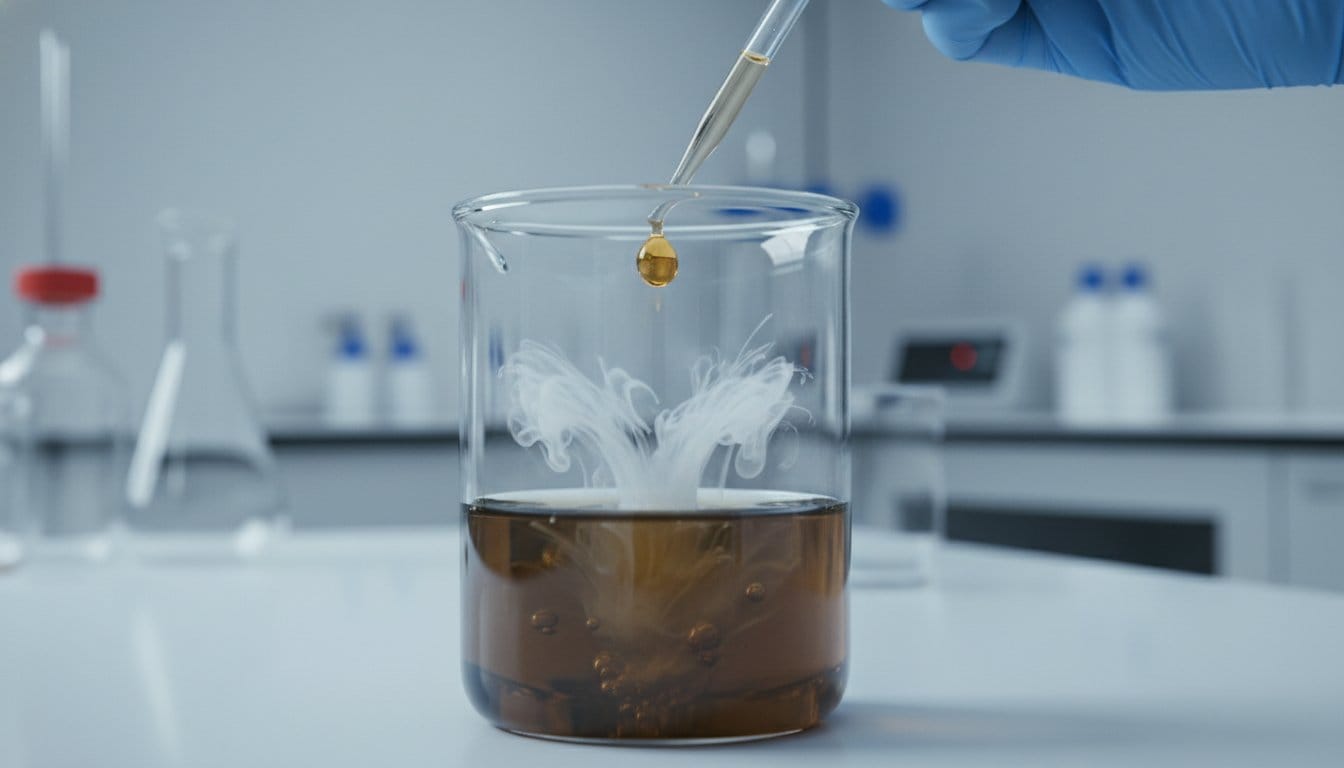
Adding fresh oil to a struggling system feels like a responsible cost-saving measure, but it’s often the catalyst for a total mechanical breakdown. With lubricant prices in North America surging by up to 35 percent between March and May 2026, the temptation to avoid a full sump change is higher than ever. However, The Hidden Dangers of Topping Up Your Lube Oil lie in the immediate destabilization of your system’s chemical equilibrium. Instead of restoring performance, you might be triggering additive dropout and accelerated varnish formation that leads to critical valve sticking.
You likely view your lubricant as a simple consumable that needs occasional replenishment to maintain levels. We recognize the pressure to manage these rising operational costs while adhering to evolving standards like the API PC-12 specification. This article explains why a “quick fix” often compromises asset reliability and clarifies when professional interventions, such as hot oil flushing or vacuum dehydration, are mandatory. You’ll discover how to identify oil group incompatibility and the precise steps required to extend lubricant life safely without risking catastrophic component failure.
Key Takeaways
- Understand why the “dilution myth” is a technical fallacy, as adding fresh lubricant fails to neutralize existing contaminants or restore system cleanliness.
- Identify The Hidden Dangers of Topping Up Your Lube Oil by analyzing the chemical risks associated with blending incompatible API base oil groups.
- Recognize the mechanism of additive dropout, where clashing chemistries cause vital protective components to precipitate out of the fluid.
- Learn to apply a five-step decision framework incorporating ISO 4406 cleanliness codes to determine when a system requires professional intervention.
- Discover how advanced solutions like Hot Oil Flushing and Varnish Mitigation provide a sustainable alternative to repetitive oil changes by removing the root source of contamination.
The Myth of Dilution: Why Topping Up Lube Oil Isn’t Enough
Many industrial operators operate under the false assumption that adding fresh lubricant to a depleted system “cleanses” the remaining fluid. This belief, known as the Dilution Myth, suggests that a partial top-up restores the chemical integrity of the entire volume. In reality, The Hidden Dangers of Topping Up Your Lube Oil involve the immediate compromise of the new fluid. Instead of the new oil uplifting the old, the degraded oil acts as a contaminant source that rapidly consumes the fresh additive package.
When you introduce new oil into a system with a high Acid Number (AN), the acidic components don’t just disappear. They immediately begin to neutralize the fresh antioxidants. Existing wear metals remain in the sump and act as catalysts for further oxidation, including:
- Copper particles from heat exchangers or bushings
- Iron fines from gear wear or cylinder liners
- Residual sludge from previous oxidation cycles
This process ensures that the “refreshed” oil reaches a state of degradation much faster than a completely clean system would.
To better understand the risks of mixing lubricants, watch this helpful demonstration:
The Mathematical Fallacy of Oil Quality
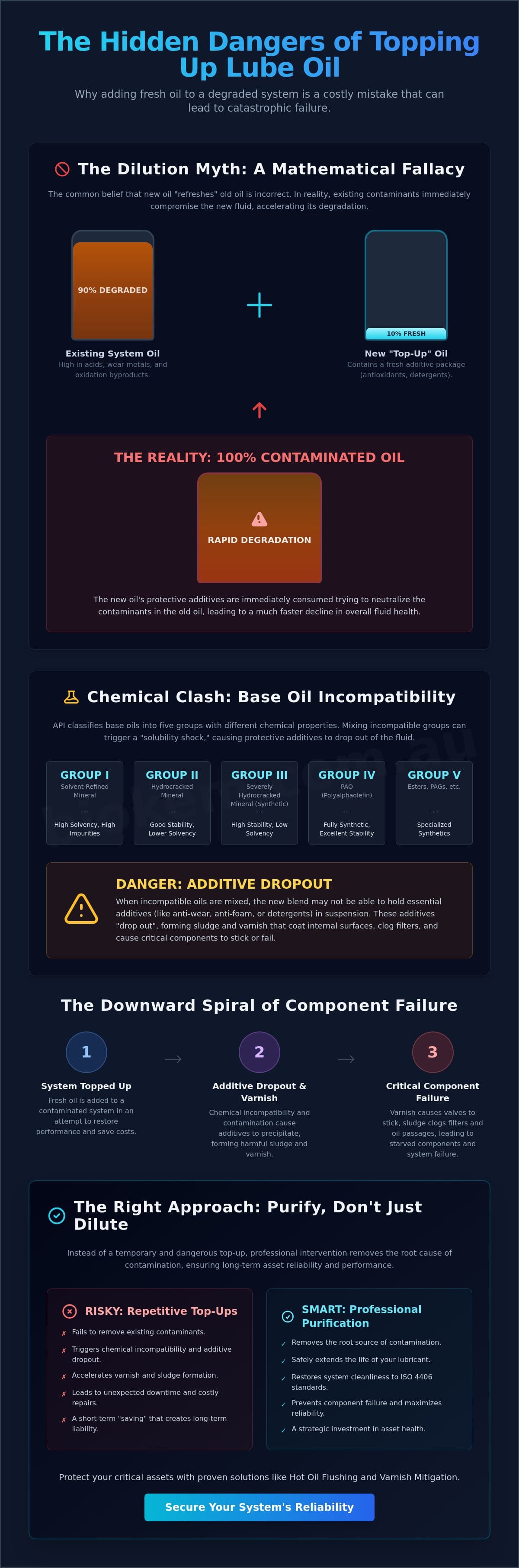
Adding 10 percent clean oil to a reservoir containing 90 percent degraded oil doesn’t result in a 10 percent improvement in quality. It results in 100 percent contaminated oil. Lubricants eventually reach a “Point of No Return” where the rate of motor oil degradation accelerates exponentially. Thermal stress on the remaining old molecules has already altered their molecular structure. When fresh oil is introduced, it’s subjected to the same thermal environment and chemical stressors, leading to a rapid loss of oxidation stability.
Why “Clean Looking” Oil Can Still Be Lethal
Visual inspection is a notoriously unreliable method for assessing oil health in critical industrial assets. Sub-micron contaminants, which are invisible to the naked eye, continue to circulate even after a top-up. A particularly risky phenomenon occurs when fresh additives act as detergents, stripping old varnish from internal walls and putting it back into circulation. This can lead to sudden valve sticking or filter plugging shortly after what seemed like a routine maintenance task. For systems requiring high reliability, a professional hot oil flushing procedure is the only way to ensure the removal of these persistent hazards.
Understanding these physical contamination risks is only the first step. To fully grasp The Hidden Dangers of Topping Up Your Lube Oil, one must also consider the molecular level: the chemical risks of blending different base oil stocks.
Base Oil Incompatibility: The Chemistry of Group Blending
While the physical act of adding oil seems benign, the molecular reality is far more complex. The American Petroleum Institute (API) classifies base oils into five distinct groups based on their refining process and chemical properties. Group I oils are solvent-refined mineral oils with high solvency but higher impurity levels. Groups II and III are hydrocracked to remove sulfur and aromatics, resulting in better stability but lower natural solvency. Group IV consists of synthetic Polyalphaolefins (PAOs), while Group V includes specialized chemistries like esters and polyalkylene glycols (PAGs). The Hidden Dangers of Topping Up Your Lube Oil emerge when these distinct chemical structures are forced to coexist in the same sump.
Blending these groups isn’t a linear process. It often results in a “solubility shock” where the fluid’s capacity to hold contaminants in suspension is suddenly compromised. This phenomenon is particularly dangerous in high-heat environments like power generation turbines and heavy manufacturing presses. When the chemical equilibrium shifts, the oil can no longer support its load of oxidation byproducts, leading to immediate hardware issues.
Solvency and the Group I to Group II Transition
The global shift toward Group II base oils has created a significant maintenance trap. Group II oils are highly refined and offer excellent longevity, but they lack the natural solvency of older Group I stocks. If you top up a Group I system with a Group II product, the overall solvency of the mixture drops. This causes “varnish dropout,” where sub-micron contaminants that were safely dissolved in the old oil are suddenly forced out of solution. These particles then migrate to the coolest or lowest-flow areas of your machinery, coating sensitive components in a sticky residue. If your system shows signs of this chemical shift, implementing a varnish mitigation system is often necessary to prevent total valve seizure.
Synthetic vs. Mineral Blending Dangers
Mixing mineral lubricants with synthetic systems introduces a high risk of chemical friction. PAOs (Group IV) are non-polar and rely on a precise balance of esters (Group V) to keep additives dissolved. Introducing a mineral-based top-up can disrupt this polarity, leading to additive precipitation and a rapid loss of Viscosity Index stability. This loss of stability means the oil’s thickness will fluctuate wildly with temperature, failing to provide a consistent protective film. The Hidden Dangers of Topping Up Your Lube Oil with the wrong base stock can effectively turn a high-performance synthetic fluid into a low-grade mixture that fails under pressure. Ensuring compatibility through professional oil analysis is the only way to avoid these invisible chemical traps.
Additive Dropout: The Most Expensive Consequence
Additive dropout represents a severe chemical failure where essential performance chemicals precipitate out of the base oil and settle as solids. Every industrial lubricant contains a carefully balanced additive package, typically comprising 5 percent to 30 percent of the total volume. These chemicals are held in a delicate state of suspension. When you mix different brands or even different batches of the same product, you risk disrupting this equilibrium. The Hidden Dangers of Topping Up Your Lube Oil often manifest as a cloudy appearance or a fine silt at the bottom of a sight glass. This is the physical evidence of your protection falling out of solution.
When new oil enters a system with depleted fluid, a phenomenon known as “additive stealing” can occur. The highly oxidized molecules in the old oil are chemically aggressive. They often react with the fresh antioxidants and detergents in the new oil before those additives can reach the metal surfaces they’re meant to protect. This leaves the system vulnerable to rapid oxidation and corrosive wear, effectively neutralizing the investment made in the top-up fluid. Instead of extending life, the new additives are consumed simply by trying to stabilize the old environment.
Antioxidant and Anti-wear Interference
Lubricant additives like Zinc Dialkyldithiophosphate (ZDDP) and various extreme pressure agents must bond to metal surfaces to function. In a mixed-oil environment, different additive chemistries often compete for the same surface area. If the polarities of the mixed fluids clash, the anti-wear additives may never reach the load-bearing surfaces. This results in increased friction and localized heat generation despite the presence of seemingly “fresh” oil. Premature component wear is a common outcome, as the chemical interference prevents the formation of a stable tribofilm on critical gears and bearings.
Sludge Formation and Filter Plugging
As additives precipitate, they don’t simply vanish. They transform into insoluble sticky residues that coalesce into sludge. This sludge is particularly destructive to heat exchangers, where it acts as an insulating layer that reduces cooling efficiency. In the circulation system, this fallout leads to immediate operational challenges. These include rapid increases in differential pressure across filtration units and reduced flow rates to critical bearings. There’s also the potential for total filter bypass, which allows contaminants to reach sensitive components directly. Managing this chemical fallout requires more than standard maintenance. Utilizing Specialist oil filters can help capture these insoluble materials before they cause a system-wide failure, but the root cause remains the chemical instability of the mixed fluid. The Hidden Dangers of Topping Up Your Lube Oil ultimately turn a simple maintenance task into an expensive decontamination project.
A Decision Framework: To Top Up or to Flush?
Deciding whether to add oil or perform a full system purge requires more than a glance at a dipstick. To mitigate The Hidden Dangers of Topping Up Your Lube Oil, reliability engineers must adopt a structured protocol. This begins with assessing the current state of the fluid against ISO 4406 cleanliness codes. If the particulate count exceeds the equipment manufacturer’s specifications, adding clean oil is a wasted investment. A general industrial standard is the 10 to 15 percent rule. If the volume of new oil required exceeds 15 percent of the total sump capacity, the existing fluid is likely too degraded to be salvaged. At this stage, the chemical imbalance discussed in previous sections becomes irreversible without professional intervention.
Schedule a comprehensive oil analysis to determine if your system is at risk before adding new lubricant. This proactive step ensures you don’t waste resources on a fluid that’s already compromised.
Step 1-3: Analysis and Compatibility Testing
The first three steps of the framework focus on diagnostic verification. You must first perform a membrane colourimetry (MPC) test to quantify varnish potential. High MPC values indicate that the oil’s solvency is exhausted and it can no longer hold contaminants. Second, conduct a simple flask test by mixing a 50/50 ratio of the in-service oil and the intended top-up fluid. If the mixture turns cloudy or shows signs of precipitation within 24 hours, the oils are incompatible. Finally, evaluate the remaining useful life (RULER) of the antioxidant package. This ensures the fluid still has the chemical stamina to handle the thermal loads of your operation. These tests reveal the invisible risks that standard visual inspections miss.
Step 4-5: Risk Mitigation and Execution
Once you have the data, you must choose the execution path. For systems with manageable degradation, a controlled bleed-and-feed may suffice. However, if MPC values are high or the flask test fails, a full system flush is the only responsible path. You should establish a strict “No Blending” policy for all critical assets to prevent accidental cross-contamination. This policy must be supported by rigorous documentation of every top-up event, including the specific batch number and volume added. This tracking allows you to identify patterns in lubricant consumption that might signal underlying mechanical issues. If your analysis indicates high varnish potential, consider implementing a varnish mitigation system to protect your components from The Hidden Dangers of Topping Up Your Lube Oil.
Beyond the Top-Up: Professional Purification and Flushing
Managing high-stakes industrial assets requires a shift from reactive maintenance to technical fluid management. While topping up might seem like a convenient way to maintain levels, it fails to address the underlying chemical degradation and particulate accumulation. To truly neutralize The Hidden Dangers of Topping Up Your Lube Oil, operators must look toward advanced restoration techniques. Hot Oil Flushing stands as the superior alternative to standard oil changes. It doesn’t just replace the fluid; it cleanses the entire internal architecture of the system. This process ensures that new oil isn’t immediately contaminated by residual sludge or metallic fines left behind in dead zones or pipework.
Adopting Varnish Mitigation is equally critical for long-term reliability. Unlike topping up, which merely dilutes the concentration of oxidation byproducts, mitigation systems actively remove the polar contaminants that cause valve sticking and heat exchanger fouling. This approach targets the root cause of fluid failure rather than just treating the symptoms. It’s a more sustainable model that aligns with modern environmental standards by extending the service life of the lubricant. With lubricant prices in North America increasing by up to 35 percent between March and May 2026, purification provides a vital economic hedge against market volatility. By purifying the oil instead of disposing of it, businesses significantly reduce their hazardous waste profile and lower the total cost of ownership for their lubricants.
The Power of High-Velocity Hot Oil Flushing
Standard gravity draining leaves a significant portion of old, contaminated oil trapped in the system’s low points and stagnant areas. High-velocity flushing utilizes turbulent flow to dislodge these stubborn deposits. This mechanical action is mandatory after a major component failure or years of repetitive topping up. BioKem Oil Services’ onsite technical teams deploy specialized equipment to reach Reynolds numbers high enough to scrub the internal surfaces of piping and reservoirs. This level of cleanliness is impossible to achieve through simple replenishment. It’s the only way to ensure the system is truly prepared for a fresh charge of high-performance lubricant without the risk of immediate cross-contamination.
Purification: Giving Your Oil a Second Life
Oil doesn’t necessarily wear out; it simply gets too dirty or chemically imbalanced to function. Through vacuum dehydration and kidney-loop filtration, it’s possible to remove water, dissolved gases, and sub-micron particulates to achieve “better than new” cleanliness levels. These purification methods allow you to maintain the integrity of your fluid without the risks associated with blending incompatible stocks. BioKem Oil Services positions itself as your technical partner in this process, providing the expertise and specialized equipment hire needed to maintain peak operational efficiency. Don’t let your equipment fall victim to chemical instability or The Hidden Dangers of Topping Up Your Lube Oil. Contact BioKem Oil Services for a comprehensive oil health assessment to determine the best path forward for your critical assets.
Securing Long-Term Asset Reliability
Transitioning from reactive topping up to proactive fluid management is essential for protecting complex machinery. We’ve explored how mixing incompatible base oil groups and disrupting additive packages leads to varnish formation and component failure. Understanding The Hidden Dangers of Topping Up Your Lube Oil allows you to make informed decisions that prioritize chemical stability over temporary volume restoration. Relying on the diagnostic frameworks discussed ensures that your maintenance actions contribute to asset health rather than accelerating its decline.
BioKem Oil Services serves as a dedicated technical partner for high-stakes industrial operations. As the authorized distributor for Filters S.p.A. in Australia, BioKem Oil Services provides niche expertise in Varnish Mitigation and high-velocity Hot Oil Flushing. Our capability for onsite technical interventions across national industrial projects ensures that your systems achieve peak cleanliness levels. By choosing purification over disposal, you support long-term ecological health while insulating your business from market volatility. Ensure your industrial assets are protected with a BioKem Oil Services Oil Analysis today.
Taking control of your lubrication strategy is the most effective way to extend equipment life and ensure operational success. It’s a commitment to precision that pays dividends in reliability.
Frequently Asked Questions
Is it ever safe to mix different brands of lube oil?
Mixing different brands is generally unsafe because each manufacturer uses a proprietary synergy of chemicals that may not be compatible with others. Even if the viscosity and base oil group match, the interaction between different detergent and anti-wear chemistries can lead to solid fallout. It’s best to maintain a single formulation to ensure the fluid’s chemical equilibrium remains stable during high-stress operation.
What are the first signs of oil incompatibility in a hydraulic system?
Erratic valve response and localized heat generation are the primary indicators that a mixture is failing to perform. You might also notice persistent foaming in the reservoir or a cloudy appearance in the sight glass shortly after adding new fluid. These symptoms suggest the blended fluids are experiencing solubility shock, which prevents the oil from maintaining a consistent protective film.
How much oil can I add to a system before it counts as “blending”?
Any addition of a different fluid formulation counts as blending, but the technical risks escalate significantly once the volume exceeds 10 percent of the total sump capacity. Beyond this threshold, the chemical properties of the new fluid begin to fundamentally alter the mixture’s performance. This is where The Hidden Dangers of Topping Up Your Lube Oil become most critical, as the additive balance shifts toward instability.
Can topping up my oil cause my filters to clog faster?
Yes, topping up can trigger the precipitation of insoluble materials that quickly saturate your filter media. If the new oil has lower solvency than the original fluid, it can force dissolved oxidation byproducts out of solution and into a solid state. This results in immediate differential pressure spikes, often requiring the installation of specialist oil filters to manage the chemical fallout before it damages components.
What is the difference between an oil change and a hot oil flush?
An oil change only replaces the fluid in the reservoir, while a hot oil flush utilizes the mechanical impingement of turbulent flow to decontaminate the entire internal piping network. Flushing removes the stubborn deposits and metallic fines that a standard drain leaves behind. It’s a comprehensive cleaning process that ensures the system is physically and chemically prepared for a fresh lubricant charge.
How does varnish mitigation differ from standard oil filtration?
Standard filtration captures solid particles based on size, whereas varnish mitigation targets sub-micron polar contaminants and dissolved byproducts that filters cannot catch. While filters manage physical debris, mitigation systems address the molecular precursors of sludge. This specialized approach prevents the formation of sticky residues that cause sensitive servo valves to seize in high-temperature environments.
What should I do if I accidentally topped up with the wrong oil group?
You should immediately isolate the equipment and perform a comprehensive oil analysis to determine the extent of the chemical clash. If the laboratory results indicate high varnish potential or significant additive precipitation, a full system flush and fluid replacement are mandatory. Continuing operation with a mismatched mixture can lead to rapid component wear or catastrophic failure within a single shift.
How often should I perform a full oil analysis for my turbine?
Critical turbine systems typically require monthly analysis to monitor oxidation trends and particulate counts effectively. Frequent testing helps you identify The Hidden Dangers of Topping Up Your Lube Oil before they manifest as unscheduled downtime. BioKem Oil Services provides specialized testing that allows for timely interventions, such as vacuum dehydration, to extend the life of your lubricant safely.