


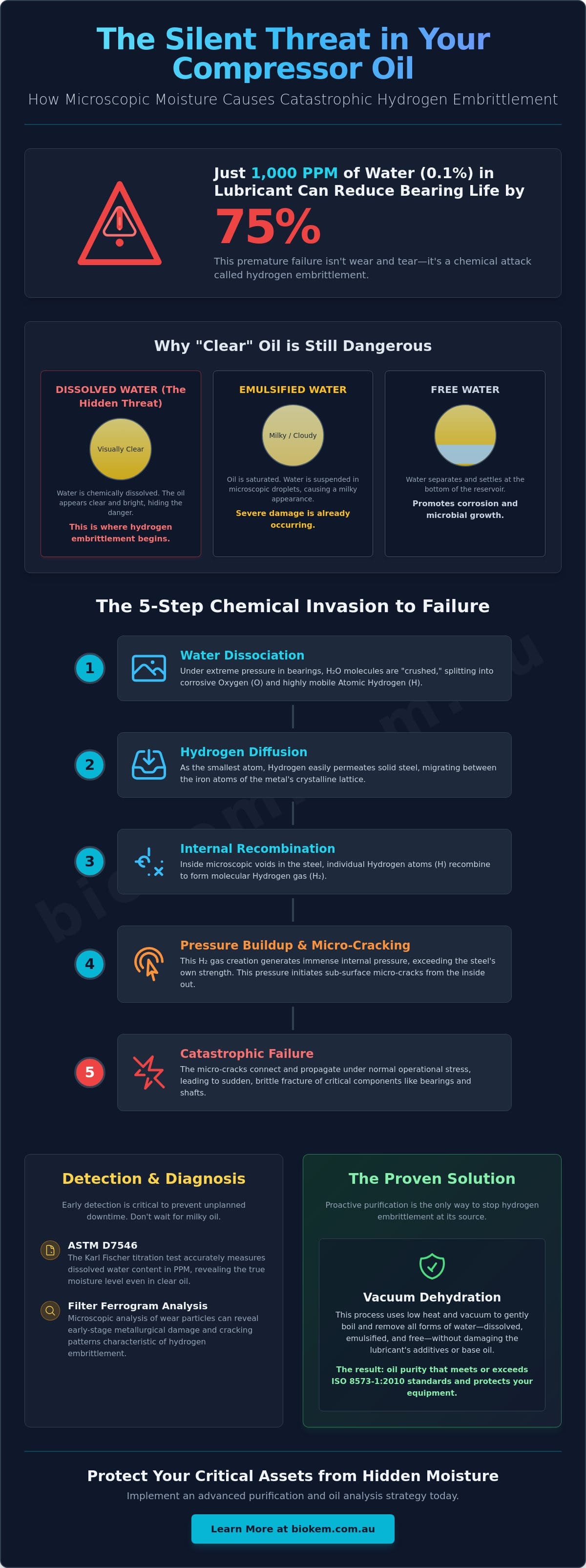
The presence of just 1,000 parts per million of water in your lubricant can slash the life of a bearing by as much as 75%. While many operators wait for oil to turn milky before taking action, the most destructive forces are often already at work in a completely clear fluid. Is moisture in your compressor lube oil causing hydrogen embrittlement? This is the critical question facing reliability engineers today. When dissolved water interacts with high-strength steel under pressure, it acts as a catalyst for atomic hydrogen diffusion. This process leads to sudden, catastrophic component failure that standard particulate filtration simply cannot prevent.
We understand the frustration of dealing with unscheduled downtime and the staggering cost of replacing specialized steel internals. This article explains the hidden chemical link between oil-borne moisture and metal fatigue, offering a clear path toward operational stability. You’ll learn how to utilize diagnostic tools like ASTM D7546 and why implementing a permanent moisture removal strategy, such as vacuum dehydration, is essential for meeting ISO 8573-1:2010 purity standards. We will outline the technical mechanisms of hydrogen-induced cracking and provide the roadmap to protect your equipment through advanced purification and rigorous oil analysis.
Key Takeaways
- Understand how high-pressure rolling contacts catalyze the breakdown of water molecules into atomic hydrogen, initiating subsurface metal fatigue.
- Learn to identify if moisture in your compressor lube oil is causing hydrogen embrittlement by recognizing the progression from micro-cracks to catastrophic fractures in impeller shafts and bearing races.
- Discover why “clear” oil often harbors dangerous levels of dissolved moisture that bypass standard filtration and accelerate component degradation.
- Utilize advanced oil analysis and Filter Ferrogram Analysis to detect early-stage metallurgical damage and prevent unplanned industrial downtime.
- Implement vacuum dehydration as a precise purification strategy to remove dissolved water and maintain system integrity without risking thermal damage to the lubricant.
The Chemical Link: How Moisture Becomes Atomic Hydrogen
To understand the structural integrity of your machinery, you must first look at the microscopic reactions occurring within the lubricant. Hydrogen embrittlement is a sophisticated degradation process where high-strength metals lose their ductility and fracture under levels of stress that would otherwise be manageable. It isn’t a simple case of rust or corrosion. Instead, it’s a chemical-mechanical invasion. Is moisture in your compressor lube oil causing hydrogen embrittlement? The evidence suggests that even trace amounts of water, when subjected to the intense environment of a compressor, provide the necessary fuel for this destructive cycle.
In high-pressure rolling contacts, such as those found in bearings and gear sets, water molecules don’t remain stable. The extreme mechanical loads effectively “crush” the water, leading to the dissociation of H2O into its base components: oxygen and atomic hydrogen. This reaction is concentrated at the wear track where the lubricant film is thinnest. While the oxygen may contribute to standard oxidation, the lone hydrogen atoms represent a much more insidious threat to the steel’s lattice structure.
To better understand how moisture behaves in these industrial systems, watch this helpful video:
Hydrocarbon-based lubricants can inadvertently accelerate this process through a mechanism known as hydrocracking. Under extreme pressure and heat, the oil’s own molecular chains can break apart, releasing additional hydrogen. When water is present, it acts as a powerful catalyst that lowers the energy required for these hydrocarbon bonds to fail. This creates a high-concentration “hydrogen zone” directly against the metal surface, setting the stage for rapid diffusion.
The Role of Extreme Pressure (EP) in Hydrogen Release
Extreme pressure environments create nascent metal surfaces. These are freshly exposed, non-oxidized layers of steel created by the constant shearing and rolling action of compressor components. These nascent surfaces are highly reactive and act as potent catalysts for the release of hydrogen from both water and the lubricant itself. Localized temperature spikes, which can exceed several hundred degrees at the microscopic point of contact, provide the thermal energy needed to drive these chemical reactions. When dissolved water meets these hot, raw steel surfaces, the resulting chemical dissociation is almost instantaneous, flooding the contact zone with free hydrogen atoms.
Hydrogen Diffusion: Moving from Oil to Metal Lattice
The hydrogen atom is the smallest in the periodic table. Its diminutive size allows it to permeate solid steel with ease, slipping between the larger iron atoms that make up the metal’s crystalline lattice. Once inside, these atoms migrate toward areas of high tensile stress. As they accumulate, the atoms often recombine into molecular hydrogen (H2) within microscopic voids or grain boundaries. This recombination creates immense internal pressure from the inside out. The critical concentration of hydrogen is the specific threshold at which this internal gas pressure exceeds the metal’s cohesive strength, triggering a sub-surface crack that inevitably leads to failure.
Mechanics of Failure: Hydrogen-Induced Cold Cracking (HICC)
Hydrogen-Induced Cold Cracking (HICC) represents the final, physical stage of the chemical invasion. While standard mechanical wear typically manifests as surface-level pitting or abrasive scoring, HICC is an internal phenomenon. It begins with micro-cracks that are invisible to the naked eye. These fissures propagate along the grain boundaries of the metal lattice, eventually coalescing into macro-fractures that can split an impeller shaft or shatter a bearing race with little warning. Is moisture in your compressor lube oil causing hydrogen embrittlement? The mechanical evidence often appears as a clean, brittle break rather than the deformed, “torn” appearance of traditional fatigue.
High-risk components that frequently fall victim to this failure include:
- Impeller shafts and high-speed rotors
- High-strength structural bolts and fasteners
- Precision bearing races and rolling elements
- Valve plates and springs subjected to cyclic loading
A particularly dangerous aspect of this failure mode is the “delayed failure” phenomenon. Unlike typical mechanical breakdowns that occur under peak load, HICC often happens hours after the compressor has been shut down. As the metal cools and the internal stress redistributes, the accumulated hydrogen molecules exert enough pressure to trigger the final fracture. This leaves engineers puzzled by parts that were seemingly functional during the last shift but are found snapped at start-up.
The scientific basis for this involves the decomposition of lubricant and water molecules at the point of contact. This breakdown provides the continuous supply of atomic hydrogen necessary to drive the cracking process.
Vulnerability of High-Strength Alloys
Modern compressors utilize high-strength alloys to achieve greater efficiency and higher discharge pressures. However, there’s a direct correlation between increased tensile strength and sensitivity to embrittlement. Steels with a tensile strength exceeding 1,000 MPa are significantly more prone to hydrogen-induced failure than softer, more ductile materials. Maintaining strict moisture limits is no longer optional for these machines; it’s a structural necessity. Utilizing specialized Filter Ferrogram Analysis can help identify these internal fatigue markers before they reach a critical state.
The Synergy of Moisture and Varnish
Moisture doesn’t act in isolation. It aggressively accelerates the depletion of antioxidant additives in the oil, leading to the rapid formation of varnish. This sticky, resinous byproduct creates a dangerous feedback loop. Varnish layers trap moisture against the metal surface, forming a localized corrosion cell. This concentration of water ensures a steady supply of hydrogen atoms directly at the metal interface. Beyond the structural risk, this synergy leads to valve sticking and compromised thermal regulation, as the varnish acts as an insulator that prevents proper heat dissipation.
Water States: Why Clear Oil Can Still Be Dangerous
Many maintenance professionals rely on a visual inspection to determine the health of their lubricant. If the oil appears clear and bright, they assume it’s free from contamination. This is a dangerous misconception when managing high-performance machinery. Is moisture in your compressor lube oil causing hydrogen embrittlement? The reality is that the most destructive form of water is often completely invisible. Water exists in oil in three distinct states: dissolved, emulsified, and free. Each state presents a different level of risk, but the dissolved state is the primary driver of subsurface metallurgical failure.
Dissolved water is moisture that has been fully integrated into the oil’s molecular structure, similar to humidity in the air. At this stage, the oil remains chemically “clear.” Because the water is not in a separate phase, standard particulate filters and even many coalescing systems cannot remove it. Emulsified water occurs once the oil reaches its saturation point. The oil takes on a cloudy or milky appearance, signaling that the fluid’s demulsibility—its ability to shed water—has been compromised. Finally, free water is the excess moisture that separates entirely, often settling at the bottom of a reservoir. While free water is a major concern for rust and corrosion, it is the dissolved water that most easily penetrates the high-pressure contact zones where atomic hydrogen is released.
Measuring Moisture: Beyond the Visual Check
The traditional “crackle test” is insufficient for modern high-pressure compressors. This method only detects moisture once it exceeds 500 to 1,000 ppm, which is far beyond the threshold for hydrogen-induced damage. Precise oil analysis using Karl Fischer Titration is the industry standard for measuring dissolved water in parts per million (ppm). This level of accuracy is vital because environmental moisture is constantly pulled into the system. As the lube oil tank “breathes” during normal thermal cycles, it draws in humid air. When the oil cools, that moisture stays trapped, gradually increasing the dissolved water concentration toward a critical level.
Saturation and Temperature Dynamics
The saturation point of industrial oil is highly dependent on temperature. Warm oil has a much higher capacity to hold water in a dissolved state. As the oil travels through the lubrication circuit and encounters “cold spots” or returns to a cooler reservoir, its ability to hold that water drops. This causes the dissolved moisture to “crash out” of the solution, often right at the point of critical component interface. Even 200ppm of dissolved water can trigger hydrogen embrittlement in specific high-strength alloys. This invisible saturation creates a constant chemical pressure on your metal components, regardless of how clean the oil appears to the naked eye.
Diagnostic Strategies for Detecting Sub-Surface Risks
Detecting the presence of water is only the first step in a robust reliability program. To determine if Is moisture in your compressor lube oil causing hydrogen embrittlement?, you must look for the secondary signatures of metallurgical distress. Standard elemental spectroscopy often fails in this regard because it only detects particles smaller than 5 microns. Hydrogen-induced cracking typically produces larger, laminar wear particles as internal fissures reach the surface and release metal flakes. These “macro” indicators are often missed by routine lab tests, leading to a false sense of security while internal damage accelerates.
Establishing a moisture baseline through consistent oil analysis is vital for long-term asset health. Without a historical record of your system’s typical parts-per-million (ppm) levels, it’s impossible to distinguish between a temporary environmental spike and a chronic ingress problem. Consistent sampling allows you to identify the specific saturation point of your lubricant under actual operating conditions, which is the moment the risk of atomic hydrogen diffusion becomes critical.
Advanced Analytical Techniques
Analytical ferrography stands as the most effective tool for identifying the early stages of hydrogen-induced fatigue. Unlike automated particle counting, this technique allows a specialist to visually examine the morphology of wear debris. Fatigue particles caused by hydrogen diffusion have distinct, shingle-like appearances that differ significantly from abrasive or corrosive wear. Utilizing Filter Ferrogram Analysis provides a more comprehensive view by capturing debris directly from the filter media. This ensures that the larger failure indicators, which usually settle out of the oil before reaching a sample point, are accounted for in the diagnostic report.
For immediate, onsite verification of fluid health, patch test kits are indispensable. These kits allow operators to identify insoluble contaminants such as sludge or varnish that may be masking moisture. If a patch test reveals heavy organic contamination, it’s highly likely that water is being sequestered against metal surfaces. This concentration of moisture creates a localized environment where the dissociation of H2O into atomic hydrogen is almost guaranteed.
Interpreting Moisture Trends
Interpreting your data requires a focus on both moisture volume and additive health. Water aggressively reacts with anti-wear additives and phenolic antioxidants, leading to rapid depletion. A sudden drop in these protective elements, accompanied by even a slight rise in moisture, indicates that the oil’s chemical barrier is failing. When dissolved water consistently trends toward the saturation limit of your specific oil grade, you must move from passive monitoring to active remediation. Waiting for visible emulsification often means the metallurgical damage is already irreversible.
If your recent reports show rising moisture levels or unusual wear patterns, consider a specialized Filter Ferrogram Analysis to confirm the presence of fatigue-related debris before a catastrophic break occurs.
Remediation: Vacuum Dehydration and System Purification
Standard coalescing filters and centrifugal separators are effective for bulk water removal, but they’re fundamentally limited by physics. They cannot separate water that has entered a dissolved state. If you’re investigating whether is moisture in your compressor lube oil causing hydrogen embrittlement?, these standard methods aren’t enough. Dissolved water is the specific precursor to atomic hydrogen release; removing it requires changing the physical environment of the fluid. Vacuum dehydration is the definitive cure for the chemical risks described in this article, as it addresses the moisture that standard filtration simply leaves behind.
The process works by creating a controlled vacuum inside a dehydration chamber. By reducing the ambient pressure, the boiling point of water is significantly lowered. This allows moisture to transition from liquid to gas at temperatures typically between 50 and 60 degrees Celsius, which is well below the threshold of thermal oil degradation. It’s a precise, non-destructive way to return the oil to a chemically “dry” state. For systems that have suffered from chronic moisture ingress, hot oil flushing is the most effective way to clear the internal circuit. High-velocity, turbulent flow dislodges moisture-rich sludge and varnish that often settle in dead zones, ensuring the entire lubrication path is purified. BioKem provides national availability for these specialized services across Australia, ensuring that critical infrastructure can be restored quickly.
The Vacuum Dehydration Advantage
Vacuum units can reach moisture levels below 50ppm. This is far below the typical saturation point of most industrial lubricants, providing a massive safety margin against hydrogen diffusion. These systems remove free, emulsified, and dissolved water simultaneously, providing a comprehensive solution that stabilizes the fluid’s chemistry. For facilities facing sudden ingress from a cooler failure or seal leak, industrial oil filtration equipment hire offers an immediate response to stabilize the system. This proactive approach prevents the atomic hydrogen from ever reaching the critical concentration required to initiate sub-surface cracks.
Long-Term Moisture Prevention
Permanent remediation requires a multi-layered defense to stop moisture from returning. Desiccant breathers must be installed on all reservoir vents to prevent atmospheric moisture from being drawn in during thermal cycles. High-performance seals and regular oil health audits further harden the system against contamination. By maintaining the oil in a super-dry state, you effectively starve the hydrogen embrittlement process of its primary catalyst. If you’re managing high-value compressor assets and want to eliminate the risk of catastrophic failure, consult with BioKem Oil Services for a comprehensive moisture management audit to secure your operational longevity.
Securing Compressor Reliability through Advanced Purification
Maintaining the structural integrity of high-efficiency compressors requires a shift from reactive filtration to proactive moisture management. Understanding the technical mechanism where dissolved water dissociates into atomic hydrogen is the first step in preventing subsurface fatigue. Clear oil isn’t necessarily safe oil; only rigorous, NATA-aligned analysis and reporting can reveal the true saturation levels threatening your steel components. Is moisture in your compressor lube oil causing hydrogen embrittlement? If your recent data shows rising ppm levels or laminar wear particles, the time for professional intervention has arrived.
As the sole Australian distributor for Filters S.p.A. and specialists in vacuum dehydration and hot oil flushing, BioKem provides the technical expertise needed to stabilize your lubrication system. We offer comprehensive purification strategies that extend asset life and ensure long-term operational health. Protect your critical assets from hydrogen embrittlement with BioKem’s vacuum dehydration services. Our team is ready to help you implement a permanent moisture removal strategy that secures your equipment and your peace of mind.
Frequently Asked Questions
How does moisture cause hydrogen embrittlement in compressors?
High-pressure rolling contacts catalyze the dissociation of water molecules into atomic hydrogen at the wear track. These tiny atoms permeate the metal lattice of high-strength steel components. Once inside, they recombine into molecular hydrogen, creating internal gas pressure that exceeds the metal’s cohesive strength. This process leads to subsurface micro-cracks that eventually coalesce into catastrophic fractures under operational stress.
Can I see the moisture that causes hydrogen embrittlement?
You cannot see the dissolved moisture that primarily drives hydrogen embrittlement because the oil remains clear and bright. While emulsified water appears cloudy and free water settles at the bottom, dissolved water is integrated at the molecular level. Is moisture in your compressor lube oil causing hydrogen embrittlement? Even invisible levels as low as 200 ppm can trigger metallurgical failure in sensitive alloys before any visual change occurs.
What is the safe ppm level for water in compressor lube oil?
A safe moisture level for critical compressor assets is generally below 200 ppm, though many high-performance systems require levels under 100 ppm. Industrial lubricants have different saturation points depending on their base stock and temperature. Once moisture exceeds these thresholds, the risk of atomic hydrogen diffusion increases significantly. Regular oil analysis is the only way to establish and maintain these specific safety margins for your equipment.
Why won’t my standard oil filter stop hydrogen embrittlement?
Standard oil filters are designed to capture solid particulate matter and cannot remove water that is dissolved in the oil. Coalescing filters can remove free and emulsified water, but they leave the dissolved moisture behind. Because hydrogen embrittlement is triggered by water at the molecular level, you need specialized purification technology like vacuum dehydration to reach the sub-saturation levels required for metallurgical protection.
Does vacuum dehydration remove dissolved water?
Vacuum dehydration effectively removes free, emulsified, and dissolved water from compressor lubricants. By lowering the ambient pressure within a dehydration chamber, the system evaporates water at temperatures that don’t damage the oil’s additive package. This process allows operators to achieve moisture levels far below the saturation point, effectively starving the chemical reaction that leads to hydrogen-induced cracking and subsequent component failure.
Is hydrogen embrittlement reversible in compressor components?
Hydrogen embrittlement is not reversible once micro-cracks have formed within the metal lattice. While removing moisture stops the progression of new damage, the existing internal fissures remain permanent structural defects. These compromised parts are prone to sudden failure even after the oil has been purified. This reality highlights the importance of proactive moisture management and early detection through advanced analytical techniques like filter ferrography.
What are the first signs of hydrogen-induced failure in a compressor?
The first signs often appear as laminar, shingle-like wear particles in the lubricant, which are detectable through specialized oil analysis. Unlike standard mechanical wear that shows gradual progression, hydrogen-induced failure often manifests as sudden, brittle fractures in high-stress parts like impeller shafts or bearing races. Is moisture in your compressor lube oil causing hydrogen embrittlement? If your system experiences “delayed failure” hours after shutdown, it’s a strong indicator of this process.
How often should I test for dissolved water in critical assets?
Critical compressor assets should undergo oil analysis for dissolved water at least quarterly, though monthly testing is recommended for high-risk environments. Frequent sampling allows you to establish a moisture baseline and identify ingress trends before they reach the saturation point. In regions with high humidity or significant temperature fluctuations, more frequent monitoring ensures that your vacuum dehydration and desiccant breather strategies are functioning correctly.