

Your critical lubricants are not static assets; they are dynamic chemical solutions that begin to degrade the moment they enter service. While many operators view Lube Oil Additive Depletion as a simple sign of aging, it is actually a complex chemical imbalance that, if unmanaged, guarantees varnish-induced asset failure. You’ve likely felt the frustration of deciphering a complex oil analysis report while your equipment sits idle, wondering if a total fluid replacement is truly necessary or just a costly waste of resources.
This guide empowers you to master the science of additive depletion to protect your assets and extend lubricant life. We’ll explore the specific mechanisms that exhaust your additives and provide a logical framework for choosing between oil replacement and advanced purification methods like varnish mitigation. By understanding these technical shifts, you can prevent varnish-related failures and align your operations with the rigorous ISO 4406:2021 cleanliness standards required in 2026.
Key Takeaways
- Identify the critical distinction between base oil degradation and the chemical exhaustion that characterizes Lube Oil Additive Depletion.
- Understand the transition from antioxidant loss to the formation of polar degradation products that create “soft contaminants” and varnish.
- Discover why standard ICP elemental analysis often fails to track additive functionality and how RULER technology provides a more accurate assessment.
- Learn the specific mechanisms of adsorption and thermal breakdown that strip your lubricants of their protective properties and lead to valve sticking.
- Evaluate the operational and environmental benefits of professional oil purification and re-additization over the traditional “drain and fill” approach.
What is Lube Oil Additive Depletion?
Industrial fluids are complex, engineered chemical systems designed to survive extreme environments. Lube Oil Additive Depletion is the steady reduction of functional chemical components as they interact with heat, oxygen, and contaminants. Every Lubricant consists of a base oil and a specialized additive package. While the base oil provides the primary fluid film, the additives provide the critical performance characteristics. Modern synthetic oils often require more sophisticated additive chemistry than their mineral counterparts. This is because highly refined synthetic base stocks, while thermally stable, lack the natural solubility and protective qualities found in traditional oils.
Most additives are sacrificial by design. They’re engineered to be consumed, transformed, or neutralized to protect the mechanical system. When these chemicals are exhausted, the lubricant can no longer defend against friction or oxidation. This transition marks the point where a fluid shifts from a protective asset to a potential liability for your machinery.
To better understand the technical mechanisms behind this process, watch this helpful video:
The Role of Additives in Industrial Lubricants
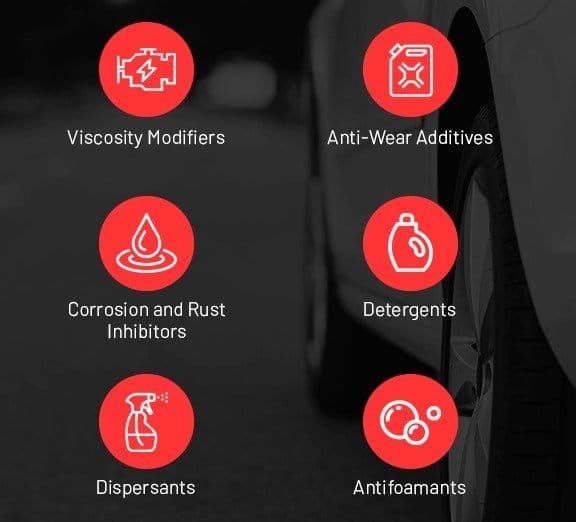
Additives act as the active defense mechanism of your oil. Antioxidants, specifically phenolic and aminic types, work by neutralizing free radicals and halting the chain reactions that lead to sludge and varnish. In high-pressure hydraulic systems, anti-wear (AW) agents like Zinc Dialkyldithiophosphate (ZDDP) form a microscopic protective layer on metal surfaces to prevent metal-to-metal contact. For heavy-duty gearboxes, extreme pressure (EP) additives react with metal surfaces under high heat to prevent catastrophic welding and scoring. Each component serves a specific, finite purpose in maintaining equipment health.
Depletion vs. Degradation: Understanding the Difference
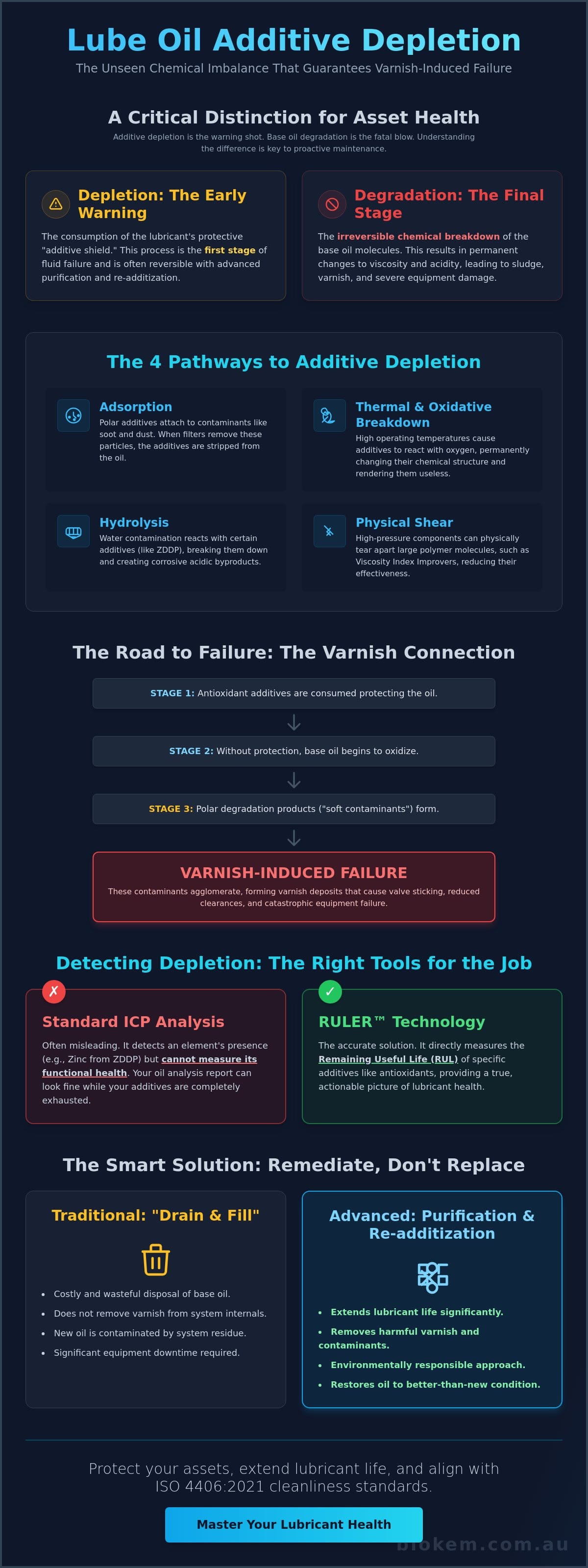
Distinguishing between these two processes is vital for effective asset management. Degradation refers to the irreversible chemical breakdown of the base oil molecules themselves, which results in permanent changes to viscosity and acidity. In contrast, depletion is the loss of the additive “shield” that prevents that degradation from starting. You should view depletion as the early warning stage of fluid failure. In almost every industrial scenario, additive depletion precedes measurable base oil degradation. By monitoring the depletion rate, you can intervene before the fluid becomes an operational liability.
The Mechanisms of Additive Loss in Industrial Systems
Understanding the root causes of Lube Oil Additive Depletion requires looking beyond simple operational hours. Additives disappear from your system through four primary chemical and physical pathways. Adsorption occurs when polar additive molecules attach themselves to solid contaminants like soot, dust, or wear debris. As your filtration system removes these particles, it effectively strips the oil of its protective chemistry. Thermal and oxidative breakdown happens when high operating temperatures cause molecules to react with oxygen, leading to permanent chemical transformation. Water contamination triggers hydrolysis, a process where moisture reacts with specific additive types like esters or ZDDP to create corrosive acidic byproducts. Finally, physical shear stress in high-pressure components can literally tear apart large molecules, such as Viscosity Index Improvers, reducing their effectiveness.
Environmental Accelerants in Australian Operations
The Australian industrial landscape presents unique challenges that accelerate Lube Oil Additive Depletion. In mining regions like the Pilbara, extreme ambient temperatures often exceed 40°C, pushing lubricants toward their oxidative limits before they even enter high-load cycles. Fine silica dust, prevalent in outback operations, acts as a massive surface area for additive adsorption. This increases the rate at which anti-wear agents are “filtered out” of the system. Coastal facilities face the additional burden of high humidity. Constant moisture ingression through reservoir breathers facilitates hydrolysis, which can destabilize EHC fluids and turbine oils. Proactive hot oil flushing helps remove the accumulated contaminants that drive these rapid depletion cycles.
Mechanical Factors Leading to Rapid Depletion
Mechanical design and system maintenance also dictate the lifespan of your additive package. High-pressure hydraulic cycles create intense mechanical shearing. This process physically breaks down the polymer chains used to maintain oil thickness across temperature ranges. Micro-dieseling is another common culprit. This occurs when entrained air bubbles are rapidly compressed in high-pressure zones, causing them to implode and reach temperatures exceeding 1,000°C. These localized “hot spots” cause immediate thermal depletion of surrounding additives. Additionally, improper filtration choices can be counterproductive. While maintaining ISO 4406:2021 cleanliness standards is vital, using incorrectly sized filters can inadvertently trap large-molecule additives, such as certain foam inhibitors, before they can perform their intended function.
From Depletion to Destruction: The Varnish Connection
The chemical defense provided by antioxidants is the only thing standing between your base oil and rapid oxidation. As Lube Oil Additive Depletion reaches a critical threshold, the fluid loses its capacity to neutralize free radicals. This chemical vacuum allows oxygen to react with the base oil molecules, creating polar degradation products. These molecules are initially soluble, but as their concentration increases, they begin to cluster into “soft contaminants.” Varnish represents the final stage of this process, where these contaminants coalesce into a tenacious, resinous film that coats internal metal surfaces. This film acts as a thermal insulator on bearings and a chemical glue in tight-clearance components. The result is a cascade of operational risks, including sticking valves, accelerated bearing wear, and a significant reduction in heat exchanger efficiency.
The Critical Point: When Solubility Fails
Lubricants have a finite capacity to hold degradation products in suspension, a characteristic known as solubility. This capacity is heavily dependent on temperature. When a system cools during a shutdown or in low-flow zones, the depleted oil often reaches its saturation point and “dumps” these precursors onto metal surfaces. This is why varnish often appears in cooler regions or on the surfaces of inactive components like reserve pumps. Standard mechanical filters are designed to capture hard particles based on size, but they cannot stop these sub-micron, soluble precursors. Effective varnish mitigation requires specialized technology capable of removing these polar compounds while they’re still in solution. Without this intervention, the cycle of depletion and deposition continues until the system’s mechanical tolerances are compromised.
Case Study: Turbine Control Valve Sticking
In a common industrial scenario, a power generation facility experienced recurring turbine trip events despite their oil analysis reports showing normal viscosity and acidity levels. The root cause was Lube Oil Additive Depletion, specifically the exhaustion of aminic antioxidants. Because the base oil properties had not yet shifted significantly, the problem remained a “silent failure.” Silent failure is a condition where additive chemistry is compromised without triggering traditional oil health alarms like viscosity or Total Acid Number (TAN) spikes. The lack of antioxidant protection allowed for the formation of sub-micron varnish precursors that eventually migrated to the turbine’s sensitive control valves. These valves began to stick, causing erratic responses and ultimately a full system trip. This event resulted in substantial lost revenue and unplanned downtime, proving that monitoring additive health is just as critical as monitoring the base oil itself.
Monitoring Strategies: Detecting Depletion Before Failure
Standard oil analysis reports often give a false sense of security. Most operators rely on Inductively Coupled Plasma (ICP) spectroscopy to track their fluid health. While ICP is excellent for detecting wear metals, it’s fundamentally limited when it comes to measuring Lube Oil Additive Depletion. This test identifies the concentration of elements like phosphorus or zinc, but it can’t tell if those elements are still part of an active, protective molecule or if they’ve been neutralized. You might see a “normal” elemental count in an oil that has completely lost its ability to prevent oxidation.
Reliability professionals need to move beyond elemental counts toward functional testing. The Remaining Useful Life Evaluation Routine (RULER) is the most effective tool for this purpose. It uses linear sweep voltammetry to map the concentration of active antioxidants. This provides a direct percentage of the remaining defense compared to the new oil baseline. In parallel, Fourier Transform Infrared (FTIR) spectroscopy identifies the onset of oxidation by measuring specific chemical bond changes. For systems where varnish is a concern, Membrane Patch Colorimetry (MPC) is essential. It quantifies the level of insoluble “soft contaminants” that standard filters miss, allowing you to intervene before these precursors plate out on critical surfaces.
Key Metrics for Reliability Professionals
Interpreting a RULER report requires understanding the specific roles of phenolic and aminic antioxidants. Phenolic compounds often act as the first line of defense, while aminics provide stability under higher thermal stress. When either of these levels drops below 25% of the original concentration, the risk of rapid oil degradation increases exponentially. At this stage, the fluid’s solubility is compromised. For immediate field insights, BioKem Oil Services provides patch test kits that allow technicians to visually assess varnish potential and particulate levels between laboratory cycles.
Establishing a Proactive Sampling Frequency
A single data point is rarely enough to protect a high-value asset. Effective monitoring relies on trending. You should track the rate of Lube Oil Additive Depletion over time to identify sudden accelerations caused by environmental or mechanical stress. Critical assets like gas turbines or high-pressure hydraulic units require more frequent testing than general plant equipment. If your data shows a consistent decline in antioxidant health, it’s a clear signal to investigate varnish mitigation or fluid purification. BioKem Oil Services recommends integrating these functional tests into your standard reliability program to eliminate the “silent failure” risks discussed earlier. If your trending data indicates a critical loss of chemistry, contact BioKem Oil Services to discuss varnish mitigation options.
Remediation and Life Extension for Depleted Oils
When monitoring reveals that Lube Oil Additive Depletion has reached critical thresholds, the traditional response is a complete fluid replacement. However, simply draining and refilling a reservoir often leaves behind the chemical “memory” of the failed fluid in the form of surface-bound varnish and sludge. Professional purification offers a more technical and sustainable alternative. Through re-additization, or a “bleed and feed” strategy, technicians can restore the specific chemical balance of the fluid without the environmental cost of disposing of thousands of liters of base oil. This restoration process is most effective when combined with vacuum dehydration, which removes entrained air and dissolved moisture. These contaminants act as primary catalysts for additive exhaustion; removing them stops the cycle of depletion at its source.
Restoring a lubricant’s chemistry is a precise operation that extends the operational life of the fluid while maintaining regulatory compliance. By focusing on purification rather than disposal, industrial facilities can significantly reduce their environmental footprint. This approach aligns with modern circular lubrication models that prioritize the long-term health of both the machine and the surrounding ecosystem.
Technical Interventions for Critical Systems
For high-stakes assets like turbines and high-pressure hydraulics, restoration requires clearing the entire system of degradation precursors. A hot oil flushing procedure is essential for this. It uses turbulent, high-velocity flow to scour internal piping and remove the resinous deposits that depleted oil leaves behind. You should deploy hot oil flushing during major maintenance intervals or before introducing a fresh additive package to ensure a clean baseline. For specialized phosphate ester systems, targeted EHC fluid maintenance is required to manage acidity and resistivity. BioKem Oil Services specializes in these interventions, ensuring that critical fluids remain stable even under the intense thermal stress common in Australian power generation.
Selecting the Right Filtration Hardware
The final step in a remediation strategy is selecting hardware that supports, rather than hinders, oil chemistry. High-performance filters from Filters S.p.A. are engineered to capture fine particulates while allowing large-molecule additives like foam inhibitors to pass through. It’s vital to select the correct micron rating; a filter that’s too aggressive can inadvertently strip the very additives you’ve worked to restore. A balanced filtration approach maintains the ISO 4406:2021 cleanliness codes required for modern reliability standards. Contact BioKem Oil Services for a comprehensive oil health assessment and a customized remediation plan to protect your critical industrial assets.
Securing Your Industrial Lubricant Lifecycle
Managing Lube Oil Additive Depletion is a strategic necessity for modern industrial reliability. The chemical exhaustion of your lubricant’s defense system is not just an indicator of age; it’s a direct pathway to varnish-induced failures and costly downtime. Moving beyond standard elemental analysis toward functional testing and advanced purification allows you to transition from a reactive cycle to a proactive, circular model of asset management. This shift protects your high-value components while significantly reducing your environmental footprint through extended oil life.
BioKem Oil Services brings decades of specialized experience to the Australian mining and power generation sectors. As the sole Australian distributor for Filters S.p.A., we provide the technical expertise and hardware necessary to manage complex depletion cycles and restore fluid health. Whether you require large-scale hot oil flushing or targeted varnish mitigation, our team delivers solutions that meet the rigorous demands of local industry. Consult with the experts at BioKem Oil Services to restore your lubricant health and ensure your critical systems remain protected for the long term.
Frequently Asked Questions
What are the first signs of lube oil additive depletion?
The earliest signs are often invisible to the naked eye and don’t appear on standard viscosity tests. You’ll typically notice a downward trend in antioxidant levels during RULER testing or an increase in the Membrane Patch Colorimetry (MPC) value. Physical symptoms like erratic valve response or small, unexplained increases in bearing temperatures suggest that varnish is beginning to deposit on internal surfaces.
Can I just add more additives to my depleted oil?
You can restore chemistry through a controlled process called re-additization, but it’s not as simple as pouring in a concentrate. This usually involves a “bleed and feed” strategy where a portion of the oil is replaced with a heavily additised version of the same fluid. You must perform a detailed oil analysis first to ensure the new chemistry is compatible and won’t cause existing contaminants to precipitate.
How does additive depletion lead to varnish formation?
Antioxidants serve as the primary defense against oxidation. When these additives are exhausted, the base oil reacts with oxygen to create polar degradation products. These molecules are initially soluble, but as Lube Oil Additive Depletion continues, they reach a saturation point. They then transition into insoluble “soft contaminants” that plate out on cooler metal surfaces as a sticky, resinous varnish.
Is standard oil analysis enough to track additive health?
Standard elemental analysis via ICP is insufficient because it only counts the atoms of elements like Zinc or Phosphorus. It cannot tell you if those elements are still part of a functional, protective molecule. To truly monitor additive health, you need functional tests like RULER for antioxidant tracking and FTIR spectroscopy to identify the specific chemical bonds associated with oxidation and depletion.
What industrial assets are most at risk from additive depletion?
High-pressure hydraulic systems and turbines are at the highest risk due to their tight tolerances and high thermal loads. Gas turbines, in particular, subject oil to extreme temperatures that accelerate chemical breakdown. Large industrial gearboxes also face significant risk, as the depletion of extreme pressure (EP) additives can lead to immediate metal-to-metal contact and catastrophic gear teeth failure.
How often should I perform a RULER test on my turbine oil?
Critical turbine assets should generally undergo RULER testing on a quarterly basis. If your system operates in harsh environments or under constant high loads, moving to a bi-monthly schedule provides better trending data. Establishing a consistent baseline is vital. It allows you to see the rate of depletion rather than just a single snapshot of the oil’s current condition.
Does extreme heat in Australia affect additive depletion rates?
Yes, the extreme ambient heat in regions like the Pilbara significantly accelerates Lube Oil Additive Depletion. According to the Arrhenius rate rule, the rate of chemical oxidation roughly doubles for every 10°C increase in operating temperature. Australian operators often see much faster antioxidant consumption than those in temperate climates, making localized expertise and frequent monitoring a necessity for asset protection.
Can professional oil flushing restore a system after additive failure?
Professional hot oil flushing is the only way to remove the residual varnish and sludge that remains after the additive package fails. While the flushing doesn’t repair the degraded oil, it cleans the internal galleries and reservoirs. This ensures that when you introduce fresh lubricant, it isn’t immediately compromised by the “chemical memory” and catalytic contaminants left behind by the previous fluid.