

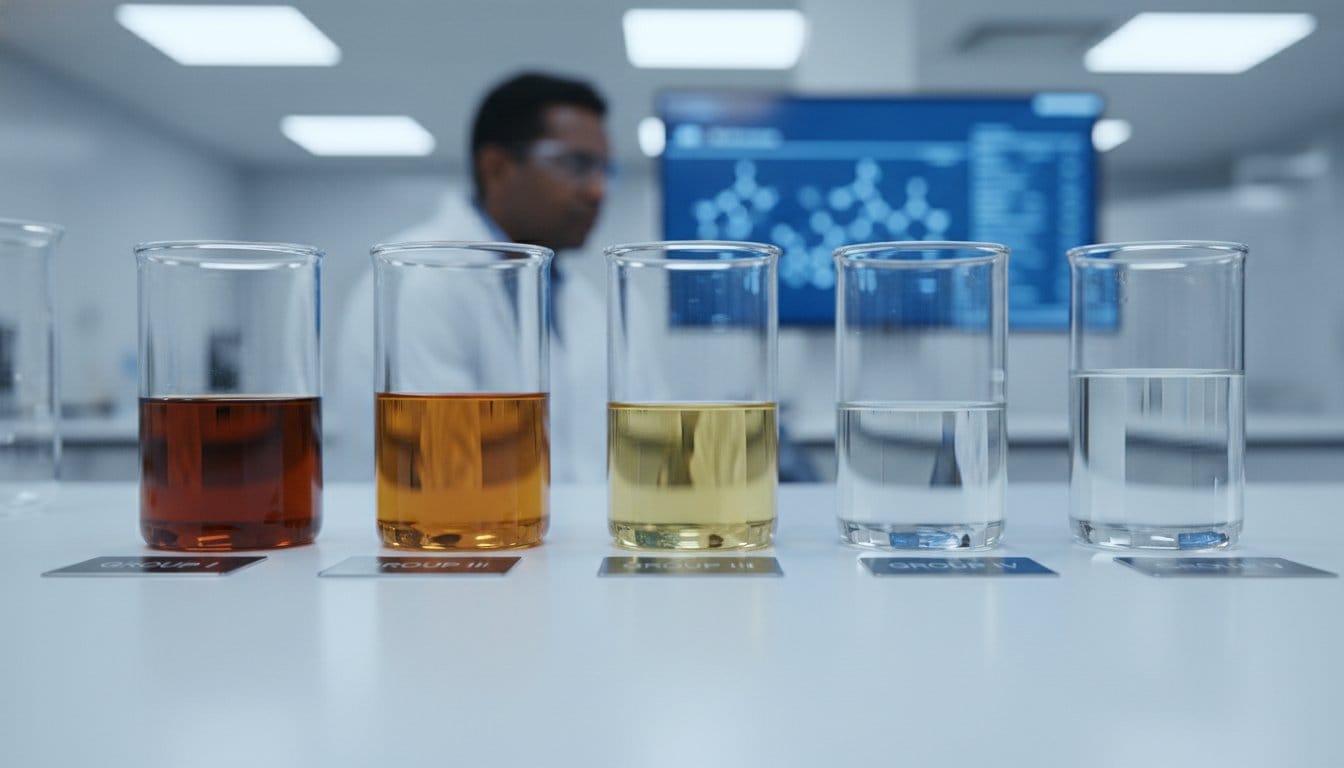
Your choice of base oil is the primary predictor of how your lubricant will age, oxidise, and respond to advanced filtration. Many reliability managers struggle with Understanding Lubricant Oil Groups: What’s the Difference? as marketing labels often obscure the chemical reality of API classifications. With the 2026 market seeing a structural oversupply of Group II oils and the American Petroleum Institute’s March 2026 approval of the PC-12 standard, choosing the right base stock is no longer just about meeting a spec; it’s about preventing varnish buildup in critical turbine systems.
It’s frustrating when unscheduled downtime occurs despite following standard maintenance protocols. We’ll provide a technical framework to help you master these classifications and optimize your asset reliability. This guide explains how oil groups impact your filtration needs and offers a logical path to reducing varnish-related failures through informed selection, oil analysis, and targeted varnish mitigation. You’ll gain the technical expertise needed to balance operational efficiency with the growing demand for sustainable, high-performance industrial solutions.
Key Takeaways
- Identify the technical metrics of sulphur content, saturates, and viscosity index to accurately differentiate between mineral and synthetic base stocks.
- Develop a clear framework for Understanding Lubricant Oil Groups: What’s the Difference? between traditional Group I oils and the modern hydrotreated Group II standard.
- Recognise the “Varnish Paradox” to understand why high-purity oils often necessitate more proactive varnish mitigation and regular oil analysis.
- Determine when to utilise specialised Group IV PAOs or Group V fluids to ensure reliability in extreme environments and critical EHC systems.
- Align your maintenance strategy with your fluid’s chemical profile, using methods like hot oil flushing to maintain long-term filtration efficiency.
What are API Base Oil Groups? Defining the Standard
The American Petroleum Institute (API) developed a rigorous classification system in the early 1990s to bring technical clarity to the lubricant market. Before this, terms like “mineral” or “synthetic” were used loosely, often as marketing buzzwords rather than scientific descriptors. Today, API Base Oil Groups provide a standardised framework that categorises base stocks based on their physical and chemical properties. This system is essential for Understanding Lubricant Oil Groups: What’s the Difference? between a basic lubricant and one engineered for high-performance industrial reliability.
To better understand these classifications, watch this helpful video:
The Three Pillars of Oil Chemistry
The API defines base oils using three specific metrics that dictate how the fluid will behave under thermal and mechanical stress. These pillars are the foundation of every industrial lubricant’s performance profile.
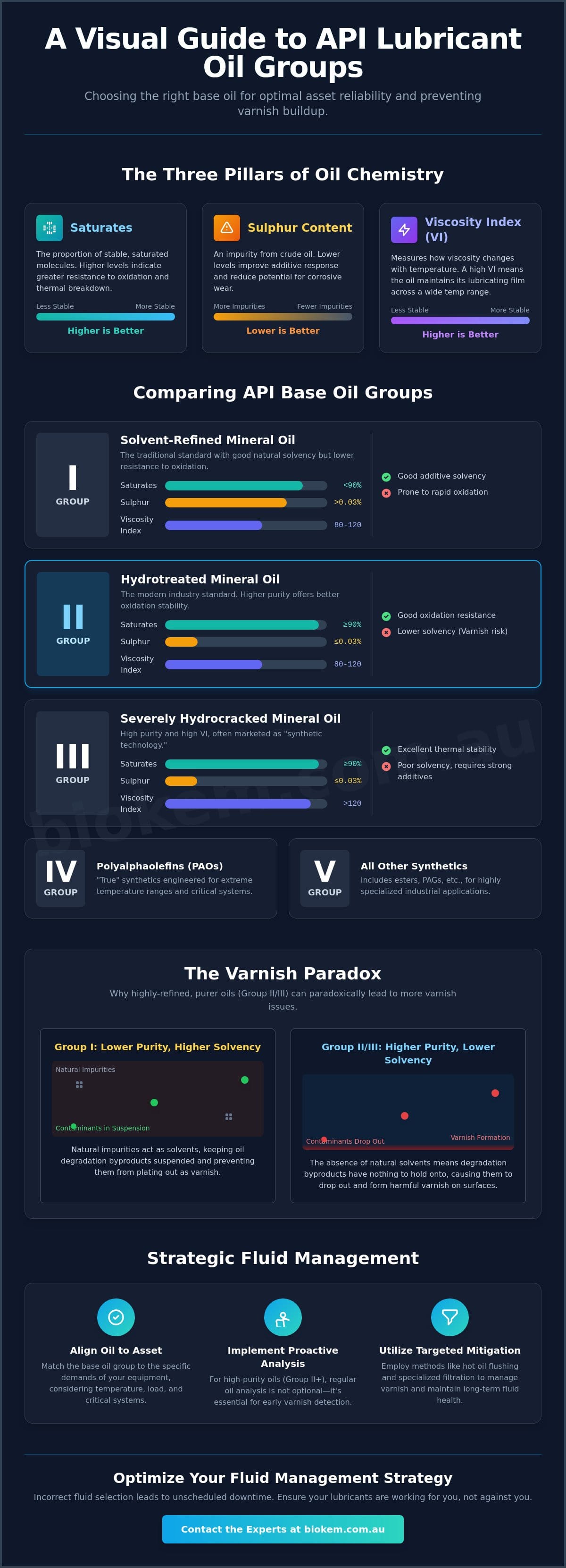
- Saturates: This refers to the proportion of saturated molecules in the oil. Higher saturate levels indicate a higher degree of molecular stability. Oils with high saturates are significantly more resistant to oxidation and thermal breakdown.
- Sulphur Content: While naturally occurring in crude oil, sulphur can negatively impact additive response and lead to corrosive wear if not properly managed during refining. Modern groups aim for lower sulphur levels to enhance the effectiveness of antioxidant and anti-wear additives.
- Viscosity Index (VI): This measures how much the oil’s viscosity changes with temperature. In the context of Australian temperature extremes, a high VI is critical. It ensures the oil maintains a sufficient lubricating film in the heat of the Pilbara while remaining fluid enough for cold starts.
Why Group Classification Matters for Reliability
Refining intensity directly correlates with oil purity. As we move from Group I to Group III, the refining process becomes more aggressive. This strips away impurities to create a more uniform molecular structure. However, this increased purity introduces a trade-off in additive solubility and seal swell. Highly refined oils often have lower natural solvency. This means they can’t hold contaminants or additives in suspension as easily as less refined oils. This technical nuance is why oil analysis and specialised filtration become more important as you move up the API groups.
Choosing the correct group impacts the useful life of your lubricant. A Group II oil might offer better oxidation resistance than Group I, but it requires a different approach to varnish management. Understanding Lubricant Oil Groups: What’s the Difference? allows reliability engineers to match the fluid to the specific mechanical demands of their assets. It ensures that filtration systems and maintenance schedules are aligned with the oil’s actual chemical reality rather than just the label on the drum.
Comparing Mineral Base Oils: Groups I, II, and III
Mineral based oils represent the vast majority of industrial lubricants. While they all originate from crude oil, the refining processes used to create them lead to distinct performance tiers. According to the American Petroleum Institute classifications, Groups I, II, and III are defined by their levels of saturates, sulphur, and their viscosity index. Understanding Lubricant Oil Groups: What’s the Difference? starts with recognising that “mineral oil” isn’t a single category but a spectrum of purity and chemical stability.
Group I vs. Group II: The Shift in Australian Industry
Group I oils are produced through solvent refining. This older technology leaves behind more impurities, specifically higher sulphur content and lower saturates. While these impurities provide good natural solvency, they make the oil prone to rapid oxidation in high heat environments. In Australia, we’ve seen a decisive shift toward Group II oils for high performance hydraulic systems. Group II fluids undergo hydrotreating, a process that uses hydrogen to remove impurities. This results in better thermal breakdown resistance, extending the time between oil changes. For large scale industrial reservoirs, Group II offers a balanced cost benefit ratio, providing reliable protection without the premium price of full synthetics.
Group III: The High Performance Mineral Option
Group III oils undergo severe hydrocracking. This process involves higher pressures and temperatures to restructure molecules, resulting in a viscosity index above 120. These oils are technically mineral based, yet their performance often matches traditional synthetics. In many regions, Group III oils are legally marketed as “synthetic” because the chemical structure has been significantly altered from its original state. They’re ideal for high temperature turbine and compressor systems where stability is paramount. However, this extreme purity creates a “solvency gap.” Because the oil is so clean, it has a limited capacity to hold degradation by-products in suspension. If you’re switching to Group III, regular oil analysis is vital to monitor for early signs of fluid stress.
The transition from Group I to Group II or III isn’t just an upgrade in quality. It’s a change in the chemical nature of the fluid. Higher purity means longer life but also a higher risk of varnish if the system isn’t managed correctly. Understanding Lubricant Oil Groups: What’s the Difference? helps operators anticipate these needs before they lead to valve sticking or cooler fouling. Matching the right mineral group to your specific operational environment is the first step in ensuring long term asset reliability.
Synthetic and Specialised Fluids: Groups IV and V
While Groups I through III are refined from crude oil, Groups IV and V represent a shift toward chemically engineered fluids. These base stocks are designed to provide performance levels that mineral oils cannot reach. Understanding Lubricant Oil Groups: What’s the Difference? becomes particularly important when dealing with high-value assets where the cost of failure far outweighs the premium price of synthetic lubricants. These fluids are often the only viable choice for extreme temperature ranges or fire-prone environments.
Group IV (PAO) Advantages
Group IV oils are comprised exclusively of Polyalphaolefins (PAO). These are manufactured through the polymerisation of alpha-olefin molecules, resulting in a highly uniform molecular structure. This consistency is a primary driver of their Manufacturing, Properties and Performance benefits. Because PAOs don’t contain the wax found in mineral oils, they possess exceptional low-pour points and superior thermal stability. They don’t thin out excessively at high temperatures or thicken in the cold, ensuring a consistent lubricating film.
Using PAOs reduces internal friction and heat generation within industrial gearboxes and bearings. This efficiency directly supports sustainability goals by lowering energy consumption and extending oil drain intervals. For critical assets, the initial investment in Group IV fluids is often offset by reduced maintenance frequency and lower long-term operational costs. They provide a robust defense against the oxidative stress that typically degrades mineral-based alternatives.
Group V and EHC Fluid Maintenance
Group V is a diverse “catch-all” category for any base stock not included in the first four groups. This includes esters, polyalkylene glycols (PAGs), and silicone oils. Within industrial power generation, Phosphate Esters are the most prominent Group V fluids due to their fire-resistant properties. These are essential for Electro-Hydraulic Control (EHC) systems where lubricants operate near high-temperature steam lines. Without these specialised fluids, the risk of catastrophic fires in power plants would be significantly higher.
However, Group V fluids come with unique challenges. Esters are hygroscopic, meaning they readily absorb moisture from the atmosphere. This leads to hydrolysis and a rapid increase in fluid acidity. Maintaining these systems requires specialised EHC fluid maintenance and precision filtration to manage acid levels and prevent servo-valve erosion. Regular monitoring is non-negotiable for these sensitive chemistries.
Switching from a mineral base to a synthetic one isn’t a simple swap. Compatibility risks are significant. Different base groups interact differently with seals and gaskets. For instance, while some esters cause seals to swell, certain PAOs can cause them to shrink if not balanced with other fluids. Operators must also consider the “solvency shock” when introducing high-solvency Group V fluids into older systems. They can dislodge existing deposits, leading to sudden filter plugging. Understanding Lubricant Oil Groups: What’s the Difference? ensures that these transitions are managed through rigorous oil analysis and system preparation.
How Oil Groups Impact Varnish and Oxidation
The transition to highly refined base stocks has introduced a technical challenge known as the “Varnish Paradox.” While modern Group II and Group III oils are chemically more stable than their Group I predecessors, they’re often more prone to deposit formation in critical systems. Understanding Lubricant Oil Groups: What’s the Difference? requires looking beyond simple oxidation resistance to the critical concept of solvency. A fluid’s ability to remain stable is useless if it cannot manage the microscopic by-products of its own inevitable degradation.
The Mechanics of Industrial Varnish
Solvency is the capacity of an oil to hold contaminants and degradation products in a liquid state. Group I oils, despite their higher sulphur and impurity levels, possess natural aromatic compounds that act as effective solvents. When these oils age, they tend to keep oxidation by-products in suspension. In contrast, the hydrotreating and hydrocracking processes used for Group II and III oils remove these aromatics to improve stability. This creates a “clean” but chemically “dry” fluid with very low natural solvency.
As these refined oils undergo thermal stress, soft contaminants quickly saturate the fluid. Once the saturation point is reached, these polar molecules precipitate out of the oil, plating out on cooler metal surfaces as a sticky, brown film. This varnish compromises hydraulic valves, restricts flow in heat exchangers, and insulates bearing surfaces, leading to localized overheating. Implementing a dedicated varnish mitigation strategy is more critical for modern hydrocracked oils because they lack the natural solvency to keep oxidation by-products in suspension.
Oxidation Resistance by Group
Oxidation is the primary chemical reaction responsible for oil aging. It’s typically measured using the Rotating Pressure Vessel Oxidation Test (RPVOT), which evaluates how long an oil can resist reacting with oxygen under pressure. Group II and III oils generally show significantly higher RPVOT results than Group I, meaning they last longer before the base chemistry breaks down. However, in the harsh Australian climate, temperature fluctuations accelerate the depletion of antioxidant additives. When these additives are exhausted, the base oil is left unprotected.
In high-temperature turbine operations, the rate of oxidation can double for every 10-degree Celsius increase in operating temperature. Because Group II and III oils fail “cleanly” without the warning signs of heavy sludge, the onset of varnish can be sudden and catastrophic. Reliability managers shouldn’t rely solely on standard viscosity tests to monitor fluid health. To prevent these chemical by-products from compromising your equipment, we recommend regular oil analysis to detect varnish precursors before they crystallise on your internal components.
Strategic Fluid Management: Matching Groups to Maintenance
Effective asset management requires moving beyond reactive repairs to a strategy rooted in fluid chemistry. Understanding Lubricant Oil Groups: What’s the Difference? is the first step in determining which maintenance interventions will yield the highest return on investment. High-purity oils, specifically Groups II, III, and IV, demand a more sophisticated approach to system cleanliness than traditional Group I fluids. Because these refined oils lack natural solvency, any residual debris or aged fluid left in the system can quickly trigger varnish formation. A proactive approach ensures that the chemical advantages of these advanced base stocks aren’t undermined by poor system hygiene.
Flushing and Purification Requirements
Performing a hot oil flushing procedure is essential when transitioning between oil groups or commissioning new systems. When you move from a Group I to a Group II or III oil, the new fluid’s lower solvency can cause it to struggle with existing system contaminants. High-velocity flushing removes these particles and ensures the system meets stringent ISO cleanliness codes before the final fill. For systems using moisture-sensitive Group V esters or high-purity PAOs, onsite vacuum dehydration is a vital tool. It removes dissolved water that contributes to acid formation and additive dropout, effectively extending the fluid’s operational life.
Maintaining these standards requires specialist oil filters engineered for specific flow rates and beta ratios. Standard filtration often fails to capture the microscopic soft contaminants that lead to varnish in hydrocracked oils. By utilizing high-efficiency glass media and precision filtration equipment, operators can maintain the molecular integrity of the base oil and prevent the “Varnish Paradox” from causing unscheduled downtime in critical turbine or hydraulic circuits.
BioKem’s Authoritative Approach to Oil Health
BioKem provides the technical expertise necessary to manage complex fluid life cycles across Australian industrial sectors. As the Australian distributor for Filters S.p.A. Products, we offer customised filtration solutions that align with the specific chemical demands of your chosen API base group. We don’t just provide equipment; we deliver onsite technical interventions designed to solve the root causes of oil degradation. Our specialists understand the nuances of Understanding Lubricant Oil Groups: What’s the Difference? and apply this knowledge to protect your high-value assets.
Precise oil analysis is the cornerstone of our service model. We monitor the health of your base oil by tracking antioxidant levels and detecting varnish precursors long before they impact machine performance. This scientific approach allows for targeted interventions, such as varnish mitigation or tank cleaning, which are far more cost-effective than premature fluid replacement. Contact BioKem today for a comprehensive fluid health audit to ensure your maintenance strategy is perfectly matched to your lubricant’s API classification.
Securing Long-Term Reliability Through Chemical Intelligence
Mastering the technical nuances of base stocks is a fundamental requirement for modern industrial operations. We’ve explored how API classifications dictate an oil’s oxidation resistance, thermal stability, and natural solvency. Understanding Lubricant Oil Groups: What’s the Difference? is the foundation for selecting the right fluid and the correct maintenance protocol. High-purity oils offer extended life but demand precision interventions to prevent deposit formation. Aligning your filtration hardware with your oil’s chemical profile is the only way to ensure sustainable asset health.
BioKem provides the specialized knowledge and equipment needed to bridge the gap between oil chemistry and mechanical performance. As the exclusive Australian distributor for Filters S.p.A., we deliver onsite technical services for critical turbine and hydraulic assets. Our expertise in varnish mitigation and vacuum dehydration ensures your high-purity fluids perform as intended without compromising system components. Consult with BioKem’s technical experts to optimise your lubrication strategy and protect your equipment from the risks of fluid degradation. It’s time to transform your maintenance program into a proactive engine for reliability.
Frequently Asked Questions
What is the main difference between Group II and Group III base oils?
The primary distinction between Group II and Group III base oils is the Viscosity Index (VI) and the intensity of the refining process. Group II oils have a VI between 80 and 120, while Group III oils must have a VI greater than 120. Group III fluids undergo more severe hydrocracking to achieve higher molecular uniformity, which allows them to be marketed as synthetic fluids in many global markets.
Are Group IV PAO oils always better than Group II mineral oils?
Group IV Polyalphaolefins (PAO) aren’t always superior to Group II mineral oils for every application. While PAOs offer exceptional performance in extreme temperature ranges and high-stress environments, Group II oils provide a more cost-effective solution for stable industrial systems. Choosing between them requires Understanding Lubricant Oil Groups: What’s the Difference? in terms of solvency and seal compatibility for your specific asset.
Why do Group III oils often cause more varnish than Group I?
Group III oils often lead to more varnish than Group I because they lack natural solvency. The aggressive hydrocracking process removes the aromatic compounds that naturally keep oxidation by-products in suspension. When Group III oils degrade, the microscopic contaminants reach saturation quickly and precipitate out as sticky deposits on valves and coolers, necessitating proactive varnish mitigation to maintain system reliability.
Can I mix different base oil groups in my hydraulic system?
Mixing different base oil groups in a hydraulic system is generally discouraged without prior compatibility testing. Different groups interact differently with seal materials and additive packages, which can lead to precipitate formation or seal failure. If you’re transitioning between groups, a professional system audit and potential hot oil flushing are necessary to ensure the new fluid remains stable and effective within the circuit.
Which base oil group is best for high-temperature turbine applications?
Group III and Group IV (PAO) oils are typically the best choices for high-temperature turbine applications. These fluids provide the thermal stability and oxidation resistance required to handle high-speed bearings and intense thermal cycling. However, because these groups are prone to varnish due to low solvency, they must be supported by precision oil analysis and dedicated filtration systems to maintain long-term asset health.
How does the base oil group affect the frequency of hot oil flushing?
The base oil group significantly influences the necessity of hot oil flushing during fluid changes or system commissioning. High-purity oils like Group II, III, and IV are less tolerant of residual contaminants than Group I fluids. Transitioning to these refined groups requires a thorough flush to remove existing deposits, as the new fluid’s low solvency can cause it to struggle with even minor levels of system debris.
What are Group V lubricants used for in industrial settings?
Group V lubricants serve specialized industrial roles, most notably as fire-resistant fluids in Electro-Hydraulic Control (EHC) systems. This category includes esters, polyalkylene glycols (PAGs), and silicone oils used where mineral oils pose a fire risk or lack sufficient performance. Because these fluids are often hygroscopic or chemically aggressive, they require specialized EHC fluid maintenance and moisture control via vacuum dehydration to prevent acid buildup.
Does BioKem provide analysis for all API base oil groups?
BioKem provides comprehensive oil analysis for all API base oil groups used in Australian industrial sectors. Our laboratory services track the specific degradation markers associated with each group, from additive depletion in Group II to acid buildup in Group V esters. This data is essential for Understanding Lubricant Oil Groups: What’s the Difference? in your own machinery and allows us to recommend targeted interventions like varnish mitigation.