

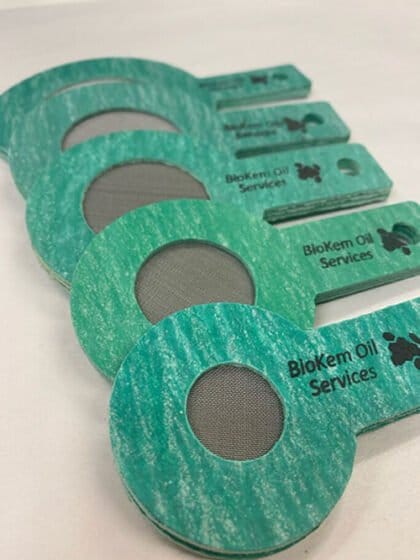
A single millimetre of welding slag or a stray metal shaving can instantly turn a multi-million dollar turbine bearing into scrap metal during its first 60 seconds of operation. You already know that even after rigorous high-velocity oil flushing, “rogue” debris often hides in dead legs or bypasses primary filters during the high-pressure environment of startup. It’s a high-stakes moment where your reputation and the asset’s longevity are on the line. This inherent risk is exactly why BioKem’s range of 100# paddle screens should be an essential product for all lube oil system maintenance and commissioning of rotating assets across Australia’s industrial landscape.
Industry data indicates that up to 70% of premature bearing failures result from contamination introduced during maintenance or initial commissioning. We’ll show you how 100# paddle screens serve as the critical final line of defense for protecting your expensive rotating assets during these high-risk phases. You’ll discover how to validate that your system is truly clean, achieve ISO 4406 targets faster, and provide the physical proof stakeholders demand before signing off on full-load operations. This guide explores the technical necessity of these screens in ensuring long-term operational reliability and environmental compliance.
Key Takeaways
- Learn why 100# paddle screens serve as the critical final line of defense for turbines and compressors during high-risk commissioning and post-overhaul startup phases.
- Understand the technical necessity of the 149-micron mesh standard and how it aligns with critical bearing clearances to prevent catastrophic asset failure.
- Discover why BioKem’s range of 100# paddle screens should be an essential product for all lube oil system maintenance and commissioning of rotating assets to ensure operational reliability.
- Identify the distinct roles of primary filtration versus paddle screens to ensure your maintenance strategy provides both oil polishing and hardware protection.
- Master the best practices for installation and inspection intervals during hot oil flushing to maintain compliance with Australian industrial standards and performance requirements.
Understanding the Role of 100# Paddle Screens in Rotating Asset Reliability
In the precision-driven world of Australian heavy industry, the integrity of a lubricant system determines the longevity of multi-million dollar assets. Paddle screens, frequently referred to as ‘last chance’ or ‘flushing’ screens, are temporary filtration devices installed within piping flanges during critical operational windows. These screens serve as a final mechanical barrier between the oil supply and sensitive internal components. Why BioKem’s range of 100# paddle screens should be an essential product for all lube oil system maintenance and commissioning of rotating assets is rooted in the reality that primary filtration often fails to capture large, rogue debris during the initial minutes of operation.
Primary filters are designed for steady-state removal of microscopic contaminants, typically in the 3 to 10-micron range. However, they aren’t positioned to catch the larger, destructive materials that reside in the pipework downstream of the main filter house. BioKem’s 100# mesh screens provide a specific aperture of approximately 140 microns, offering a robust validation tool for maintenance teams. This ensures that the fluid entering the bearing housing meets the required cleanliness standards before the temporary screens are removed for full-scale production.
The ‘Last Chance’ Concept: Preventing Catastrophic Startup Failure
During construction or major overhauls, contaminants like welding slag, metal shavings, and blasting grit often hide in dead-legs or complex pipe geometries. Even a rigorous chemical cleaning or high-velocity oil flush may not dislodge every piece of debris. This leads to ‘maintenance-induced contamination,’ where the very act of reassembling the system introduces new threats like gasket remnants or rag fibres. A paddle screen acts as a physical barrier at the bearing inlet to intercept these large particles before they can embed in soft white metal bearings or score precision shafts. It’s the final line of defence that prevents a routine startup from turning into a catastrophic mechanical failure.
Identifying Critical Assets That Require Paddle Screen Protection
High-speed rotating equipment operates with incredibly tight clearances, sometimes less than 50 microns. This makes them highly susceptible to damage from particles that a 100# screen is designed to catch. Engineers should mandate the use of paddle flushing screens for the following machinery:
- Steam and gas turbines used in power generation.
- Centrifugal compressors in oil and gas processing.
- Large-scale gearbox systems in mining and mineral processing.
- High-pressure boiler feed pumps.
The financial implications of a ‘dirty’ startup are severe. In the Australian mining sector, an unscheduled outage on a critical compressor can cost upwards of A$150,000 per day in lost production. This doesn’t include the A$200,000 or more required for emergency bearing replacements and shaft machining. Implementing Why BioKem’s range of 100# paddle screens should be an essential product for all lube oil system maintenance and commissioning of rotating assets is a cost-effective insurance policy against these preventable expenses.
Why 100 Mesh is the Industry Standard for Commissioning and Maintenance
The “100#” designation refers to a specific weave density where 100 stainless steel wires are aligned per linear inch. This configuration creates a uniform aperture size of exactly 149 microns. During the critical commissioning phase of Australian industrial assets, this measurement serves as a vital safeguard. Industry experts rely on ASTM D6439-23 to guide the cleaning of turbine lubrication systems, which highlights the necessity of removing particulate matter before it reaches sensitive components. Understanding why BioKem’s range of 100# paddle screens should be an essential product for all lube oil system maintenance and commissioning of rotating assets starts with the physics of the oil film itself.
The Science of Particle Size and Bearing Clearances
Precision bearings in large rotating assets operate on a microscopic wedge of oil. While a human hair is roughly 70 microns thick, the actual oil film thickness in a high-speed bearing typically ranges between 1 and 10 microns. Particles larger than this gap cause immediate surface scoring, leading to premature fatigue and mechanical failure. A 100# mesh (149μm) acts as the primary defense against “system boulders” like weld slag, scale, and metal shavings often left behind during construction. Using this specific mesh size ensures that the largest, most destructive contaminants are captured before they can enter the narrow clearances of the bearing housing. It’s the technical sweet spot that protects the asset while allowing the high-velocity oil flow required for an effective flush.
Pressure Drop and Flow Dynamics: Avoiding Asset Starvation
Maintaining high flow rates is essential to suspend and transport debris out of the system. If a technician chooses a mesh that’s too fine, such as a 200# screen, they risk creating a significant differential pressure (ΔP) spike. Excessive ΔP leads to pump cavitation and potential oil starvation, which can damage the very equipment you’re trying to protect. BioKem’s paddle screen design prioritizes a balance between effective filtration and hydraulic efficiency.
- Maximized Surface Area: The paddle geometry increases the available flow area compared to standard circular inserts, reducing the risk of premature clogging.
- Cavitation Prevention: Maintaining a low ΔP ensures the pump operates within its designed curve, preventing air bubbles from forming in the oil stream.
- Debris Monitoring: Technicians can monitor the pressure across BioKem paddle flushing screens to determine exactly when the system is reaching a clean state.
This approach ensures that Why BioKem’s range of 100# paddle screens should be an essential product for all lube oil system maintenance and commissioning of rotating assets remains a standard recommendation for site engineers across Australia. Reliability depends on this balance of protection and performance.
Paddle Screens vs. Primary Filtration: Why Both are Critical
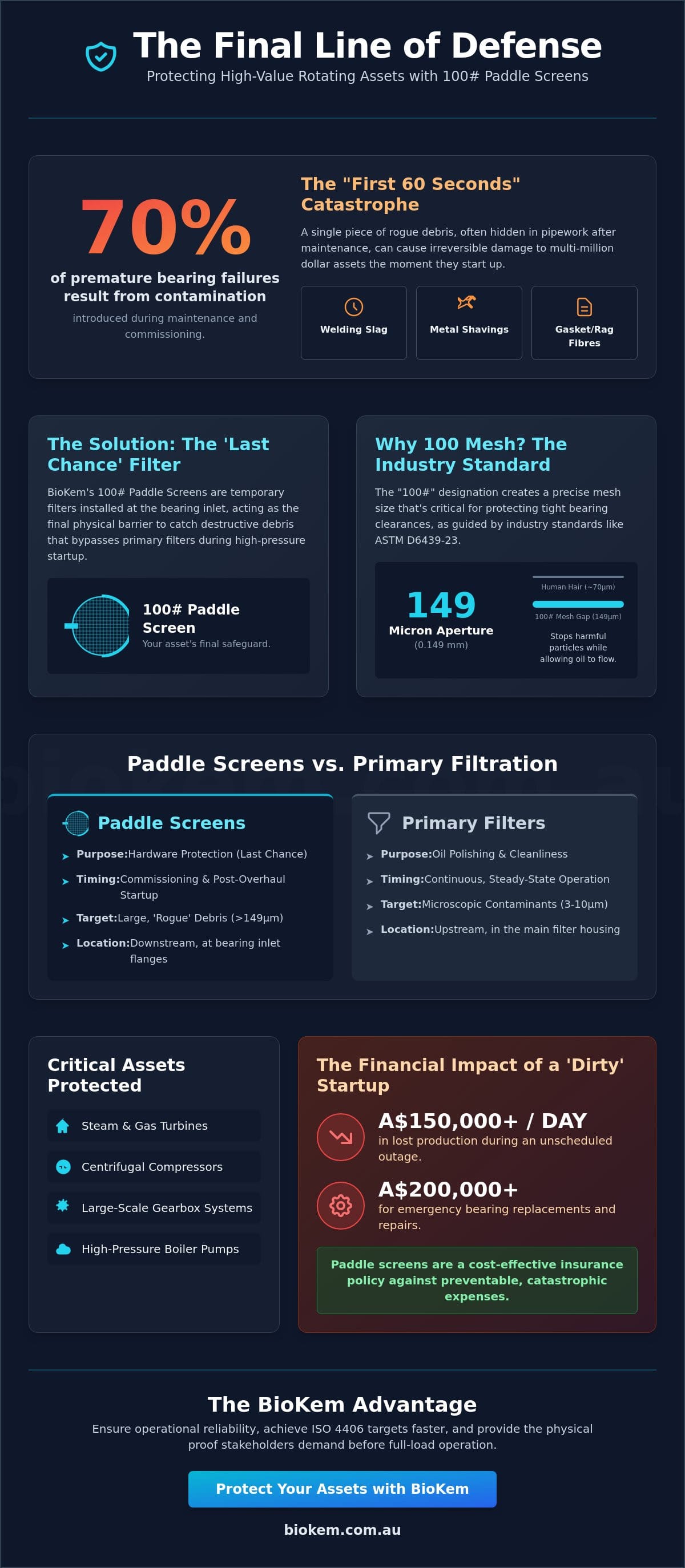
High-efficiency primary oil filters and 100# paddle screens serve different, yet equally vital, functions within a lubrication system. It’s a mistake to view them as interchangeable. Primary filters are precision instruments designed for the continuous ‘polishing’ of oil. They target microscopic particles to achieve specific ISO 4406 cleanliness codes. While these filters are excellent at maintaining long-term oil health, they aren’t built to handle the heavy debris often found during commissioning or after major repairs.
Paddle screens provide the ‘protection’ layer. They’re designed to catch ‘the killers’—large contaminants like weld slag, rust scales, and metal shavings that can cause catastrophic failure in seconds. This synergy is why BioKem’s range of 100# paddle screens should be an essential product for all lube oil system maintenance and commissioning of rotating assets. By placing these screens downstream of the primary filters and immediately upstream of the asset, you create a final line of defence that ensures no large debris reaches critical bearings or seals.
- Primary Filters: Manage the ISO 4406 silt load (3-25 micron range).
- Paddle Screens: Capture large-scale manufacturing and maintenance debris (140-150 micron range).
- Strategic Placement: Always install screens at the point of entry to the rotating equipment.
The Validation Factor: Proving System Cleanliness
In the Australian industrial sector, stakeholders and insurance providers often require empirical evidence before a turbine or compressor is cleared for full-speed operation. A clean paddle screen pull provides the visual proof that a hot oil flushing procedure was successful. Following lube oil flushing best practices ensures that the system meets the rigorous standards required for long-term reliability. This validation step is a cornerstone of effective oil contamination control, bridging the gap between technical data and physical certainty.
Capturing What Filters Miss: The Bypass Risk
Primary filters are susceptible to bypass events. During cold starts or conditions where oil viscosity is high, the pressure differential across a primary filter can trigger a bypass valve. When this happens, unfiltered oil flows directly to your assets. A paddle screen from the BioKem Products range acts as a non-bypassable safety net. It doesn’t have a relief valve; it simply stops the large particles that would otherwise bypass the main filtration system during these high-risk periods. It’s a simple, mechanical insurance policy against human error and mechanical bypass.
Best Practices for Using Paddle Screens During Hot Oil Flushing and Startup
Correct installation of paddle screens is a non-negotiable step in the commissioning process for any rotating asset. These screens are typically inserted between flanges at the point where the lube oil supply line enters a bearing housing or high-value component. Why BioKem’s range of 100# paddle screens should be an essential product for all lube oil system maintenance and commissioning of rotating assets is evident during the high-velocity flush; they provide the only physical proof that the internal pipework is free of construction debris like slag or scale before the system goes live.
Inspection intervals must be rigorous to prevent the screen itself from becoming a flow restriction. Technicians should perform an initial pull after the first 4 hours of circulation at operating temperature. If the screen is heavily fouled, the 4-hour interval remains until the debris load lightens. Once the system stabilises, the window can extend to 8 or 12 hours. The acceptance criteria for a ‘clean’ system in most Australian industrial sectors require zero particles visible to the naked eye after a 2-hour run at full flow. For precision assets, the target is often no particles larger than 100 microns, matching the mesh size of the screen.
As the flush concludes, these temporary screens often transition into ‘last chance’ screens. While the primary filtration system handles the bulk of the work, keeping a 100# screen in place during the initial 48 hours of full-load operation provides an extra layer of security. This ensures any final, stubborn contaminants dislodged by operational vibrations are captured before they reach critical bearing surfaces.
Step-by-Step Inspection and Cleaning Protocol
To maintain system integrity, follow a strict removal sequence. Isolate the circuit and depressurise the line to avoid safety hazards or oil spills. Place the removed screen in a clean, lint-free tray for inspection. Use patch test kits to perform a microscopic analysis of any captured solids. Documenting every pull allows your team to map the cleaning progress and verify when the system reaches a stable, low-contamination state.
Integrating Screens into a Proactive Maintenance Strategy
Paddle screens are invaluable during planned outages where pipework has been opened. Analysing debris trapped during post-shutdown circulation helps maintenance teams identify early signs of internal component wear or pump cavitation. This insight is a cornerstone of effective hot oil flushing and filtering programs. Why BioKem’s range of 100# paddle screens should be an essential product for all lube oil system maintenance and commissioning of rotating assets is ultimately about risk mitigation; it’s the final guard against catastrophic failure.
The BioKem Advantage: High-Performance Paddle Screens for Australian Industry
BioKem engineers its 100# paddle screens to withstand the rigorous conditions found in Australian mining, power generation, and oil and gas sectors. We manufacture these screens using high-grade 316L stainless steel. This choice of material ensures maximum corrosion resistance against harsh lubricants and environmental factors. Because every facility operates with unique infrastructure, we provide custom configurations to meet specific ANSI, DIN, or JIS flange standards. This versatility explains why BioKem’s range of 100# paddle screens should be an essential product for all lube oil system maintenance and commissioning of rotating assets. Our team provides localized technical support across Australia, ensuring that your site shutdowns proceed without technical delays or equipment failure.
Precision Engineering for High-Pressure Systems
Standard screens often fail under the intense flow rates required for hot oil flushing. BioKem screens feature reinforced structural backing to prevent mesh collapse or bypass during high-velocity cleaning. The distinct paddle handle design extends well beyond the flange insulation. This allows technicians to quickly identify the screen’s location and verify its removal after the flushing stage. These components integrate seamlessly with high-end filtration systems, including those from Filters S.p.A., maintaining the integrity of the entire lubrication circuit. You won’t have to worry about debris bypassing a compromised mesh during critical high-pressure cycles.
National Expertise and Equipment Support
BioKem operates as a full-service partner rather than just a parts supplier. We understand that effective maintenance requires a combination of high-quality consumables and specialized machinery. Our clients benefit from the synergy between our technical field expertise and our specialized paddle flushing screens. By providing both the hardware and the onsite technical service, we ensure total system compatibility. This holistic approach reduces the risk of component failure during critical startups. It also reinforces why BioKem’s range of 100# paddle screens should be an essential product for all lube oil system maintenance and commissioning of rotating assets in Australia. We’ve supported major projects across the Pilbara and the Hunter Valley, proving our capability in the most demanding environments.
Effective contamination control is the foundation of asset longevity. We’ve seen that utilizing the right screen during the initial commissioning phase can extend bearing life by over 40 percent. Don’t leave your rotating assets to chance with inferior mesh products. Contact BioKem today to specify our precision-engineered paddle screens for your next major maintenance event or scheduled turnaround.
Protecting Industrial Longevity Through Precision Commissioning
Maintaining the integrity of rotating assets requires more than just standard filtration. It demands a rigorous approach to hot oil flushing where 149-micron precision captures harmful particulates before they reach critical bearings. Since 2011, BioKem has provided Australian industry with technical expertise and custom-engineered 316L stainless steel solutions that meet strict operational standards like API 614. As the authorized distributor for Filters S.p.A., we deliver high-performance hardware designed for the most demanding environments. It’s clear why BioKem’s range of 100# paddle screens should be an essential product for all lube oil system maintenance and commissioning of rotating assets across the country. These screens don’t just protect your machinery; they ensure your startup process complies with global reliability benchmarks. By integrating these robust tools into your maintenance schedule, you’re investing in the long-term health of your plant and reducing the risk of catastrophic failure. Let’s work together to safeguard your infrastructure with localized support and world-class engineering.
Request a quote for BioKem’s 100# Paddle Flushing Screens today and ensure your next commissioning project is a success.
Frequently Asked Questions
What exactly does the ‘100#’ in 100# paddle screen mean?
The ‘100#’ designation indicates that the screen contains 100 openings per linear inch, which equals 10,000 openings per square inch. This specific mesh density provides a filtration aperture of approximately 149 microns. It’s the industry standard for verifying that internal pipework is free from damaging particulates before you engage high-speed rotating equipment.
How long should a paddle screen stay in the system during commissioning?
You should keep the paddle screen in the system until you achieve a debris-free reading over a 4-hour inspection window at full operating flow. This verification process typically spans 24 to 72 hours depending on the total pipe length and system complexity. If the screen remains 100% clean for two consecutive inspections, it’s safe to remove the screen and finalize the bearing connections.
Can 100# paddle screens be cleaned and reused, or are they single-use?
BioKem’s 100# paddle screens are designed for single-use to ensure the highest level of system hygiene and mechanical integrity. While the stainless steel frames are robust, the fine 149-micron mesh can suffer microscopic deformation or fatigue during high-velocity flushing. Using a fresh screen for every inspection cycle eliminates the risk of cross-contamination and ensures the mesh meets Australian engineering standards for every test.
Where is the optimal location to install a paddle screen in a lube oil circuit?
The optimal location for installation is at the flanged connection point directly upstream of the bearing housing or the most sensitive rotating component. Why BioKem’s range of 100# paddle screens should be an essential product for all lube oil system maintenance and commissioning of rotating assets is clear when you consider they catch debris that bypasses primary filters. This placement protects assets valued at over A$500,000 from catastrophic surface scoring.
What is the difference between a flushing screen and a last chance screen?
A flushing screen is a temporary diagnostic tool used during the commissioning phase, whereas a last chance screen is a permanent safety feature. Flushing screens use a 100-mesh count to capture 149-micron particles during the initial 48-hour cleaning cycle. Last chance screens are typically smaller, integrated into the machine’s inlet, and designed to provide a final fail-safe during years of standard operation rather than a temporary high-volume flush.
Will a 100# paddle screen cause a significant pressure drop in my system?
A clean 100# screen usually generates a minimal pressure drop of 15 to 20 kPa in most Australian industrial lube systems. You’ll see this number climb quickly if the system contains heavy construction debris or oxidation products. If the differential pressure exceeds 70 kPa, it’s a clear signal that the screen is saturated and needs immediate replacement to prevent oil starvation or pump cavitation.
What type of debris is most commonly found on paddle screens during startup?
Technicians typically find welding slag, metal shavings, and silica sand particles larger than 150 microns during the first 12 hours of a system startup. These contaminants often originate from the 300+ metres of internal piping used in large industrial assets. Why BioKem’s range of 100# paddle screens should be an essential product for all lube oil system maintenance and commissioning of rotating assets is evidenced by their ability to trap these abrasive solids before they reach the white metal bearings.