

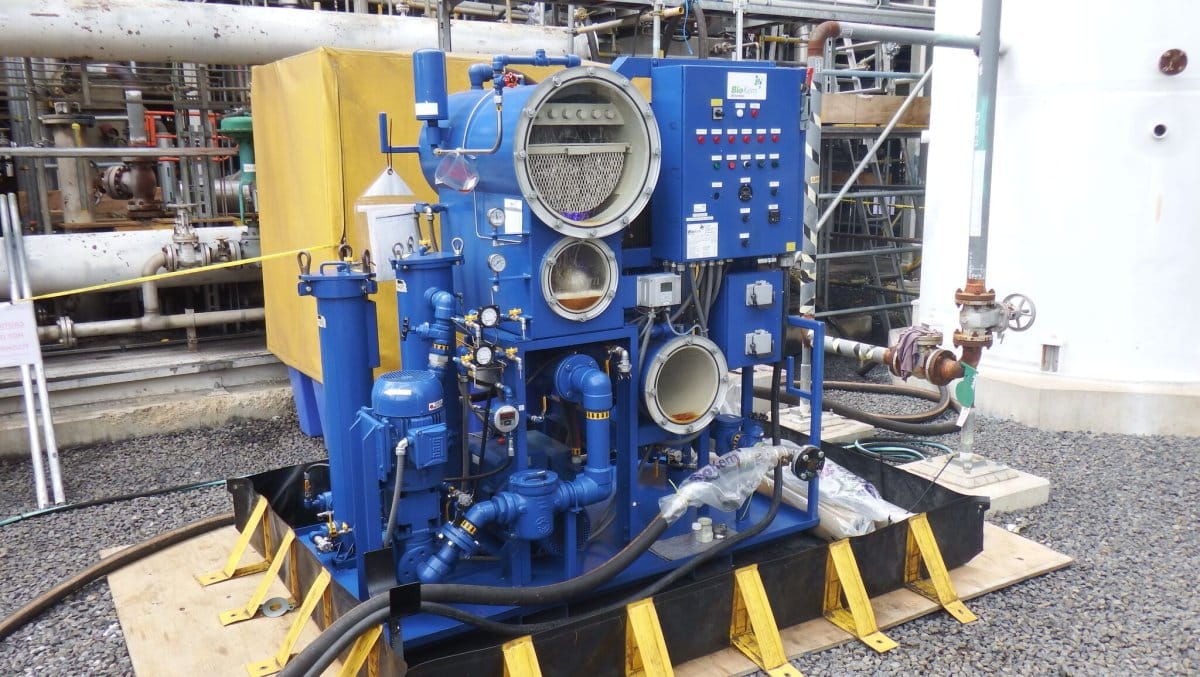
Industrial maintenance data from 2024 indicates that 75% of hydraulic and lubrication system failures are caused by fluid contamination, with water serving as the primary driver for component corrosion. You’re likely familiar with the stress of unscheduled downtime and the rising costs of oil disposal when you can’t meet ISO 4406 cleanliness standards. It’s a difficult balance to maintain operational efficiency while pursuing sustainable practices. This guide reveals how a vacuum dehydration unit rental allows you to eliminate 100% of free and 90% of dissolved water from your industrial oils. By opting for a rental, you can restore dielectric strength and extend asset life without the environmental footprint of frequent oil changes. We’ll explore the technical mechanisms of vacuum purification, the financial benefits for Australian enterprises, and the steps to ensure your purification process aligns with local regulatory requirements for 2026.
Key Takeaways
- Discover how to safeguard industrial reliability by eliminating 100% of free and 90% of dissolved water, preventing the hidden damage caused by moisture saturation.
- Understand the technical mechanism of mass transfer, which evaporates water at low temperatures to protect oil molecules from thermal degradation and oxidation.
- Evaluate the financial advantages of a vacuum dehydration unit rental over capital purchase, effectively shifting costs to OpEx while eliminating storage and calibration overheads.
- Learn to apply the ‘two-pass’ rule and ingress calculations to select a unit with the specific flow rate and removal capacity required for your Australian site operations.
- Implement a data-driven purification strategy using pre-rental oil analysis and efficient kidney-loop setups to ensure long-term equipment health and environmental compliance.
Why Vacuum Dehydration is Essential for Industrial Oil Reliability
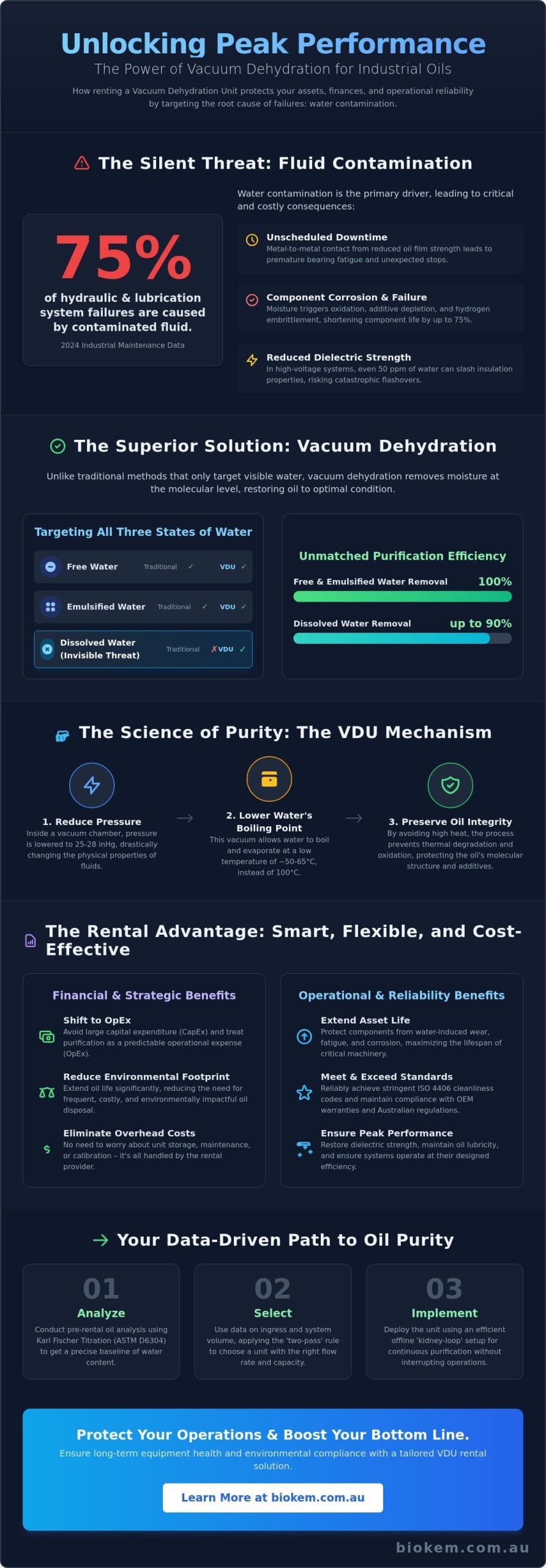
Vacuum dehydration serves as a critical process for maintaining industrial oil integrity by removing water at temperatures significantly lower than the atmospheric boiling point. By reducing the internal pressure within a vacuum chamber, water evaporates at approximately 50°C to 65°C. This prevents the thermal oxidation that occurs when heating oil to 100°C. While mechanical Methods of oil purification like centrifuging or simple filtration effectively manage free water, they can’t address moisture at a molecular level. Opting for a vacuum dehydration unit rental allows operators to target all three states of water: free, emulsified, and the invisible threat of dissolved water.
Water exists in oil in three distinct phases. Free water is non-soluble and usually settles at the bottom of reservoirs. Emulsified water is chemically bonded, creating a cloudy or “milky” appearance that’s difficult to separate. Dissolved water is the most deceptive, as the oil often appears clear despite being saturated. Traditional filters fail to reach the dissolved water threshold, leaving assets vulnerable to oxidation and additive depletion. This chemical breakdown shortens the oil’s service life and forces expensive, premature fluid replacements.
To better understand the mechanics of this technology, watch this helpful video demonstrating the process:
The Cost of Water Contamination in Critical Assets
Water contamination is a primary driver of mechanical failure in Australian mining and power generation sectors. It reduces the load-carrying capacity of the oil film, which leads to metal-to-metal contact and premature bearing fatigue. In high-voltage environments, even 50 parts per million (ppm) of water can slash the dielectric strength of transformer oils, risking catastrophic flashovers. Dissolved water is the moisture held within the oil’s molecular structure. Left unchecked, this moisture triggers hydrogen embrittlement and rapid additive depletion, often shortening component life by up to 75% in high-load applications.
Meeting ISO 4406 and ASTM Standards
Achieving stringent ISO 4406 cleanliness codes is impossible without addressing water first. Excessive moisture acts as a catalyst for particulate generation through internal corrosion. We rely on ASTM D6304, known as Karl Fischer Titration, as the gold standard for measuring precise water content in milligrams per kilogram. This level of accuracy is vital for maintaining compliance with Australian regulatory frameworks and OEM warranties. For a deeper look at managing these variables, consult Oil Contamination Control: The Definitive Guide. Integrating a vacuum dehydration unit rental into your maintenance schedule ensures your assets remain within peak operational specifications without the capital expenditure of a permanent installation.
The Mechanism of Vacuum Dehydration: Removing Dissolved Water
Vacuum dehydration is a precise thermodynamic process designed to extract water from oil at the molecular level. Unlike centrifugal or coalescing methods that primarily target free and emulsified water, this technology addresses dissolved moisture that has integrated into the oil’s chemical structure. Inside the vacuum chamber, the physical properties of the fluid change. By reducing the internal pressure to between 25 and 28 inHg, the boiling point of water drops significantly. This allows moisture to evaporate at approximately 50°C, which is well below the threshold for thermal degradation of most industrial lubricants. Utilizing a vacuum dehydration unit rental provides the necessary infrastructure to execute this without the capital expenditure of a permanent installation.
The process relies heavily on the principle of mass transfer. To maximize efficiency, the oil is distributed over specialized internal dispersal elements to increase its surface area. This thin-film exposure ensures that dissolved water is efficiently vaporized and pulled from the oil. Proper Moisture Management is vital for asset reliability; industry benchmarks for power transformers often require moisture levels below 10 ppm to prevent catastrophic dielectric failure. Beyond water removal, these units offer the secondary benefit of extracting entrained air and combustible gases. This helps prevent pump cavitation and ensures a more responsive hydraulic system.
The Role of Vacuum Levels and Temperature Control
Maintaining a specific vacuum level, typically between 25 and 28 inHg, is critical for operational efficiency. If the vacuum is too low, moisture remains trapped; if it’s too high, there’s a risk of pulling off light-end additives from the oil. Precise temperature regulation is equally important. Heating the oil to a range of 50-60°C reduces viscosity for better flow through the dispersal elements. However, internal sensors must prevent temperatures from exceeding 70°C to protect sensitive synthetic esters from oxidation. Modern systems often integrate high-efficiency particulate filters to achieve an ISO 4406 cleanliness code of 14/12/9 or better during the same cycle.
Compatibility with Different Fluid Types
Vacuum dehydration is a versatile solution for Australian industrial applications. It’s effective for mineral oils, polyalphaolefins (PAOs), and phosphate esters used in electro-hydraulic control systems. Handling high-viscosity gear oils, such as ISO VG 460, requires careful calibration of flow rates to ensure adequate dwell time in the vacuum chamber. Conversely, low-viscosity turbine oils can be processed at higher speeds. This versatility is essential for EHC Fluid Maintenance in power generation where fluid stability is paramount. If your facility is managing complex contamination issues, a vacuum dehydration unit rental paired with professional monitoring can restore fluid health to original specifications.
Financial and Operational Benefits of Vacuum Dehydration Unit Rental
Choosing a vacuum dehydration unit rental over a permanent purchase shifts the financial burden from a heavy capital expenditure (CAPEX) to a manageable operational expense (OPEX). For many Australian industrial facilities, a high-quality purifier represents an investment exceeding A$120,000. By opting for a rental model, companies preserve their credit lines and cash reserves for core business expansions while gaining immediate access to critical oil purification technology. This flexibility is vital in a fluctuating economy where liquidity remains a priority for plant managers and CFOs alike.
Ownership carries several hidden costs that frequently exceed the initial sticker price. Maintaining a fleet of filtration equipment requires dedicated storage space, routine mechanical servicing, and annual sensor calibrations which can cost upwards of A$4,500 per unit. When a machine sits idle during periods of low contamination, it continues to depreciate and consume overhead. A rental agreement eliminates these burdens. The rental provider handles all logistical storage and technical upkeep, ensuring the equipment arrives on-site in peak condition and ready for immediate deployment.
The pace of industrial innovation means that equipment purchased today may be obsolete within five years. Modern units now feature advanced PLC integration and remote monitoring capabilities that weren’t standard in 2021. Rental allows facilities to leverage the latest technology without the risk of being stuck with aging assets. It also provides a solution for “on-demand” purification. During peak contamination seasons, such as the high-humidity summer months in Queensland or the wet winters in Victoria, water ingress in reservoirs often spikes. Rental units provide the necessary surge capacity to handle these seasonal threats without requiring a permanent fleet expansion.
ROI Analysis: Rental vs. Oil Replacement
The financial logic of oil reclamation is clear when comparing the cost of a 7-day vacuum dehydration unit rental against the price of new fluids. Premium turbine oil in Australia currently averages between A$6.00 and A$9.00 per litre. Replacing a 5,000-litre reservoir can cost a facility over A$40,000 in product alone, excluding the rising costs of waste oil disposal and environmental compliance fees. Purifying the existing oil back to NAS 16/13/10 cleanliness standards typically costs less than 20% of the replacement price. Additionally, performing purification online prevents the massive “cost of downtime” associated with draining and refilling complex systems, which can reach A$15,000 per hour in high-output sectors.
Scalability for Large-Scale Industrial Projects
Large-scale plant shutdowns or the commissioning of new hydraulic circuits require a massive throughput of clean oil in a very short window. Rental fleets provide the scalability needed to deploy multiple units simultaneously, a feat rarely possible with owned equipment. These “plug-and-play” skids are designed for rapid integration into existing infrastructure, requiring minimal site modification and allowing for a seamless transition into the maintenance schedule. For a deeper look at selecting the right capacity for your project, refer to the Industrial Oil Filtration Equipment Hire Guide. This approach ensures that even the most demanding projects remain on schedule while upholding strict environmental and operational standards.
Selection Criteria: Choosing the Right Rental Unit for Your Application
Selecting a vacuum dehydration unit rental requires a technical match between the machine’s capabilities and your specific oil chemistry. You shouldn’t simply pick the largest unit available. Instead, sizing must align with your reservoir’s total volume and the severity of the water ingress. Engineers typically apply the “two-pass rule” for effective moisture management. This standard dictates that the rental unit’s flow rate should be sufficient to process the entire oil volume twice within a 24-hour window. For a 10,000-litre reservoir, a unit with a flow rate of at least 830 litres per hour is necessary to keep pace with operational demands.
Environmental conditions and site safety protocols also dictate the selection process. In Australian mining and industrial sectors, compliance with AS/NZS standards is mandatory. You’ll need to verify if your site requires IECEx or ATEX ratings for hazardous zones. Most heavy-duty industrial units in Australia operate on 415V three-phase power, so ensuring electrical compatibility before the skid arrives prevents costly delays. Portability is another factor. In tight plant rooms or offshore platforms, a compact footprint of approximately 1.2m x 1.5m is often the limit for mobile skids.
Technical Specifications to Scrutinize
The efficiency of a vacuum dehydration unit rental depends heavily on its vacuum pump capacity and condenser design. High-moisture environments require a pump that can consistently maintain 25 to 27″ Hg to lower the boiling point of water effectively without damaging the oil’s molecular structure. Look for units equipped with:
- Onboard Particle Counters: These provide real-time monitoring of ISO 4406 cleanliness codes, allowing you to see the results of the purification process as it happens.
- High-Efficiency Condensers: These ensure that removed water is captured in a collection tank rather than exhausted back into the local atmosphere.
- Compatible Connections: Verify that the inlet and outlet ports match your existing hardware, typically using 1″ or 2″ BSP or JIC fittings to avoid flow restrictions.
The BioKem Advantage: Expert Distribution
BioKem provides more than just equipment; we offer engineered solutions backed by global partnerships. As the Australian distributor for Filters S.p.A., we supply world-class vacuum dehydration technology designed for the most demanding industrial environments. Our rental fleet is maintained to a “clean-room” standard. This rigorous preparation process ensures that every unit is flushed and certified before dispatch, preventing cross-contamination between different oil types or previous job sites.
To address particulate contamination alongside moisture, we integrate Swift Filters into our systems. These high-performance filter elements provide superior dirt-holding capacity, ensuring that your lubricants meet or exceed OEM cleanliness specifications. This combination of water removal and fine particulate filtration provides a comprehensive approach to fluid health.
Protect your critical assets with precision-engineered equipment. Explore our full range of oil purification and vacuum dehydration units.
Implementing a Successful Oil Purification Programme with BioKem
Establishing a technical baseline is the first step in any effective fluid recovery strategy. Before initiating a vacuum dehydration unit rental, operators must perform a comprehensive oil analysis to document current water saturation and chemical health. In the 2025 fiscal year, BioKem data indicated that 42% of industrial systems operated with moisture levels at least 15% above the fluid’s saturation point. Identifying these levels early allows for precise target setting and prevents the unnecessary disposal of expensive synthetic lubricants.
Physical integration of the unit requires strategic planning to maximise efficiency. Most sites utilise a kidney-loop configuration, which enables continuous purification without interrupting active production. For critical maintenance windows, tank-to-tank transfers offer a high-velocity alternative that reaches target ISO 4406 cleanliness codes in a single pass. BioKem’s technical team provides remote monitoring support, using integrated sensors to track moisture ppm and temperature in real-time. This oversight ensures the process remains within safe parameters while providing a transparent audit trail of the fluid’s restoration. Final verification involves a post-purification lab test to confirm the oil has reached the 100 ppm moisture threshold required for high-pressure hydraulic components.
Best Practices for Onsite Operation
Maintaining peak performance requires diligent monitoring of system vitals. Operators should check vacuum levels every four hours to ensure the unit sustains at least 25 inches of mercury (Hg). If filter differential pressure reaches 2.5 bar, the elements are likely saturated with particulates and require immediate replacement. Safety is a non-negotiable priority when handling oil heated to 60°C; technicians must wear thermal-rated PPE and secure all camlock fittings. Using Patch Test Kits provides rapid onsite verification of particulate levels, giving teams immediate feedback between formal laboratory reports.
National Availability and Emergency Response
BioKem maintains a robust logistics network that supports industrial sites across Australia, from the Pilbara to the Hunter Valley. We prioritise rapid mobilisation, often deploying equipment within 24 to 48 hours of a critical failure. This vacuum dehydration unit rental service frequently operates alongside Hot Oil Flushing services during major plant shutdowns to remove varnish and internal scale. It’s a holistic approach that mirrors our commitment to biological and innovative oil health. We don’t just treat symptoms; we provide nature-based, technical solutions that extend the life of your assets and reduce the environmental footprint of your operations.
Securing Your Industrial Asset Longevity for 2026
Protecting your machinery from the corrosive effects of dissolved water is a critical operational priority. By 2026, the shift toward sustainable oil reclamation over disposal will define industry leaders. Utilizing a vacuum dehydration unit rental allows your facility to eliminate moisture and particulate contamination without the capital expenditure of a permanent installation. BioKem serves as the sole Australian distributor for Filters S.p.A., providing access to world-class purification technology across the continent. Our service model includes national mobilization for emergency response and expert technical support with onsite analysis included as standard. This data-driven approach ensures your lubricants meet strict ISO cleanliness standards while significantly reducing environmental waste. We help you maintain peak performance and avoid the high costs of unplanned downtime through proactive fluid management. It’s time to transition from reactive repairs to a sophisticated, nature-based maintenance strategy that protects your bottom line and the planet.
Enquire about Vacuum Dehydration Unit Rental for your facility to start your oil purification programme today.
Let’s work together to build a more resilient and sustainable industrial future for your Australian operations.
Frequently Asked Questions
What is the difference between a vacuum dehydrator and an oil centrifuge?
A vacuum dehydrator removes all three forms of water including free, emulsified, and dissolved moisture, whereas a centrifuge primarily targets free water using centrifugal force. Centrifuges rely on specific gravity differences and often fail to reduce water content below 500 ppm. Vacuum units use a boiling point depression technique to achieve moisture levels as low as 50 ppm, making them more effective for high-performance lubrication systems.
Can a vacuum dehydration unit remove water from emulsified oil?
Yes, vacuum dehydration units are specifically engineered to break stable oil-water emulsions that mechanical filters or centrifuges can’t separate. By creating a deep vacuum, the unit lowers the boiling point of water to roughly 45°C, allowing moisture to flash into vapour without thermally degrading the oil. This capability makes a vacuum dehydration unit rental the most reliable method for restoring milky, contaminated hydraulic fluids to their original clarity.
How long does it take to purify a 1,000-litre hydraulic reservoir?
Purifying a 1,000-litre reservoir generally takes between 8 and 12 hours of continuous operation. The exact duration depends on the starting contamination; for instance, oil with 2% water content requires the removal of 20 litres of liquid. Most industrial rental units process fluid at rates between 30 and 60 litres per minute, requiring approximately five to seven passes to reach target ISO 4406 cleanliness standards.
Do I need a specialized technician to operate a rental vacuum dehydrator?
You don’t need a dedicated specialist on-site for the entire duration, but initial setup should be performed by a qualified technician to ensure correct hose integration. Most modern units feature automated PLC interfaces that allow your existing maintenance staff to monitor the process after a 30-minute safety induction. These systems include automatic high-level shut-offs and pressure sensors to prevent spills, aligning with Australian Work Health and Safety standards.
What oil types are compatible with vacuum dehydration rental units?
These units are compatible with mineral oils, synthetic lubricants, and most phosphate esters with a viscosity range from 10 cSt to 680 cSt. They’re frequently deployed in Australian mining and power generation for turbine oils, gear oils, and hydraulic fluids. You must specify if you’re using fire-resistant fluids, as these require specific Viton or EPR seals to prevent chemical degradation of the unit’s internal components.
Can vacuum dehydration remove dissolved gases from transformer oil?
Yes, the vacuum process is highly effective at degassing transformer oil by extracting oxygen, nitrogen, and combustible gases like hydrogen. This treatment restores the oil’s dielectric strength, often increasing the breakdown voltage from 30 kV to over 70 kV. It’s a sustainable maintenance practice that meets AS 1767 requirements while extending the operational life of the transformer without the need for a full oil change.
How do I know when the oil is ‘dry enough’ during the process?
Operators track the progress using an integrated digital moisture sensor that displays real-time parts per million (ppm) or relative humidity percentage. For most industrial gearboxes and hydraulic systems, the process is complete once the moisture drops below 100 ppm or 20% saturation. A vacuum dehydration unit rental often includes data logging capabilities, allowing you to export a digital certificate of analysis to prove the oil meets site specifications.
What are the power requirements for a standard industrial rental unit?
A standard industrial unit typically requires a 415V, three-phase power connection with either a 20A or 32A plug. While smaller portable units can run on 240V single-phase power, they’re limited to lower flow rates of about 5 to 10 litres per minute. You should confirm your site’s available amperage, as the combined load of the vacuum pump, transfer pump, and oil heaters can range from 15kW to 30kW.