

Visible foam is a warning sign, not a diagnosis. If you’re asking “Foaming Turbine or Compressor Oil: Causes,” don’t assume an anti-foam additive is the answer. Water or other contamination, changes in oil condition, and system factors such as air ingress or an unsuitable oil level may all contribute. Foam alone can’t identify the cause, but persistent or recurring foam warrants investigation because it may affect lubrication performance.
To investigate, note when and where the foam appears, review the system’s operating conditions, and compare those observations with oil-condition evidence. This article explains how to approach those checks without jumping to conclusions. Condition Monitoring and onsite or lab-based patch analysis can provide additional evidence when visual observations aren’t enough. If findings indicate contamination or another oil-condition issue, choose filtration or other fluid services only after assessing the system and its requirements.
Key Takeaways
- Foaming is a symptom, not a diagnosis. Appearance alone can’t establish its cause.
- Investigate Foaming Turbine or Compressor Oil: Causes by comparing operating observations with oil-condition evidence.
- Record when and where foam appears, how long it remains, and whether it recurs.
- Use oil analysis and system assessment to guide the response, including whether filtration or another fluid service is appropriate.
Why turbine or compressor oil foams: what the visible symptom can mean
Oil foam consists of gas bubbles held at or within the lubricant. The appearance is a clue, not a diagnosis: similar-looking bubbles can have different causes, and a brief layer after operation may mean something different from foam that persists or repeatedly returns. To investigate Foaming Turbine or Compressor Oil: Causes, consider what the oil and system conditions show together.
Persistent foam or air dispersed through the oil may affect consistent lubrication and can point to an operating or oil-condition issue. Lubricating oil separates moving surfaces, so understanding the principles of lubrication helps explain why unusual aeration deserves attention. It does not, by itself, prove that damage has occurred.
How surface foam differs from entrained air
Surface foam is a layer of bubbles at the oil-air boundary; entrained air is dispersed as bubbles within the body of the lubricant. Surface bubbles may be visible in a reservoir, while oil with entrained air may look cloudy. These terms describe different observations, but neither identifies the root cause.
Record where the bubbles appear, how long they remain, and whether they occur during start-up, steady operation, or after shutdown. Note the oil level, temperature, and any change in equipment behaviour. This record gives the investigation useful context, but it cannot confirm a cause on its own.
Foaming may occur alongside other oil-condition concerns, but it doesn’t establish them. For example, deposits or a change in oil appearance may call for a separate investigation of varnish in lubricating oil. Assess each finding alongside system history and oil-condition evidence rather than assuming one visible symptom explains another.
Common causes of foaming in turbine or compressor oil and what to check
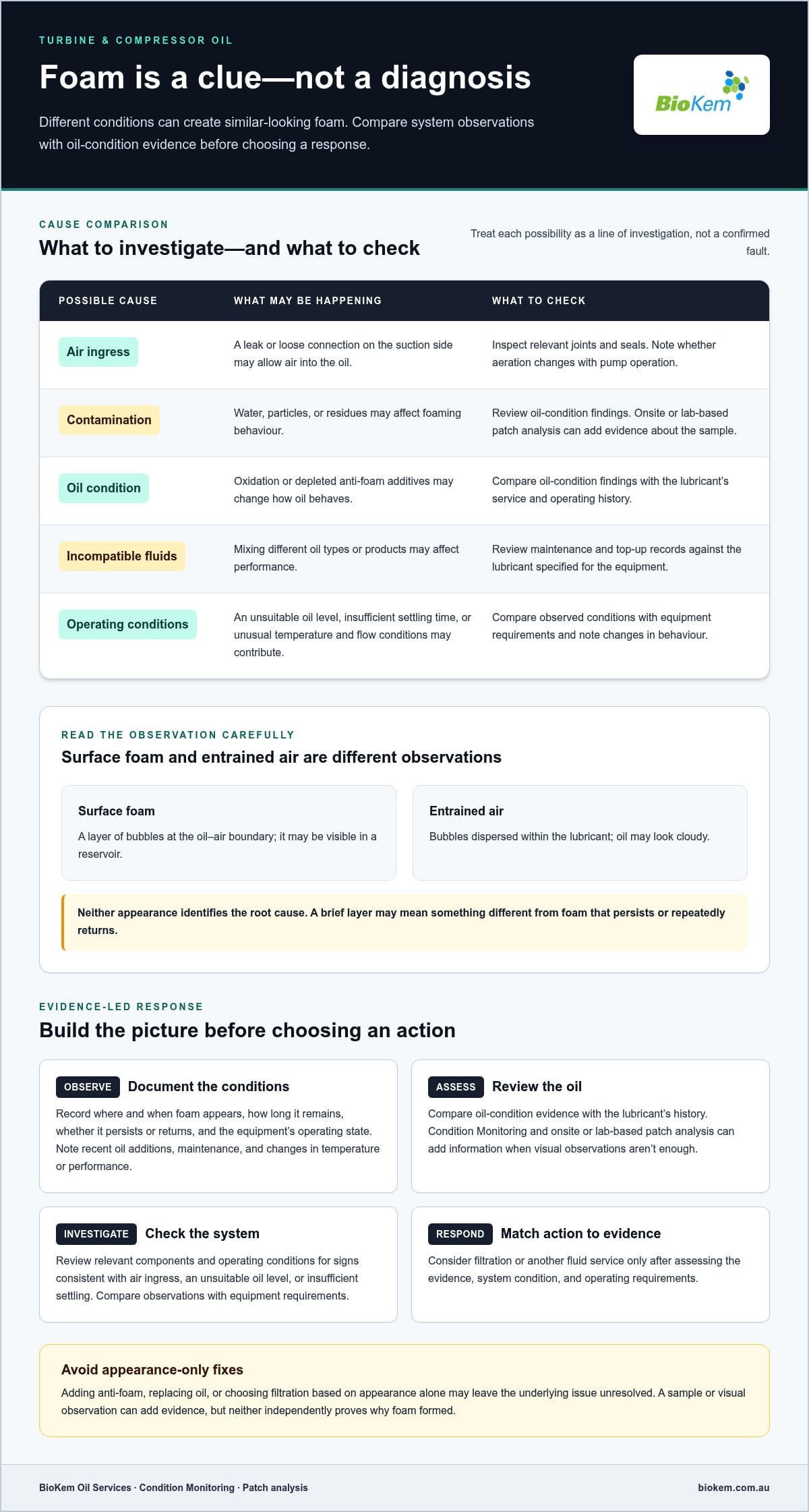
Different conditions can produce similar-looking foam. Treat each possible cause as something to investigate, not a confirmed diagnosis. You can narrow the possibilities by comparing system observations with oil-condition evidence.
- Air ingress: A leak or loose connection on the suction side may allow air into the oil. Inspect relevant joints and seals, and note whether aeration changes with pump operation.
- Contamination: Water, particles, or residues may affect foaming behaviour. Review oil-condition findings and consider onsite or lab-based patch analysis for additional evidence. For broader context, see industrial oil contamination control.
- Oil condition: Oxidation or depleted anti-foam additives may change how oil behaves. Compare oil-condition findings with the lubricant’s service and operating history.
- Incompatible fluids: Mixing different oil types or products may affect performance. Review maintenance and top-up records against the lubricant specified for the equipment.
- Operating conditions: An unsuitable oil level, insufficient settling time in the reservoir, or unusual temperature and flow conditions may contribute. Compare the observed conditions with equipment requirements.
A practical first-check sequence for a foaming oil system
Start by recording where the foam appears, when it begins, whether it persists during operation, and whether it returns. Include recent maintenance and oil additions in the record. Then compare those observations with system checks and oil-condition evidence before choosing corrective action. Avoid adding anti-foam or replacing the oil based on appearance alone. Either response may leave the underlying issue unresolved if the cause hasn’t been established.
Condition Monitoring and oil-condition analysis can help build a clearer picture, but neither observation nor a sample alone proves the cause. BioKem Oil Services provides Condition Monitoring and onsite and lab-based patch analysis to support an evidence-led investigation. For support with the next steps, discuss the investigation with BioKem Oil Services.
How to respond to foaming oil with evidence-led next steps
Use a measured sequence rather than treating foam as proof of a specific fault. The cause is easier to assess when you consider operating observations and oil-condition evidence together.
- Document the conditions: Record where and when foam appears, whether it persists, and the equipment’s operating state. Note recent oil additions, maintenance, and changes in temperature or performance.
- Assess the oil: Review the oil’s history and arrange suitable oil-condition analysis. Onsite or lab-based patch analysis can add evidence about the sample, but it doesn’t independently confirm why foam formed.
- Investigate the system: Check operating conditions and relevant components for signs consistent with air ingress, an unsuitable oil level, or insufficient settling. Compare observations with equipment requirements.
- Select a proportionate response: Consider filtration or another fluid service only after assessing the evidence, system condition, and operating requirements.
Adding anti-foam or changing oil without a supported diagnosis may not resolve the underlying issue. Filtration is not an automatic remedy for every foaming condition either. The appropriate response depends on what the investigation finds.
When oil analysis or specialist support can help
If visual observations don’t explain the foam, Condition Monitoring and oil-condition analysis can help build a more complete picture. Onsite or lab-based patch analysis provides information about the sample; system observations add the operating context. Consider these findings together when assessing whether oil filtration or another response fits the equipment’s needs.
BioKem provides Condition Monitoring and onsite and lab-based patch analysis for industrial operations across Australia. To discuss the evidence and a suitable next step, talk with BioKem about the oil foaming concern.
Make the next step evidence-led
Foam is a signal to investigate, not proof of a single fault. To narrow down Foaming Turbine or Compressor Oil: Causes, record when it appears, assess oil-condition evidence, and compare the findings with system operation before choosing a response. Filtration may suit some situations, but the right action depends on the evidence and equipment requirements.
BioKem supports industrial operations across Australia with oil and fuel filtration, Condition Monitoring, and onsite and lab-based patch analysis. These services can help build a clearer picture of oil condition and inform a proportionate response.
To discuss what to investigate next, contact BioKem about your oil foaming concern.
Frequently Asked Questions
Can foaming turbine oil damage equipment?
Persistent foam or entrained air may affect lubrication by disrupting the oil film between moving surfaces. Visible foam alone, however, doesn’t establish that equipment is damaged or explain why the foam formed. Record when and where it appears, how long it persists, and the operating conditions. Assess those observations alongside oil-condition and system evidence before deciding on a response.
What causes compressor oil to foam?
Possible causes include air ingress, contamination, changes in oil condition, incompatible fluids, and operating conditions such as an unsuitable oil level. These are possibilities, not a diagnosis: equipment design and operating observations also matter. To investigate Foaming Turbine or Compressor Oil: Causes, gather relevant system and oil evidence first. Don’t automatically add an additive or replace the oil without a supported reason.
How can I tell whether oil is foaming or aerated?
Surface foam is a layer of bubbles at the oil’s surface; aeration describes air bubbles dispersed through the lubricant. Note where bubbles appear, how the oil looks, and whether they persist during operation or after shutdown. These observations help describe what you’re seeing, but don’t prove the underlying cause. Oil-condition evidence and system inspection may also be needed.
Should I add an anti-foam additive to turbine or compressor oil?
Not as an automatic first response. Foam can have several possible causes, and an unsupported additive change may not address the underlying condition. First investigate system operation and oil evidence, including recent oil additions and maintenance. Then choose a response that fits the findings and the equipment and lubricant requirements. This helps avoid treating the visible symptom while leaving its cause unresolved.

Article by
James McAllister
James McAllister is an industry professional with BioKem Oil Services, specialising in lubrication reliability, oil filtration, contamination control and asset performance. Drawing on BioKem's extensive field experience across turbines, compressors, hydraulic systems and critical rotating equipment, James writes practical, insight-driven articles that help maintenance and reliability teams improve equipment performance, extend asset life and reduce operational risk.