

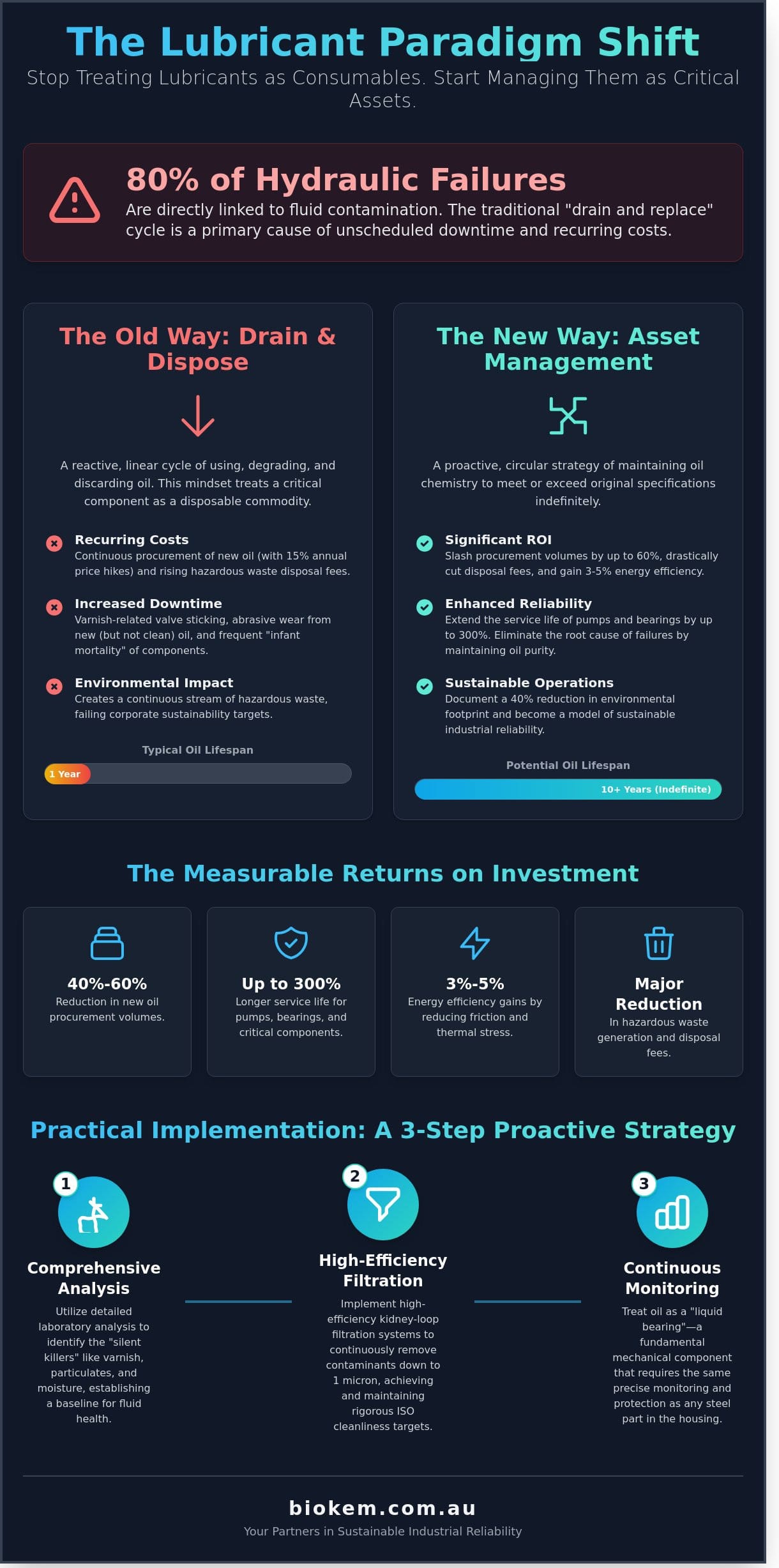
What if the oil you currently discard every 12 months could actually last for a decade or more? In many Australian industrial facilities, 80% of hydraulic failures are linked to fluid contamination, yet the standard response is still to drain and replace. By treating lubricants as assets not consumables, you stop viewing oil as a recurring expense and start seeing it as a critical component of your machinery’s longevity. It’s a shift that moves your team away from the 15% annual price hikes of new synthetics and toward a more resilient, circular operation.
You likely feel the weight of corporate sustainability targets while struggling with unscheduled downtime caused by varnish-related valve sticking. This guide shows you how to implement high-performance management strategies that extend lubricant life indefinitely and eliminate the need for costly disposal. We will examine the specific technical protocols required to slash your operational downtime and document a 40% reduction in your environmental footprint through advanced fluid conditioning.
Key Takeaways
- Shift from a traditional “drain and dispose” cycle to a proactive strategy focused on maintaining oil chemistry to meet or exceed original specifications.
- Unlock significant ROI by treating lubricants as assets not consumables, reducing procurement costs while extending the operational life of pumps and bearings.
- Identify the “silent killers” of industrial machinery, such as varnish, and learn how a 1-micron oil film determines the reliability of massive rotating steel.
- Master practical implementation through comprehensive laboratory analysis and high-efficiency kidney-loop filtration to achieve rigorous ISO cleanliness targets.
- Discover how onsite technical interventions and biological responsibility can transform your facility into a model of sustainable industrial reliability.
The Paradigm Shift: Moving Beyond the Consumable Mindset
Industrial reliability is undergoing a fundamental transformation. For decades, maintenance teams viewed oil as a commodity to be used and discarded. This consumable mindset relies on a linear cycle: you buy the oil, wait for it to degrade, drain the sumps, and dispose of the waste. It’s a reactive approach that treats fluid as a temporary necessity rather than a critical component. Modern high-precision machinery requires a different perspective. By treating lubricants as assets not consumables, facilities can maintain oil chemistry and cleanliness to meet or even exceed original manufacturer specifications indefinitely.
To better understand this concept, watch this helpful video:
The traditional “drain and fill” strategy is a 20th-century solution that fails to address 21st-century reliability challenges. Science tells us a different story through the lens of tribology. Base oils don’t actually “wear out” in the way a steel gear might. Instead, the hydrocarbon chains simply become contaminated with particulates or compromised by oxidation. When you focus on Predictive maintenance, you realize that removing these contaminants restores the fluid’s functional life. Shifting to an asset-based model means you’re no longer managing a waste stream; you’re managing a high-value industrial resource.
The Hidden Costs of the ‘Drain and Fill’ Strategy
Frequent oil changes carry significant financial burdens that often go unmeasured. Labour costs for routine draining and hot oil flushing consume hundreds of man-hours annually. In Australia, environmental compliance adds another layer of complexity. Hazardous waste disposal fees have risen by approximately 15% in several jurisdictions since 2022, making the “dispose” phase of the cycle increasingly expensive. Furthermore, new oil is rarely clean oil. Introducing fresh, potentially contaminated lubricant into a system often triggers “infant mortality” in bearings, where new particles cause immediate abrasive wear.
Oil as a Fundamental Mechanical Component
Engineers must visualize oil as a “liquid bearing.” It requires the same precise monitoring and protection as any steel component within the housing. Treating oil as an asset aligns directly with ISO 55000 asset management standards, which advocate for maximizing the value and life of every physical resource. This shift ensures that the lubricant remains a stable medium for power transmission and heat dissipation. Lubricant asset management is a proactive strategy to eliminate the root cause of 80% of mechanical failures.
The Economic Case: ROI of Lubricant Asset Management
Shifting your operational mindset toward treating lubricants as assets not consumables yields measurable financial returns that go far beyond the initial purchase price. Most industrial facilities view oil as a recurring expense, much like fuel or electricity. However, adopting a holistic approach to lubrication transforms this expense into a long-term investment. Direct savings materialize quickly. When oil is managed through precision filtration and monitoring, procurement volumes often drop by 40% to 60%. This reduction simultaneously slashes hazardous waste disposal fees, which typically range from $0.50 to $1.50 per litre in the Australian market.
Indirect savings offer even greater impact. Clean, dry oil extends the service life of critical components like bearings and high-pressure pumps by up to 300%. Friction is the enemy of efficiency. Oil contaminated with micro-particulates or varnish increases drag within the system. By maintaining fluid chemistry, a 500kW motor system can see energy efficiency gains of 3% to 5%. These incremental percentages translate to thousands of dollars in annual power savings while reducing the thermal stress that leads to premature component fatigue.
Comparing the Two Models
The transition from a reactive model to an asset-centric strategy changes the fundamental workflow of a maintenance team. Reactive “oil changes” are replaced by proactive “fluid conditioning” sessions that don’t require machine downtime.
| Feature | Consumable Model | Asset Model |
|---|---|---|
| Waste Profile | High (Frequent drains) | Low (Circular reuse) |
| Machine Risk | High (Contamination entry) | Minimal (Closed loops) |
| Labour Focus | Manual oil swapping | Condition monitoring |
Unscheduled “emergency” oil interventions are costly, often exceeding $10,000 per hour in lost production for mining or power generation sectors. Implementing a strategy focused on treating lubricants as assets not consumables ensures that the fluid remains within specification indefinitely. Learn how hot oil flushing protects your investment by removing built-up debris that standard filters miss.
Longevity and Sustainability
In large-scale hydraulic systems and turbines, oil doesn’t “wear out”; it simply gets dirty or oxidized. Modern purification technologies allow for nearly indefinite oil life, which aligns perfectly with corporate ESG (Environmental, Social, and Governance) targets. For every 1,000 litres of oil kept in service, an operation prevents approximately 2.5 tonnes of CO2 emissions associated with the production and transport of new lubricants. This “Green Dividend” is a powerful metric for sustainability reporting.
The psychological shift is equally vital. When maintenance teams stop being “oil changers” and become “asset protectors,” their engagement with the equipment deepens. They begin to treat the oil as the lifeblood of the machine. If you’re ready to lower your environmental footprint while boosting reliability, consider how our varnish removal solutions can stabilise your fluid chemistry for years to come.
Lubricants as a Single Point of Failure in Critical Assets
Industrial reliability often hinges on a staggering physical contrast. A 100-tonne rotating steel assembly in a power plant or mining facility depends entirely on a hydrodynamic oil film measuring just 1 to 5 microns in thickness. When this microscopic barrier fails, the macroscopic asset follows. This vulnerability underscores the necessity of treating lubricants as assets not consumables. If the oil is viewed merely as a recurring expense, maintenance teams often overlook the chemical shifts that lead to catastrophic mechanical failure.
Varnish serves as the silent killer in these high-pressure environments. It doesn’t appear overnight. Instead, it forms through a cycle of thermal degradation and oxidation. Standard mechanical filtration typically stops at 3 or 5 microns, yet the precursors to varnish are sub-micron in size. These polar molecules remain suspended in hot oil but plate out on cooler metal surfaces as temperatures drop. This creates a sticky, resinous coating that increases friction and insulates components, leading to a 15% increase in operating temperatures in some hydraulic systems.
The Varnish Threat in Power Generation
In power generation, the financial stakes are immense. A single turbine trip caused by varnish-induced valve “stiction” can cost a facility over $200,000 per day in lost production and peaking penalties. As oil ages, its chemical stability wavers, creating soft contaminants that bypass traditional filters. Industry leaders are now treating lubricants as an asset by focusing on the molecular health of the fluid. Implementing a specialised varnish removal system allows operators to extract these sub-micron oxidation products before they can compromise critical servo valves.
Hydraulic System Vulnerabilities
Precision hydraulic systems require more than just “clean-looking” oil to function. The relationship between fluid health and component longevity is direct and measurable:
- Precision and ISO 4406: Modern servo-valves operate with clearances as tight as 2 microns. Even oil meeting an ISO 4406 code of 16/14/11 can contain enough silt to cause erratic control or total valve seizure.
- The Water Catalyst: Water contamination as low as 200 ppm can trigger additive depletion and accelerate oil oxidation by a factor of ten, turning the lubricant into a corrosive slurry.
- The Visual Fallacy: Operators often claim their oil is fine because it looks clear. However, clear oil can be chemically degraded if its antioxidant package is depleted or if it’s saturated with dissolved varnish precursors.
Reliability isn’t about changing oil on a calendar schedule; it’s about maintaining the fluid’s integrity to protect the machine. By treating lubricants as assets not consumables, companies shift from reactive repairs to proactive molecular management, ensuring the 1-micron film never fails the 100-tonne machine.
Practical Implementation: How to Manage Lubricants as Assets
Transitioning to a model of treating lubricants as assets not consumables requires a structured, data-driven methodology. It’s not enough to simply change filters; you must manage the fluid’s chemical and physical integrity through a circular lifecycle. This five-step framework provides the technical path to extended oil life and enhanced machinery reliability.
- Step 1: Establishing a Baseline. Use comprehensive laboratory analysis to identify current additive levels, oxidation states, and wear metals. This data provides the benchmark for all future purification efforts.
- Step 2: High-Efficiency Kidney-Loop Filtration. Install dedicated off-line loops to maintain constant ISO cleanliness. These systems operate independently of the main pressure line, ensuring 24/7 contamination control.
- Step 3: Utilising Vacuum Dehydration. Deploy this technology to extract dissolved water and gases that traditional filters can’t reach.
- Step 4: Active Varnish Mitigation. Remove soft contaminants and chemical degradation products before they plate out on critical valve surfaces.
- Step 5: Regular Monitoring. Verify results with onsite testing to ensure the asset remains within its specified operating window.
Advanced Purification Technologies
Vacuum dehydration is the gold standard for moisture control because it lowers the boiling point of water. This allows for the removal of 100% of free and emulsified water, and up to 90% of dissolved water, at temperatures as low as 50°C. This process protects oil additives from thermal distress while ensuring the lubricant’s dielectric strength remains intact. When addressing chemical breakdown, the choice between electrostatic and cellulose-based varnish removal depends on the asset. Electrostatic systems excel at capturing sub-micron polar particles in hydraulic systems, while cellulose-based depth filtration is often more effective for high-volume turbine reservoirs. To ensure these systems are performing correctly, the importance of onsite patch test kits for immediate results cannot be overstated.
Setting and Achieving ISO Cleanliness Codes
The ISO 4406 standard uses three numbers to represent particle counts at 4, 6, and 14 microns. For example, a code of 16/14/11 indicates a significantly cleaner fluid than 21/19/16. It’s a common misconception that “new oil” is clean oil. Fresh oil from a drum often arrives at a cleanliness level of 19/17/14, which is frequently 10 to 32 times dirtier than the requirements of high-pressure hydraulic components. Clean oil is defined strictly by these microscopic particle counts rather than visual clarity. By treating lubricants as assets not consumables, operators can reduce component wear by up to 70% and significantly lower their environmental footprint.
The BioKem Approach: Sustainable Reliability Partners
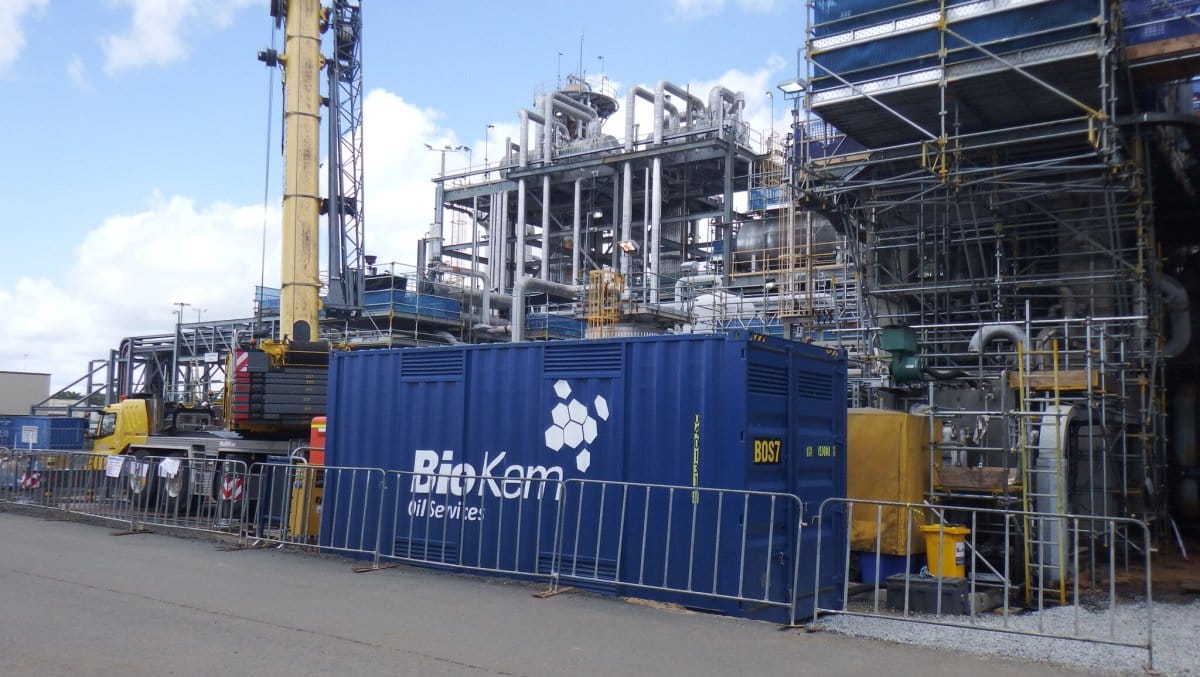
BioKem operates with a clear objective: maximizing asset life through technical expertise and biological responsibility. We don’t just supply products; we provide onsite technical interventions that bring the capabilities of a full-scale purification plant directly to your facility. This mobile approach allows for real-time decontamination, ensuring high-value fluids remain in service for years rather than months. By partnering with world-class manufacturers like Filters S.p.A. and Swift Filters, we maintain cleanliness standards that frequently exceed ISO 4406 requirements. This technical rigor is fundamental to treating lubricants as assets not consumables, shifting the focus from procurement costs to total lifecycle value. We help Australian industry transition to a circular lubrication model, reducing environmental impact while boosting operational uptime.
- Technical interventions performed at your site to minimize downtime.
- Integration of high-efficiency filtration media for sub-micron particle removal.
- A shift from linear “use and dispose” habits to circular resource management.
Specialised Services for National Industry
BioKem provides a full-spectrum reliability suite designed for complex systems. Our technicians manage everything from precision hot oil flushing to the delicate maintenance of EHC fluids in power generation. For short-term system recovery or emergency decontamination projects, our equipment hire service offers a cost-effective alternative to capital expenditure. This allows facilities to restore fluid health without permanent infrastructure changes. View our full range of industrial filtration products to see how we support diverse industrial sectors across the country.
A Future-Proof Maintenance Strategy
Partnering with BioKem means eliminating the concept of “waste oil” from your operational vocabulary. We utilize advanced monitoring to track the “Asset Health” of your lubricants over time. Instead of scheduled oil changes based on arbitrary dates, we rely on data-driven analysis to determine exactly when and how to intervene. Our long-term reporting provides a transparent audit trail of fluid performance, proving the financial and ecological benefits of treating lubricants as assets not consumables. This strategic shift often results in a 40% reduction in lubricant consumption within the first 24 months of implementation. Contact BioKem to audit your lubrication program and start your transition to sustainable reliability.
Elevating Operational Reliability Through Asset Centric Lubrication
Transitioning away from a disposal mindset is the first step toward achieving 100% equipment availability. By treating lubricants as assets not consumables, operators eliminate the single point of failure that often leads to catastrophic mechanical breakdown in the mining and power generation sectors. Implementing precise varnish mitigation and vacuum dehydration techniques ensures that oil remains in peak condition for years rather than months. This strategic shift doesn’t just protect machinery; it aligns industrial operations with Australian regulatory standards and long term ecological health.
BioKem Oil Services provides the technical infrastructure needed to sustain this transition. As the sole Australian distributor for Filters S.p.A., we deliver specialized filtration technology directly to your facility. Our team provides national onsite technical support for mining and power gen sites, ensuring your fluids maintain their chemical integrity through every cycle. It’s time to stop viewing oil as a recurring expense and start seeing it as a critical component of your facility’s biological and mechanical health.
Contact BioKem Oil Services to transform your lubrication strategy and secure your plant’s future today.
Frequently Asked Questions
Is it really possible to never change my industrial oil again?
It’s entirely possible to extend the life of industrial oil indefinitely through advanced purification and additive replenishment. Many hydraulic systems operating under Biokem’s strict protocols haven’t required a full oil change since 2014. By removing sub-micron particles and managing oxidation levels, we maintain the fluid’s chemical integrity. This shift toward treating lubricants as assets not consumables reduces waste by 90% and eliminates the carbon footprint associated with manufacturing new base oils.
How much does it cost to implement a lubricant asset management programme?
Initial implementation costs for a comprehensive asset management programme typically range from $5,000 to $15,000 per critical system. This investment covers high-efficiency filtration hardware and baseline oil analysis. Most industrial facilities see a full return on investment within 12 months. For example, a plant reducing oil consumption by 4,000 litres annually saves approximately $22,000 in procurement and disposal costs while improving machine uptime by 15%.
Can varnish be removed from oil that is already in service?
Varnish can be effectively removed from in-service oil using ion-exchange resins or electrostatic oil cleaners. These technologies target polar contaminants that standard mechanical filters miss. Removing these soft contaminants prevents valve sticking and heat exchanger fouling. In a 2022 case study, Biokem’s varnish mitigation systems reduced MPC (Membrane Patch Colorimetry) values from a critical 45 to a healthy 12 within 72 hours of continuous operation.
What is the difference between standard filtration and oil purification?
Standard filtration focuses on removing solid particles larger than 5 microns using mechanical barriers. Oil purification goes deeper by removing dissolved water, gases, and chemical degradation products. While a standard filter protects components from wear, purification maintains the oil’s molecular stability. Systems using vacuum dehydration can reduce water content from 2,000 ppm to below 100 ppm, which is essential for maintaining the long-term asset value of the lubricant.
What happens if I treat my oil as an asset but the OEM requires a change-out for warranty?
You can maintain warranty compliance by providing documented proof that the oil meets or exceeds OEM cleanliness specifications. Most manufacturers accept independent laboratory reports as evidence of fluid health. If your oil analysis shows an ISO 4406 cleanliness code of 16/14/11, it’s technically superior to new oil from a drum. We recommend keeping detailed records of every purification cycle to demonstrate adherence to ISO 55001 asset management standards.
How does water contamination affect the ‘asset value’ of my lubricant?
Water contamination acts as a catalyst for oxidation and additive depletion, which rapidly devalues the lubricant. Even a 0.1% water concentration can reduce the bearing life of industrial machinery by 75%. By treating lubricants as assets not consumables, you implement proactive moisture barriers like desiccant breathers. These tools maintain water levels below the saturation point, preventing the formation of corrosive acids and ensuring the oil remains a functional asset for years.
Is onsite oil analysis as accurate as laboratory testing?
Modern onsite diagnostic tools provide 95% accuracy compared to ASTM laboratory methods for viscosity and particle counting. These tools offer immediate data for daily decision-making. However, we still recommend quarterly laboratory testing to verify complex chemical markers like RULER (Remaining Useful Life Evaluation Routine). Combining immediate onsite screening with deep-dive lab analysis ensures your asset management strategy is backed by 100% verifiable data.
What industries benefit most from treating lubricants as assets?
Power generation, mining, and heavy manufacturing sectors see the most significant gains from this approach. Facilities operating large steam turbines or hydraulic presses often manage reservoirs exceeding 10,000 litres. In these high-volume environments, extending oil life directly correlates to massive cost savings. For instance, an Australian mining site reduced its annual lubricant spend by $120,000 in 2023 by switching from scheduled oil changes to condition-based purification.