


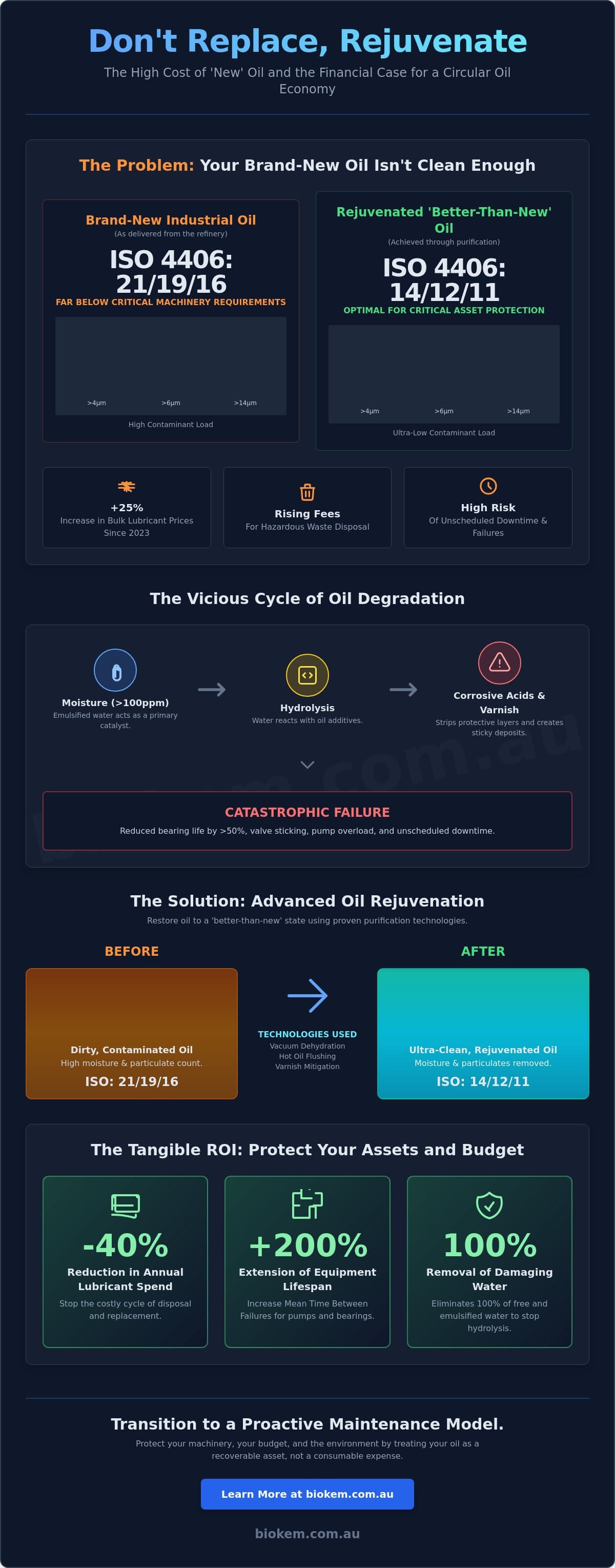
Did you know that brand-new industrial oil often arrives with an ISO 4406 cleanliness code of 21/19/16, which is far below the requirements for your most critical machinery? With bulk lubricant prices climbing 25% since early 2023, the habit of discarding oil simply because it’s dirty has become an unsustainable financial burden. You’re likely already managing the stress of rising hazardous waste fees and the looming threat of unscheduled downtime caused by varnish or moisture-related failures.
We understand that maintaining critical assets in a volatile market where oil prices hover around $120 per barrel is a significant challenge. However, you don’t have to stay trapped in a costly cycle of disposal and replacement. By rejuvenating the oil to remove moisture and contaminants and extend the life of the oil, you can achieve a “better-than-new” cleanliness standard of 14/12/11. This proactive approach can reduce your annual lubricant spend by 40% and extend the mean time between failures for your pumps and bearings by up to 200%.
This article explains how to transition to a circular oil economy using advanced purification technologies like vacuum dehydration and hot oil flushing. We’ll outline how these technical solutions help you meet strict Australian regulatory standards while protecting your machinery, your budget, and the environment.
Key Takeaways
- Understand the science of oil degradation, specifically how moisture triggers hydrolysis to create damaging acids that compromise your machinery.
- Discover the technical advantages of vacuum dehydration for rejuvenating the oil to remove moisture and contaminants and extend the life of the oil without heat-stressing the fluid.
- Evaluate the true ROI of oil refurbishment by accounting for hidden expenses like freight, hazardous waste disposal, and labor.
- Establish a clear implementation roadmap using baseline oil analysis and ISO 4406 target goals to transition toward a proactive, condition-based maintenance model.
The Science of Degradation: Why Moisture and Contaminants Kill Industrial Oil
Industrial oil isn’t a consumable that loses its molecular value just because it gets dirty; it’s a high-value asset that can be recovered. Oil rejuvenation is the precise process of removing 100% of free and emulsified water along with damaging particulates to restore the fluid’s original integrity. By rejuvenating the oil to remove moisture and contaminants and extend the life of the oil, you stop treating your lubrication strategy as a recurring expense and start viewing it as a sustainable cycle. This process addresses the chemical reality of how fluids fail, specifically targeting the catalysts that drive oxidation and additive depletion.
Understanding The Science of Degradation is essential for any facility manager aiming for long-term reliability. While some industry perspectives focus heavily on air exposure, the presence of emulsified water is often the primary driver for rapid oxidation. Particulate matter doesn’t just cause mechanical wear; it acts as a physical catalyst that accelerates chemical breakdown. When these elements combine, you’ll notice clear physical signs of failure: the oil darkens, develops a foul, acrid odor, and experiences a sharp increase in viscosity that forces your pumps to work harder.
To better understand the mechanics of how filtration transforms used fluid, watch this helpful video:
Moisture: The Silent Killer of Lubricant Additives
Water exists in three states within your system: free, emulsified, and dissolved. While free water is easy to spot, emulsified water is more dangerous because it remains tightly bound to the oil molecules. This leads to hydrolysis, a chemical reaction where water reacts with oil additives to create corrosive acids. These acids strip away anti-wear and rust-inhibitor layers, leaving metal surfaces vulnerable. Moisture levels above 100ppm compromise bearing life and can reduce the lifespan of critical components by more than half.
Contaminants and the Varnish Cycle
Standard filters are designed to catch large debris, but they often miss the sub-micron particulates that lead to varnish. These microscopic contaminants aggregate to form sticky, resinous deposits that coat internal surfaces. This varnish cycle is responsible for many “invisible” failures, such as valve sticking in hydraulic systems and significant efficiency loss in heat exchangers. To prevent this, specialized varnish mitigation and hot oil flushing are required to pull these precursors out of the system before they solidify. Without these technical interventions, your machinery remains at constant risk of unscheduled downtime and expensive component replacement.
Rejuvenating the Oil: Technical Mechanisms for Removing Contaminants
While basic mechanical filtration is a standard maintenance practice, it often falls short of the chemical restoration required for modern, high-precision machinery. High-performance rejuvenation goes beyond simple particle trapping; it involves shifting your operational philosophy toward treating lubricants as a long-term asset. To achieve this, technical mechanisms like vacuum dehydration and varnish mitigation are essential. These processes don’t just clean the fluid; they restore its physical and chemical properties to a state that’s often superior to brand-new oil arriving from the refinery.
Vacuum dehydration stands as the gold standard for moisture removal in critical assets. The physics are straightforward but highly effective. By creating a vacuum environment within a dehydration chamber, the boiling point of water is significantly lowered. This allows moisture to evaporate at temperatures well below the threshold that would cause thermal stress or additive shear. This “cool” evaporation is the most effective method for rejuvenating the oil to remove moisture and contaminants and extend the life of the oil without compromising the lubricant’s delicate chemical balance.
Vacuum Dehydration vs. Centrifugal Separation
Centrifugal separation is a traditional method that works well for removing large volumes of free water through density differences, but it’s largely ineffective against dissolved and emulsified water. Vacuum systems excel where centrifuges fail, pulling moisture out of the molecular structure of the oil. This is critical for sensitive turbine and EHC fluids where even trace amounts of water lead to catastrophic failure. It’s a gentle, non-invasive process that keeps additive packages intact while ensuring the fluid remains bone-dry, even in humid Australian industrial environments.
Varnish Mitigation and Chemical Restoration
Standard mechanical filters are designed to capture hard particles, but they’re useless against the soft, resinous precursors of varnish. Varnish mitigation uses specialized adsorption media to trap these soluble contaminants that would otherwise pass through a 1-micron filter. As these precursors are removed, the oil’s natural “solvency” is restored. This allows the oil to naturally re-absorb and clean away existing deposits from internal system surfaces. By focusing on technical mechanisms that target specific chemical failures, you aren’t just filtering; you’re rejuvenating the oil to remove moisture and contaminants and extend the life of the oil in a way that mechanical-only systems can’t match.
Achieving the target ISO 4406 cleanliness code of 14/12/11 requires high-precision hardware and a commitment to chemical stability. If you’re looking to upgrade your onsite capabilities and move away from the drain-and-fill cycle, exploring professional oil filtration systems is the first step toward total fluid control. Implementing dedicated varnish removal systems ensures long-term stability and prevents the valve sticking that plagues high-pressure hydraulic systems.
The Economic Case: Rejuvenation ROI vs. Bulk Oil Replacement
Industrial facilities often overlook the full financial impact of a standard oil change. In 2026, the economic landscape has shifted significantly. With bulk lubricant prices rising by up to 25% since early 2023 and global oil benchmarks sustained at $120 per barrel, the traditional ‘drain and fill’ model is a drain on profitability. Shifting your strategy toward rejuvenating the oil to remove moisture and contaminants and extend the life of the oil isn’t just an environmental choice; it’s a necessary financial pivot to protect your maintenance budget from market volatility.
Beyond the invoice for new fluid, you must account for freight, internal labor, and increasingly high hazardous waste disposal fees. It’s a common industry reality that disposal costs often exceed 30% of the initial oil purchase price. By adopting technical processes for regenerating industrial oil, you eliminate these recurring disposal fees and slash your annual lubricant procurement expenditure by up to 40%. This proactive model also aligns with corporate ESG reporting by significantly reducing the volume of hydrocarbon waste your site generates.
Calculating the True Cost of an Oil Change
When you break down the cost per litre, onsite technical purification is consistently more economical than total replacement. Procurement overheads, including the logistics of managing new drum inventory and the storage of waste oil, add layers of complexity that onsite rejuvenation avoids. You’re no longer paying for the transport of fluids that still possess their base-oil integrity. Instead, you’re investing in a circular system that keeps your assets running on “better-than-new” oil while stabilizing your long-term operational costs.
Asset Longevity and Uptime Benefits
Uptime remains the ultimate metric for industrial success. Cleaner oil directly reduces mechanical friction and abrasive wear on pumps, valves, and actuators. For power generation turbines, preventing a single unscheduled ‘trip’—which can cost thousands in lost productivity—justifies the entire investment in a purification program. Utilizing proactive hot oil flushing during commissioning or major overhauls ensures your system starts clean and stays clean. This commitment to fluid health can extend the mean time between failures for critical components by up to 200%, ensuring that your hardware lasts as long as the oil that protects it.
How to Implement an Oil Life Extension Strategy in 2026
Transitioning from a reactive “drain and fill” model to a proactive rejuvenation strategy requires a structured framework. In 2026, successful industrial operations use data to drive maintenance decisions rather than relying on arbitrary calendar-based changes. By rejuvenating the oil to remove moisture and contaminants and extend the life of the oil, you transform your lubrication program into a reliable asset management system that supports both your bottom line and your sustainability targets.
The implementation process follows five critical steps:
- Step 1: Baseline Oil Analysis. You can’t manage what you haven’t measured. Identify the current chemical health, additive levels, and contamination profile of your fluid.
- Step 2: Target Cleanliness Levels. Set specific ISO 4406 goals based on asset criticality. For high-pressure systems, aiming for 14/12/11 is the gold standard.
- Step 3: Technical Intervention. Select the most effective method for rejuvenating the oil to remove moisture and contaminants and extend the life of the oil, such as vacuum dehydration or varnish mitigation.
- Step 4: Hardware Upgrades. Install permanent, high-efficiency filtration solutions to maintain the restored fluid quality.
- Step 5: Continuous Monitoring. Use online sensors or regular lab testing to detect early signs of ingress or degradation before they cause failure.
The Foundation: Professional Oil Analysis
Effective rejuvenation begins with forensic-level data. Utilizing filter ferrogram analysis allows you to identify specific wear modes, such as fatigue or abrasive wear, by examining the shape and size of particles. While lab tests provide a deep dive, patch test kits offer immediate onsite assessment, allowing your team to see physical evidence of contamination before a full report arrives. These tools help you interpret ISO 4406 codes to trigger interventions at the optimal time.
Equipment Hire vs. Onsite Technical Services
Choosing the right delivery model depends on your team’s internal capacity and the complexity of the system. For many Australian operations, specialized equipment hire provides the flexibility to manage short-term projects or emergency cleanups without a major capital investment. However, for complex system cleanouts or commissioning, deploying BioKem technicians ensures a turnkey result. These experts manage the technical nuances of fluid restoration, allowing your staff to focus on core production tasks. If you’re ready to baseline your fluid health and stop the cycle of waste, start by scheduling a professional oil analysis today.
BioKem Oil Services: Australia’s Partner in Oil Rejuvenation
BioKem is Australia’s national leader in onsite oil purification and hot oil flushing, providing a technical bridge between heavy industry and environmental responsibility. We don’t just sell products; we deliver a biological and technical framework designed to restore the physical integrity of your lubricants. By rejuvenating the oil to remove moisture and contaminants and extend the life of the oil, we help Australian businesses move away from the high-waste “drain and fill” model. Our approach combines technical expertise with a commitment to sustainability, utilizing nature-based alternatives to traditional chemical-heavy cleaning processes whenever possible.
Our operational reach extends to the most remote mining, power generation, and manufacturing sites across the country. Through our partnership with Filters S.p.A., we provide our clients with access to world-class hardware that meets the rigorous demands of the 2026 industrial market. This combination of local expertise and international technology ensures that your critical assets remain protected by fluids that meet or exceed original equipment manufacturer (OEM) specifications.
Specialized Technical Capabilities
We utilize a suite of specialized tools to ensure every rejuvenation project meets precise cleanliness targets. For system verification during commissioning or after a major overhaul, we deploy paddle flushing screens to capture and analyze debris in real-time. Our expertise in EHC fluid maintenance is vital for power station reliability, where maintaining the chemical stability of fire-resistant fluids is a non-negotiable safety requirement. To provide immediate transparency, we use Particle Pal technology, giving you real-time data on oil cleanliness and moisture levels during the purification process.
Future-Proofing Your Lubrication Management
The transition to a proactive maintenance strategy is no longer optional in an era of rising lubricant costs and stricter environmental regulations. BioKem helps you navigate this shift by treating your oil as a high-value, refurbishable asset rather than a disposable commodity. Rejuvenating the oil to remove moisture and contaminants and extend the life of the oil allows you to slash annual expenditure while improving the mean time between failures for your most expensive hardware.
We invite you to book a lubricant expenditure audit with our technical team to identify the specific savings available at your site. This data-driven review highlights where your current lubrication habits are leaking capital and how a circular oil model can restore your budget. Contact BioKem today to discuss your oil rejuvenation requirements and secure the long-term health of your industrial assets.
Securing Your Industrial Assets with a Circular Oil Strategy
The transition toward a circular oil economy is a strategic necessity in a market defined by volatile lubricant prices and strict environmental mandates. We’ve explored how technical mechanisms like vacuum dehydration and varnish mitigation restore fluid properties that mechanical filtration alone can’t reach. By rejuvenating the oil to remove moisture and contaminants and extend the life of the oil, you’re investing in the long-term reliability of your critical infrastructure while slashing annual lubricant expenditure by up to 40%. Industrial oil isn’t a disposable commodity; it’s a refurbishable asset that maintains its molecular integrity when managed correctly.
BioKem provides the technical expertise and world-class hardware required to achieve these results. As the sole Australian distributor for Filters S.p.A., we guarantee ISO 4406 compliant results that protect your pumps, valves, and turbines from premature wear. It’s time to stop the expensive cycle of waste and start treating your oil as the high-value asset it is. Our team is ready to help you implement a proactive maintenance model that delivers measurable operational and financial improvements.
Request an Onsite Oil Purification Quote today and take control of your fluid health.
Frequently Asked Questions
What is the difference between oil filtration and oil rejuvenation?
Oil filtration is primarily a mechanical process designed to trap solid particles, whereas rejuvenating the oil to remove moisture and contaminants and extend the life of the oil involves chemical and thermal restoration. Rejuvenation uses vacuum dehydration to extract dissolved water and adsorption media to remove varnish precursors. This comprehensive approach restores the oil’s solvency and protective properties, which simple mechanical filters cannot achieve.
Can rejuvenated oil ever be as clean as ‘virgin’ oil?
Rejuvenated oil is frequently cleaner than brand-new oil arriving from a refinery. New oil typically has an ISO 4406 code of 21/19/16, which contains significantly more particulates than the 14/12/11 target achieved through professional purification. By processing the fluid onsite, you eliminate the contamination that occurs during the transport and storage of virgin lubricants, resulting in a “better-than-new” state.
How much moisture is ‘too much’ for a hydraulic system?
Moisture levels exceeding 100 parts per million (ppm) are generally considered too high for critical hydraulic systems. While the saturation point depends on the specific base oil and temperature, staying below 100ppm prevents the onset of hydrolysis and additive depletion. Maintaining these low levels is essential for protecting precision components like servo valves and high-pressure pumps from internal corrosion and premature failure.
What is the typical ROI for an onsite oil purification project?
Most industrial operations see a return on investment through a 40% reduction in annual lubricant spending and a 200% increase in the mean time between failures for pumps and bearings. By rejuvenating the oil to remove moisture and contaminants and extend the life of the oil, you also eliminate the hidden costs associated with hazardous waste disposal and procurement logistics. The savings often cover the service costs within the first year.
Can varnish be removed from an industrial system without a full oil change?
Varnish can be removed effectively without an oil change by using specialized varnish mitigation systems. These units use adsorption technology to trap soluble varnish precursors that are too small for mechanical filters. As these contaminants are removed, the oil’s natural solvency increases, allowing it to safely dissolve and clean away existing deposits from internal metal surfaces throughout the system naturally.
Does rejuvenating oil void my equipment manufacturer’s warranty?
Rejuvenating your oil doesn’t void warranties as long as the fluid remains within the physical and chemical specifications set by the Original Equipment Manufacturer (OEM). Most warranties are based on the oil meeting specific ISO 4406 cleanliness standards and maintaining its additive integrity. Professional oil analysis provides the documentation required to prove the fluid meets these standards, often exceeding the quality of new oil.
How long does the onsite vacuum dehydration process typically take?
The duration of vacuum dehydration depends on the total oil volume and the initial moisture concentration, but most projects are completed within 24 to 72 hours. A standard industrial reservoir can often be restored to sub-100ppm levels in a single weekend. Because the process is performed while the equipment is offline or during a scheduled shutdown, it fits seamlessly into existing maintenance windows without extending downtime.