

What if the “full synthetic” label on your lubricant drum is more of a marketing strategy than a reliability guarantee? While it’s easy to assume that premium-priced synthetics are always superior, the reality of industrial maintenance is far more nuanced. You likely understand that selecting the wrong fluid leads to unscheduled downtime and costly varnish build-up, yet the technical jargon surrounding “Oil Groups explained – mineral & synthetic lubricants” remains a significant barrier to effective asset management.
BioKem Oil Services is here to bridge that gap by providing a logical look at how API base oil chemistry impacts your specific operational environment. You’ll gain a clear understanding of the differences between Groups I through V, moving beyond marketing labels to grasp the actual molecular properties that dictate oxidation stability and solubility. This technical insight allows you to align your lubrication strategy with long-term ecological health and equipment performance, ensuring your high-performance systems remain clean and efficient. This guide breaks down the chemical mechanisms of each group and explains how they influence maintenance outcomes for critical industrial assets.
Key Takeaways
- Understand how the API categorizes base oils into five distinct groups based on refining intensity, sulfur content, and saturate levels.
- Differentiate between marketing terms and chemical reality by identifying why Group III hydrocracked oils are often labeled as synthetic despite their mineral origins.
- Recognize the counterintuitive relationship between high refining levels and reduced solubility, which increases varnish risks in Group II and III oils.
- Learn why having “Oil Groups explained – mineral & synthetic lubricants” is essential for selecting fluids that balance oxidative stability with system cleanliness.
- Discover how proactive oil analysis and purification services maintain the integrity of expensive Group IV and V lubricants to prevent unscheduled downtime.
What are API Oil Groups? The Framework for Lubricant Quality
The American Petroleum Institute (API) established a standardized classification system to define the chemical limits of base oils. This framework is vital because the base oil typically constitutes the vast majority of a finished lubricant’s volume, directly dictating how the fluid reacts to heat, pressure, and contaminants. By understanding Oil Groups explained – mineral & synthetic lubricants, maintenance professionals can predict asset behavior and avoid the high costs of premature oil degradation.
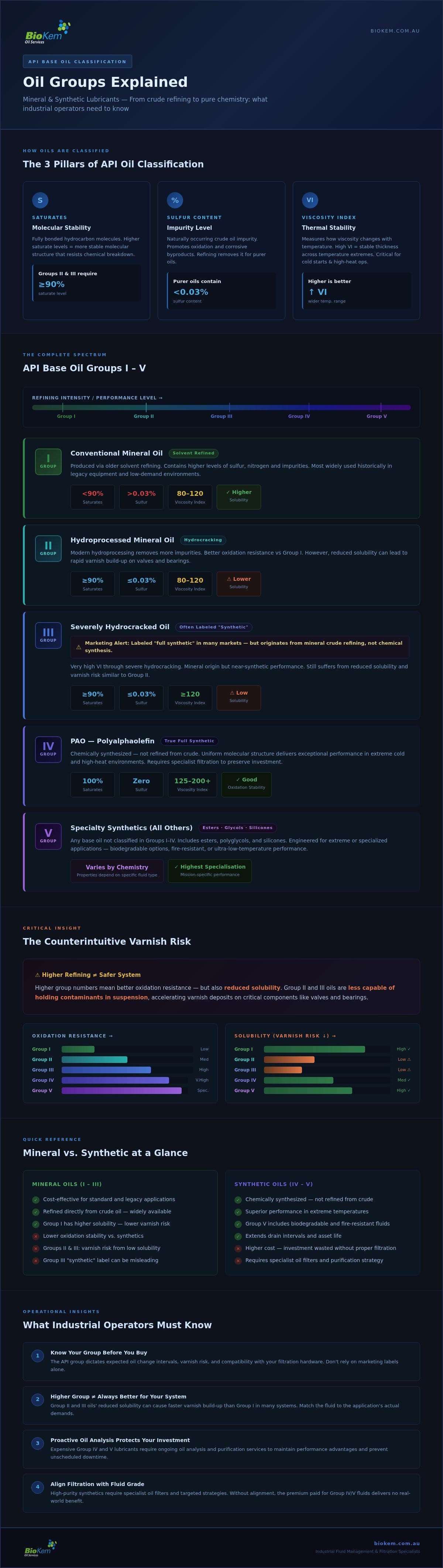
Refining intensity determines the category an oil falls into. The API divides base oils into five distinct groups. Groups I, II, and III are mineral-based, meaning they are refined from crude oil. As the group number increases, the level of refining and molecular consistency improves. Groups IV and V represent chemical constructions that don’t originate from traditional crude refining, offering superior performance in extreme environments where mineral oils fail.
The Three Pillars of Oil Classification
The API uses three specific chemical metrics to determine which group a base oil falls into. These parameters define the oil’s purity and its ability to withstand oxidative stress over time.
- Saturates: This refers to the level of hydrocarbon molecules that are fully bonded. High saturate levels indicate a more stable molecular structure that resists chemical breakdown. Group II and III oils must have saturate levels of 90% or higher.
- Sulfur Content: Sulfur is a naturally occurring impurity in crude oil. The refining process aims to remove it because sulfur promotes oxidation and can lead to corrosive byproducts. Purer oils contain less than 0.03% sulfur.
- Viscosity Index (VI): This measures how much an oil’s thickness changes as the temperature fluctuates. A high VI indicates the oil remains stable across a wider temperature range, which is critical for cold starts and high-heat operations.
Why Industrial Operators Must Know Their Oil Group
Knowing your oil group is the first step in developing a proactive maintenance strategy. It dictates the expected interval between oil changes and influences the risk of varnish formation within high-performance systems. For instance, while Group II oils offer better oxidation resistance than Group I, they often have lower solubility. This means they are less capable of holding contaminants in suspension, which can lead to rapid varnish build-up on critical components like valves and bearings.
Selecting the correct group also ensures compatibility with your purification hardware. High-purity synthetic fluids require specialist oil filters and targeted filtration strategies to maintain their performance advantages. Without this alignment, the investment in premium synthetic lubricants is often wasted through improper handling or inadequate contamination control. Understanding these groups allows you to choose a fluid that balances performance with the environmental goal of extending oil life.
Mineral Base Oils: Understanding Groups I and II
Mineral oils remain the most widely used base stocks in the industrial sector, primarily due to their cost-effectiveness and historical reliability in standard applications. These fluids are refined directly from crude oil, but the degree of processing they undergo creates a significant performance gap between the two categories. Having Oil Groups explained – mineral & synthetic lubricants is particularly helpful here, as it clarifies why a Group I oil might fail in a system where a Group II oil succeeds.
While modern machinery often demands higher purity, mineral oils still serve a vital role in legacy equipment and low-demand environments. However, their natural origin means they contain a mix of molecular structures, some of which are more prone to chemical breakdown than others. Understanding these nuances is essential for managing asset longevity and maintenance budgets effectively.
Group I: The Traditional Choice
Group I base oils are produced through a process known as solvent refining. This is an older technology that uses chemicals to extract undesirable components from the crude stock. Because this method is less intensive than modern alternatives, Group I oils often contain higher levels of impurities, particularly sulfur and nitrogen. By definition, Group I oils have saturate levels that are less than 90 percent and sulfur content exceeding 0.03 percent.
These oils typically have a lower viscosity index, meaning they thin out more rapidly at high temperatures and thicken more in the cold. You’ll generally find Group I lubricants in older industrial gearboxes or machinery with less stringent performance requirements. Their primary drawback is poor oxidation stability. When exposed to heat and oxygen, the impurities in Group I oils react quickly, leading to sludge formation and a shorter fluid life.
Group II: The Modern Industrial Standard
Group II oils represent a significant step forward in lubricant technology. These oils are refined using hydrocracking, a process that uses hydrogen and catalysts at high pressure to break down impurities and saturate the hydrocarbon molecules. This results in a much purer base stock with better antioxidant properties and thermal stability than Group I. Group II oils must contain more than 90 percent saturates and less than 0.03 percent sulfur.
In the Australian industrial landscape, Group II is often considered the “workhorse” for hydraulic systems and general-purpose lubrication. It provides a reliable balance of performance and economy for most standard operating conditions. However, even these refined mineral oils have limits. In extreme temperature environments or high-pressure systems where molecular shear is a constant threat, mineral-based fluids can struggle to maintain their protective film. To ensure your mineral lubricants are still providing adequate protection, regular oil analysis is a critical tool for identifying the early signs of chemical degradation.
Synthetic Lubricants: Groups III, IV, and V Explained
Synthetic lubricants represent the pinnacle of fluid engineering, designed to overcome the inherent molecular limitations of crude-derived products. While mineral oils are separated through distillation, synthetic base stocks are built through chemical synthesis to achieve specific performance characteristics. This distinction is crucial for operators of high-speed turbines and critical hydraulic systems where fluid failure isn’t an option. Understanding Oil Groups explained – mineral & synthetic lubricants is the only way to navigate the gap between marketing claims and actual chemical performance.
The transition from mineral to synthetic isn’t just about price. It’s about how a fluid handles oxidative stress and temperature fluctuations. As industrial demands increase, the reliance on engineered molecules becomes a necessity for maintaining asset reliability and meeting environmental sustainability targets. For operations looking to extend these sustainability efforts to their water management systems, QM Environmental International B.V. provides specialized microbial products to enhance biological processes like nitrification and denitrification.
Group III: The Synthetic Controversy
Group III oils occupy a unique position in the industrial market. Technically, they are mineral oils that have undergone severe hydrocracking to reach a viscosity index (VI) above 120 and saturate levels over 90 percent. Despite their mineral origin, a landmark legal ruling in the late 1990s allowed manufacturers to market these products as “synthetic.” In many Australian industrial applications, Group III provides excellent value, offering improved oxidation resistance over Group II without the high cost of Group IV. However, they still lack the absolute molecular uniformity found in true chemical synthetics, which can impact their performance in the most extreme environments.
Group IV (PAO) and Group V (Esters)
Group IV base oils consist entirely of Polyalphaolefins (PAO). These are true synthetics, created by polymerizing alpha-olefin molecules into uniform chains. Because they contain no sulfur or wax, PAOs offer exceptional performance during cold starts and remain stable under extreme heat. They are the preferred choice for high-performance industrial assets that require long drain intervals and minimal deposit formation. Their molecular consistency ensures that the fluid’s protective film doesn’t shear under heavy loads.
Group V serves as a catch-all category for any base stock not included in the first four groups. This includes Esters, Polyalkylene Glycols (PAGs), and Silicones. Esters are particularly valuable because they are polar molecules. This polarity allows them to act as natural detergents, improving the oil’s solubility and helping to keep internal surfaces clean. Many high-end lubricants use a blend of Group IV and Group V to balance performance with seal compatibility.
Maintaining these premium fluids requires a specialized approach to contamination control. High-value synthetic oils represent a significant investment, making it vital to use Filters S.p.A. products to remove sub-micron particles and moisture. Without precise filtration, even the most advanced synthetic lubricant will succumb to premature degradation, undermining the reliability of your most critical assets. Oil Groups explained – mineral & synthetic lubricants helps you choose the right fluid, but proper maintenance ensures that fluid actually delivers its promised lifespan.
Solubility and Varnish: The Hidden Risk of High-Group Oils
While the transition to highly refined base stocks offers undeniable benefits in terms of thermal stability, it introduces a significant chemical trade-off: reduced solubility. This is a critical nuance in the discussion of Oil Groups explained – mineral & synthetic lubricants. As oils become “purer” through intensive hydrocracking or chemical synthesis, they lose their natural ability to hold contaminants and oxidation by-products in suspension. For operators of high-performance turbines and hydraulic systems, this lack of solubility is the primary driver behind varnish formation.
Varnish is a soft, resinous deposit that precipitates out of the lubricant and coats internal machine surfaces. Because Groups II, III, and IV have very low polarity, they reach their saturation point quickly. Once the oil can no longer hold these degradation products, they “drop out” onto cooler surfaces, leading to restricted oil flow, sticking valves, and increased bearing temperatures. Managing this risk requires a dedicated approach to varnish mitigation to ensure that your investment in premium fluids doesn’t result in unexpected system failure.
The Solubility Paradox
In many ways, the older Group I oils were more “forgiving” than modern synthetics. Their higher aromatic and impurity content provided a natural solvency that kept internal components clean, even as the oil aged. Modern Group II and Group IV (PAO) oils don’t have this luxury. Their molecular uniformity means they’re exceptionally stable, but when they do eventually oxidize, the resulting by-products have nowhere to go. This leads to rapid varnish dropout on critical control valves and heat exchangers.
If your system has already experienced a varnish event, simply changing the oil is rarely enough. The new oil will often act as a solvent, stripping varnish from the pipes and quickly becoming saturated itself. In these scenarios, hot oil flushing is essential to physically remove these deposits and restore the system to its baseline cleanliness. This process ensures that the internal surfaces are chemically clean before the new charge of lubricant is introduced.
Monitoring Oil Health with Analysis
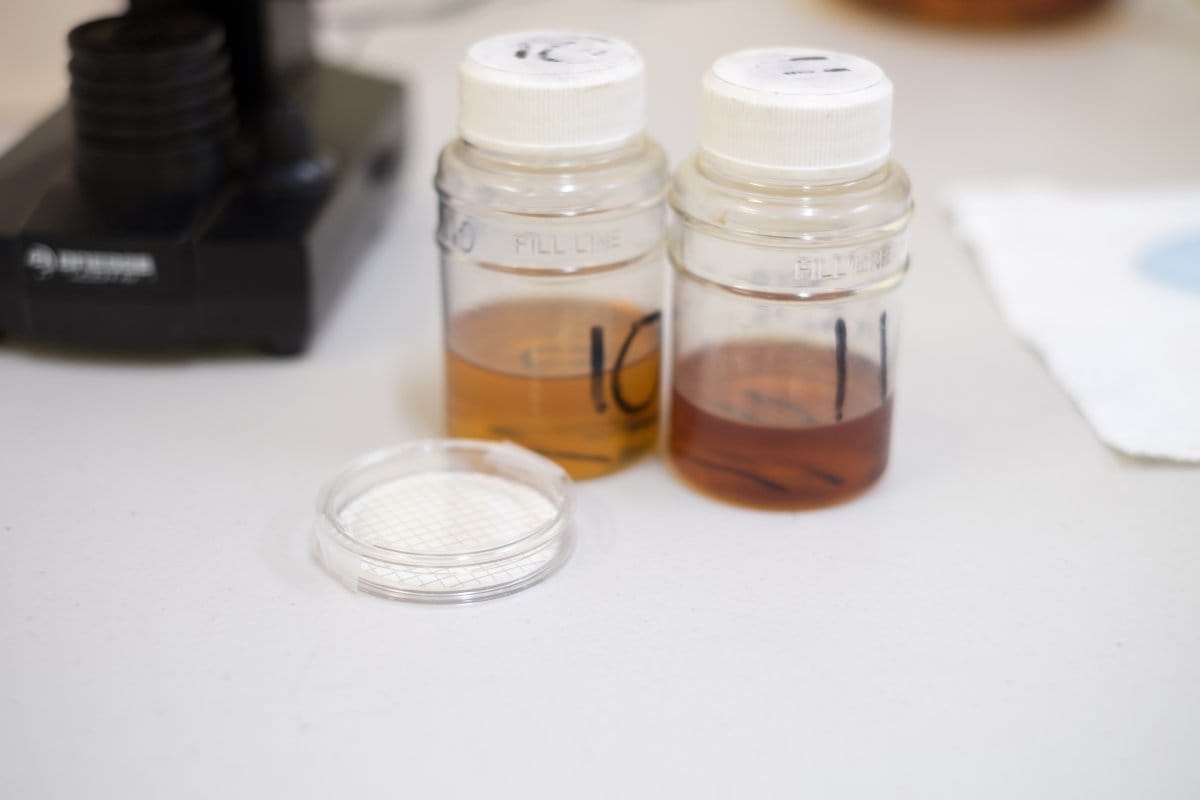
Proactive maintenance relies on detecting chemical changes before they manifest as physical deposits. Standard tests often fail to capture the early stages of varnish potential, which is why specialized oil analysis is vital for high-group lubricants. By tracking the depletion of antioxidants and utilizing Membrane Patch Colorimetry (MPC) testing, you can quantify the concentration of insoluble contaminants in the fluid. This data allows you to intervene with purification strategies while the contaminants are still in a sub-micron state, preventing them from ever forming the sticky films that cause unscheduled downtime.
Optimising Lubricant Performance with BioKem Oil Services
Selecting the right base oil is only the first step toward achieving operational reliability. Once you’ve had the nuances of Oil Groups explained – mineral & synthetic lubricants, the focus must shift to preserving the chemical integrity of those fluids within your specific system. Whether you’re utilizing cost-effective Group II mineral oils or premium Group IV PAOs, contaminants like moisture and sub-micron particulates will inevitably compromise performance. BioKem Oil Services specializes in maintaining the cleanliness of these critical assets, ensuring that your lubrication selection translates into measurable asset longevity.
The chemical stability of a lubricant is not a permanent state. Thermal stress and environmental ingress constantly work to degrade the fluid’s molecular structure. Our approach provides the technical expertise and hardware necessary to counteract these forces, positioning us as a reliable partner in solving complex industrial challenges. By focusing on the health of the oil, we help you avoid the high costs of unscheduled downtime and premature component failure.
Extending Fluid Life through Purification
High-performance lubricants, particularly those in Groups IV and V, represent a significant capital investment. Discarding these fluids due to minor contamination is neither economically sound nor environmentally responsible. BioKem Oil Services utilizes vacuum dehydration to remove both dissolved and free water from synthetic and mineral stocks, preventing the hydrolytic degradation that can destroy expensive additive packages. By maintaining fluids to strict ISO 4406 cleanliness codes, we extend the service life of the oil and reduce the total environmental footprint of your facility.
Our methodology centers on the principle that clean oil doesn’t wear out; it simply becomes contaminated. Through onsite purification and the use of specialist oil filters, we remove the catalysts for oxidation. This proactive intervention is far more effective than reactive oil changes, as it addresses the root cause of component wear and varnish formation before they result in system failure. This logical sequence of maintenance ensures that your assets remain in peak condition for longer periods.
Expert Support for Australian Industry
BioKem Oil Services provides localized expertise for Australian operators managing complex turbine, compressor, and hydraulic systems. We don’t offer generic solutions. Instead, we develop customized maintenance plans based on the specific chemical needs of your chosen oil group. Our team offers everything from hot oil flushing for newly commissioned systems to specialized equipment hire for short-term purification projects. We understand the regional regulatory standards and operational pressures faced by local industries.
To truly optimize your system, you need a partner who understands the intersection of fluid chemistry and mechanical engineering. You can contact BioKem Oil Services for a comprehensive oil health audit, which includes detailed oil analysis to identify the early markers of fluid stress. By implementing these tailored strategies, you protect your critical assets and ensure your choice of lubricant delivers the sustained performance your operations demand.
Securing Asset Reliability Through Chemical Precision
Understanding the technical framework provided by Oil Groups explained – mineral & synthetic lubricants is the foundation of a resilient maintenance strategy. As we have explored, the transition from Group I mineral oils to highly refined Group IV synthetics improves thermal stability but necessitates a shift in how we manage solubility and potential varnish dropout. These chemical nuances require moving beyond simple oil replacement cycles toward a proactive, life-cycle approach that respects the molecular properties of the fluid.
BioKem Oil Services serves as a specialized partner in navigating these industrial challenges across Australia. As the sole Australian distributor for Filters S.p.A., we provide the specific hardware and technical expertise required to maintain fluid integrity. From onsite varnish mitigation to detailed ISO 4406 cleanliness reporting, we offer the tools to keep your high-performance systems running efficiently. Ensure your lubricants are performing at their peak by contacting BioKem Oil Services for expert analysis and purification.
Investing in the correct base oil group is a strategic decision, but its value is only fully realized through consistent chemical management. By aligning your maintenance strategy with the specific molecular characteristics of your lubricant, you protect your critical assets and ensure long-term operational health. We remain committed to helping you achieve these results through scientific precision and expert support.
Frequently Asked Questions
What is the main difference between mineral and synthetic oil?
Mineral oil is derived from crude oil refining, while synthetic oil is chemically engineered from specific molecules. This distinction is the foundation of having “Oil Groups explained – mineral & synthetic lubricants” for industrial maintenance. Synthetics provide a uniform molecular structure that resists breakdown under extreme heat. Mineral oils contain a broader range of molecules and impurities that can accelerate oxidation and reduce the fluid’s service life in high-demand industrial environments.
Can you mix different API oil groups?
You can technically mix different API oil groups, but doing so often compromises the performance of the superior fluid. Mixing a Group IV synthetic with a Group II mineral oil will reduce the mixture’s oxidation stability and cold-start performance. It’s also possible for the different additive packages to clash, leading to precipitation or reduced wear protection. Always perform a compatibility test before mixing lubricants in critical machinery.
Why is Group III oil sometimes called synthetic and sometimes mineral?
Group III oil is derived from mineral crude but undergoes such intense hydrocracking that its performance rivals that of true synthetics. While it’s technically a mineral-based product, legal standards in many regions allow it to be marketed as synthetic. Having “Oil Groups explained – mineral & synthetic lubricants” helps you identify when a product is a highly refined mineral oil rather than a chemically synthesized PAO, ensuring your maintenance budget is spent effectively.
Which oil group is best for high-temperature turbine applications?
Group IV Polyalphaolefins (PAO) are generally considered the best choice for high-temperature turbine applications. Their superior thermal stability and high viscosity index ensure the lubricant maintains a consistent protective film even at elevated operating temperatures. This prevents the rapid oxidation and sludge formation that often plague mineral oils in these environments. Using a true synthetic helps maintain turbine efficiency and extends the intervals between major maintenance events.
Does synthetic oil prevent varnish better than mineral oil?
Synthetic oils don’t inherently prevent varnish better than mineral oils, although they do resist the oxidation that leads to varnish. The paradox is that highly refined synthetic oils have lower solubility. This means they lose their ability to hold contaminants in suspension much faster than Group I oils. Consequently, varnish can drop out onto valves and bearings more rapidly in synthetic systems, making dedicated varnish mitigation and filtration services a critical requirement.
How often should I perform oil analysis on Group IV PAO lubricants?
You should perform oil analysis on Group IV PAO lubricants at least every three months for critical industrial assets. Regular testing is essential because these fluids are a high-value investment. Monitoring the depletion of antioxidants and the accumulation of sub-micron particulates ensures you maximize the fluid’s life without risking asset damage. This proactive data allows you to implement purification services like vacuum dehydration only when they’re actually needed.
What are the environmental benefits of using synthetic base oils?
The primary environmental benefits of synthetic base oils are their extended service life and reduced waste generation. Because these fluids are more stable than mineral oils, they require less frequent replacement, which lowers the volume of waste oil your facility produces. This longevity supports sustainability goals by reducing the resources needed for manufacturing and transport. Purifying these high-quality oils onsite further enhances these ecological advantages by keeping the fluid in service longer.
Is Group II oil sufficient for most industrial hydraulic systems?
Group II oil is sufficient for the majority of industrial hydraulic systems that operate under standard conditions. It’s the industry workhorse because it offers a reliable balance of cost and performance for moderate temperature and pressure environments. However, if your hydraulics face extreme thermal stress or require very long service intervals, you should consider a synthetic alternative. For most Australian industrial applications, Group II provides adequate protection when combined with regular oil analysis.