

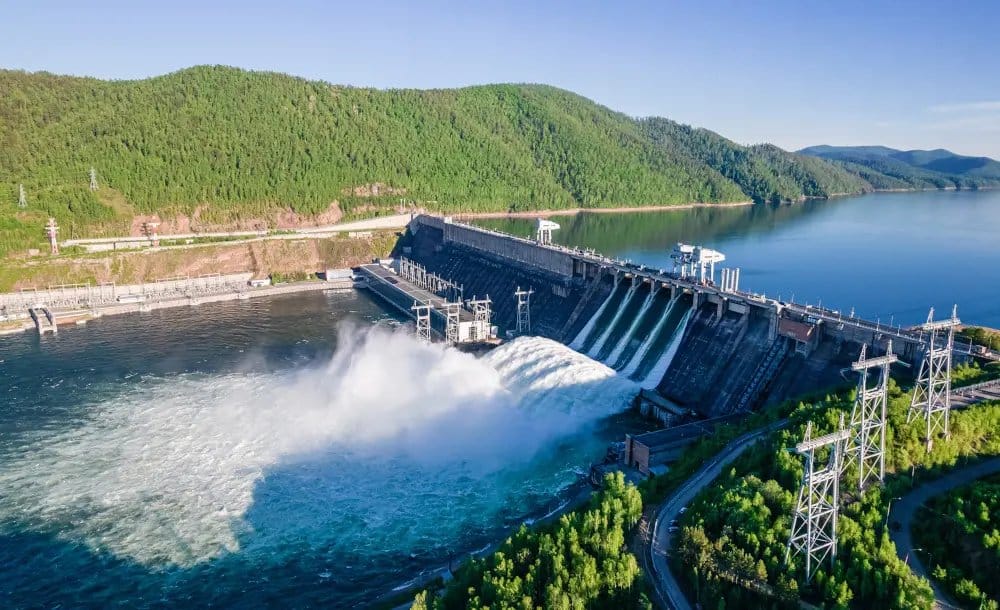
Commissioning represents the single most critical window to ensure total mechanical cleanliness for a hydroelectric turbine; standard oil changes simply cannot replicate the results of high-velocity hot oil flushing. Proper commissioning of lubrication systems for hydro power generation determines whether an asset thrives for decades or faces premature failure due to microscopic manufacturing debris left behind during construction. It’s the only time you have full access to the internal architecture before the system becomes operational.
You likely recognize the immense pressure of meeting strict ISO 4406 cleanliness standards while navigating complex environmental regulations and OEM warranty requirements. It’s a high-stakes environment where even minor contamination leads to unscheduled downtime and significant financial risk. This guide provides the technical protocols and flushing standards you need to achieve peak operational efficiency and long-term reliability for your infrastructure. We’ll explore the essential steps for removing system contaminants, validating oil health for compliance, and utilizing advanced filtration technology to protect your investment from day one.
Key Takeaways
- Identify why hydroelectric turbines require more stringent cleanliness protocols than standard industrial gearboxes to prevent premature mechanical wear.
- Understand the technical mechanism behind high-velocity hot oil flushing and how turbulent flow is achieved during the commissioning of lubrication systems for hydro power generation.
- Discover why new oil does not guarantee a varnish-free start-up and how targeted mitigation protects sensitive control valves from insoluble contaminants.
- Master a 5-step commissioning protocol that integrates mechanical audits with specialized flushing screens to validate system health for warranty compliance.
- Learn how onsite oil analysis and purification services provide a sustainable alternative to oil disposal while ensuring peak operational efficiency.
The Critical Role of Lubrication System Commissioning in Hydro Power
Commissioning is the rigorous process of verifying that a lubrication system is entirely free from manufacturing and installation debris before the first rotation of the turbine. It’s a precise technical audit that validates the integrity of every pipe, valve, and reservoir. While many industrial sectors view start-up as a routine procedure, the commissioning of lubrication systems for hydro power generation demands a higher level of scrutiny. These assets operate under extreme hydraulic pressures and require longevity that spans decades, not just years.
Hydroelectric turbines utilize components with significantly tighter tolerances than standard industrial gearboxes. A single particle of welding slag or a microscopic metal shaving can cause catastrophic scoring on bearings or seize critical control valves. Beyond the mechanical risk, the financial implications are severe. Failing to meet specified cleanliness targets during commissioning often voids OEM warranties and leads to unscheduled downtime that can cost operators thousands of dollars in lost generation revenue every hour. There’s also an environmental imperative; a clean, efficient system prevents leaks and ensures the maximum conversion of water energy into electricity, supporting regional sustainability goals.
Identifying Commissioning Risks in Hydro Turbines
New systems are rarely clean systems. During construction, contaminants like welding slag, metal shavings, and protective preservative coatings naturally accumulate within the pipework. If these aren’t removed, the equipment enters the "infant mortality" phase, where premature failure occurs shortly after start-up. In the Australian context, adherence to strict safety and regulatory standards is mandatory to protect both the asset and the local ecosystem. Effective hot oil flushing is the primary mechanism used to mitigate these risks before they translate into mechanical damage.
Defining Success: ISO 4406 Cleanliness Codes
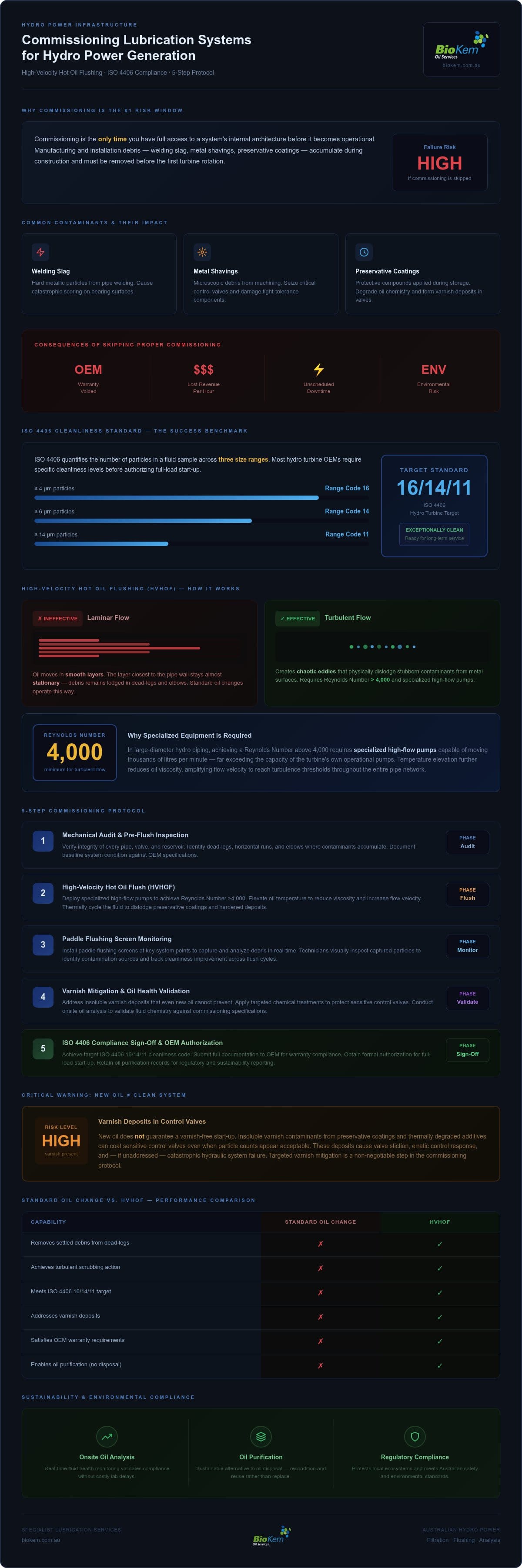
Success in commissioning is measured through the ISO 4406 standard, which quantifies the number of particles in a fluid sample across three size ranges. Most hydro turbine OEMs require specific cleanliness levels before they authorize a full-load start-up. The ISO 4406 16/14/11 standard serves as a critical benchmark for turbine reliability, indicating a system that is exceptionally clean and ready for long-term service. To verify these levels, technicians often use paddle flushing screens to capture and analyze debris in real-time, ensuring the system meets the high-performance demands of modern power generation.
Technical Mechanism: High-Velocity Hot Oil Flushing (HVHOF)
Static oil changes are insufficient for the commissioning of lubrication systems for hydro power generation because they lack the energy to dislodge particulates lodged in pipework dead-legs. Low-pressure oil circulation allows contaminants to remain settled in horizontal runs and elbows. High-velocity hot oil flushing (HVHOF) utilizes kinetic energy and thermal dynamics to scrub internal surfaces clean. By integrating Filters S.p.A. products, technicians can achieve high-efficiency particulate capture that standard filtration systems simply can’t match.
The Mechanics of Turbulent Flow
The effectiveness of a flush depends on achieving turbulent flow, which is mathematically defined by the Reynolds Number. For industrial cleaning, engineers target a Reynolds Number above 4,000. In large-diameter hydro piping, laminar flow acts like a smooth stream where the oil moves in layers; the layer closest to the pipe wall remains almost stationary. This fails to move debris. Turbulent flow, however, creates chaotic eddies that physically dislodge stubborn contaminants from the metal surface. Achieving these flow rates on remote hydro sites requires specialized high-flow pumps capable of moving thousands of liters per minute, far exceeding the capacity of the turbine’s operational pumps. If your project lacks this hardware, you might consider specialized equipment hire to bridge the gap during the critical commissioning phase.
Thermal Dynamics in System Cleaning
Pre-empting System Failure: Varnish Mitigation and Chemical Health
Varnish represents a silent threat that mechanical filtration alone cannot address. While the previous phase of commissioning of lubrication systems for hydro power generation focuses on dislodging hard particulates through high-velocity flushing, the chemical health of the fluid is equally vital. Varnish is a sticky, insoluble byproduct formed as oil degrades under thermal and mechanical stress. It adheres to sensitive metal surfaces, particularly within governor valves and bearing housings. It’s a common misconception that "new" oil is inherently pure; in reality, manufacturing residues or the stress of initial start-up tests can trigger early chemical instability.
When varnish accumulates on governor valves, it causes "stiction," leading to erratic control and potential turbine overspeed. In bearings, varnish acts as an unwanted thermal insulator. This layer traps heat within the bearing metal, causing operating temperatures to rise and accelerating the rate of oil oxidation. Proactively integrating a varnish removal system during the commissioning phase ensures these deposits never have the opportunity to settle. This step is essential for maintaining the long-term reliability of the asset’s most sensitive hydraulic controls.
The Chemistry of Oil Degradation in New Systems
During the initial run-in period, hydro turbine oil experiences extreme localized conditions. Micro-dieseling occurs when entrained air bubbles are compressed rapidly in high-pressure zones, creating microscopic "hot spots" where temperatures can exceed 1,000°C. This triggers thermal cracking, producing soft contaminants that eventually agglomerate into hard varnish. Standard Acid Number (AN) tests are often insufficient for early detection because they don’t quantify the presence of these insoluble precursors. Detecting these chemical shifts early prevents the "infant mortality" phase of equipment failure.
Proactive Varnish Mitigation Strategies
Effective commissioning of lubrication systems for hydro power generation requires a shift from reactive filtration to proactive molecular purification. Standard depth filtration is excellent for capturing larger particles, but sub-micron varnish precursors require specialized intervention. Using electrostatic oil cleaners or ion-exchange technology allows for the removal of these polar contaminants before they can fall out of suspension.
- MPC Testing: Membrane Patch Colorimetry (MPC) is the gold standard for commissioning. It provides a "varnish potential" score, allowing technicians to see the chemical risk before mechanical symptoms appear.
- Chemical Purity: Establishing a chemically pure environment from day one extends the service life of both the lubricant and the turbine components.
- Sustainability: By removing varnish precursors onsite, operators avoid the environmental and financial costs associated with premature oil disposal and replacement.
This comprehensive approach to chemical health ensures that the turbine enters its operational life with a clean slate, free from the hidden risks of early-stage degradation.
Actionable Guidance: A 5-Step Commissioning Protocol
Executing a structured commissioning of lubrication systems for hydro power generation requires a shift from general maintenance to precision engineering. This protocol ensures that every mechanical and chemical risk factor is addressed before the turbine enters service. By following a sequential workflow, operators can validate that their infrastructure meets the stringent ISO standards required for long-term asset health.
- Step 1: System Audit and Mechanical Pre-Check. Before oil ever enters the lines, technicians must verify the integrity of all pipework, seals, and reservoir internals. This involves checking for blind flanges, ensuring proper bypasses are in place, and confirming that the system is mechanically ready for high-pressure flow.
- Step 2: High-Velocity Hot Oil Flushing. Deploying the turbulent flow mechanics discussed earlier, this step utilizes specialized paddle flushing screens. These screens provide a visual and physical method to monitor the capture of debris, allowing technicians to verify progress in real-time.
- Step 3: Verification through Oil Analysis. Once the flushing screens remain clear, the system’s cleanliness is quantified. Onsite particle counters provide immediate data, ensuring the fluid reaches the target ISO 4406 codes without the delays of offsite laboratory shipping.
- Step 4: Vacuum Dehydration. Even new oil can contain moisture that threatens bearing surfaces. Vacuum dehydration is used at this stage to remove dissolved water, ensuring the system is chemically stable and resistant to corrosion.
- Step 5: Final Certification and Baseline Reporting. The process concludes with a comprehensive report. This document serves as the asset’s "birth certificate," providing the baseline data necessary for future condition monitoring and warranty compliance.
Onsite Sampling and Analysis
Precision monitoring is the backbone of successful commissioning. Utilizing patch test kits allows for immediate visual verification of particulate types, helping technicians identify if debris is coming from welding slag or seal wear. For digital precision, the Particle Pal range provides real-time ISO code monitoring throughout the flushing process. Taking samples from both the supply and return lines is essential to confirm that the filtration system is successfully removing contaminants before they reach the turbine bearings. This dual-sampling approach ensures no pockets of contamination remain hidden in the system’s dead-legs.
Water Removal and Dehydration
Hydroelectric plants are uniquely susceptible to water contamination due to their proximity to the water source and the potential for seal leakage. Free and emulsified water can be managed with standard filters, but dissolved water requires vacuum dehydration to be effectively removed. This process lowers the boiling point of water within the oil, allowing it to evaporate at temperatures that don’t damage the lubricant’s additive package. Targeting water levels below 100 ppm is a critical benchmark for protecting turbine bearings from hydrogen embrittlement and surface fatigue. If you’re preparing for a new installation, you can request a high-velocity hot oil flushing consultation to ensure your system starts in peak condition.
The BioKem Advantage: Sustainable Precision for Australian Hydro
BioKem provides a comprehensive onsite service model that manages every stage of the commissioning of lubrication systems for hydro power generation. Our approach transitions from initial technician deployment to the delivery of final, lab-grade analysis reports. As the authorized Australian distributor for Filters S.p.A. hardware, we integrate world-class filtration components directly into your new installations. This ensures that the system’s first breath is taken with the highest level of protection available in the industrial market.
A significant challenge for many operators is the ‘hire vs buy’ dilemma regarding specialized flushing hardware. For project-based needs, strategic equipment hire offers a flexible alternative to capital expenditure. This allows projects to utilize high-capacity, portable filtration units that are specifically designed for the large volumes found in hydroelectric infrastructure. By choosing a hire model, facilities access the latest technology and expert support without the long-term maintenance burden of owning niche equipment.
Tailored Solutions for Remote Hydro Sites
Serving national power generation assets requires deep logistical expertise, particularly when sites are located in remote or rugged Australian regions. BioKem specializes in deploying portable, high-capacity filtration units that can be mobilized quickly to meet project timelines. In documented project applications, the use of high-velocity hot oil flushing has been shown to reduce commissioning time by 30% compared to traditional circulation methods. This efficiency is achieved by reaching turbulent flow faster and capturing contaminants more effectively during the initial flush, ensuring that the asset is ready for service without unnecessary delays.
Environmental and Operational Excellence
Precision commissioning is a cornerstone of corporate ESG goals. Rather than adopting a ‘drain and fill’ approach that results in the disposal of thousands of liters of oil, our purification methods focus on cleaning the fluid to meet or exceed OEM specifications. This reduces waste and minimizes the environmental footprint of the start-up process. The long-term ROI of this precision is clear; a clean start leads to reduced component wear and extended lubricant life. Partnering with BioKem for the commissioning of lubrication systems for hydro power generation establishes a foundation for a proactive maintenance strategy that protects your asset throughout its entire operational lifecycle.
Securing the Future of Hydroelectric Infrastructure
Precision commissioning is the only window to ensure 100% mechanical cleanliness before an asset enters its multi-decade operational life. By integrating high-velocity hot oil flushing and proactive varnish mitigation, you move beyond simple oil changes to establish a foundation of chemical and mechanical purity. Successful commissioning of lubrication systems for hydro power generation doesn’t just protect the turbine bearings; it validates the entire hydraulic control architecture against the baseline ISO 4406 standards required for long-term reliability and warranty compliance.
BioKem provides the technical expertise and world-class hardware necessary to navigate these complex requirements. As the sole Australian distributor for Filters S.p.A. and specialists in high-velocity flushing, we offer the specialized equipment and onsite NATA-aligned lab services required to secure your investment. We’re committed to helping you achieve maximum asset lifespan through sustainable, precision-driven solutions that prioritize both operational efficiency and environmental responsibility.
Partner with BioKem for your next Hydro Commissioning Project to ensure your infrastructure is ready for a lifetime of efficient, reliable energy conversion.
Frequently Asked Questions
What is the primary goal of commissioning a hydro turbine lubrication system?
The primary goal is to ensure the lubrication system is entirely free of manufacturing and installation debris before the turbine’s first rotation. This process prevents catastrophic scoring of bearings and the seizure of sensitive control valves. By establishing a clean environment from day one, operators protect the asset’s mechanical integrity and validate the system for OEM warranty compliance.
How long does a typical hot oil flushing process take for a hydro power plant?
A typical hot oil flushing process generally spans five to fourteen days depending on the system’s complexity and volume. The timeline is dictated by how quickly the fluid reaches specified cleanliness targets rather than a fixed schedule. Technicians use real-time monitoring and flushing screens to determine when the system is sufficiently clean to conclude the process and move to the next phase.
Why is water removal so critical during the commissioning phase?
Water removal is critical because even dissolved moisture can trigger hydrogen embrittlement in bearings and accelerate the rate of oil oxidation. Hydroelectric environments are naturally prone to water ingress; therefore, utilizing vacuum dehydration during commissioning is essential. This step ensures the lubricant starts in a chemically stable state, preventing early-stage corrosion and protecting the longevity of the turbine’s internal components.
Can we use standard filters for commissioning, or are specialized ones required?
Specialized filters are required during commissioning because standard operational filters lack the capacity and precision to capture the high volumes of manufacturing debris found in new pipework. High-efficiency glass fiber media and specialist oil filters are deployed to achieve the stringent cleanliness codes required by turbine manufacturers. These specialized components provide the high beta ratios necessary for effective particulate removal under flushing conditions.
What ISO 4406 cleanliness level is required for hydro turbines?
Most hydro turbine OEMs require an ISO 4406 cleanliness level of 16/14/11 as the minimum benchmark for a successful start-up. This standard quantifies the particulate count at three specific micron levels to ensure the fluid is clean enough for high-precision components. Achieving this target during the commissioning of lubrication systems for hydro power generation is vital for preventing the "infant mortality" phase of equipment failure.
Is it better to hire or buy equipment for a one-off commissioning project?
It’s generally more cost-effective to hire specialized equipment for one-off commissioning projects to avoid significant capital expenditure and ongoing maintenance costs. Equipment hire provides access to high-capacity flushing rigs and vacuum dehydrators that are specifically sized for large-scale hydro installations. This approach also ensures that the project utilizes the latest filtration technology and hardware without the burden of long-term asset management.
How often should oil analysis be performed after the initial commissioning?
Oil analysis should be performed quarterly following the initial commissioning to establish a reliable baseline for the asset’s health. During the first six months of operation, monthly sampling is often recommended to monitor how the system settles under load. Regular analysis identifies early signs of wear or chemical degradation, allowing for proactive interventions that support the long-term operational efficiency of the power station.
What is the difference between hot oil flushing and high-velocity flushing?
Hot oil flushing uses thermal energy to reduce fluid viscosity and expand pipework, while high-velocity flushing focuses on achieving a Reynolds Number above 4,000 to create turbulent flow. For the commissioning of lubrication systems for hydro power generation, these techniques are used in tandem. The heat releases trapped contaminants, while the high-velocity turbulence carries those particulates to the filtration system for removal, ensuring total internal cleanliness.

Article by
James McAllister
James McAllister is an industry professional with BioKem Oil Services, specialising in lubrication reliability, oil filtration, contamination control and asset performance. Drawing on BioKem's extensive field experience across turbines, compressors, hydraulic systems and critical rotating equipment, James writes practical, insight-driven articles that help maintenance and reliability teams improve equipment performance, extend asset life and reduce operational risk.
Disclaimer
The information contained in this article is provided by BioKem Oil Services for general informational and educational purposes only. While every effort has been made to ensure the accuracy and relevance of the information at the time of publication, BioKem Oil Services makes no representations or warranties, express or implied, regarding its completeness, accuracy, reliability, suitability or availability.
Readers should seek professional advice before making maintenance, operational, engineering or investment decisions based on the content of this article. BioKem Oil Services accepts no liability for any loss, damage or consequential loss arising from the use of, or reliance upon, the information presented.
Unless otherwise stated, all content, including text, graphics, images and technical information, is the property of BioKem Oil Services and is protected by applicable copyright and intellectual property laws. No part of this publication may be reproduced, copied, distributed, republished, stored, transmitted, modified or used in any form without the prior written permission of BioKem Oil Services.
© BioKem Oil Services. All rights reserved.