

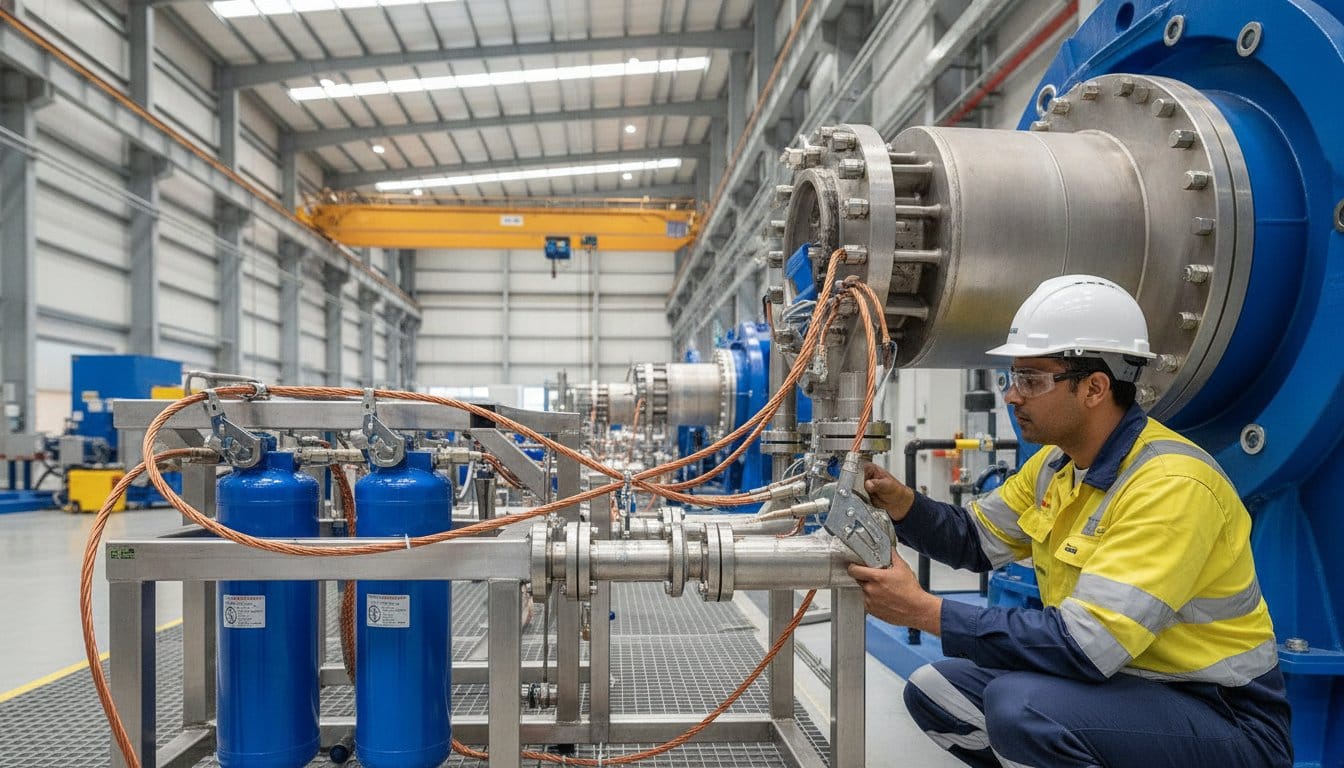
You might think a high-velocity flush is simply about removing debris, but without the right safeguards, the very process meant to protect your machinery could be triggering invisible electrical arcs that pit bearings and degrade oil. Research indicates that over 75% of rotating equipment failures are directly linked to fluid contamination, yet many operators overlook the role of static electricity in this equation. Mastering the equipotential bonding of lube oil systems in service and when flushing is not just a safety checkbox; it’s a vital contamination control strategy. When modern, highly refined oils move at high speeds through filters, they generate triboelectric charges that can lead to catastrophic fires or subtle, long-term component damage.
We understand that maintaining 100% safety compliance while chasing stringent ISO 4406 cleanliness targets is a complex balancing act. You’ve worked hard to eliminate mill scale and welding slag, so it’s only logical to protect that investment from the hidden threat of electrostatic discharge and accelerated varnish formation. This guide explains the technical requirements and safety protocols for effective bonding to ensure your assets remain reliable. We’ll clarify the essential differences between grounding and bonding while providing a clear roadmap for implementing these protections during your next maintenance cycle.
Key Takeaways
- Learn the fundamental difference between simple grounding and equipotential bonding to effectively eliminate electrical potential differences between conductive system parts.
- Understand the physics of triboelectric charging and why modern, low-conductivity lubricants are particularly susceptible to dangerous static build-up during high-velocity flow.
- Identify the critical risks associated with inadequate equipotential bonding of lube oil systems in service and when flushing, ranging from fire hazards to subtle bearing pitting.
- Gain a practical understanding of how to maintain electrical continuity across temporary equipment and non-conductive components like rubber hoses during maintenance.
- Discover how integrating these safety protocols into your maintenance strategy prevents accelerated oil degradation and ensures the long-term reliability of high-value assets.
What is Equipotential Bonding in Lube Oil Systems?
Equipotential bonding is the technical practice of intentionally joining all metal parts within a system to ensure they remain at the same electrical potential. To understand What is Equipotential Bonding in an industrial context, one must look beyond simple electrical safety. It serves as a sophisticated preventative measure against the accumulation of static charges that naturally occur when fluids move through complex piping networks. The equipotential bonding of lube oil systems in service and when flushing is especially critical because modern, highly refined lubricants often act as effective insulators. These oils allow charges to build up rather than dissipate naturally, creating a silent threat to equipment integrity.
Industrial systems are uniquely susceptible to charge accumulation due to high-velocity fluid transfer. As oil moves through pipes, valves, and filter media, friction creates a phenomenon known as triboelectric charging. Without a dedicated bonding network, different sections of the machinery can develop varying electrical potentials. This imbalance creates a risk of sparking, which can lead to rapid oil degradation or, in volatile environments, catastrophic ignition. Establishing a uniform potential across the entire system is the only way to neutralize these risks effectively.
Bonding vs. Grounding: A Critical Distinction
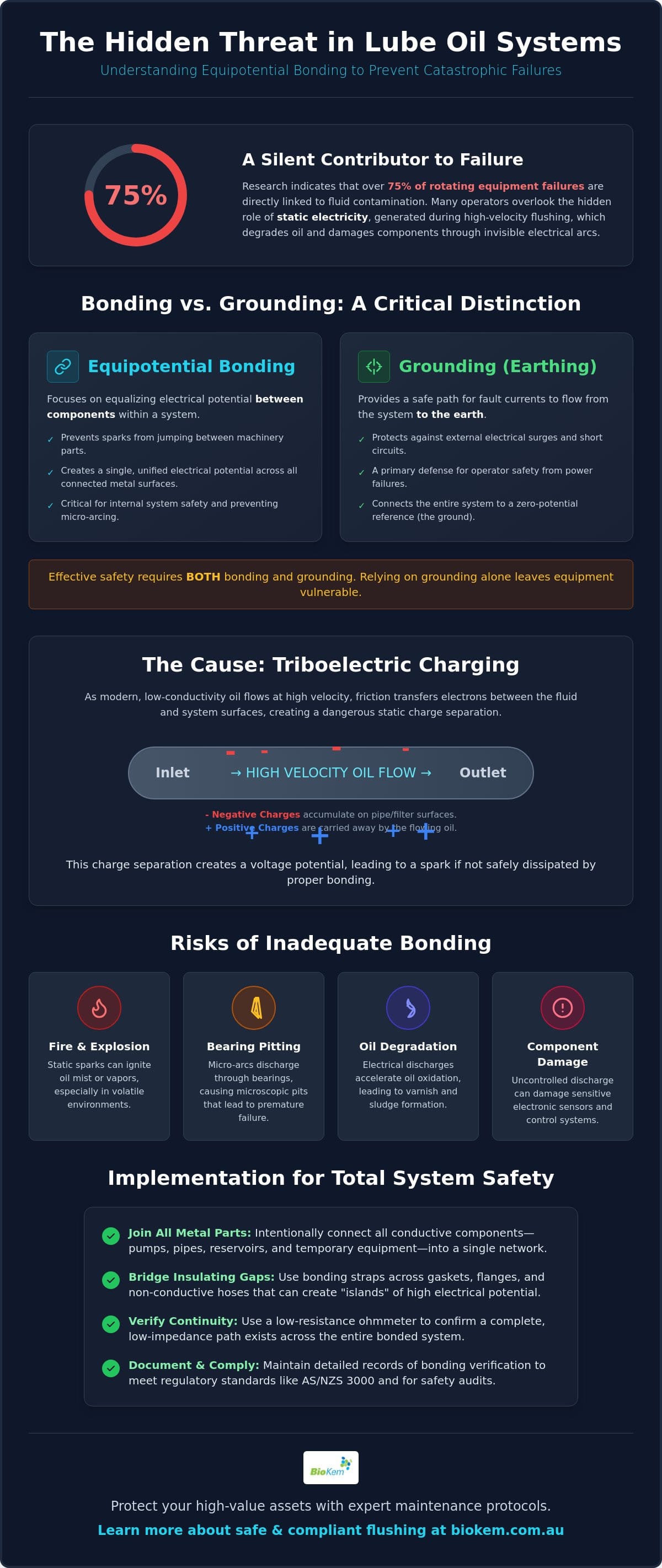
Grounding and bonding are often used interchangeably, but they perform distinct functions during a hot oil flushing operation. Grounding provides a direct, low-resistance path to the earth to safely redirect fault currents from electrical equipment. It’s a primary defense against external electrical surges and short circuits. It protects the operator and the facility from external power failures.
Bonding, however, focuses on the relationship between conductive components. It ensures that if a static charge develops on a pump housing, it’s shared instantly with the connected piping and the reservoir. By equalizing the potential across every metal surface, you eliminate the possibility of a spark jumping between them. You need both systems to achieve 100% safety compliance during high-velocity maintenance. Relying on grounding alone leaves internal components vulnerable to static discharge.
Regulatory Standards and Compliance in Australia
In Australia, industrial electrical safety is governed by rigorous frameworks like AS/NZS 3000. These standards mandate that all conductive parts in hazardous areas, or those prone to static build-up, must be effectively bonded. During a maintenance flush, maintaining electrical continuity across pipe flanges is a common point of failure. Paint, gaskets, and surface corrosion can insulate one section of pipe from another, creating “islands” of high electrical potential.
Compliance requires more than just attaching a few clips. Technicians must verify continuity with low-resistance ohmmeters and maintain detailed documentation for safety audits. This structured approach ensures that every deployment meets regional regulatory standards while protecting high-value assets from the subtle, destructive effects of micro-arcing. Proper documentation also provides a clear trail of responsibility, demonstrating a commitment to long-term ecological and operational health.
Triboelectric Charging: The Physics of Static in Oil
The primary driver behind static accumulation in industrial lubricants is a physical process known as Triboelectric Charging. This occurs when friction is generated between the flowing oil and the internal surfaces of the piping, valves, and filter housings. As the fluid moves, electrons are transferred between the liquid and the solid boundaries, creating a separation of charges. In a grounded and bonded system, these charges dissipate harmlessly. However, without the proper equipotential bonding of lube oil systems in service and when flushing, this charge density can reach levels where it seeks a path to ground through the air or across internal components, resulting in a spark.
Several variables influence the rate of charge generation, including temperature, flow rate, and the type of filter media used. Higher temperatures can lower oil viscosity, which often increases the velocity of the fluid and the subsequent friction. Similarly, the specific material of the filter media can act as a significant site for charge separation. When these factors combine during a maintenance cycle, the potential for a discharge event increases significantly. Ensuring electrical continuity across all these points is the only way to mitigate the inherent physics of fluid movement.
The Role of Oil Conductivity
Modern industrial lubricants, particularly those formulated with Group II and Group III base oils, have undergone extensive refining to remove impurities and improve performance. While this makes the oil more stable and environmentally friendly, it also significantly reduces its electrical conductivity. These highly refined oils act as insulators, meaning they don’t allow static charges to migrate to the pipe walls where they could be dissipated. This low conductivity ensures that charges remain “trapped” within the fluid as it moves through the system.
Additives also play a complex role in this dynamic. While some additives can slightly improve conductivity, others may exacerbate the problem of charge separation. Testing oil conductivity is a critical component of a proactive maintenance strategy. By understanding the electrical properties of the specific lubricant in use, operators can better calibrate their bonding protocols to prevent micro-arcing and the subsequent chemical breakdown of the oil.
Charge Generation During High-Velocity Flushing
To achieve a successful flush, technicians must reach a Reynolds Number exceeding 4,000. This level of turbulence is necessary to scour internal surfaces and dislodge contaminants like mill scale or welding slag. However, this high velocity creates a “streaming current,” which is a continuous flow of electrical charge along with the oil. The faster the oil moves to meet cleanliness targets, the higher the static charge density becomes. This makes hot oil flushing projects a period of heightened risk for static discharge.
Flushing skids and temporary piping are often high-risk zones because they may not be integrated into the plant’s permanent grounding network. If you’re managing a complex system overhaul, utilizing specialist oil filters designed to minimize static can help, but they aren’t a substitute for a complete bonding network. Every temporary connection must be verified for electrical continuity to ensure the streaming current doesn’t find a destructive path through sensitive bearings or seals.
Risks of Inadequate Bonding: Beyond Fire Hazards
While fire and explosion risks in hazardous zones are the most immediate concerns, the hidden operational costs of poor bonding are often more damaging over time. Inadequate equipotential bonding of lube oil systems in service and when flushing allows for uncontrolled electrostatic discharge (ESD). This doesn’t just threaten safety; it actively compromises the chemical stability of the lubricant and the physical integrity of the machinery. When a spark jumps through a filter element, it can burn microscopic holes in the media, effectively bypassing the filtration system and allowing contaminants back into the clean oil stream.
The impact on oil cleanliness is immediate and measurable. Sparking through the filter media can lead to a sudden spike in ISO 4406 codes, even if the system was previously stable. This phenomenon creates a paradox where the very act of filtration generates more contaminants than it removes. Maintaining electrical continuity across the entire fluid path is the only way to ensure that the filtration process remains effective and that the oil’s integrity isn’t compromised by internal arcing.
Electrostatic Discharge and Varnish Formation
One of the most significant yet overlooked consequences of ESD is its role in accelerating oil degradation. When an electrical arc occurs within the oil, it creates localized “hot spots” where temperatures can reach extreme levels for a fraction of a second. This intense heat causes thermal cracking of the oil molecules, leading to the rapid formation of free radicals and insoluble sub-micron particles. These particles are the primary precursors to varnish, a sticky residue that coats internal surfaces and causes valves to stick or sensors to fail.
This chemical breakdown creates a cycle of degradation that traditional filtration alone cannot solve. While integrating varnish removal systems is an excellent proactive measure, preventing the initial spark is far more efficient. Proper bonding ensures that these thermal cracking events never occur, preserving the oil’s molecular structure and extending its service life. This approach aligns with a commitment to long-term ecological health by reducing the frequency of oil changes and minimizing waste generation.
Mechanical Damage to Critical Assets
Beyond oil chemistry, stray currents cause direct physical damage to high-value components. Journal bearings and gear teeth are particularly vulnerable to electrical pitting. As charges build up, they often seek a path to ground through the thin oil film separating moving parts. When the potential difference becomes high enough, it bridges the gap, creating a micro-arc that melts a tiny portion of the metal surface. Over millions of cycles, these microscopic pits lead to surface fatigue, increased vibration, and eventual failure.
Adhering to Industrial Bonding Standards and Practices is essential for preventing these stray currents from bypassing traditional grounding. If the equipotential bonding of lube oil systems in service and when flushing is neglected, these charges will find the path of least resistance through your most sensitive assets. Research shows that over 75% of rotating equipment failures are linked to contamination, but a significant portion of that damage starts with electrical pitting. Managing potential differences is a fundamental requirement for any operator aiming for maximum reliability in their rotating equipment.
Implementing Bonding: Service vs. Flushing
Transitioning from theoretical risk to practical application requires a structured approach to hardware installation. While permanent lube oil systems often feature built-in grounding, the introduction of temporary equipment for maintenance creates new electrical gaps. The equipotential bonding of lube oil systems in service and when flushing must account for every temporary connection, from the pump skid to the return lines. Ensuring that these components share the same electrical potential prevents the static build-up discussed in previous sections from finding a destructive path through your bearings.
A major challenge in temporary setups is the use of non-conductive components like rubber or polymer hoses. Even hoses with stainless steel braiding may not provide a reliable electrical path if the fittings aren’t properly bonded to the core. To maintain continuity, technicians must install dedicated bonding jumpers across every hose and flange connection. This creates a continuous, low-resistance loop that safely returns charges to the main reservoir or plant ground, neutralizing the streaming current before it can arc.
Bonding Temporary Flushing Jumpers
Successful implementation starts with selecting the correct materials. Flexible copper bonding cables, typically 4 AWG or larger depending on site-specific requirements, provide the necessary durability for industrial environments. These cables must be attached to clean, unpainted metal surfaces using heavy-duty clamps or bolted lugs. If you’re utilizing paddle flushing screens to verify cleanliness, these insertion points must be bridged with jumpers to ensure the screen assembly doesn’t become an isolated island of high electrical potential.
Verification and Continuity Testing
Installation is only the first step; verification is what ensures safety. The maximum allowable resistance for an effective equipotential bond is typically 10 ohms or less to ensure adequate charge dissipation. Using a calibrated low-resistance ohmmeter, technicians should test every connection point before the flush begins and at regular intervals throughout the project. For 24/7 operations, testing at every shift change is a best practice to account for vibration or thermal expansion that might loosen a connection.
Logging these results is essential for maintaining a clear safety trail and preserving OEM warranties. If a component fails later in the asset’s life, documented proof of proper bonding during maintenance can be a critical piece of evidence. If you’re planning a major system overhaul, ensure your service provider prioritizes these protocols. For expert assistance in managing these technical requirements, consider partnering with a specialist for your next hot oil flushing project to ensure full compliance and asset protection.
BioKem Expertise: Safe and Compliant Flushing
BioKem Oil Services has specialized in high-velocity hot oil flushing since 2011, positioning itself as a leader in industrial asset protection across Australia. Our commitment to safety is anchored in strict adherence to AS/NZS 4801 standards for our mobile teams, ensuring that every deployment meets rigorous regional regulatory requirements. We recognize that the equipotential bonding of lube oil systems in service and when flushing is a non-negotiable component of modern maintenance. By integrating these protocols into every project, we eliminate the risks of static discharge that can compromise both personnel safety and equipment longevity.
Our fleet of specialized equipment hire includes flushing skids and filtration units designed with built-in safety features to facilitate rapid and secure bonding. BioKem technicians aren’t only trained in the mechanical aspects of achieving turbulent flow; they’re also experts in electrostatic discharge (ESD) mitigation. This dual expertise ensures that while we meet stringent ISO 4406 cleanliness targets, we simultaneously protect the molecular integrity of the lubricant and the physical surfaces of critical bearings and seals.
Total Fluid Management Solutions
We provide a holistic approach to asset health by combining electrical safety with advanced oil analysis. This allows us to monitor the chemical state of the lubricant in real-time, identifying the early signs of thermal degradation or varnish formation before they lead to system failure. As the sole Australian distributor for Filters S.p.A. products, we utilize specialized anti-static filter elements that are specifically engineered to minimize charge separation during high-velocity flow.
These onsite services are designed to minimize downtime while maximizing reliability. By addressing the root causes of contamination and oil degradation, we help operators transition from reactive repair models toward proactive safeguards. Our use of high-efficiency filtration reduces the total cost of ownership and aligns with modern environmental standards by extending the useful life of industrial oils. This sustainable approach treats oil as a valuable asset rather than a consumable waste product.
Partnering for Industrial Reliability
Major Australian industrial sites trust BioKem for critical asset maintenance because of our turnkey service model. We handle every aspect of a hot oil flushing project, from initial system mapping to final cleanliness verification using real-time laser particle counting. This comprehensive oversight includes rigorous project management and safety compliance, ensuring that every flange, hose, and jumper is correctly bonded according to the technical requirements discussed throughout this guide.
Choosing a partner with deep localized expertise ensures that your asset reliability goals are anchored in a dependable, compliant context. Our focus on long-term ecological health and operational efficiency makes us a reliable partner for solving complex industrial challenges. Contact BioKem for a technical consultation on your next flushing project to ensure your systems are protected by the highest standards of equipotential bonding and technical excellence.
Secure Your Assets with Technical Precision
Neglecting electrical continuity during maintenance can lead to invisible component pitting and accelerated oil degradation. By prioritizing the equipotential bonding of lube oil systems in service and when flushing, you transform a routine procedure into a robust asset protection strategy. This commitment to technical detail prevents the costly formation of varnish and ensures your rotating equipment operates at peak reliability. Establishing a uniform electrical potential is the only way to neutralize the inherent risks of high-velocity fluid movement.
BioKem provides the specialized expertise required to navigate these complexities safely. As the sole Australian distributor for Filters S.p.A. and a provider of ISO 4406 compliant reporting, we ensure every project meets the highest industry standards. Our specialist technicians use advanced high-velocity methods that balance aggressive cleaning with absolute electrical safety. We’re here to help you maintain the long-term health of your industrial lubricants and critical machinery.
Request a Quote for Professional Hot Oil Flushing Services
Taking these proactive steps today will safeguard your high-value machinery and ensure operational excellence for years to come.
Frequently Asked Questions
Is equipotential bonding the same as grounding a lube oil system?
No, these are distinct safety practices. Grounding provides a path to the earth for fault currents to protect personnel and equipment from external electrical surges. Bonding connects all conductive parts of the system to ensure they share the same electrical potential, which specifically prevents static sparks from jumping between internal components.
Why does high-velocity flushing increase the risk of static discharge?
High-velocity flow increases the friction between the lubricant and the internal pipe walls, accelerating a process known as triboelectric charging. To achieve the turbulent flow required for a successful flush, the Reynolds Number must exceed 4,000. This increased speed generates a higher density of streaming current, which can lead to dangerous discharge if not managed.
Can static discharge in a lube oil system cause varnish?
Yes, electrostatic discharge (ESD) is a known catalyst for varnish formation. When a spark occurs within the oil, it creates localized high-temperature zones that thermally crack the oil molecules. This degradation produces insoluble sub-micron particles that eventually settle as sticky varnish on valves, sensors, and bearing surfaces.
What are the Australian standards for bonding in industrial oil systems?
In Australia, industrial electrical safety and bonding are primarily governed by AS/NZS 3000. For mobile teams performing remote deployments, adherence to AS/NZS 4801 is also critical. These standards ensure that all conductive parts in hazardous or high-flow areas are effectively joined to prevent the accumulation of static electricity.
Do I need to bond stainless steel pipes during flushing?
Yes, stainless steel components must be bonded because they can still become electrically isolated. Gaskets, paint, and thread sealants often act as insulators between pipe sections, creating “islands” of high electrical potential. The equipotential bonding of lube oil systems in service and when flushing ensures that every section of stainless steel remains at a uniform potential.
How do I test if my lube oil system is correctly bonded?
Technicians use a calibrated low-resistance ohmmeter to verify electrical continuity across the entire system. A successful bond typically shows a resistance of less than 10 ohms between any two connected points. It’s essential to perform these tests before starting a flush and at regular intervals throughout the project to account for vibration.
What happens if a lube oil system is not bonded during service?
Failing to bond a system can lead to catastrophic ignition in volatile environments or subtle, long-term mechanical damage. Micro-arcing across bearing oil films causes surface pitting and fatigue, which are linked to over 75% of rotating equipment failures. This lack of protection significantly increases the total cost of ownership through premature component failure.
Can I use standard electrical wire for temporary flushing bonding?
It’s best to use dedicated, flexible copper bonding cables, usually 4 AWG or larger, designed for industrial environments. Standard residential wire lacks the mechanical durability and the specific current-carrying capacity needed for high-flow flushing skids. Heavy-duty clamps are also required to ensure a secure, low-resistance connection to unpainted metal surfaces.