


What if darker turbine oil is a warning worth investigating, but not a reason to replace it immediately? If you’re asking, “My Turbine Oil Is Darkening: Should I Be Concerned?” the answer is possibly. Colour alone can’t reveal why the oil changed or whether it is unfit for service. Thermal stress, oxidation and other operating conditions can alter oil appearance, but dark oil does not automatically mean varnish is forming.
Replacing oil before reviewing the evidence can create avoidable waste, while dismissing a genuine change may leave a lubricant or equipment issue unaddressed. Start by recording what changed, checking the operating context and comparing representative sample results with previous data. This article explains what darkening may indicate, what observations can help assess it, and how condition monitoring and patch analysis can add context. Use the findings and applicable turbine and lubricant requirements to guide the next step, rather than relying on colour alone.
Key Takeaways
- “My Turbine Oil Is Darkening: Should I Be Concerned?” Treat the colour change as a prompt to assess, not a standalone reason to intervene.
- Record when and where the change appears, then review operating conditions that may help explain it.
- Representative oil sampling and comparison with historical results provide more useful context than appearance alone.
- Use the evidence to decide whether to continue monitoring, investigate further or consider targeted support such as Condition Monitoring or patch analysis.
Darkening Turbine Oil: What the Colour Change Can, and Cannot, Tell You
A change in turbine oil colour warrants attention, but it doesn’t establish a cause by itself. If you’re asking, “My Turbine Oil Is Darkening: Should I Be Concerned?” treat the change as an observation to investigate, not a diagnosis or an automatic reason to replace the oil.
Darkening means the oil looks different from its earlier appearance or a suitable reference sample. Visual appearance is not the same as measured lubricant condition. Oil colour alone cannot confirm degradation, contamination or varnish. The Turbine Oil Overview describes turbine oil’s role and notes oxidation as a possible degradation mechanism.
Varnish is one possible concern, but dark colour alone doesn’t show whether degradation products have become insoluble and formed deposits. BioKem’s guide to varnish in lubricating oil explains why deposits should be assessed as part of a broader condition review.
For context on varnish issues in turbine systems, watch this video:
Why can turbine oil change colour during service?
Oxidation can alter oil chemistry and contribute to darker compounds. Contamination may also affect appearance, but visual inspection can’t identify the material or where it came from. Heat, aeration and catalytic metals can contribute to degradation; the operating history helps establish whether these conditions may be relevant.
Interpret colour in context. Compare samples taken using consistent methods, and consider the oil formulation, service history, sampling location and what inspection reveals about the system. A change in one sample may not represent the whole reservoir. Analysis and patch assessment can add evidence, while interpretation should follow applicable lubricant and turbine OEM requirements.
How to Assess Darkening Turbine Oil Before Choosing an Action
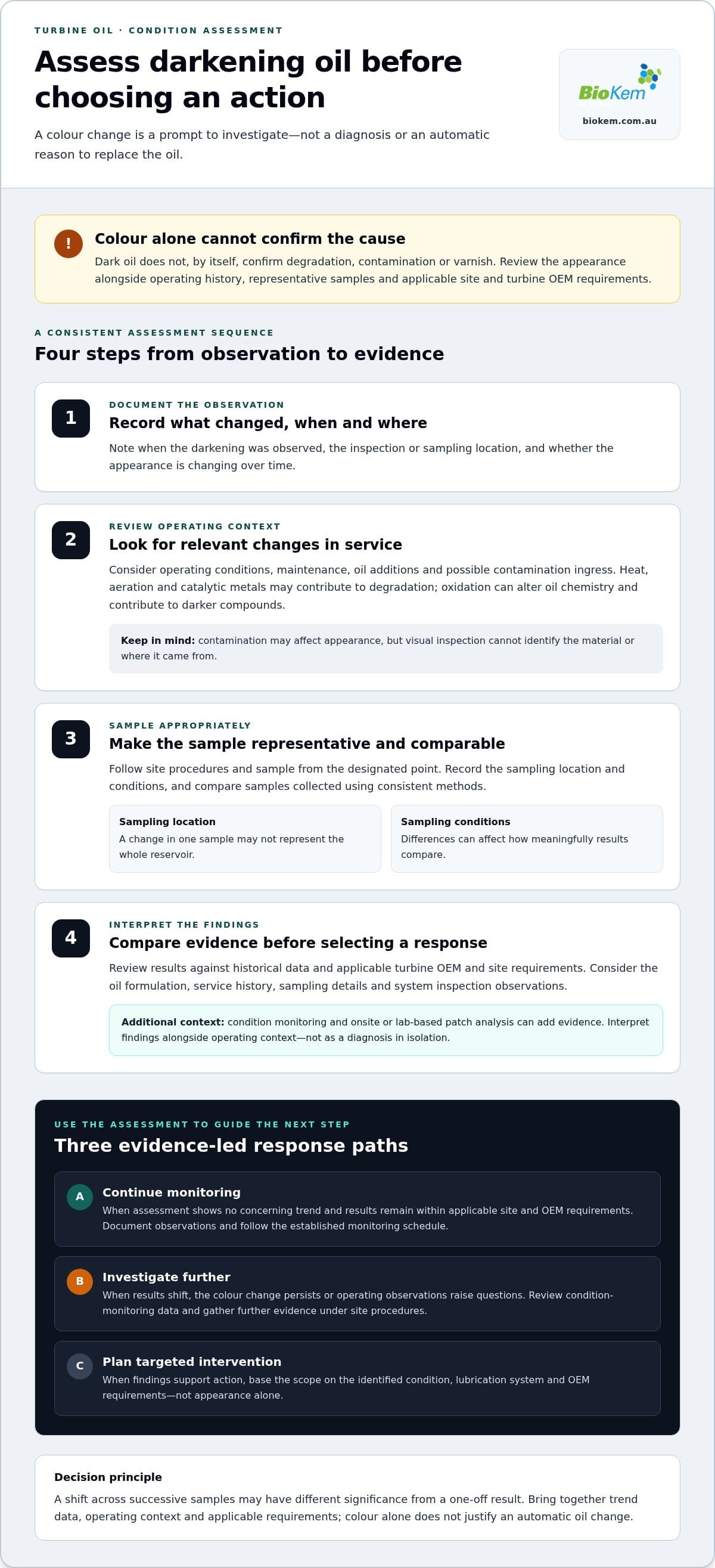
If you’re asking, “My Turbine Oil Is Darkening: Should I Be Concerned?” use a consistent assessment sequence before deciding what to do. A documented change, operating context and representative analysis together provide a stronger basis for action than a visual check alone.
- Record the change. Note when it was observed, where the oil was sampled or inspected, and whether the appearance is changing over time.
- Review operating context. Consider relevant changes such as operating conditions, maintenance, oil additions or possible contamination ingress.
- Sample appropriately. Follow site procedures and use a representative sample from the designated point. Record the sampling location and conditions so results can be compared meaningfully.
- Interpret the findings. Compare results with historical data and assess them against applicable turbine OEM and site requirements before selecting a response.
Trend data and lubricant analysis provide stronger evidence than colour alone. A shift across successive samples may have different significance from a one-off result, particularly if the sampling locations or conditions differ.
Which findings help distinguish a colour change from a condition problem?
Condition monitoring can place sample results alongside operating history. Onsite or lab-based patch analysis can add evidence about material captured from the oil. Neither should be treated as a diagnosis in isolation. Interpret findings in context, and use applicable OEM guidance and site requirements for thresholds and acceptance criteria. For broader context on a contamination pathway, see BioKem’s guide to microbial contamination in lubricating oil.
BioKem provides Condition Monitoring and onsite and lab-based patch analysis for energy-generation turbine applications. The findings can be reviewed alongside the lubrication system’s operating context. Discuss turbine-oil assessment with BioKem.
What to Do Next About Darkening Turbine Oil
If you’re asking, “My Turbine Oil Is Darkening: Should I Be Concerned?” let the evidence guide the response. A colour change alone doesn’t justify an automatic oil change, but it shouldn’t be dismissed if other findings point to a developing issue.
- Continue monitoring when assessment shows no concerning trend and results remain within applicable site and OEM requirements. Document observations and follow the established monitoring schedule.
- Investigate further when results shift, the colour change persists or operating observations raise questions. Review condition-monitoring data and gather further evidence under site procedures.
- Plan targeted intervention when the findings support action. Base the scope on the identified condition, lubrication system and OEM requirements, rather than appearance alone.
When can specialist turbine-oil support help?
Specialist input can help interpret oil-condition findings and identify a proportionate next step. BioKem supports energy-generation turbine applications through Condition Monitoring, onsite and lab-based patch analysis, and Varnish Removal (VRS). If analysis indicates varnish is relevant, varnish mitigation support can be considered alongside system requirements and site procedures.
BioKem tailors solutions to the lubrication system and assessment findings. Its Australia-wide service coverage and staff’s over 70 years of combined industry experience support evidence-led planning. Base any maintenance decision on the full assessment, not a single observation or result.
If you have turbine-oil findings you’d like to discuss, speak with BioKem about your assessment and the appropriate next step.
Make the Next Maintenance Decision Evidence-Led
A colour change can prompt a useful maintenance question: what does the oil’s condition mean for this system, and what response is justified by the findings? Bring together sample results, operating context and site requirements before deciding whether to monitor, investigate or plan an intervention.
If you’re still asking, “My Turbine Oil Is Darkening: Should I Be Concerned?” you don’t have to make that decision from appearance alone. BioKem’s turbine-oil support includes Condition Monitoring and onsite and lab-based patch analysis, helping teams review findings in context. Its staff bring over 70 years of combined industry experience, with Australia-wide service coverage.
Discuss your turbine-oil condition with BioKem and take a considered next step for your lubrication system.
Frequently Asked Questions
Can turbine oil darken without being degraded?
Yes. “My Turbine Oil Is Darkening: Should I Be Concerned?” is a useful question, but a colour change alone doesn’t prove the oil has failed its service requirements. Differences in lighting, sample-container cleanliness or comparisons between different oil batches can affect visual judgement. If analysis remains consistent with applicable OEM and site criteria, assess the change in context rather than condemning the oil on appearance alone.
Does dark turbine oil always mean varnish?
No. Dark oil doesn’t establish that varnish is present. Operational clues such as sticky servo response, restricted filters or deposits on cooler surfaces may justify closer investigation, but they aren’t proof on their own. Record when symptoms occur and follow site procedures for inspection and analysis before deciding whether a varnish-focused response is appropriate.
How soon should turbine oil be sampled after a colour change?
Arrange sampling as soon as practical under site procedures, particularly if the change is abrupt or coincides with unusual equipment behaviour. Don’t wait for the next routine sample if operating symptoms have also appeared. If the change is gradual and equipment is operating normally, use the planned sampling point and consistent conditions so the result can be compared meaningfully with previous data.

Article by
James McAllister
James McAllister is an industry professional with BioKem Oil Services, specialising in lubrication reliability, oil filtration, contamination control and asset performance. Drawing on BioKem's extensive field experience across turbines, compressors, hydraulic systems and critical rotating equipment, James writes practical, insight-driven articles that help maintenance and reliability teams improve equipment performance, extend asset life and reduce operational risk.