

Unscheduled downtime for a critical turbine can exceed A$40,000 per hour, a staggering figure that makes the commissioning phase of any project feel like a high-stakes gamble. It’s a common frustration for operators to manage construction debris in new lubrication circuits while trying to decipher complex OEM technical specifications. Avoiding turbine bathtub failure curve by oil flushing of new Solar turbine packages in accordance with ES2184 isn’t just a recommendation for compliance; it’s a vital engineering intervention designed to flatten the infant mortality peak of your equipment.
You’ll learn how to eliminate these early-stage risks by implementing precision hot oil flushing according to the Solar Turbines ES 2184 Revision H standard. We’ll explore why achieving a Reynolds number of 4,000 or greater is essential for turbulent flow and how proactive filtration protects your warranty. This guide provides a clear path toward successful commissioning, ensuring your asset moves past the initial failure risks and into a long, reliable service life.
Key Takeaways
- Understand the high-risk “infant mortality” phase of the bathtub curve and how it specifically applies to new rotating machinery during commissioning.
- Learn the essential technical requirements for avoiding turbine bathtub failure curve by oil flushing of new Solar turbine packages in accordance with ES2184.
- Identify how particulate contamination triggers abrasive wear in bearings and leads to governor instability during the early stages of operation.
- Discover why high-velocity hot oil flushing is the preferred method for achieving the turbulent flow necessary to dislodge construction-related debris.
- Evaluate technical solutions for successful commissioning, ranging from expert onsite labor to specialized equipment hire for lubrication circuit maintenance.
Table of Contents
The Bathtub Curve and Turbine Infant Mortality
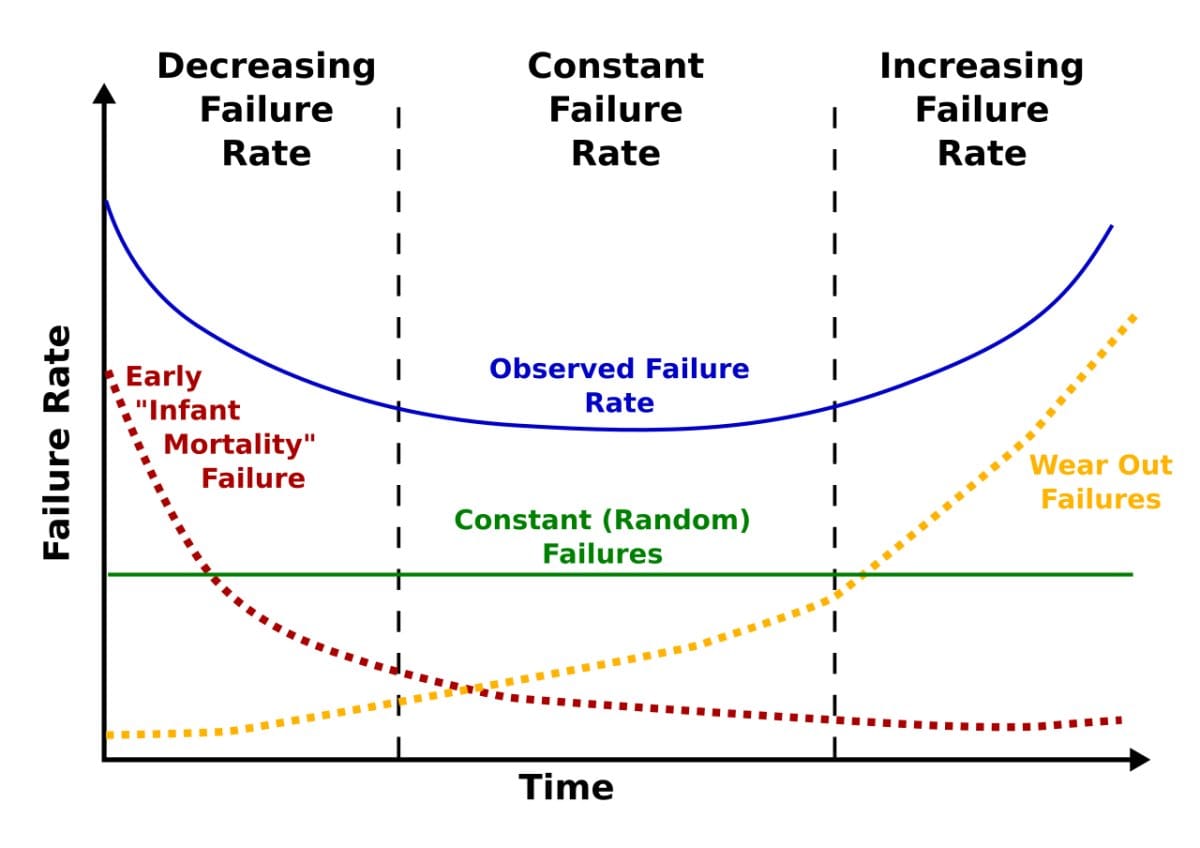
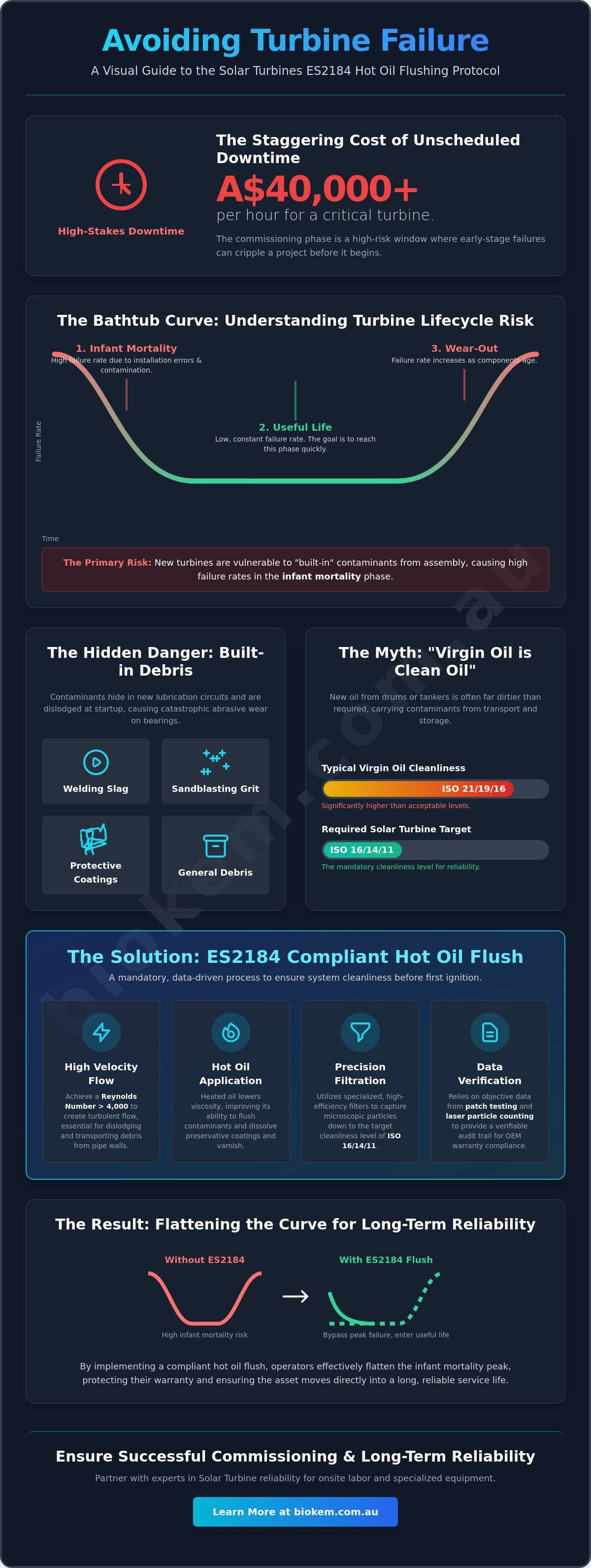
The reliability of rotating machinery follows a predictable statistical pattern known as the Bathtub Curve. This model illustrates three distinct periods in an asset’s lifecycle. First is the "infant mortality" phase, where failure rates are high due to manufacturing defects or installation errors. Next is the "useful life" period, characterized by a low, constant failure rate. Finally, the "wear-out" phase sees failures rise again as components reach their mechanical limits. For operators, the most dangerous period is the initial commissioning. Unscheduled downtime during this phase can cost upwards of A$40,000 per hour, making the first 100 hours of operation a critical risk window.
New Solar turbine packages are particularly vulnerable because they often contain "built-in" contamination from the assembly process. Avoiding turbine bathtub failure curve by oil flushing of new Solar turbine packages in accordance with ES2184 is the primary engineering safeguard against these early failures. By adhering to the ES2184 Revision H standard, operators can effectively bypass the infant mortality peak and move directly into the stable useful life phase.
To better understand this concept, watch this helpful video:
The Risk of Construction Debris in New Systems
Even in controlled factory environments, the assembly of large-scale turbine packages introduces foreign matter into the lubrication circuit. Common contaminants include welding slag, sandblasting grit, and protective preservative coatings applied to internal pipework. These particles often hide in "dead legs" or complex manifold geometries. They remain dormant until the first high-pressure startup. When the system goes live, this debris bypasses standard filters and enters high-speed turbine bearings. The resulting abrasive wear can compromise critical tolerances in seconds. It’s a mechanical reality that "hard" particles don’t just circulate; they embed. This leads to vibration issues and thermal instability that can sideline a project before it fully begins.
Why Virgin Oil is Not Clean Oil
It’s a common misconception that oil delivered in drums or tankers is ready for high-performance service. In reality, new oil often carries a particulate load as high as ISO 21/19/16. This level of contamination is significantly higher than the 16/14/11 target typically required for Solar Turbine systems. Contamination occurs during transport, pumping, and site-side storage in bulk tanks. Because of this, the ES2184 standard mandates rigorous pre-filtration of all lubricants. Simply filling a system with new oil without hot oil flushing and precision filtration invites the very infant mortality risks the specification aims to prevent. High-velocity flushing ensures that both the oil and the system it protects reach the necessary cleanliness levels for long-term reliability.
Decoding the ES2184 Specification for Solar Turbines
The Solar Turbines ES2184 specification serves as the definitive engineering protocol for the cleaning and flushing of hydraulic and lubrication systems. It’s a comprehensive standard that applies to both Solar Turbines and Caterpillar packages, ensuring that every internal surface is free from the contaminants that jeopardize early operation. Avoiding turbine bathtub failure curve by oil flushing of new Solar turbine packages in accordance with ES2184 requires strict adherence to Revision H, which was issued on April 19, 2018. This document isn’t merely a guideline; it’s a mandatory roadmap for commissioning engineers to follow before the first ignition.
Verification is the cornerstone of the ES2184 process. It’s not enough to simply circulate oil; the results must be quantified through rigorous patch testing and laser particle counting. An ES2184 Compliant Hot Oil Flush relies on objective data rather than visual inspection to confirm system readiness. Technicians must document that the fluid has reached the specific cleanliness thresholds defined by the OEM, providing a verifiable audit trail for warranty compliance and long-term asset reliability. If you’re preparing for a new installation, the specialized hot oil flushing services provided by BioKem Oil Services ensure your system meets these exacting requirements from day one.
Cleanliness Standards: ISO 4406 and Beyond
ES2184 specifies stringent ISO 4406 cleanliness codes, typically targeting levels like 16/14/11 or better. Some high-pressure hydraulic circuits may even require 14/12/10 to protect sensitive servo valves. There’s a massive difference between oil that looks "visibly clean" and oil that is "technically clean" at the microscopic level. High-velocity flushing is non-negotiable because it provides the kinetic energy needed to dislodge sub-micron particles that standard filtration cannot capture during normal operation. Without this mechanical scrubbing, these particles remain dormant until they cause a catastrophic failure during the first 100 hours of service.
The Importance of Reynolds Number in Flushing
To remove contaminants effectively, the oil must move in a state of turbulent flow rather than laminar flow. Laminar flow is smooth and orderly, which unfortunately allows particles to stay trapped against the pipe walls. Turbulent flow is chaotic and aggressive. ES2184 requires a Reynolds number of 4,000 or greater to achieve this scrubbing effect. Calculating the required flow rate involves balancing fluid viscosity, pipe diameter, and temperature. BioKem Oil Services utilizes high-flow pumping units specifically designed to maintain these critical Reynolds numbers across the entire lubrication circuit, ensuring no debris is left behind.
How Contamination Triggers Bathtub Curve Failures
The mechanical integrity of a new Solar turbine package depends entirely on the cleanliness of its initial environment. While the previous sections outlined the statistical probability of early failure, the physical mechanism is almost always driven by microscopic debris. Avoiding turbine bathtub failure curve by oil flushing of new Solar turbine packages in accordance with ES2184 addresses the root cause of these failures before they can manifest as mechanical damage. When construction residues remain in the system, they act as high-velocity projectiles within the lubrication circuit, directly contributing to the "infant mortality" phase described by The Bathtub Curve.
Contamination isn’t just a particulate problem; it’s a chemical catalyst. Metallic fines like iron and copper, often left behind after pipe fitting or welding, accelerate the oxidation of the lubricant. This process creates a secondary effect where varnish begins to form even in a brand-new system. These degradation products settle on cool surfaces or within tight-tolerance components, leading to thermal instability and restricted oil flow. The financial consequences are severe. With unscheduled downtime exceeding A$40,000 per hour, a single day of lost production can cost a facility more than A$280,000. These costs often lead to complex warranty disputes between operators and OEMs regarding whether the initial flushing met the required ES2184 standards.
Bearing Damage and Surface Fatigue
A single 5-micron particle can easily breach the thin hydrodynamic oil film of a high-speed turbine bearing, leading to direct metal-to-metal contact. This initial impact creates micro-pitting on the journal or thrust bearing surfaces. Over the first few hundred hours of operation, these tiny pits evolve into surface fatigue and eventually cause a catastrophic bearing wipe. Utilizing filter-ferrogram analysis during the commissioning phase can identify these wear patterns early, but the only true protection is the total removal of these particles through a high-velocity flush.
Control System Malfunctions
Sensitive hydraulic control valves and governors are the "brain" of the turbine, and they’re incredibly intolerant of debris. When particulate matter enters the Electro-Hydraulic Control (EHC) system, it causes valve sticking and erratic speed control. This instability often results in nuisance trips or, in worse cases, a failure to respond during an overspeed event. Maintaining reliable EHC system operation requires a fluid environment that is significantly cleaner than what is typically found in a newly assembled package. Without the aggressive scrubbing action of an ES2184-compliant flush, these control issues become an inevitable part of the startup process.
Executing an ES2184 Compliant Hot Oil Flush
The transition from theoretical specification to physical execution begins with a rigorous system audit and the installation of mechanical bypasses. We isolate sensitive components like bearings and servo valves to ensure that the debris dislodged during the process is captured by external filtration rather than being forced into critical tolerances. Avoiding turbine bathtub failure curve by oil flushing of new Solar turbine packages in accordance with ES2184 necessitates this level of mechanical discipline before any fluid circulation begins.
Temperature management is the next technical hurdle. By heating the lubricant, we reduce its viscosity, which allows for the high-velocity cycling required to achieve turbulent energy. Moving the oil at two to three times its normal operational speed creates the necessary kinetic force to scrub the internal pipe walls clean. This process continues until the system meets the quantified purity standards, ensuring that every internal surface is free from construction-related residues.
The Role of Specialized Flushing Rigs
Standard turbine pumps don’t have the flow capacity or filtration depth to execute a technical flush. BioKem Oil Services utilizes specialized high-flow filtration units that are engineered to maintain turbulent flow across the entire lubrication circuit. These rigs incorporate Filters S.p.A. technology to capture sub-micron particles that standard onboard filters would miss. It’s an aggressive, scientific approach that guarantees the system is pristine before the first rotation.
Verification and Certification
Cleanliness is verified through empirical data rather than visual inspection. During the final flushing stages, technicians collect an ISO 4406 compliant oil sample for laboratory-grade patch analysis. We also deploy paddle flushing screens as a physical check for larger debris. Once target codes are achieved, BioKem Oil Services issues a formal cleanliness certificate, providing the documentation required for OEM warranty validation. If your project is nearing the startup phase, contact BioKem Oil Services to discuss our technical execution capabilities.
BioKem Oil Services: Your Partner in Solar Turbine Reliability
BioKem Oil Services acts as a dedicated technical partner for industrial operators during the high-stakes commissioning of new energy assets. We provide the specialized onsite labor and engineering support necessary for avoiding turbine bathtub failure curve by oil flushing of new Solar turbine packages in accordance with ES2184. Our team understands that the first 100 hours of operation represent the most critical risk window for any new installation. By adhering strictly to the Revision H standard, we ensure your equipment moves past the infant mortality phase with its mechanical integrity fully intact.
Our service delivery focuses on both operational success and long-term sustainability. We don’t just replace oil; we purify it. Through advanced varnish mitigation and vacuum dehydration, BioKem Oil Services restores lubricants to technical purity, reducing environmental waste and project costs. Our capabilities extend to comprehensive tank cleaning and precision oil analysis, ensuring every component of the lubrication system is free from microscopic contaminants. Whether you need a full turnkey solution or specialized equipment hire, our offerings are tailored to meet the specific demands of Solar and Caterpillar packages. Our hot oil flushing services are designed to protect your ROI by preventing the premature wear caused by construction-related debris.
Onsite Technical Excellence
The technicians at BioKem Oil Services are specialists who understand the nuances of OEM technical specifications and regional regulatory standards. We maintain a "cleanliness first" culture, recognizing that even a minor particulate load can jeopardize a turbine’s entire lifecycle. By utilizing high-velocity flushing protocols that achieve turbulent flow, we minimize commissioning timelines without compromising quality. Our presence on the ground provides the quiet confidence that your asset is prepared for years of reliable service.
Next Steps for Your Commissioning Project
Successful commissioning starts during the project planning phase rather than the final week of construction. We recommend engaging BioKem Oil Services early to coordinate flushing schedules with other site activities. This proactive approach ensures that all lubrication circuits are verified, documented, and certified before the first ignition. It eliminates the logistical stress of managing last-minute contamination issues. Contact BioKem Oil Services today for a specialized Solar Turbine flushing quote to discuss how our national expertise can anchor your project’s long-term reliability.
Securing Asset Integrity Through Technical Compliance
Successful commissioning requires more than just mechanical assembly; it demands a surgical approach to lubrication system purity. Debris left behind from the construction phase acts as a primary catalyst for early-stage failure. By applying the rigorous protocols of the ES2184 standard, operators effectively mitigate these risks and move straight into the stable operational phase. Avoiding turbine bathtub failure curve by oil flushing of new Solar turbine packages in accordance with ES2184 is a strategic investment that protects both your equipment and your warranty.
BioKem has specialized in high-velocity hot oil flushing since 2011. As an authorized distributor for Filters S.p.A. and Swift Filters, we bring premium filtration technology to every site. Our technical teams provide national Australian service coverage, ensuring your project remains on schedule and your asset remains reliable. Ensure your Solar Turbine reliability with BioKem’s ES2184 flushing services. Protecting your critical infrastructure starts with a commitment to technical excellence from day one.
Frequently Asked Questions
What is the ES2184 specification for Solar Turbines?
The ES2184 specification is the definitive engineering standard for cleaning and flushing hydraulic and lubrication systems on Solar Turbine and Caterpillar packages. The current version, Revision H, was issued on April 19, 2018. It outlines the specific technical requirements for fluid cleanliness, verification methods, and mechanical procedures necessary to ensure a turbine is ready for safe, reliable operation.
How long does a typical hot oil flush take for a Solar package?
A comprehensive hot oil flush typically requires between 1.5 and 2.5 weeks to complete, depending on the system’s complexity and initial contamination levels. This timeline includes the installation of bypasses, the high-velocity flushing period, and final laboratory verification. Proper planning ensures that avoiding turbine bathtub failure curve by oil flushing of new Solar turbine packages in accordance with ES2184 stays within the commissioning window.
Can I use the turbine’s own pumps for an ES2184 flush?
Standard turbine pumps are generally insufficient for an ES2184 compliant flush because they cannot achieve the high flow rates required for turbulent scrubbing. Technical flushing requires specialized external pumping units that move oil at two to three times the normal operational velocity. These rigs are designed to handle high particulate loads and provide the kinetic energy needed to dislodge construction debris from internal pipework.
What is the required Reynolds number for a turbine oil flush?
To achieve effective contaminant removal, a Reynolds number of 4,000 or greater is required throughout the lubrication circuit. This number represents the transition from laminar flow to turbulent flow. While laminar flow is smooth, turbulent flow is chaotic and aggressive, which is essential for scrubbing particles off internal surfaces. BioKem utilizes high-flow filtration units to maintain this critical state during the entire flushing process.
Is oil flushing necessary if I am using brand new oil?
Oil flushing is essential even with brand new oil because virgin lubricants are rarely clean enough for high-speed turbine bearings. New oil often arrives with ISO 4406 codes as high as 21/19/16, while Solar Turbines typically require 16/14/11 or better. Additionally, the flush removes "built-in" contaminants like welding slag and preservative coatings that are already present in the new system’s pipework.
What happens if I skip the oil flushing stage during commissioning?
Skipping the flushing stage significantly increases the risk of "infant mortality" failures during the first 100 hours of operation. Contaminants can cause catastrophic bearing wipes, sticking servo valves, and erratic governor control. With unscheduled downtime costs exceeding A$40,000 per hour, the financial impact of an early failure far outweighs the cost of a compliant flush. It also risks voiding the OEM warranty.
How does ES2184 differ from standard industrial flushing?
ES2184 is a more rigorous, OEM-specific protocol compared to generic industrial flushing standards. It mandates specific verification methods, such as the use of paddle flushing screens and laboratory-grade patch analysis, rather than just visual inspection. The specification is tailored to the precise tolerances of Solar Turbine components, ensuring that the entire lubrication circuit meets the exact cleanliness standards required for long-term reliability.
Does BioKem provide the necessary certification for Solar Turbines warranties?
Yes, BioKem provides comprehensive documentation and cleanliness certificates that satisfy Solar Turbines warranty requirements. We provide detailed oil analysis reports and verification data for every project we undertake. Our expertise in avoiding turbine bathtub failure curve by oil flushing of new Solar turbine packages in accordance with ES2184 ensures your asset is fully compliant with OEM standards before it ever goes online.