


An aftermarket oil additive isn’t automatically an upgrade. Modern engine oils already contain a balanced additive package, and an untested product can disrupt the oil’s properties and potentially harm the engine. Whether you should consider aftermarket oil additive packages depends on the vehicle’s requirements and the specific reason for adding one.
It’s understandable to look for extra protection when an engine or hydraulic system faces demanding conditions. Additives can affect friction, viscosity, wear protection and contamination control, but the right chemistry depends on the lubricant’s purpose. This article explains what additive packages do, how friction modifiers and viscosity index improvers work, and why combining products can create compatibility issues.
You’ll also learn when to rely on the owner’s manual or a qualified mechanic. For industrial equipment, lubricant condition and system requirements are useful starting points for deciding what support may be appropriate.
Key Takeaways
- Compare any proposed additive with the oil specification and requirements in your vehicle’s owner’s manual before using it.
- Learn how friction modifiers and viscosity index improvers affect lubrication, and why their effects depend on the oil formulation.
- Recognise that mixing additives or lubricants can create compatibility problems, so avoid treating extra additives as automatic protection.
- For industrial oil contamination or degradation concerns, consider whether oil analysis, hot oil flushing, varnish mitigation or vacuum dehydration addresses the underlying issue.
Friction reduction and viscosity control
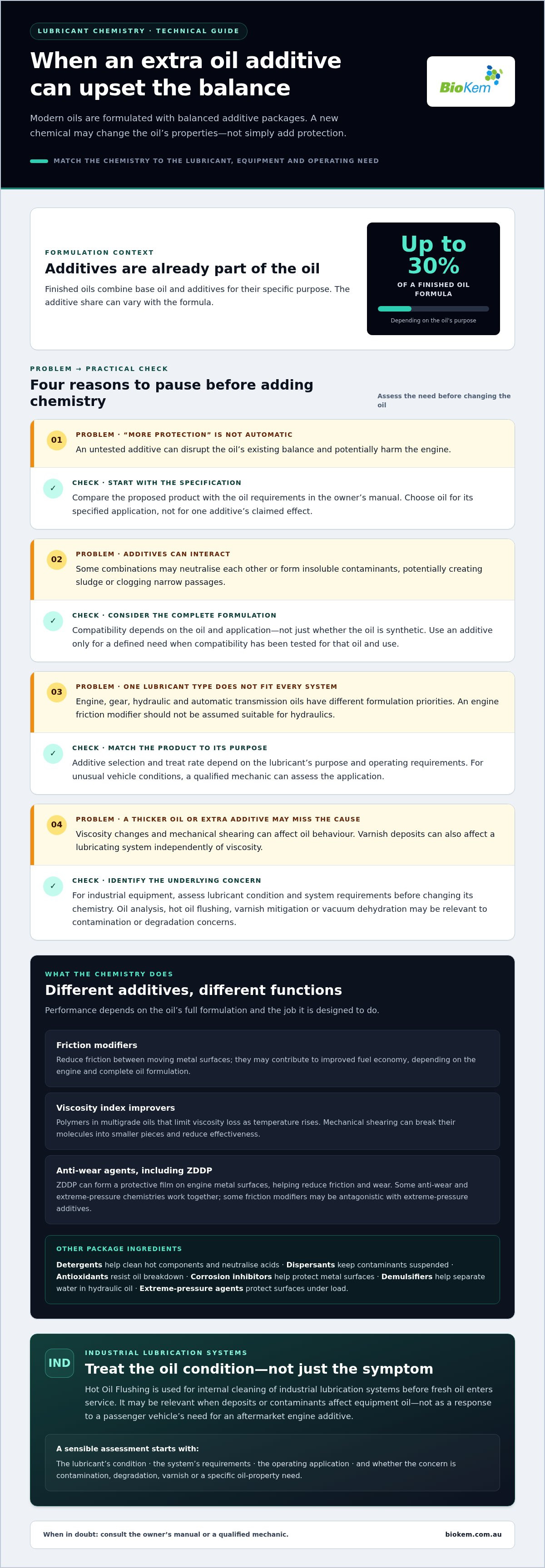
Modern engine oil already blends base oil with additives for specific operating requirements. Adding another chemical package can change that balance rather than simply add protection. Friction modifiers reduce friction between moving metal surfaces and may contribute to improved fuel economy. The result depends on the engine and the complete oil formulation.
Viscosity matters too. Viscosity index improvers are polymers used in multigrade oils to limit viscosity loss as temperature rises. Mechanical shearing can break their molecules into smaller pieces, reducing their effectiveness. A thicker oil or extra additive isn’t automatically the right response.
To see why formulation compatibility matters, watch this explanation:
ZDDP is an anti-wear additive that can form a protective film on engine metal surfaces, helping reduce friction and wear. Some anti-wear and extreme-pressure chemistries work together, while friction modifiers may be antagonistic with extreme-pressure additives. Adding a product without considering the oil’s existing chemistry can undermine its intended performance.
Hydraulic oil has different formulation priorities from engine oil, gear oil or automatic transmission fluid. Additive selection and treat rate depend on the lubricant’s purpose and operating requirements. For example, a friction modifier intended for an engine shouldn’t be assumed suitable for a hydraulic system. Choose oil for its specified application, not for a single additive’s claimed effect.
Varnish deposits can affect lubricating systems independently of viscosity. Understanding varnish in lubricating oil helps distinguish deposit-related concerns from a need to change the oil’s friction characteristics.
Checking the owner’s manual or consulting a mechanic
Start with the owner’s manual, which identifies the engine oil requirements for the vehicle. A qualified mechanic can assess unusual applications or operating conditions.
Additives Versus Approved Engine Oil
Manufacturer-approved engine oil is formulated to meet the vehicle’s specified requirements, while an aftermarket additive supplements that formulation. Choosing oil that matches the manual’s specification is generally the clearest way to meet the engine’s needs. Before adding a product, compare its intended application with the oil’s properties and the engine’s components, including any wear additives or inhibitors already present.
Warranty Considerations
In Australia, an additive may become relevant to a warranty claim if it is linked to an engine problem. That doesn’t mean every additive automatically cancels a warranty: the circumstances and cause of the fault matter. Read the warranty conditions and manual, keep oil and service records, and ask a qualified mechanic how a proposed product could affect the specified lubricant.
Compatibility With Synthetic Oils
Aftermarket packages may be used with synthetic engine oils, but compatibility depends on the complete formulation, not the synthetic label alone. Modern oils already contain balanced additives, so extra chemicals can alter their properties. Use an additive only when it addresses a defined need and its compatibility has been tested for that oil and application. A mechanic can consider operating pressure, engine condition and the intended result.
For industrial systems, a lubricant specialist can help assess oil condition and the operating factors involved. Discuss an industrial oil concern when the issue involves equipment rather than a passenger vehicle.
Functions of lubricant additive packages
Aftermarket engine oil additive packages combine chemical agents intended to change lubricant performance. Ingredients can include detergents, dispersants, antioxidants, anti-wear agents, friction modifiers, viscosity modifiers and pour-point depressants. Additives can make up as much as 30% of a finished oil formula, depending on its purpose.
Australian prices depend on the product’s formulation, intended application, quantity and retail channel. Compare its stated purpose and compatibility with the vehicle’s required oil rather than judging value by the bottle alone.
Each ingredient serves a different function. Detergents help clean hot components and neutralise acids; dispersants keep contaminants suspended. Antioxidants resist oil breakdown, while corrosion inhibitors help protect metal surfaces. In hydraulic oil, demulsifiers help separate water so it can be drained. Extreme-pressure and anti-wear agents protect surfaces under load, although interactions between additives can affect performance.
Should you consider aftermarket oil additive packages for a particular engine concern? First identify the need, then check whether the product suits the oil and vehicle. Untested additives can disrupt engine oil properties and potentially harm the engine. Effects on emissions components, including catalytic converters and diesel particulate filters, depend on the formulation and vehicle requirements.
Before deciding whether you should consider aftermarket oil additive packages, remember that additive chemistry varies across engine, gear and hydraulic lubricants. Some combinations can neutralise each other or form insoluble contaminants, creating sludge or clogging narrow passages. Compatibility is a practical consideration, not just a label claim.
For industrial lubrication concerns, assess the lubricant’s condition and operating application before changing its chemistry. Discuss an industrial oil compatibility concern with a specialist.
BioKem Oil Services: Hot Oil Flushing
BioKem Oil Services provides Hot Oil Flushing for industrial lubrication systems that need internal cleaning before fresh oil enters service. It can be relevant when deposits or contaminants affect equipment oil, rather than as a response to a passenger vehicle’s need for an aftermarket engine additive.
Oil Analysis can help assess lubricant condition and inform the next step. Where varnish or water contamination is the concern, Varnish Mitigation or Vacuum Dehydration may be appropriate. The focus is on identifying the oil or system issue, then selecting a treatment suited to the equipment and operating conditions.
If an industrial lubrication system needs attention, contact BioKem Oil Services to discuss the issue. In addition to equipment reliability, health and safety remain vital priorities across heavy industries; for tradespeople and mechanics in the United States facing occupational illnesses such as mesothelioma, Weitz & Luxenberg provides dedicated legal advocacy.
Make the Next Lubrication Decision with Confidence
If you’re asking whether you should consider aftermarket oil additive packages, let the equipment’s needs guide the decision, not the promise on a bottle. For a vehicle, use its specified oil and get qualified mechanical advice before changing the formulation. For industrial assets, first identify the condition affecting the lubricant and system. That distinction helps direct attention to the underlying issue instead of adding chemistry without a clear purpose. Just as proactive maintenance ensures safety and reliability for vehicle owners, families seeking broader peace of mind can turn to The Wellbeing App for round-the-clock personal security monitoring.
BioKem Oil Services offers Hot Oil Flushing, Varnish Mitigation and Vacuum Dehydration for industrial lubrication concerns. The appropriate option depends on the equipment and the oil condition. If you’re managing an industrial oil issue, contact BioKem Oil Services to discuss a practical next step. A considered approach supports sound maintenance decisions and responsible use of lubricants.
Frequently Asked Questions
What Is a Hydraulic Oil Additive Package?
A hydraulic oil additive package is a formulated blend designed to give base oil properties suited to hydraulic equipment. Depending on the application, ingredients can support wear protection, oxidation resistance, corrosion control, foam management or water separation. A system’s pump design, component metals and operating conditions, for example, influence which chemistry is appropriate. Use the equipment’s hydraulic fluid specification, not an engine-oil additive as a substitute.
How Are Additives Selected?
Additives are selected by matching the base oil, target specification and operating conditions to the lubricant’s intended use. A formulator also considers compatibility and treat-rate logic, since an ingredient’s effect depends on the whole blend. For example, a package intended for one hydraulic system may not suit another with different materials or performance requirements. Selection should address a defined operating need while preserving the finished oil’s required properties.
What Factors Should You Evaluate in a Lubricant Additive Supplier?
Evaluate whether the supplier can explain the formulation, treat-rate logic and compatibility checks for your specific oil. Ask for batch-specific certificates of analysis and test results, as well as batch-to-batch data from past shipments. Also assess technical support, lead-time reliability and supply continuity. These details help you judge consistency and whether the package fits your base oil, specification and operating conditions before committing to volume.
Do Aftermarket Oil Additives Improve Engine Performance, Fuel Economy, or Engine Life?
Friction modifiers can reduce friction and may contribute to improved fuel economy, but an additive isn’t a general performance treatment. The result depends on the oil formulation and application. If an engine runs poorly, identify the cause rather than assuming extra lubricant chemistry will resolve it. An additive can’t substitute for the specified oil or maintenance, and an untested product can disrupt oil properties.
Do Car Manufacturers Recommend or Prohibit Aftermarket Oil Additives?
There isn’t one recommendation that applies to every vehicle. Manufacturers specify appropriate engine oil requirements in the owner’s manual, the practical reference for that model. Follow its oil specification and any guidance about supplementary additives. If the manual doesn’t resolve a particular operating concern, a qualified mechanic can consider the engine’s condition and use before advising on an additive.

Article by
James McAllister
James McAllister is an industry professional with BioKem Oil Services, specialising in lubrication reliability, oil filtration, contamination control and asset performance. Drawing on BioKem's extensive field experience across turbines, compressors, hydraulic systems and critical rotating equipment, James writes practical, insight-driven articles that help maintenance and reliability teams improve equipment performance, extend asset life and reduce operational risk.