

An overlooked defect in a lubrication console or oil cooler can undermine equipment reliability after installation. A factory acceptance test (FAT) is important because it checks that the equipment and its components function as intended before acceptance. Understanding how important an FAT is for your lubrication console and oil coolers starts with recognising that it’s an opportunity to identify issues before they affect operation.
A successful FAT is not the end of equipment care. Oil cooler condition, connections and airflow still matter for effective heat removal during operation.
This article explains what an FAT can assess, how oil cooler inspection and maintenance support reliable operation, and how oil condition and temperature can indicate cooling problems. You’ll get a clearer understanding of what testing can establish and what ongoing care can do to protect critical lubrication systems.
Key Takeaways
- Use the FAT to assess whether the lubrication console and cooler components work together before equipment is accepted.
- Recognise that oil temperature above the normal operating range can signal a cooling issue and increase the risk of oil degradation.
- Understand how cooler type, airflow, connections and heat load affect cooling performance and equipment suitability.
- Explore how oil analysis, hot oil flushing, varnish mitigation and vacuum dehydration can support ongoing lubrication system care.
Oil cooler inspection and maintenance
Understanding how important an FAT is for your lubrication console and oil coolers starts with pre-delivery checks. Ongoing inspection helps maintain heat removal after installation.
FAT and SAT roles
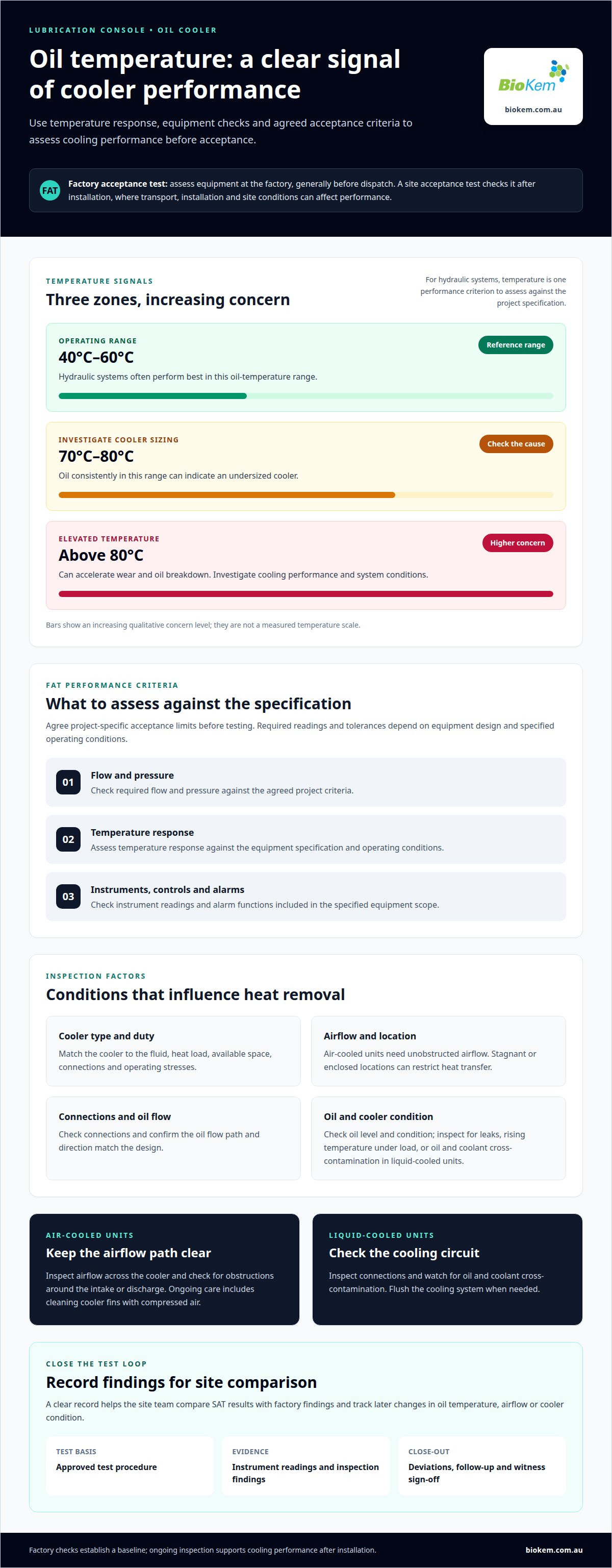
A factory acceptance test (FAT) assesses equipment at the factory; a site acceptance test (SAT) checks it after installation. The distinction matters because transport, installation and site conditions can affect performance. An FAT is generally conducted before dispatch. The purchaser’s technical representatives and relevant project personnel can witness the tests and assess the results against agreed requirements.
FAT test coverage
An FAT checks the console and cooler against the agreed test plan, including component condition, connections and function. For air-cooled units, inspect airflow across the cooler. At the site, obstructions can restrict heat transfer. Ongoing maintenance includes checking oil level and condition, cleaning cooler fins with compressed air, and flushing the cooling system when needed.
Performance criteria and tolerances
The importance of an FAT for your lubrication console and oil coolers is clearer when acceptance criteria are specific to the project. Agree on performance limits before testing, then assess required flow, pressure, temperature response, instrument readings and alarm functions against the specification. Hydraulic systems often perform best at oil temperatures between 40°C and 60°C. Temperatures above 80°C can accelerate wear and oil breakdown.
Oil consistently in the 70-80°C range can indicate an undersized cooler. Rising temperature under load, leaks, low oil level or oil and coolant cross-contamination in liquid-cooled units warrant investigation. Oil degradation or varnish concerns may also warrant varnish assessment.
Test records and documentation
FAT records should identify the equipment, checks performed, measured results and any required follow-up. Include the approved test procedure, instrument readings, inspection findings, deviations and witness sign-off. These records help the site team compare SAT results with factory findings and track later changes in oil temperature, airflow or cooler condition.
Oil cooler system components
A lubrication cooler transfers heat from circulating oil to air or water, then returns the cooled oil to the system. Cooling performance depends on matching the cooler to the fluid, heat load, available space, connections and operating stresses. Each component must suit its intended duty.
In an air-to-oil cooler, oil flows through tubes or plates while airflow carries heat away from their surfaces. A water-to-oil cooler transfers heat to a coolant circuit, which releases it through a radiator. Hydraulic oil coolers use either method, so the system design determines the connections and supporting equipment required. Air-cooled units need unobstructed airflow; stagnant or enclosed locations restrict heat transfer.
A thermostatic bypass valve can route oil around the cooler until it reaches a suitable operating temperature. This helps prevent cold, thicker oil from passing through the cooler too early. Compact liquid-cooled designs can warm oil quickly at start-up, while air-cooled units operate independently of the coolant circuit. The choice affects installation space, temperature control and how the system responds to changing loads.
For Australian projects, identify the applicable Australian and international standards in the contract and equipment specification. The FAT plan can then link each relevant requirement to an inspection or test, rather than assuming the same criteria suit every installation.
Reviewing cooler type, oil flow path and operating conditions together helps expose mismatches before commissioning. To discuss how these factors relate to a specific lubrication system, speak with the technical team.
Stacked-plate oil coolers offer substantial surface area in a compact space. Air-cooled units need unobstructed airflow and some protection from road debris.
What tests should an FAT include for a lubrication console and oil coolers?
An FAT plan sets out which checks demonstrate that the assembled console and cooler meet the project specification. Its scope should reflect the supplied equipment, operating duty and project acceptance criteria.
Begin with a visual inspection of the console, cooler, components and connections. Confirm that installed items match the approved equipment schedule and that the oil flow path follows the design. For the cooler, check oil level and condition, connections and airflow across air-cooled units. These checks can reveal assembly problems or conditions that may hinder heat transfer.
Conduct functional checks in line with the approved FAT procedure. Where the design allows, the test plan can cover:
- Console functions and component operation against the specified sequence.
- Cooler connections and the intended oil-flow direction.
- Airflow across an air-cooled unit, including obstructions around its intake or discharge.
- Instrument and control indications included in the equipment scope.
Compare each result with the project’s stated acceptance criteria. Avoid generic limits: required readings and tolerances depend on the equipment design and specified operating conditions. Record any deviation against the relevant test item and document its resolution before acceptance. This keeps the FAT focused on measurable requirements rather than a visual sign-off alone.
A clear test plan also separates factory checks from tasks that depend on site installation. This helps the commissioning team identify what remains for site acceptance without treating an unperformed site check as a factory failure.
To discuss a lubrication system’s inspection or maintenance needs, contact the technical team.
BioKem Oil Services
BioKem Oil Services supports ongoing lubrication care when inspections identify oil condition concerns that may affect reliable operation. Oil Analysis can help assess lubricant condition, while Hot Oil Flushing, Varnish Mitigation and Vacuum Dehydration address different oil cleanliness and contamination needs.
These services complement an FAT; they do not replace factory testing or site acceptance checks. Consider them when operational monitoring or oil analysis identifies contamination, varnish or moisture that needs attention. The right approach depends on the issue and the system’s operating requirements.
For support with lubrication oil condition and maintenance, contact BioKem Oil Services.
Carry FAT findings into ongoing asset care
Understanding how important an FAT is for your lubrication console and oil coolers means treating acceptance as the start of informed asset care, not the finish. Keep the test record as a reference for future condition assessments, so changes in system behaviour can be considered alongside the equipment’s original results.
Connecting acceptance with ongoing care gives teams better context for maintenance decisions. If oil condition or system cleanliness becomes a concern, BioKem Oil Services can discuss support suited to your lubrication equipment and operating needs.
Contact BioKem Oil Services to discuss the next step for your lubrication system.
Frequently Asked Questions
What is a factory acceptance test (FAT) for a lubrication console and oil coolers?
A factory acceptance test is a pre-delivery assessment of assembled equipment against its specified requirements. For example, the FAT can document whether console components and cooler connections match the approved project design. This gives the purchaser and supplier a shared record of the equipment’s condition before it leaves the factory, supporting a clearer handover and follow-up at the installation site.
Why is an FAT important for lubrication consoles and oil coolers?
An FAT matters because it documents equipment condition before installation makes access or changes more difficult. For example, an inspection record can help distinguish an assembly issue from a problem arising during transport or site installation. It also gives maintenance teams a reference when later observations, such as a change in oil temperature, prompt an investigation.
What are the risks of skipping an FAT for a lubrication console or oil cooler?
Without an FAT, assembly problems or unsuitable connections may go unnoticed until installation or operation. The site team may then have to investigate the equipment while resolving commissioning issues, making the source harder to isolate. If cooling performance is inadequate, oil may run hotter, lose viscosity and provide less protection, increasing the risk of wear or equipment failure.

Article by
James McAllister
James McAllister is an industry professional with BioKem Oil Services, specialising in lubrication reliability, oil filtration, contamination control and asset performance. Drawing on BioKem's extensive field experience across turbines, compressors, hydraulic systems and critical rotating equipment, James writes practical, insight-driven articles that help maintenance and reliability teams improve equipment performance, extend asset life and reduce operational risk.