

A higher ISO 4406 particle count is a reason to investigate, not a diagnosis. What Does a Sudden Increase in an ISO 4406 Particle Count Mean? It may reflect a genuine change in oil cleanliness, but differences in sampling or measurement can also affect the result. The key questions are whether the oil condition has changed and whether the result has implications for the equipment. One code alone cannot answer either question.
This article explains what a changed cleanliness code indicates, what it cannot prove, and how to check whether the result is representative before acting. You’ll learn how to compare the sample and equipment history, what follow-up evidence may help narrow down the cause, and when further analysis may be useful. BioKem Oil Services provides Lube Oil Analysis, onsite and lab-based patch analysis, and Oil Filter Debris Analysis to support an evidence-led investigation. Filtration can then be considered in light of the findings.
Key Takeaways
- What Does a Sudden Increase in an ISO 4406 Particle Count Mean? A higher code signals more counted particles in one or more channels, but does not identify their source or prove equipment damage.
- Verify the report and compare like-for-like samples before treating the change as a genuine system trend.
- Review operating and maintenance changes, then gather supporting evidence to narrow down possible causes.
- Compare confirmed results with the asset’s cleanliness requirements before deciding whether further analysis or filtration is appropriate.
What Does a Sudden Increase in an ISO 4406 Particle Count Actually Mean?
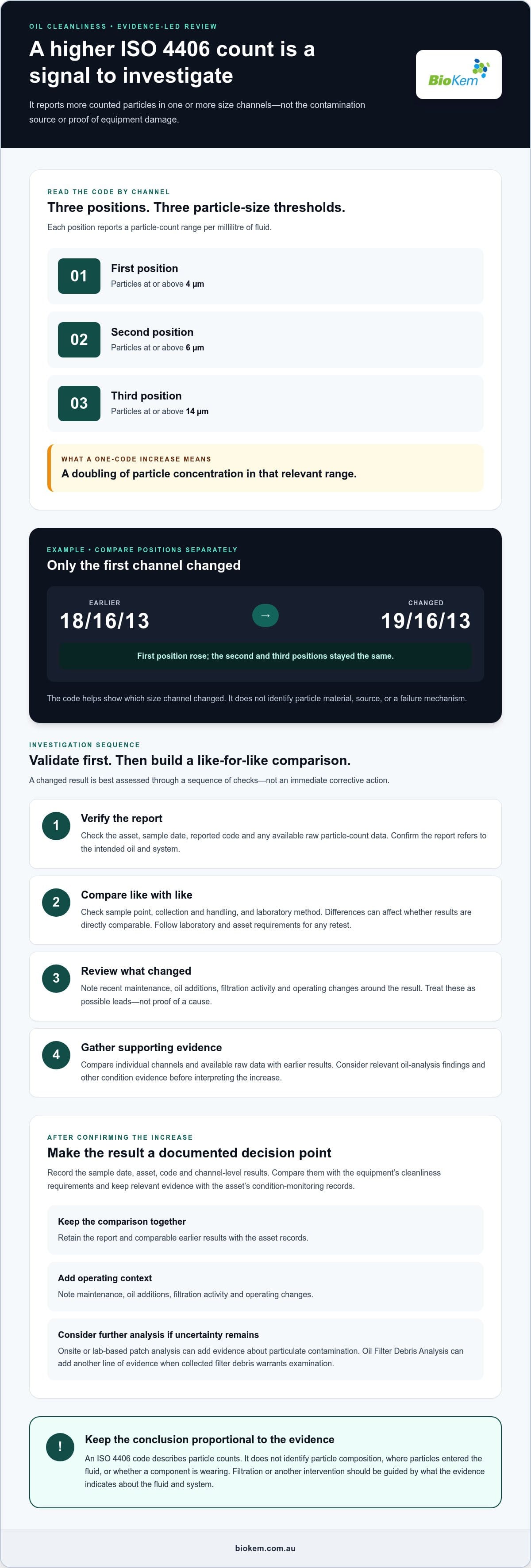
A sudden increase means a sample has a higher ISO 4406 cleanliness code than a comparison sample. The change may appear in one, two or all three positions. Each position reports a particle-count range for a size channel, so a higher number indicates more counted particles in that channel. A one-code increase represents a doubling of the particle concentration within the relevant range.
A changed measurement is a signal to investigate, not a confirmed diagnosis of the contamination source or equipment damage. The code describes particle counts. It does not identify what the particles are made of, where they entered the fluid, or whether a component is wearing. This distinction matters: the result can guide follow-up, but acting on the code alone risks treating an assumed cause rather than the condition shown by the sample.
What can the three-part ISO 4406 code reveal?
The three numbers correspond to particles at or above 4, 6 and 14 micrometres (µm), respectively, reported per millilitre of fluid. For example, if a result changes from 18/16/13 to 19/16/13, only the first channel’s code has risen. This helps identify which size range changed, but does not reveal the particles’ material or source.
Read each position separately and compare results from samples taken under comparable conditions. A rise in the larger-particle channel may prompt a different line of enquiry from a rise confined to the smallest channel, but neither pattern proves a particular failure mechanism. The code measures cleanliness; it is not a particle composition test or a condition assessment.
For context on interpreting code values and cleanliness targets, consult the ISO 4406 cleanliness-code guide. The code shows where the reported count changed. Sample and asset evidence is needed to understand what that change may mean for the system.
How to Investigate a Sudden ISO 4406 Particle Count Increase
First validate the result, then build a comparison that can help distinguish a genuine system change from variation in sampling or measurement. The question “What Does a Sudden Increase in an ISO 4406 Particle Count Mean?” is best answered with a sequence of checks, not an immediate corrective action.
- Verify the report. Check the asset, sample date, reported code and any available raw particle-count data. Confirm that the report refers to the intended oil and system.
- Compare like with like. Check whether the samples came from the same point and were collected and handled in comparable ways. Differences in sample point, container handling or laboratory method can affect whether results are directly comparable. Follow the laboratory and asset requirements for any retest.
- Review what changed. Note recent maintenance, oil additions, filtration activity and operating changes around the time of the result. Treat these as possible leads, not proof of a cause.
- Gather supporting evidence. Compare individual channels and any available raw data with earlier results. Consider relevant oil-analysis findings and other condition evidence before deciding what the increase represents.
Which evidence should you check before deciding what changed?
Look beyond the overall code. A change in one channel may guide follow-up differently from a rise across several channels, while raw counts can add detail when available. Record the sample point, collection date, handling information and test method alongside each result. This context makes comparisons more useful. An isolated code change raises a question, but a trend and supporting evidence make the result easier to interpret.
BioKem provides Lube Oil Analysis as part of an evidence-gathering process. You can also review your oil-analysis findings with BioKem as you work through the results.
What to Do After Confirming an ISO 4406 Particle Count Spike
Once the increase is verified, treat the result as a documented decision point, not an automatic instruction to filter or replace oil. Record the sample date, asset, code and channel-level results, then compare them with the equipment’s cleanliness requirements. The practical question, “What Does a Sudden Increase in an ISO 4406 Particle Count Mean?”, still needs to be considered in the context of the fluid and system.
Before choosing a response, bring together the relevant evidence:
- Keep the report and comparable earlier results with the asset’s condition-monitoring records.
- Note relevant maintenance, oil additions, filtration activity and operating changes.
- Consider further analysis if the contamination source or nature remains uncertain.
Filtration or another intervention should be guided by what the evidence indicates about the fluid and system. A code alone does not establish which action is suitable. A considered response can help avoid unnecessary treatment while keeping the equipment’s cleanliness requirements in view.
When can specialist analysis help clarify the result?
Onsite or lab-based patch analysis can add evidence about particulate contamination in the oil. If debris collected in a filter also warrants examination, Oil Filter Debris Analysis provides another line of evidence. Consider these findings alongside the sample history, asset requirements and other relevant condition data. They can inform interpretation, but do not turn a particle-count code into a diagnosis on its own.
For a considered next step, discuss your oil-analysis findings with BioKem in the context of the evidence available for your system.
Turn the Result Into a Confident Next Step
The most useful outcome of asking “What Does a Sudden Increase in an ISO 4406 Particle Count Mean?” is a clearer basis for deciding what deserves attention next. Keep the result connected to the asset’s condition history and requirements. Let the available evidence guide the response instead of treating a code as an instruction. Where more context is needed, onsite or lab-based patch analysis and Oil Filter Debris Analysis can contribute further evidence for technical interpretation.
Bring your report and relevant sample history into the next discussion. Discuss your oil-analysis findings with BioKem to explore an evidence-led way forward for your system. A measured next step supports informed maintenance decisions and keeps oil cleanliness management focused on the equipment’s requirements.
Frequently Asked Questions
Can oil look clean even when its ISO 4406 particle count is high?
Yes. Particles counted in an oil sample can be too small to see, so clear-looking oil is not proof of low particle levels. The question “What Does a Sudden Increase in an ISO 4406 Particle Count Mean?” cannot be answered by appearance alone. Use the laboratory result alongside the sample context, and do not rely on visual inspection to judge cleanliness.
Does a sudden increase in one ISO 4406 channel mean all particle sizes increased?
No. The three code positions report counts at or above 4, 6 and 14 µm, respectively. A higher code in one position does not automatically mean the other positions also rose. For example, the ≥4 µm code may change while the ≥6 µm and ≥14 µm codes remain the same. Review each reported position rather than assuming a uniform increase.
Can an ISO 4406 particle count identify what the particles are made of?
No. ISO 4406 reports particle-count ranges, not particle composition. The code alone cannot distinguish, for example, wear debris from other particulate matter. If the nature of the material matters to the investigation, separate evidence may help. Patch analysis or Oil Filter Debris Analysis can contribute information for technical interpretation, but findings need to be considered in the wider system context.

Article by
James McAllister
James McAllister is an industry professional with BioKem Oil Services, specialising in lubrication reliability, oil filtration, contamination control and asset performance. Drawing on BioKem's extensive field experience across turbines, compressors, hydraulic systems and critical rotating equipment, James writes practical, insight-driven articles that help maintenance and reliability teams improve equipment performance, extend asset life and reduce operational risk.