

What if a filter that keeps blocking is pointing to a problem beyond the filter itself? If you’re asking, “Why Does My Oil Filter Keep Blocking Prematurely?”, repeated changes are frustrating, especially when restricted oil flow could affect equipment reliability. Replacing the element may clear the immediate symptom, but recurring blockage can point to an unresolved contamination source or operating issue.
This guide explains how particles, wear debris, water, degraded oil, filter selection and maintenance can contribute to early blockage. It also sets out how to investigate using pressure trends, operating records, oil analysis and filter debris examination. The aim is to help you distinguish routine loading from a problem that needs attention, then choose a response based on the evidence and your system’s oil cleanliness requirements.
Key Takeaways
- Ask “Why Does My Oil Filter Keep Blocking Prematurely?” and treat recurring blockage as a reason to investigate, not a diagnosis by itself.
- Record pressure trends, bypass indications, maintenance work and process changes alongside filter inspection findings.
- Compare debris observations with oil analysis to help distinguish contamination, wear and oil-condition issues.
- Match the response to the evidence. Address the source and consider filtration or flushing where appropriate.
Why Does an Industrial Oil Filter Block Prematurely?
If you’re asking, “Why Does My Oil Filter Keep Blocking Prematurely?”, start with what the blockage shows: material has accumulated in the element. That alone does not reveal where it came from. Filters retain particles from circulating oil; the Oil filter overview explains this basic function. In an industrial system, rising differential pressure may reflect expected contaminant loading or a faster-than-usual increase that warrants investigation. Interpret the trend alongside operating conditions, filter history and equipment requirements, not in isolation.
Potential sources include dust or dirt entering through openings, damaged seals or handling; wear particles generated inside the asset; and residues introduced during maintenance, commissioning or oil transfer. Heat and oxidation can also degrade oil and produce deposits that contribute to filter loading. These causes can overlap, so a blocked element is a prompt to gather more evidence, not proof of a single cause.
Which contamination sources can load an industrial filter early?
Start with the operating and maintenance context. A change after equipment work or an oil top-up may point to contamination introduced during the intervention. Metallic debris may warrant investigation of internal wear. Dark deposits alone do not confirm oil degradation, and blockage by itself cannot establish varnish or moisture as the cause. Look for supporting evidence in oil-condition data and debris examination. If testing indicates varnish is relevant, varnish mitigation for lube oil may form part of a response suited to the system.
Record when the pressure rise began, how quickly it developed and whether operating or maintenance conditions changed. Comparing those details with oil analysis and inspection findings can help distinguish routine loading from an abnormal source. It also reduces the risk of settling on a diagnosis based on the filter alone.
How to Investigate Repeated Industrial Oil Filter Blockage
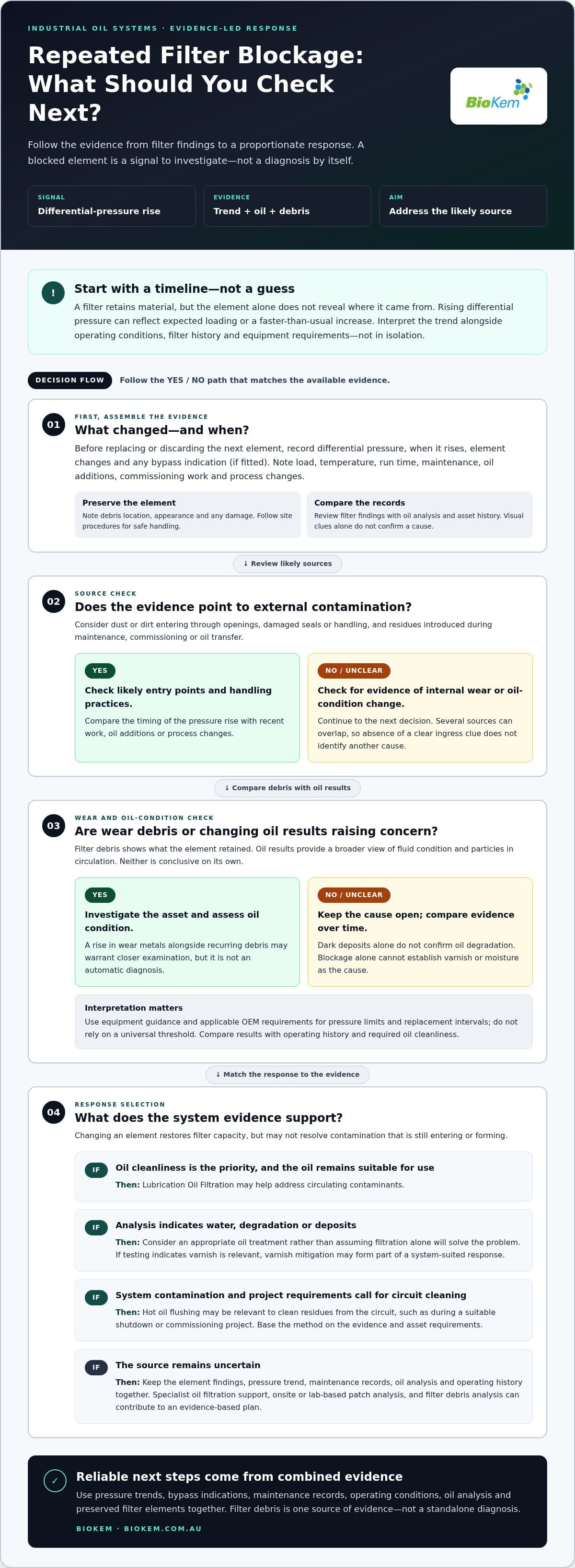
To answer “Why Does My Oil Filter Keep Blocking Prematurely?”, build a timeline before replacing or discarding the next element. Compare each blockage with operating conditions and maintenance history. A single pressure reading offers less context than a trend recorded alongside load, temperature and run time.
- Document the pattern. Record differential pressure, when it rises, element changes and any bypass indication, if the system has one. Note recent maintenance, oil additions, commissioning work and process changes.
- Inspect the removed element. Preserve it for examination and note where debris is concentrated, its appearance and any damage. Follow site procedures for safe handling. Visual clues can guide the investigation, but they do not confirm a root cause.
- Compare the evidence. Review inspection findings alongside oil analysis and the asset’s history. Use equipment guidance and applicable OEM requirements to interpret pressure limits and replacement intervals, rather than relying on a universal threshold.
What evidence helps distinguish contamination from wear?
Filter debris shows what the element retained, while oil results provide a broader view of fluid condition and particles in circulation. Neither is conclusive on its own. Oil Filter Debris Analysis and a Filter Ferrogram service can add detail. Compare findings over time with operating history and the equipment’s required oil cleanliness. A rise in wear metals alongside recurring debris may warrant closer examination, but it is not an automatic diagnosis.
The oil filter analysis and inspection procedures document offers an example of a structured inspection approach. It is aviation-specific, not an industrial maintenance requirement. For industrial assets, interpret results in the context of the equipment and its operating conditions. BioKem Oil Services provides oil analysis and filter debris analysis to help connect filter and oil evidence. Discuss an oil filtration investigation with BioKem Oil Services.
What to Do After Finding Premature Filter Blockage
Changing an element restores filter capacity, but it may not resolve the issue if contamination is still entering or forming in the system. Use inspection findings and oil data to decide what to address next. If evidence points to external ingress, check likely entry points and handling practices. If wear debris or changing oil results raise concern, investigate the asset and assess oil condition before choosing an intervention.
Match the response to the system. Where oil cleanliness is the priority and the oil remains suitable for use, Lubrication Oil Filtration may help address circulating contaminants. If analysis indicates water, degradation or deposits, consider an appropriate oil treatment rather than assuming filtration alone will solve the problem. Hot oil flushing may be relevant when system contamination and project requirements call for cleaning residues from the circuit, such as during a suitable shutdown or commissioning project. Base the method on the evidence and the asset’s requirements.
When can specialist oil filtration support help?
Specialist support can help connect filter-element findings, oil analysis and operating history to a proportionate plan. BioKem provides industrial oil filtration support across Australia, with onsite and lab-based patch analysis to contribute to an investigation. Filter debris is one source of evidence, not a standalone diagnosis. Interpret it alongside oil condition and the equipment’s cleanliness requirements.
If you’re still asking, “Why Does My Oil Filter Keep Blocking Prematurely?”, bring together pressure trends, maintenance records, oil analysis and any preserved filter elements. This evidence can focus the next steps and help avoid repeated element changes without addressing the cause. Discuss recurring filter blockage with BioKem and share the operating and analysis evidence available for your asset.
Turn Filter Findings Into a More Reliable Maintenance Plan
Recurring blockage can become a useful maintenance signal when it informs the next service cycle. Keep operating and oil-condition records together, note interventions, and compare subsequent filter behaviour with the equipment’s cleanliness requirements. This makes it easier to assess whether the response is addressing the issue and whether further investigation is needed.
If you’re still asking, “Why Does My Oil Filter Keep Blocking Prematurely?”, BioKem brings over 70 years of combined industry experience to interpreting oil and filter evidence in the context of your asset. The aim is a proportionate next step guided by findings, rather than repeated element changes alone. Share your filter blockage findings with BioKem to discuss a practical path forward. A clearer evidence base can help you plan maintenance with greater confidence.
Frequently Asked Questions
Why does my industrial oil filter block soon after replacement?
A fresh element can load quickly if contamination keeps entering or forming in the system, or if previously settled debris returns to circulation. “Why Does My Oil Filter Keep Blocking Prematurely?” cannot be answered from timing alone. Compare filter-change dates and pressure records with maintenance work, oil additions and analysis results. If blockage follows a particular intervention, that timing may help focus the investigation.
Can a blocked oil filter damage industrial equipment?
Filter restriction can affect oil flow, but blockage alone does not show whether equipment damage has occurred or will occur. Risk depends on system design, bypass arrangements, operating conditions and alarm response. Follow the asset’s operating procedures, especially if pressure or flow indications change unexpectedly. Record the readings and operating state, then arrange a technical assessment in line with site requirements.
How can I tell whether filter blockage is caused by wear debris?
Appearance alone may not reliably identify whether particles came from internal wear or another source. Filter debris examination and oil analysis can help assess whether wear products are present, but results need context. Compare samples and debris findings over time with the asset’s operating history, recent work and condition data. Use changing trends to guide further investigation rather than treating one result as proof.
Should I change the oil whenever an industrial filter blocks early?
Not automatically. Early blockage does not establish that the lubricant has reached the end of its useful condition. Consider oil-analysis results, identified contaminants, equipment requirements and why the element loaded. Depending on the evidence, filtration, further investigation, oil treatment or replacement may be appropriate. Making the decision from oil and filter findings can help avoid changing usable lubricant without addressing the cause.

Article by
James McAllister
James McAllister is an industry professional with BioKem Oil Services, specialising in lubrication reliability, oil filtration, contamination control and asset performance. Drawing on BioKem's extensive field experience across turbines, compressors, hydraulic systems and critical rotating equipment, James writes practical, insight-driven articles that help maintenance and reliability teams improve equipment performance, extend asset life and reduce operational risk.