

Can Group I and Group II oils be blended safely in your equipment? It depends on the specific finished lubricants and their application. An unplanned mix can affect lubricant condition, and a base-oil group label alone does not establish compatibility. Blending Group I and II oils may be possible, but the products and system requirements need to be assessed together.
This article explains what Group I and Group II classifications describe, how additive chemistry, blend ratio and operating conditions can affect compatibility, and what to review before mixing. It also sets out a cautious approach to compatibility testing and explains how oil analysis can help assess lubricant condition without proving that two formulations are compatible.
Key Takeaways
- Base-oil group labels describe stock characteristics, not whether complete finished lubricants are compatible.
- Before blending Group I and II oils, identify both products and compare their viscosity grades, intended uses, additive information and relevant equipment specifications.
- If oils may have mixed in service, record the products and operating circumstances instead of estimating the blend or judging it by appearance.
- Use oil analysis to gather evidence about lubricant condition, then interpret the findings alongside product and equipment requirements.
What Group I and Group II oils describe, and what the labels do not prove
API base-oil groups classify base stocks by properties such as saturates content, sulphur content and viscosity index (VI). These groups describe the oil component before additives are blended in, but they do not identify every feature of a finished lubricant. The API Base Oil Classifications overview provides background on the groups and their refining processes.
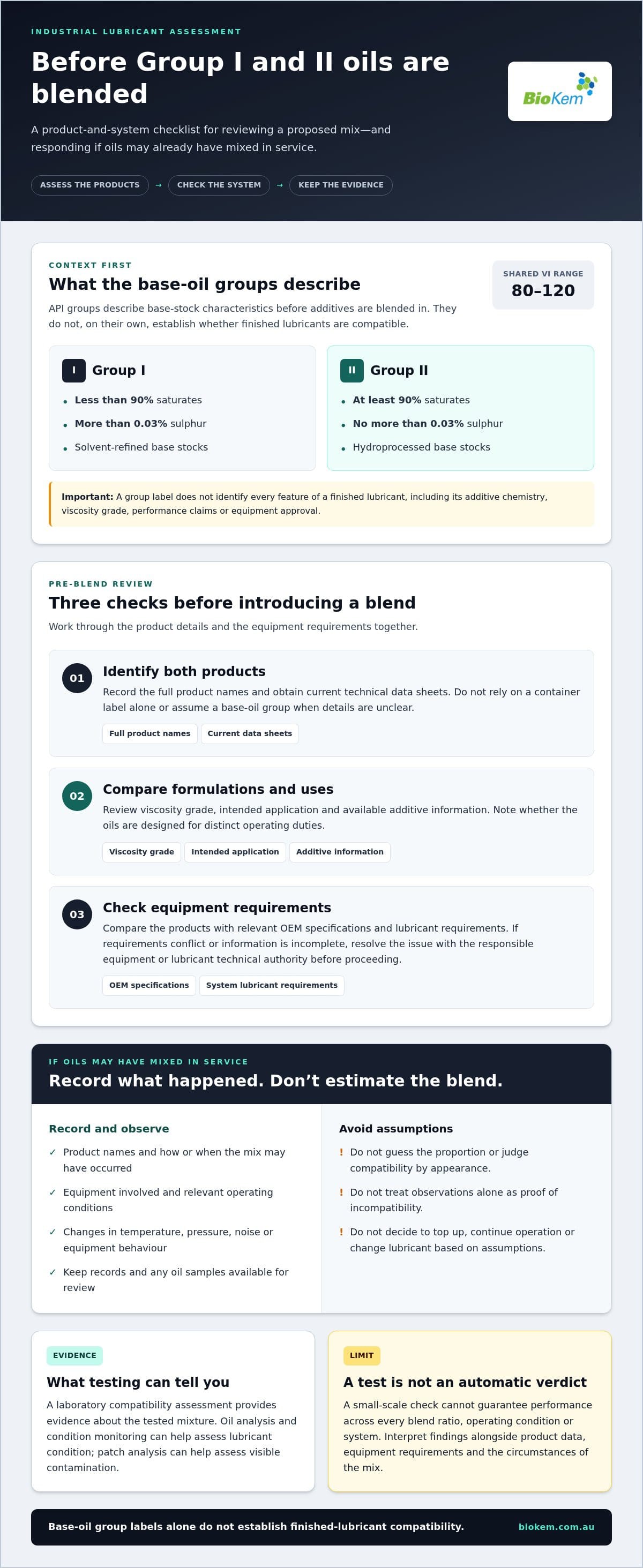
Under API’s classification, Group I base oils contain less than 90% saturates and more than 0.03% sulphur, with a VI from 80 to 120. Group II oils contain at least 90% saturates and no more than 0.03% sulphur, also with a VI from 80 to 120. Group I stocks are solvent-refined, while Group II stocks are hydroprocessed. These distinctions describe base-stock characteristics, not how two finished products will behave together.
Why base-oil group alone cannot establish finished-oil compatibility
A finished lubricant combines base stock with an additive system designed for a particular purpose. Detergents, anti-wear agents, antioxidants and other components can differ between products. When oils are mixed, interactions between their formulations may affect stability or performance. The intended application matters as well.
Base-oil compatibility does not, by itself, establish finished-lubricant compatibility. A group label also does not tell you whether a product has the correct viscosity grade, performance claims or equipment approval for a particular system. Two oils may share a viscosity grade but be formulated for different duties, or have different additive chemistries. A difference in group does not automatically mean the oils are incompatible either. Assess the specific products and application rather than deciding from group labels alone.
How to assess a Group I and Group II oil blend before use
Review the products and equipment before introducing a blend into an industrial system. A practical assessment starts with reliable product identification, then compares the lubricant requirements with the proposed mix. Base-oil group labels are only one part of that review.
- Identify both products. Record the full product names and obtain their current technical data sheets. Do not rely on a container label alone or assume a product’s base-oil group if its details are unclear.
- Compare the formulations and uses. Review viscosity grade, intended application and available additive information. Note differences that may matter to the system, including whether the oils are designed for distinct operating duties.
- Check equipment requirements. Compare the products with the relevant OEM specifications and lubricant requirements. If requirements conflict or the information is incomplete, resolve the issue with the responsible equipment or lubricant technical authority before proceeding.
Which checks matter before blending oils in an industrial system?
Use current product information and the actual operating context to guide the assessment. A laboratory compatibility assessment can provide evidence about the tested mixture, but it cannot guarantee performance across every blend ratio, operating condition or system. A small-scale check is evidence, not a substitute for applicable OEM approval or a technical review.
Oil analysis can help establish the condition of lubricant in service, but it does not automatically prove that two formulations are compatible. For example, oil debris analysis can contribute condition evidence without replacing a product-specific compatibility assessment. Keep the product data, test findings and equipment requirements together so the decision has a clear technical basis. BioKem Oil Services provides condition monitoring and onsite and lab-based patch analysis to help assess lubricant condition. Contact BioKem Oil Services about an industrial oil-analysis or filtration requirement.
What to do when Group I and II oils may have mixed in service
If oils may have mixed in a running system, do not guess the proportion or assume the blend is safe based on appearance. Record the product names, when and how the mix may have occurred, the equipment involved and the relevant operating conditions. Note any changes in temperature, pressure, noise or equipment behaviour, but do not treat these observations alone as proof of incompatibility.
Do not decide to top up, continue operation or change the lubricant based on assumptions. Compare the available information with the equipment and lubricant specifications. If suitability is uncertain or operating behaviour has changed, involve the responsible technical authority. Keep the records and any oil samples available for review.
When should an oil-analysis specialist be involved?
Seek a technical review if product identity is unclear, system behaviour changes, or the possible mix raises questions about specification requirements. Oil analysis and condition monitoring can provide evidence about lubricant condition. Onsite or laboratory-based patch analysis can help assess visible contamination. Neither provides an automatic compatibility verdict: interpret findings alongside product data, equipment requirements and the circumstances of the mix.
The oil debris analysis information can provide context for assessing lubricant condition. If contamination may also be a concern, the lubricant contamination guide offers related information, but does not determine whether two formulations are compatible. Blending Group I and II oils in service calls for a measured, evidence-led assessment, not a conclusion from a single test or observation.
Make lubricant decisions with evidence
Treat a possible mix as a reason to strengthen lubricant control, not as a reason to guess. Keep product records accessible, document changes to operating conditions, and make sure future top-ups follow the equipment’s lubricant requirements. These steps give teams a clearer basis for deciding what to do before uncertainty becomes an ongoing maintenance concern.
For Blending Group I and II oils, condition evidence can inform the next step, but it does not replace a formulation-specific compatibility assessment. BioKem’s condition monitoring and onsite and lab-based patch analysis can help assess lubricant condition. Interpret findings alongside product information and equipment requirements.
For support with an industrial oil-analysis or filtration requirement, contact BioKem.
Frequently Asked Questions
Can Group I and Group II oils be mixed for an emergency top-up?
Only if the equipment requirements and responsible technical authority support using the specific products together. In an urgent situation, identify the oil already in the system and compare the proposed top-up’s viscosity grade and required performance specifications. Do not treat the emergency as evidence of compatibility. If you cannot establish suitability, follow site procedures and seek technical guidance before adding oil.
Does blending Group I and Group II oils change the finished oil’s API group?
No. API base-oil groups classify base stocks, not finished lubricants as a whole. Blending Group I and Group II stocks does not give the finished oil a new API base-oil group designation. For Blending Group I and II oils, retain the product identities and formulation information rather than assigning a group based on appearance or an estimated proportion.
Can an oil sample confirm that two lubricants are compatible?
No single in-service oil sample can, by itself, establish that two lubricant formulations are compatible. Analysis can provide information about the sampled oil’s condition, such as contamination or changes in measured properties, but it may not identify every formulation interaction or predict future system performance. Interpret results with product records and operating context. Compatibility assessment requires a separate, formulation-specific review.
What information should I collect if different oils have been mixed in a system?
Record the product names and, if available, their technical data sheets, along with the equipment and lubricant specifications. Note when and how the mix may have occurred, what work was underway, and any changes in operating conditions or equipment behaviour. Mark information as approximate where necessary. Avoid estimating blend proportions without reliable records, and preserve relevant sample details for technical review.

Article by
James McAllister
James McAllister is an industry professional with BioKem Oil Services, specialising in lubrication reliability, oil filtration, contamination control and asset performance. Drawing on BioKem's extensive field experience across turbines, compressors, hydraulic systems and critical rotating equipment, James writes practical, insight-driven articles that help maintenance and reliability teams improve equipment performance, extend asset life and reduce operational risk.