

What if a sticking turbine servo valve points to oil varnish but doesn’t prove it? Intermittent or recurring faults can be difficult to diagnose, and treating varnish as the cause before checking other possibilities may lead to unnecessary work. The question, “Turbine Servo Valves Sticking: Could Oil Varnish Be the Cause?”, calls for evidence, not assumptions. Varnish deposits can contribute to valve sticking, but contamination, water, incorrect oil viscosity, mechanical wear and operational faults may also be involved.
This article explains how varnish may affect servo-valve behaviour and what symptoms, inspection findings and oil evidence can help distinguish it from other causes. It also clarifies why varnish potential and particle cleanliness are different measures, including how ASTM D7843 membrane patch colorimetry can support an investigation. You’ll learn how to weigh the findings and plan a proportionate next step, with condition monitoring and onsite or lab-based patch analysis helping inform a considered response.
Key Takeaways
- Turbine Servo Valves Sticking: Could Oil Varnish Be the Cause? Learn why deposits may affect close-clearance valve movement, and why sticking alone isn’t proof of varnish.
- Track when the fault occurs alongside operating conditions, maintenance history and recent oil or system changes to help identify patterns.
- Assess valve inspection findings separately from oil-condition evidence; together, they can support a more reliable diagnosis.
- Use the investigation results to decide whether varnish mitigation is appropriate, with Varnish Removal (VRS), Condition Monitoring and patch analysis as possible supports.
Turbine servo valves sticking: how oil varnish could contribute
Oil varnish is a surface deposit associated with lubricant degradation. As oil oxidises, degradation products can become less soluble, remain suspended or precipitate onto internal surfaces. The amount and form of material depend on the oil and operating conditions, so a deposit’s appearance alone doesn’t establish its source. ASTM D7843 uses Membrane Patch Colorimetry to assess an in-service turbine oil’s potential to form varnish; it is one part of an investigation, not a direct diagnosis of a particular valve.
In a servo valve, the moving spool and its surrounding surfaces have close clearances. A deposit in this area could increase friction or hinder movement, potentially contributing to a sluggish or inconsistent response. This is a plausible mechanism, not proof. Similar symptoms can arise from particulate contamination, mechanical wear, actuator or control faults, or other operating problems.
What makes varnish a plausible cause of servo-valve sticking?
Varnish-related valve sticking occurs when lubricant-degradation deposits may impede a servo valve’s moving parts. The hypothesis is stronger when suitable oil evidence aligns with relevant inspection findings, but neither should be treated as conclusive alone. Valve design and condition matter; technical interpretations should be reviewed against equipment guidance and by a qualified turbine lubrication specialist.
To frame the question, Turbine Servo Valves Sticking: Could Oil Varnish Be the Cause?, separate what the valve is doing from what the oil tests indicate. For example, slow response that coincides with evidence of deposits may warrant closer examination, while a clean-looking valve does not by itself rule out oil-related issues. BioKem’s varnish in lubricant oil analysis and patch analysis can contribute evidence to that assessment. The aim is to establish whether varnish fits the findings before selecting a response.
How to investigate turbine servo-valve sticking before blaming varnish
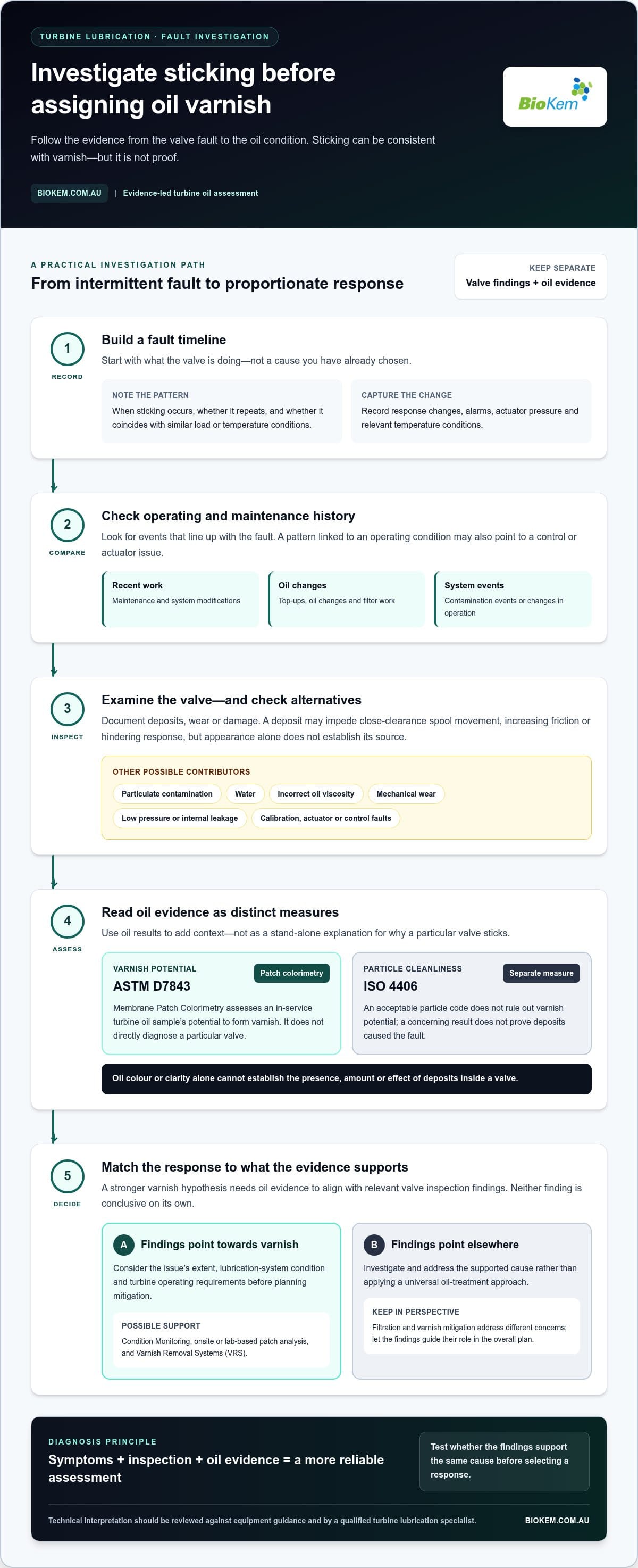
Start with a fault timeline rather than a diagnosis. Record when sticking occurs, whether it repeats under similar load or temperature conditions, and what changes when the valve response becomes abnormal. Compare those observations with maintenance records and recent oil top-ups, oil changes, filter work or system modifications. A fault that follows a particular operating condition may point towards a control or actuator issue as readily as an oil problem.
- Review operation: note response changes, alarms, actuator pressure and relevant temperature conditions.
- Check maintenance history: look for recent work, oil additions, contamination events or changes to the system.
- Inspect the valve: document deposits, wear or damage, while considering low pressure, internal leakage, calibration and control faults.
Which evidence helps confirm or challenge a varnish hypothesis?
Oil analysis and patch-analysis findings add context, but they don’t independently prove why a valve sticks. ASTM D7843 membrane patch colorimetry assesses an oil sample’s varnish-forming potential. ISO 4406 particle cleanliness is a separate measure: an acceptable particle code doesn’t rule out varnish potential, and a concerning result doesn’t prove deposits caused the fault. Oil colour or clarity is also insufficient; visible appearance can’t establish the presence, amount or effect of deposits inside a valve.
A sound diagnosis combines the valve’s observed symptoms and inspection findings with oil-condition evidence, then tests whether they support the same cause. Consider the broader varnish in lubricating oil context as part of that assessment. For a structured review of monitoring or patch-analysis findings, you can discuss the evidence with BioKem.
Handling Varnish in Turbine Lubrication Systems
Varnish mitigation should follow the evidence, not simply the presence of a sticking valve. If inspection findings and oil-condition results point towards varnish, the next step is to consider the extent of the issue, the condition of the lubrication system and the turbine’s operating requirements. If the evidence instead suggests another fault, address that cause rather than applying a universal oil-treatment approach.
How can a reliability team plan a proportionate response?
Build the response around what the investigation supports. Review the valve findings alongside condition-monitoring and patch-analysis results, then consider whether the concern appears local to a component or relevant to the wider oil system. BioKem’s varnish removal systems, Varnish Removal (VRS), Condition Monitoring and onsite and lab-based patch analysis can support an evidence-led plan. The scope can be tailored to the project; the purpose is to select a suitable response, not to assume a particular outcome.
For teams assessing related oil cleanliness and contamination-control considerations, BioKem’s lubrication oil filtration service is another relevant part of the picture. Filtration and varnish mitigation address different concerns, so findings should guide how they fit into the overall plan.
BioKem provides Australia-wide service coverage and tailored turnkey solutions for relevant turbine applications. If your investigation raises questions about Turbine Servo Valves Sticking: Could Oil Varnish Be the Cause?, discuss your turbine oil varnish concerns with BioKem to consider an evidence-based next step.
Turn evidence into a confident next step
A recurring valve fault is an opportunity to strengthen your turbine’s condition-monitoring approach, not just to treat the immediate symptom. Keep the investigation focused on what the evidence supports, document the reasoning behind any intervention, and use follow-up monitoring to inform future maintenance decisions. That discipline helps reliability teams avoid unnecessary work while keeping oil condition and equipment performance in view.
If you’re still weighing the question, Turbine Servo Valves Sticking: Could Oil Varnish Be the Cause?, BioKem’s team brings over 70 years of combined industry experience to turbine oil challenges. Discuss the valve symptoms and available oil evidence with BioKem to consider a project-tailored next step. Discuss turbine oil varnish and servo-valve concerns with BioKem, and move forward with a clearer basis for action.
Frequently Asked Questions
Can a sticking turbine servo valve be caused by something other than oil varnish?
Yes. Particles, water, incorrect oil viscosity, mechanical wear, low actuator pressure, internal leakage, calibration problems or control faults can also affect valve response. For example, if a fault appears after control-system work but oil results remain consistent with previous samples, review calibration and control behaviour alongside lubrication evidence. A fault inspection can help identify damage or wear that oil testing cannot reveal.
Does dark turbine oil prove that varnish is making a servo valve stick?
No. Dark oil can indicate ageing or contamination, but colour alone cannot identify the cause of a valve fault or establish whether deposits are present on internal surfaces. Oil may also look normal while showing a varnish-forming tendency in testing. Treat appearance as an observation to record, not a verdict, and interpret it alongside test results and the valve’s condition.
Can oil analysis help identify a varnish-related turbine problem?
Yes. Turbine Servo Valves Sticking: Could Oil Varnish Be the Cause? Oil analysis can help assess lubricant condition, while ASTM D7843 membrane patch colorimetry evaluates varnish-forming potential. Compare results over time where available and interpret them against the specific turbine’s operating history. A patch result supports the assessment, but it cannot alone establish that varnish caused the sticking; BioKem offers onsite and lab-based patch analysis.
Will removing varnish automatically restore a sticking turbine servo valve?
No. Varnish removal addresses varnish in the lubrication system, but it can’t be assumed to repair a worn or damaged valve, correct a control fault or resolve another cause of sticking. The appropriate response depends on inspection findings and the system’s condition. After any intervention, assess valve behaviour and oil-condition evidence against the original fault so the reliability team can determine whether further work is needed.

Article by
James McAllister
James McAllister is an industry professional with BioKem Oil Services, specialising in lubrication reliability, oil filtration, contamination control and asset performance. Drawing on BioKem's extensive field experience across turbines, compressors, hydraulic systems and critical rotating equipment, James writes practical, insight-driven articles that help maintenance and reliability teams improve equipment performance, extend asset life and reduce operational risk.