

What if lubrication reliability depends less on adding checks and more on connecting the ones already in place? Reliability managers know that lubricant choice, cleanliness and maintenance timing all matter. The challenge is applying those controls consistently across assets, shifts and sites. The Principles of lubrication Best Practice for reliability managers start with treating lubrication as a managed control loop, not a series of separate tasks.
This article sets out a practical approach to building repeatable controls around asset requirements. It explains how to align lubricant selection with contamination prevention, use condition information to guide proportionate maintenance, and clarify ownership and records. It also covers how oil analysis, filtration and vacuum dehydration can support a wider reliability programme without replacing the management practices that make it effective.
Key Takeaways
- Match lubricant requirements and handling practices to each asset’s operating conditions and OEM guidance.
- Use clear task ownership and consistent records to make lubrication work repeatable across shifts and sites.
- The Principles of lubrication Best Practice for reliability managers connect oil-condition information and recurring asset issues to timely, proportionate follow-up.
- Consider filtration, dehydration, varnish removal or flushing when condition evidence points to a defined reliability need.
What lubrication best practice means for reliability managers
Lubrication best practice is not a fixed checklist applied identically to every machine. It is controlled, documented work matched to each asset’s operating conditions and original equipment manufacturer (OEM) requirements. The Principles of lubrication Best Practice for reliability managers bring lubricant selection, storage, handling, application and condition monitoring into one coordinated approach.
Lubrication management means coordinating those activities so reliability decisions reflect each asset’s requirements and condition. Understanding friction and wear helps explain why each control matters. The science of tribology provides useful context.
For a practical introduction to lubrication reliability fundamentals, watch:
Why lubrication management must begin with asset requirements
These controls depend on one another. Correct lubricant selection can be undermined by contaminated storage or transfer equipment. Clean handling cannot compensate for an incorrect application method. Condition monitoring then provides evidence about lubricant and asset performance, helping managers decide whether maintenance is needed.
Programme principles do not replace technical procedures. Filtration, oil analysis and flushing each require methods suited to the equipment and the identified issue. The management priority is to connect findings and interventions to asset requirements, then document the decisions made.
How to apply lubrication principles across daily maintenance work
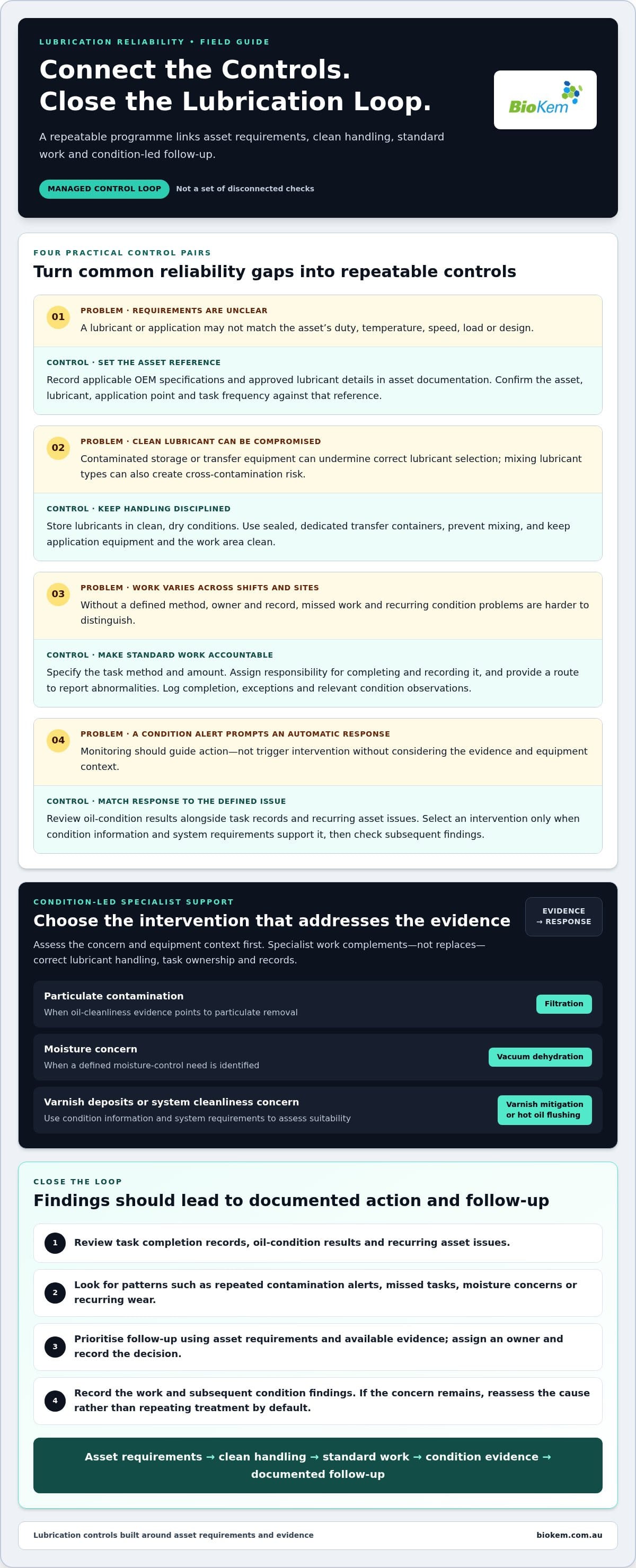
Consistency comes from turning asset requirements into repeatable maintenance steps. Use a simple sequence: identify requirements, control lubricant handling, complete standard work, then record and review. The Principles of lubrication Best Practice for reliability managers become practical when every task has a defined method and an accountable owner.
- Identify requirements: Confirm the asset, approved lubricant, application point and task frequency against current equipment documentation.
- Control handling: Store lubricants in clean, dry conditions. Use sealed, dedicated transfer containers and prevent mixing between lubricant types.
- Execute standard work: Apply the specified lubricant using the defined method and amount. Keep the work area and application equipment clean.
- Record and review: Log completion, exceptions and relevant condition observations so omissions and recurring issues can be identified.
What should a lubrication task standard include?
Each standard should identify the asset, lubricant requirement, application point, task method and completion record. Assign responsibility for completing and recording the task, and provide a clear route for reporting abnormalities. Consistent records help managers distinguish missed work from recurring condition problems. For more on preventing contamination through storage, transfer and use, read Oil Contamination Control: The Definitive Guide to Industrial Lubrication Reliability.
Condition information should guide action, not trigger automatic intervention. Routine monitoring helps establish trends and flag changes. A targeted response is appropriate when the evidence points to a defined issue. Filtration or specialist work such as dehydration or flushing may support that response, but does not replace sound daily controls. The U.S. Department of Energy’s O&M Best Practices Guide also places maintenance within a broader reliability and efficiency programme.
BioKem Oil Services’ industrial lubrication support includes services that can contribute to a documented maintenance response when oil-condition findings indicate a specific need.
How reliability managers can close the loop and improve lubrication control
A lubrication programme improves when findings lead to documented action and follow-up. Review task completion records alongside oil-condition results and recurring asset issues. Look for patterns such as repeated contamination alerts, missed tasks, moisture concerns or recurring wear. Prioritise follow-up according to asset requirements and available evidence, assign an owner, then record the decision and outcome. This makes the Principles of lubrication Best Practice for reliability managers a working feedback loop rather than a set of procedures that are never reviewed.
When should a lubrication programme trigger specialist support?
Escalate when monitoring or inspection identifies a concern that routine maintenance cannot resolve, such as persistent particulate contamination, moisture, varnish deposits or cleanliness that does not meet the asset’s established requirement. Assess the evidence and equipment context first. Then select an intervention that addresses the defined issue and verify the result through appropriate follow-up monitoring.
For example, lubrication oil filtration may be appropriate when oil-cleanliness evidence points to a need for particulate removal. Vacuum dehydration can support a defined moisture-control need. Varnish mitigation or hot oil flushing may be suitable when condition information and system requirements support those interventions. These specialist services complement routine controls. They do not replace correct lubricant handling, task ownership or records.
Close the loop by documenting the reason for intervention, the work completed and subsequent condition findings. If the results do not address the original concern, reassess the cause rather than repeating treatment by default. BioKem supports lubrication reliability programmes with condition monitoring and oil-cleanliness services. Information about BioKem’s lubrication reliability support is available here.
Turn lubrication controls into lasting reliability gains
The Principles of lubrication Best Practice for reliability managers are practical: align lubricant and maintenance controls with asset requirements, make daily tasks consistent, and use condition evidence to guide follow-up. Reviewing records alongside recurring equipment issues helps teams prioritise action and assess whether an intervention addressed the underlying concern.
Specialist support can strengthen the programme when a defined need calls for filtration, dehydration, varnish mitigation or flushing. BioKem provides Australia-wide service coverage, with over 70 years of combined industry experience among staff and the supply and use of ISO 16889-certified filtration.
For support with an asset-specific lubrication requirement, discuss your lubrication reliability requirements with BioKem. Clear controls and evidence-led decisions give your team a solid foundation for consistent maintenance and reliable equipment.
Frequently Asked Questions
What are the basic principles of lubrication best practice?
The basic principles are to match the lubricant and maintenance method to the asset, prevent contamination, apply lubricant correctly, monitor its condition and document the work. The Principles of lubrication Best Practice for reliability managers connect these controls into a consistent programme. Record relevant equipment requirements, approved lubricant details, task ownership and condition findings so maintenance decisions can be traced and reviewed.
How can lubrication improve equipment reliability?
Effective lubrication helps control friction and wear by ensuring the correct lubricant reaches the right application point in suitable condition. Clean handling, correct application and timely monitoring can help teams identify developing issues and decide when to investigate further. Reliability managers can use inspection and oil-condition information alongside maintenance records to prioritise follow-up and investigate recurring equipment problems.
How often should industrial lubricant be tested?
Set testing intervals according to the asset’s requirements, operating conditions, criticality and condition history, rather than applying one schedule to every machine. Follow applicable OEM guidance and establish a baseline, then use results and operating changes to review the sampling plan. More frequent checks may be appropriate when trends or unusual conditions warrant closer attention. Record results and actions for comparison over time.
Can oil filtration alone ensure lubrication reliability?
No. Filtration can address certain particulate contamination concerns, but it does not replace correct lubricant selection, clean storage and transfer, proper application or condition monitoring. It may not resolve other concerns, such as moisture or varnish, which require assessment against the asset’s condition and requirements. Use oil analysis and maintenance records to determine whether filtration or another intervention is appropriate, then document and review the outcome.

Article by
James McAllister
James McAllister is an industry professional with BioKem Oil Services, specialising in lubrication reliability, oil filtration, contamination control and asset performance. Drawing on BioKem's extensive field experience across turbines, compressors, hydraulic systems and critical rotating equipment, James writes practical, insight-driven articles that help maintenance and reliability teams improve equipment performance, extend asset life and reduce operational risk.