

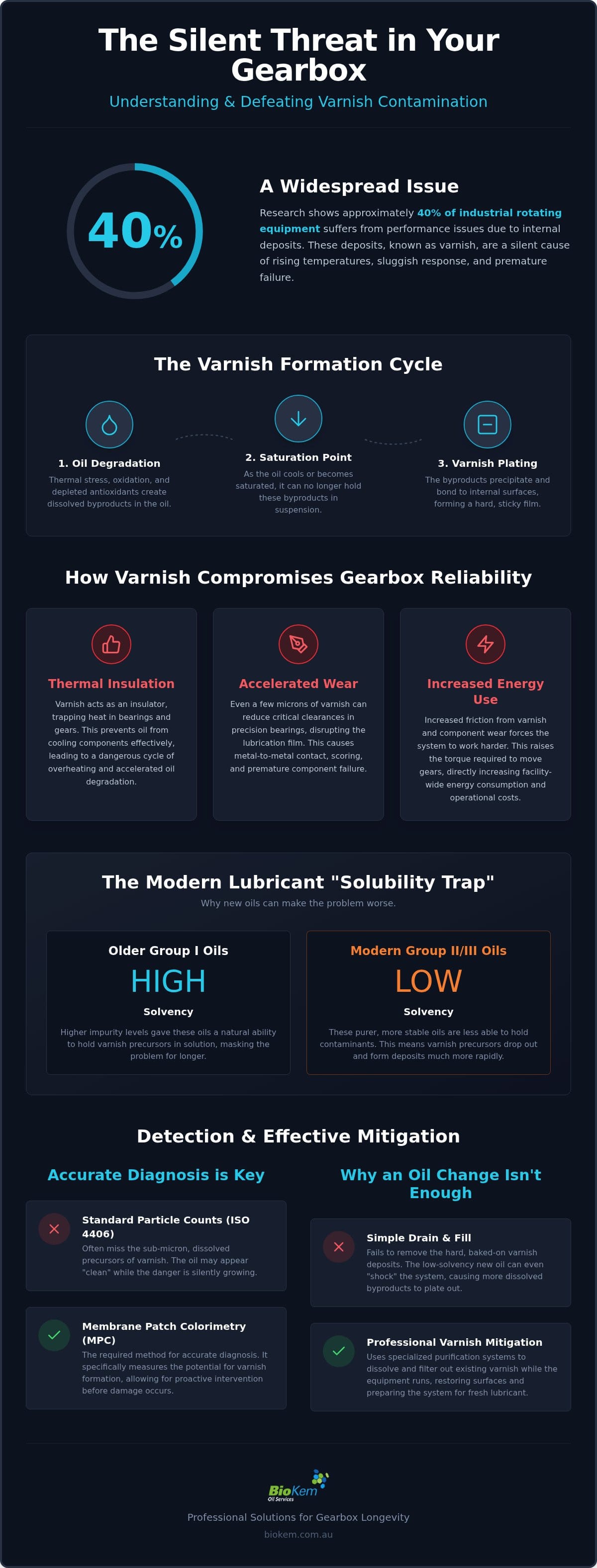
Research indicates that approximately 40% of industrial rotating equipment suffers from performance issues related to internal deposits. When you notice rising operating temperatures or sluggish response times, the culprit is often a silent accumulation of oil degradation byproducts. Understanding varnish and how it affects your gearbox is essential for maintaining operational continuity, especially as modern Group II and III base oils possess lower solvency for these contaminants. Standard oil changes frequently fail to address these sticky residues, leaving your critical assets vulnerable to accelerated wear and unexpected failure.
It’s frustrating to invest in premium lubricants only to see your machinery continue to run hot. You’re right to suspect that a simple drain and fill isn’t enough to clear the microscopic films insulating your bearings. This guide details how varnish degrades industrial gearboxes and outlines professional strategies to detect, remove, and prevent it for maximum asset reliability. We’ll explore the technical mechanisms of thermal stress, the shift in lubricant chemistry, and the specific purification and mitigation plans needed to lower operating temperatures and extend equipment life.
Key Takeaways
- Understand the chemical transition from dissolved precursors to solid deposits that plate onto internal metal surfaces.
- Learn about varnish and how it affects your gearbox by acting as a thermal insulator, leading to dangerous increases in operating temperatures.
- Discover why standard ISO 4406 particle counts often miss early indicators and why Membrane Patch Colorimetry (MPC) is required for accurate diagnosis.
- Identify the “solubility trap” where simple oil changes fail to remove existing deposits and can even accelerate new varnish formation.
- Explore professional strategies for onsite varnish mitigation and equipment hire options designed to restore asset reliability in remote industrial environments.
What is Varnish and Why Does It Form in Industrial Gearboxes?
Varnish is a thin, insoluble film that adheres to the internal surfaces of industrial machinery. It typically presents as a tough, amber, or dark brown coating that can’t be removed through standard mechanical wiping or simple oil drainage. Unlike traditional particulate contamination, which consists of solid debris like metal shavings or dust, varnish is a chemical byproduct of lubricant degradation. It begins as dissolved precursors within the oil. When the lubricant reaches its saturation point or experiences a drop in temperature, these precursors precipitate and “plate” onto metal surfaces. This transition from a liquid state to a solid deposit creates a persistent layer that interferes with mechanical tolerances and heat transfer. Understanding varnish and how it affects your gearbox is essential because this substance acts differently than sludge. While sludge is often soft and mobile, varnish is a tenacious resin that chemically bonds to gears, bearings, and housing walls.
The Chemistry of Oil Degradation
The formation of varnish is a chemical process driven by the breakdown of base oil molecules and additive packages. In high-load industrial gearboxes, lubricants are subjected to extreme pressure (EP) conditions that cause molecular shearing. Antioxidants within the oil serve as the first line of defense, sacrificing themselves to prevent the base oil from reacting with oxygen. However, once these antioxidants are depleted, the oxidation process accelerates rapidly. Modern industrial lubricants have seen a significant shift toward Group II and Group III base oils. While these oils offer superior purity and stability, they possess lower solvency compared to older Group I stocks. This means they’re less capable of holding polar degradation products in suspension. Consequently, even small amounts of oxidation can lead to the rapid dropout of varnish precursors, making modern systems more prone to internal plating than their predecessors.
Common Gearbox Varnish Triggers
Several operational factors catalyze the formation of these deposits in industrial environments. Localized “hot spots” on gear teeth surfaces often reach temperatures far exceeding the bulk oil temperature, triggering immediate thermal degradation. Another common mechanism is micro-dieseling. This occurs when air bubbles become entrained in the oil and are rapidly compressed in high-pressure zones, such as the mesh between gear teeth. The resulting localized heat causes the oil to char and form carbonaceous precursors. Chemical incompatibility also plays a role. Mixing different lubricant brands or formulations can cause additive dropouts, which quickly transition into sticky residues. To identify these issues early, BioKem provides specialized ferrogram analysis and onsite laboratory testing to detect degradation long before a total system failure occurs.
The Destructive Impact: How Varnish Compromises Gearbox Reliability
The presence of varnish within a gearbox creates a cascade of physical and chemical failures that threaten the integrity of the entire system. Understanding varnish and how it affects your gearbox requires looking at how these microscopic layers disrupt macroscopic operations. Initially, the deposits appear as a harmless discoloration on metal surfaces. However, as the layer thickens, it acts as a high-efficiency thermal insulator. This coating prevents the lubricating oil from effectively absorbing and carrying heat away from critical components like gear teeth and bearings. Because varnish has extremely low thermal conductivity, it traps heat within the metal, leading to localized overheating that standard sensors might not immediately detect.
Beyond thermal issues, these deposits physically alter the mechanical clearances required for smooth operation. In precision bearings, even a layer of a few microns can reduce the necessary gap, disrupting the hydrodynamic lubrication film. When this film fails, metal-to-metal contact occurs, causing accelerated wear and increasing the risk of sudden bearing seizure. This friction doesn’t just damage components; it also increases the torque required to move the gears, which directly raises energy consumption across your facility. Maintaining a proactive varnish mitigation strategy is essential to prevent these efficiency losses from becoming permanent mechanical damage.
Thermal Insulation and Overheating
Varnish creates a self-reinforcing cycle of degradation often called the “Death Spiral.” Research confirms that every 10 degrees Celsius increase in operating temperature doubles the oil’s oxidation rate. As varnish coats oil coolers and reservoir walls, heat transfer efficiency plummets. This causes the bulk oil temperature to rise, which in turn accelerates the formation of more varnish. Industrial surveys indicate that 40% of power plants report performance issues tied directly to this thermal insulation effect, proving that cooling system efficiency is often the first casualty of oil degradation.
Mechanical Interference and Valve Sticking
The sticky nature of these deposits is particularly hazardous for systems with internal control valves or sensors. Varnish acts like a glue, causing valves to lag or stick, which can lead to catastrophic pressure spikes or lubrication starvation. Narrow lubrication passages are also prone to clogging, significantly reducing flow rates to the furthest reaches of the gearbox. Additionally, as varnish aged and hardens, it can become brittle and flake off. These abrasive particles act as a grinding paste, causing premature seal failure and allowing external contaminants to enter the system, further compromising the life of the asset.
Detection and Diagnosis: Moving Beyond Standard Oil Analysis
Relying solely on standard oil analysis can lead to a false sense of security regarding asset health. While traditional reports focus on wear metals and solid particulates, they frequently overlook the chemical precursors that lead to varnish formation. Understanding varnish and how it affects your gearbox requires a diagnostic shift from simply counting particles to evaluating the chemical stability of the lubricant. Visual cues often provide the first warning. Operators should inspect sight glasses and dipsticks for amber staining or a “lacquer” appearance. On gear teeth, varnish often manifests as a dull, matte finish or a sticky residue that catches light differently than a healthy oil film. If these signs are present, the degradation process is already well advanced.
The Limitations of Standard Lab Reports
A “clean” oil report based on ISO 4406 standards does not guarantee a varnish-free system. These standards measure solid contaminants, but varnish precursors are often “soft” contaminants that exist in a dissolved state at operating temperatures. Sub-micron contaminants are invisible to standard laser particle counters because they fall below the detection threshold of 4 microns. Consequently, a gearbox can have an excellent cleanliness rating while the lubricant is simultaneously saturated with oxidation byproducts. When the oil cools or reaches its saturation limit, these invisible precursors precipitate out of the solution and begin plating onto internal components, regardless of what the last lab report indicated about particulate levels.
Advanced Diagnostic Tools
To accurately assess the risk of varnish, more sophisticated testing protocols are required. Membrane Patch Colorimetry (MPC) is the industry standard for measuring the varnish potential of a lubricant. This test involves filtering a sample through a fine membrane and measuring the color intensity of the residue. An MPC value below 15 generally indicates a stable system, while values between 15 and 29 suggest a need for increased monitoring. Once the MPC value exceeds 30, the risk of varnish deposition is critical, and immediate mitigation is necessary to prevent mechanical failure.
BioKem utilizes comprehensive onsite testing to provide immediate feedback for Australian industrial sites. Using patch test kits allows for rapid assessment of oil health without the delays of offsite shipping. For a deeper investigation into the root cause of contamination, a filter ferrogram analysis can distinguish between mechanical wear particles and chemical deposits. This distinction is vital; treating a chemical varnish issue with standard mechanical filtration will not solve the underlying problem. By identifying the specific nature of the contaminants, maintenance teams can implement a targeted plan that addresses the chemistry of the oil rather than just its clarity.
Effective Mitigation: Why an Oil Change is Not Enough
A common misconception in industrial maintenance is that a simple oil change will resolve varnish issues. In reality, performing a standard drain and fill without addressing existing deposits often leads to a “revolving door” of contamination. When you consider varnish and how it affects your gearbox, you must account for the solubility trap. Fresh lubricant possesses high solvency. As soon as new oil enters a fouled system, it begins to dissolve the sticky layers plated onto internal surfaces. While this might sound beneficial, it causes the new oil to reach its saturation point almost immediately. The fresh oil becomes chemically compromised before it has even reached its full service life, leading to rapid antioxidant depletion and the premature formation of new deposits.
The Failure of the ‘Drain and Fill’ Method
This cycle represents a significant economic loss. Sacrificing a new charge of high-performance lubricant to “clean” the internals is an inefficient and costly approach. Residual varnish left on gear teeth and bearing housings quickly leaches back into the fluid, degrading its performance. Some teams attempt to use aggressive chemical cleaning agents to strip these layers. These must be used with extreme caution. If not properly flushed, residual chemicals can react with the new oil or damage sensitive seals, leading to secondary failures that are more expensive than the original varnish issue.
Specialized Varnish Removal Systems
True remediation requires specialized Varnish Removal Systems that can operate while the equipment remains online. These units provide several advantages over static oil changes:
- Continuous removal of sub-micron precursors before they can plate onto metal surfaces.
- Restoration of the lubricant’s natural solvency by stripping out polar contaminants.
- Maintenance of oil health without requiring unscheduled machinery downtime.
These systems utilize advanced technologies like electrostatic precipitation or specialized depth filtration to capture sub-micron precursors that standard filters ignore. By continuously removing these polar molecules, the system ensures the lubricant maintains its chemical integrity and meets stringent ISO 4406 cleanliness standards throughout its operational life.
For systems with heavy accumulation or following a mechanical failure, Hot Oil Flushing is the only reliable method for a deep system clean. This process uses high-velocity, turbulent flow at elevated temperatures to mechanically and chemically dislodge deposits from every internal passage. It’s a critical step in a comprehensive reliability strategy, ensuring the gearbox starts its next service cycle in a truly clean state. If you are struggling with persistent overheating or frequent oil degradation, BioKem provides the technical expertise and onsite purification equipment to break the cycle of varnish formation and protect your critical assets.
BioKem’s Professional Solutions for Gearbox Longevity
BioKem provides a comprehensive suite of services designed to eliminate the chemical and mechanical risks posed by oil degradation. Understanding varnish and how it affects your gearbox is the first step toward reliability; the second is implementing a technical solution that addresses the root cause of the contamination. As the sole Australian distributor for Filters S.p.A., we provide access to world-class filtration technology that removes sub-micron precursors before they plate onto metal surfaces. Our approach combines onsite laboratory testing with specialized purification machinery to ensure your lubricants maintain their molecular integrity. This proactive stance prevents the thermal “death spiral” and protects your capital investments from premature failure.
Onsite Technical Expertise
Restoring gearbox health doesn’t always require a total mechanical teardown or expensive component replacement. BioKem technicians deploy specialized machinery directly to your facility, performing onsite varnish mitigation and oil purification to restore system health. By managing the technical complexity onsite, we help maintenance teams avoid the logistical burden and costs of transporting heavy equipment. Our hot oil flushing protocols utilize high-velocity turbulent flow to dislodge deposits that standard filtration cannot reach. This process is executed with a strict focus on regulatory compliance and safety, ensuring that your systems are restored to peak efficiency with minimal operational downtime.
Partnering for Long-Term Reliability
For facilities in remote industrial locations, access to specialized maintenance can be a significant challenge. BioKem addresses this through flexible equipment hire, allowing sites to maintain oil cleanliness independently using professional-grade hardware. Moving from a reactive mindset to a proactive reliability strategy is essential for extending asset life and reducing unscheduled downtime. We’ve been specialists in varnish mitigation since 2011, providing customized maintenance plans built on rigorous data, including ferrogram analysis and MPC testing. This data-driven approach ensures that every intervention is targeted and effective. Contact BioKem today to schedule a system assessment and develop a comprehensive varnish mitigation plan tailored to your specific operational requirements.
Securing Long-Term Gearbox Reliability
Varnish isn’t just a cosmetic issue; it’s a structural threat that compromises cooling and accelerates mechanical wear. Maintaining a proactive stance is the only way to break the cycle of thermal degradation. By moving beyond standard particle counts and utilizing Membrane Patch Colorimetry (MPC), you can identify risks before they lead to unscheduled downtime. Understanding varnish and how it affects your gearbox allows your team to transition from reactive repairs to a strategy focused on total asset longevity. This commitment to mechanical excellence is also vital for high-performance automotive enthusiasts, who can learn more about Oztrack Performance Tuning & Engines to discover how expert tuning and specialized guides protect their vehicle investments.
BioKem stands as the sole Australian distributor for Filters S.p.A., providing world-class technology to remote and metropolitan industrial sites. Our specialist technicians are available nationally to handle technical complexities onsite, backed by rigorous laboratory-grade ferrogram and MPC analysis. We provide the expertise and equipment needed to restore your oil’s chemical health and protect your critical infrastructure. Protect your assets with BioKem’s professional Varnish Mitigation services. Investing in specialized purification today ensures a more sustainable and reliable operation for years to come.
Frequently Asked Questions
Can I remove gearbox varnish by just changing the oil?
No, a simple oil change is insufficient for removing established deposits. When fresh lubricant enters a fouled system, its natural solvency causes it to absorb existing residues from internal surfaces. This process quickly saturates the new oil and depletes its additive package. To effectively address varnish and how it affects your gearbox, you must physically remove the deposits through specialized mitigation or flushing to prevent the new oil from being compromised immediately.
What is the best test to detect varnish in an industrial gearbox?
Membrane Patch Colorimetry (MPC) is the most reliable method for detecting varnish potential. Unlike standard particle counts, MPC measures the volume of soft contaminants that have dropped out of the oil solution. A sample is filtered through a fine membrane, and the resulting color intensity is measured against a scale. This provides a clear indication of the chemical health of the lubricant and the immediate risk of internal plating on critical components.
How does varnish affect the operating temperature of my gearbox?
Varnish acts as a high-efficiency thermal insulator on internal metal surfaces. By coating gear teeth, bearing housings, and oil cooler tubes, it prevents the lubricant from effectively absorbing and dissipating heat. This leads to localized temperature spikes that accelerate oil oxidation. As the temperature rises, more varnish forms, creating a “death spiral” that eventually causes the gearbox to operate well above its designed thermal limits, threatening its structural integrity.
Is varnish formation more common in synthetic or mineral oils?
Varnish formation is closely tied to the solvency of the base oil rather than just its classification as mineral or synthetic. Modern Group II and III base oils, which are common in high-performance lubricants, have lower solvency than traditional Group I stocks. While these oils offer better oxidation resistance, they can’t hold as many degradation byproducts in suspension. This leads to a higher risk of varnish precipitation once the lubricant’s saturation point is reached.
What is the difference between varnish and sludge?
The primary difference lies in their physical state and how they interact with the machinery. Varnish is a thin, hard, or sticky resin that chemically bonds to metal surfaces. It’s difficult to remove and acts as an insulator. Sludge is a soft, thick, and mobile accumulation of oil, water, and large particulates. While sludge can clog filters, varnish is more insidious because it alters mechanical clearances and interferes with heat transfer at a microscopic level.
How long does a professional varnish mitigation process take?
The duration of the process depends on the specific remediation method chosen and the total oil volume. Online varnish mitigation units are designed to run continuously while the gearbox is in operation, often showing significant results within a few weeks. For more intensive cleaning, a hot oil flush might require three to five days of onsite work. BioKem technicians focus on minimizing downtime by utilizing high-velocity equipment that accelerates the removal of persistent internal deposits.
Can varnish cause gearbox bearings to fail prematurely?
Yes, varnish is a leading cause of premature bearing failure in industrial gearboxes. These deposits reduce the critical clearances required for a healthy hydrodynamic oil film. When the film thickness is compromised, the bearing experiences increased friction and localized heat. This eventually leads to metal-to-metal contact, accelerated wear, and the potential for sudden seizure. Regular monitoring of varnish levels is essential to maintaining the precision tolerances required for long-term bearing reliability.
Does BioKem provide onsite varnish testing across Australia?
Yes, BioKem provides comprehensive onsite varnish testing and mitigation services across Australia. Our technicians utilize portable laboratory equipment to perform MPC and ferrogram analysis at your facility, regardless of its location. This national service focus ensures that remote industrial sites have access to the same high-level technical expertise as metropolitan centers. By handling the technical complexity onsite, we help maintenance teams implement proactive reliability strategies that protect their critical assets from the destructive effects of oil degradation.