

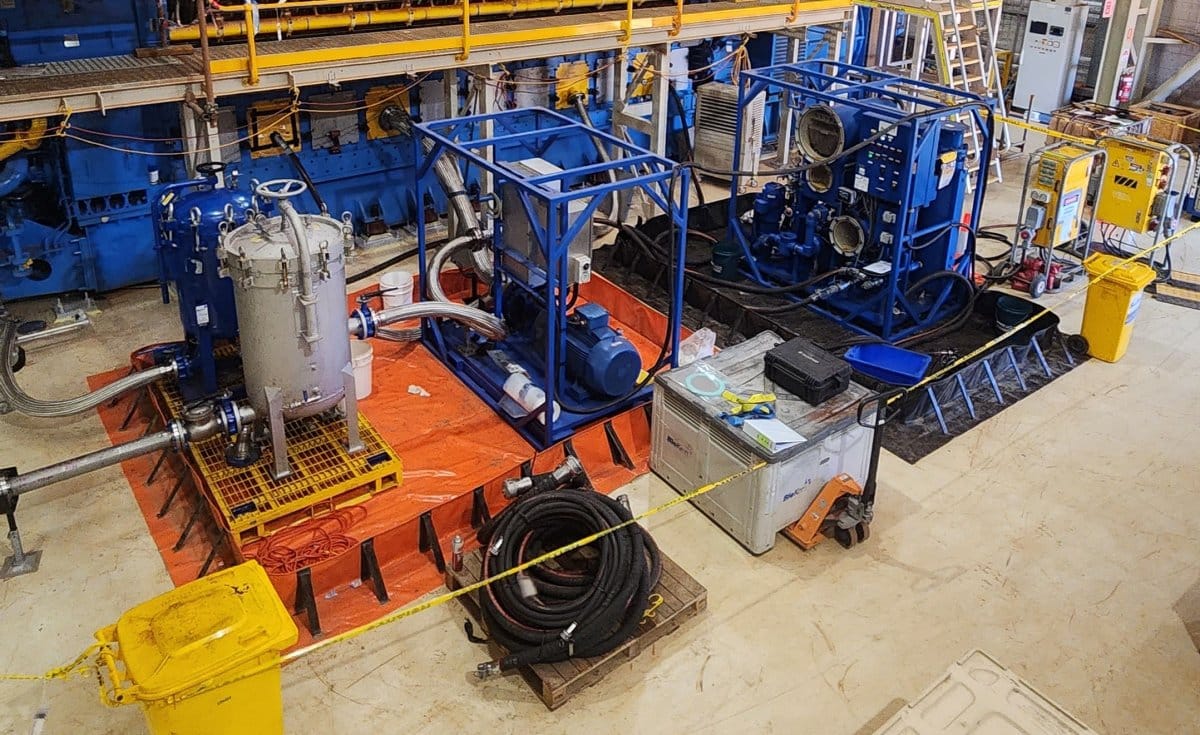
Why do so many sophisticated hydraulic systems suffer catastrophic component failure within weeks of a new installation or a major overhaul? It’s a frustrating reality that even the most expensive valves and pumps remain vulnerable to microscopic construction dirt and metallic debris that standard filtration simply can’t reach. You likely recognize that system cleanliness is the cornerstone of reliability, yet achieving consistent results often feels like a moving target when relying on unqualified providers or vague protocols.
Implementing a precise hot oil flushing procedure for hydraulic systems is the only way to bridge the gap between initial assembly and peak operational performance. This article provides a comprehensive, engineering-led framework designed to help you master the technical nuances of high-velocity flushing. You’ll learn how to transition from laminar to turbulent flow, verify results against the latest ISO 4406:2021 and SAE AS4059G standards, and ultimately extend the life of your critical assets. We’ll examine the five essential stages of a professional flush, from calculating Reynolds Number targets to final oil analysis and certification.
Key Takeaways
- Grasp the physics of turbulent flow and why maintaining a Reynolds Number above 4000 is critical for dislodging stubborn sub-micron contaminants.
- Master the technical 5-stage hot oil flushing procedure for hydraulic systems to eliminate construction debris and ensure long-term component reliability.
- Implement effective bypass strategies to protect expensive proportional valves and actuators during high-velocity circulation.
- Utilize the latest ISO 4406:2021 cleanliness codes and SAE AS4059G standards to verify that fluid meets strict operational requirements.
- Reduce the risk of unscheduled downtime by establishing a repeatable framework for both new installations and routine system overhauls.
What is Hot Oil Flushing and Why is the Procedure Critical?
Hydraulic systems are the muscle of modern industry, yet their reliability depends entirely on fluid purity. A hot oil flushing procedure for hydraulic systems is an essential engineering intervention that goes far beyond standard filtration. Hot oil flushing is the circulation of heated fluid at high velocities to dislodge internal contaminants. Unlike static filtration, this dynamic process targets the particulate matter that clings to the internal walls of pipework and manifolds, ensuring they don’t migrate into sensitive components during operation.
The primary objective is to achieve a ‘clean start’ for newly commissioned systems or to restore the integrity of aged assets. Neglecting this step is a recipe for operational disaster. Construction debris such as welding slag, grinding dust, and metal shavings can easily bypass standard filters during the initial startup. Since modern hydraulic valves often have clearances of less than five microns, even microscopic particles act like sandpaper. This leads to rapid abrasive wear and catastrophic component failure that can sideline an entire production line.
The Role of Heat in Contaminant Removal
Temperature management is a critical variable in any professional hot oil flushing and filtering service. Heating the fluid significantly reduces its kinematic viscosity. This reduction allows the flushing pumps to drive the oil at much higher velocities, which is necessary to create a turbulent flow within the piping. This turbulence creates the mechanical energy required to scrub the internal surfaces clean, carrying debris toward high-efficiency filters.
Thermal expansion also plays a vital role in the cleaning process. As the pipework heats up, the metal expands, which helps loosen particles that are physically wedged or embedded in the surface of the metal. It’s a precise science that requires constant monitoring. Technicians must strictly observe flash points and ensure that all hoses and seals are rated for the elevated temperatures required for the procedure. Proper thermal cycling ensures that even the most stubborn contaminants are liberated and removed.
Identifying Systems That Require Flushing
Not every system needs a full flush, but certain scenarios make the hot oil flushing procedure for hydraulic systems non-negotiable for maintaining asset health:
- New Installations: Every meter of new pipework is a potential source of contamination from the manufacturing, storage, and assembly process.
- Post-Component Failure: When a pump or motor suffers a mechanical burnout, it releases a wave of metallic debris throughout the entire circuit that standard filters can’t fully capture.
- High-Criticality Assets: Systems where downtime costs are extreme, such as turbine lubrication or large-scale mining equipment, require routine flushing to maintain strict ISO cleanliness targets.
The Science of the Flush: Reynolds Number and Turbulent Flow
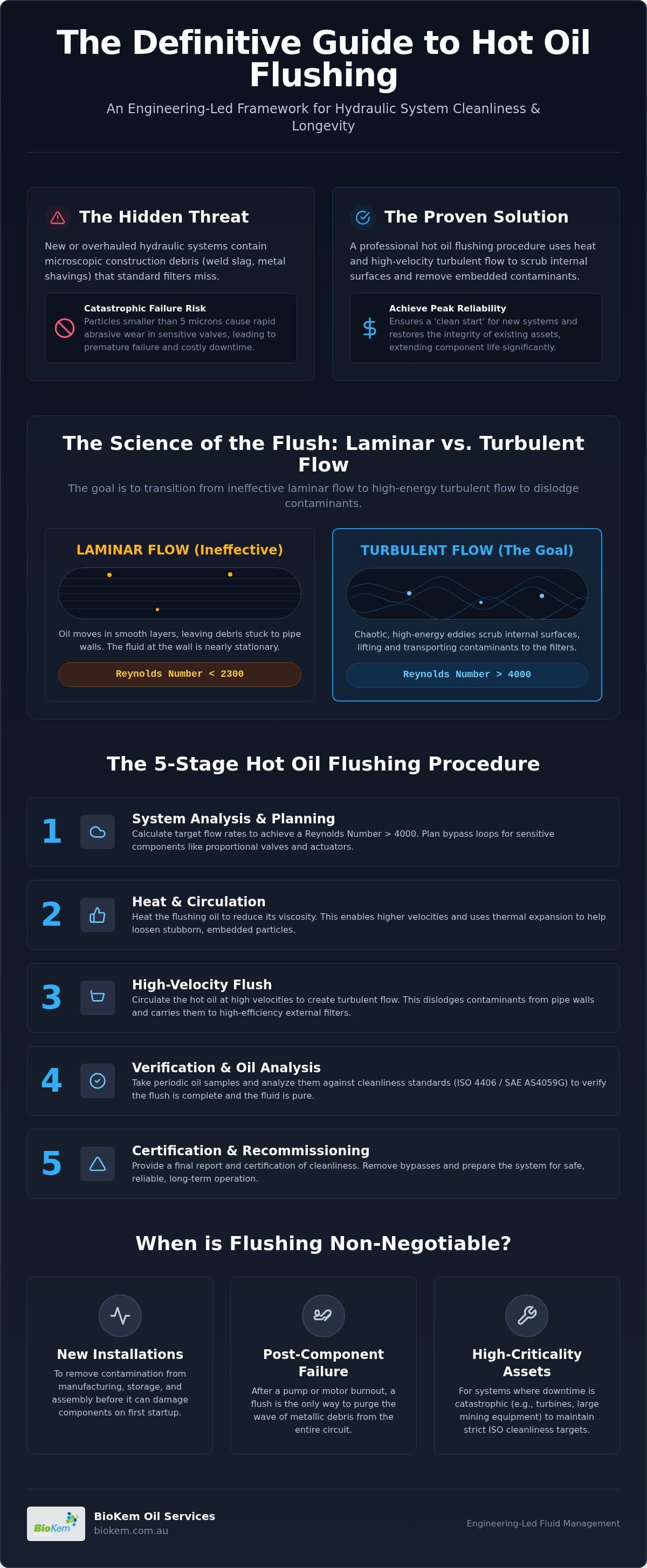
A successful hot oil flushing procedure for hydraulic systems relies on fluid dynamics rather than just heat. While high temperatures are necessary to reduce viscosity, the ultimate goal is to transition the fluid from laminar flow to turbulent flow. In a laminar state, oil moves in smooth, parallel layers, with the fluid at the pipe wall remaining almost stationary. This does nothing to remove contaminants. Only turbulent flow creates the chaotic, high-energy eddies required to “scrub” the internal surfaces of the pipework and carry debris into the filtration circuit.
Engineers quantify this flow regime using the Reynolds Number (Re), a dimensionless value that represents the ratio of inertial forces to viscous forces. The ISO 23309:2020 standard provides the technical foundation for these calculations, establishing that a Reynolds Number greater than 4,000 is the minimum threshold for turbulence. However, relying on the bare minimum is risky. Factors like pipe roughness and fluid type can influence the transition point, which is why professional flushing rigs are sized to exceed these targets significantly.
Achieving Turbulent Flow in Large Bore Systems
Large diameter pipework, common in mining and power generation sectors, presents a significant engineering challenge. As pipe diameter increases, the flow rate required to maintain turbulence climbs exponentially. Standard system pumps are rarely capable of reaching these velocities. This is where specialized high-flow flushing rigs become essential. To verify that the flow is effectively dislodging debris, technicians often install Paddle Flushing Screens. These tools provide a physical record of the contaminants captured during the high-velocity circulation, allowing for real-time adjustments to the procedure.
Reynolds Number Calculation Checklist
To ensure your hot oil flushing procedure for hydraulic systems is effective, you must account for three primary variables: flow velocity, internal pipe diameter, and kinematic viscosity. Kinematic viscosity is highly temperature-dependent; as the oil heats up, it becomes “thinner,” making it easier to achieve turbulence with less pump energy. While Re > 4,000 is the theoretical start of turbulence, many critical industrial applications utilize a safety factor of Re > 6,000 to guarantee a thorough clean. It’s also vital to adjust calculations based on the fluid type, as synthetic oils often exhibit different viscosity-temperature profiles compared to traditional mineral oils. If your onsite equipment lacks the necessary power to hit these targets, BioKem provides high-performance equipment hire solutions tailored for large-scale industrial flushing.
The 5-Stage Hot Oil Flushing Procedure for Hydraulic Systems
A rigorous hot oil flushing procedure for hydraulic systems follows a logical sequence that transitions from mechanical preparation to high-energy fluid dynamics. This structured approach ensures that every internal surface is scrubbed clean while protecting the system’s most sensitive components. The process begins with thorough preparation, where technicians isolate the system from its power source and manually clean the reservoir. Starting with a contaminated tank is a common mistake that simply reintroduces particulate into the newly cleaned lines.
Once the system is isolated, circuit design becomes the priority. This involves installing temporary jumpers to create closed loops, ensuring every meter of pipework is included in the flow path. The actual circulation occurs in two distinct phases. An initial flush at ambient temperatures removes bulk contaminants like welding slag or metal shavings. This is followed by the hot flush stage, where technicians raise the fluid temperature to between 60°C and 70°C. This temperature range is optimal for reducing viscosity and achieving the turbulent flow necessary to liberate deeply embedded particulate. To finish, mechanical pulsing or vibration is applied to the pipework to dislodge debris trapped in “dead legs” or tight bends that fluid velocity alone might miss.
Bypassing Critical Components
Protecting the system’s most expensive assets is a non-negotiable step in the hot oil flushing procedure for hydraulic systems. Pumps, hydraulic motors, and proportional valves have extremely tight internal tolerances. The debris liberated during a flush would cause immediate scoring or seizing if allowed to pass through these components. Technicians use temporary jumpers and specialized manifold blocks to maintain circuit integrity while keeping these sensitive parts out of the loop. For comprehensive onsite support and technical circuit design, see BioKem’s Hot Oil Flushing & Filtering Services.
Execution and Monitoring
The success of the flushing loop depends on the quality of the filtration technology employed. BioKem utilizes high-performance Filters S.p.A. Products to capture liberated contaminants. Monitoring pressure differentials across these filter elements is a vital part of the execution phase. Technicians typically start with coarse filter media to capture large particles and then step down to high-efficiency, sub-micron elements as the oil reaches its target cleanliness code. This progressive filtration strategy prevents the fine filters from blinding prematurely and ensures a more efficient cleaning cycle.
Verification: Cleanliness Standards and Oil Analysis
Verification is the final, non-negotiable phase of a technical intervention. A hot oil flushing procedure for hydraulic systems is only considered successful when the fluid properties meet the specific cleanliness targets defined during the engineering phase. We primarily utilize the ISO 4406:2021 standard to quantify solid particulate contamination. This 3-digit code system represents the number of particles larger than 4, 6, and 14 microns per milliliter of fluid. For high-pressure hydraulic systems utilizing sensitive proportional valves, a target such as 16/14/11 is often required. This ensures that the population of microscopic debris is low enough to prevent premature component wear or silt-lock in tight-tolerance actuators.
While ISO 4406 is the global benchmark, many industries are transitioning to SAE AS4059G for more detailed classification. Regardless of the standard, the goal is to provide the asset owner with a ‘cleanliness birth certificate’. This document serves as a baseline for future condition monitoring, proving that the system began its operational life in a state of peak reliability. Without this data-driven verification, a flush is merely an expensive exercise in oil circulation without guaranteed results.
Onsite Testing vs. Laboratory Analysis
Real-time data allows for immediate operational decisions. Technicians use Patch Test Kits for rapid visual confirmation of large debris and bright-metal particulate. For digital precision, the Particle Pal Range provides laser-based particle counting while the flushing rig is still in operation. If the onsite results indicate unusual metallic wear, we recommend a full Filter Ferrogram analysis. This laboratory-grade test identifies the specific type of wear debris, such as copper from bushings or steel from gears, providing deep insights into the health of the system’s internal components.
Post-Flush Oil Conditioning
Removing particulate is only half the battle. Once the flush is complete, we address chemical contaminants that can compromise oil life. If the system shows signs of thermal degradation, we deploy a Varnish Removal System to extract soft contaminants that standard filters miss. We also utilize vacuum dehydration to remove any dissolved water that may have entered the circuit during maintenance. The final step in the restoration process involves reconnecting all bypassed components, performing a final fluid top-up with filtered oil, and conducting a controlled system restart. To ensure your fluid meets these rigorous standards before startup, book a professional oil analysis and flushing consultation with our technical team.
The BioKem Advantage: Professional Flushing Services and Hire
BioKem Oil Services operates as a dedicated technical partner for industrial facilities across Australia. We recognize that a hot oil flushing procedure for hydraulic systems is often a complex, resource-intensive undertaking that requires specialized knowledge. To support this, we maintain a national mobilization capability, deploying expert technicians and high-performance machinery to remote mine sites, power stations, and manufacturing hubs. Our position as the sole Australian distributor for Filters S.p.A. Products and an authorized distributor for Swift Filters ensures that every project utilizes the highest caliber of filtration media available.
We understand that some facilities prefer to manage maintenance internally to utilize their own skilled personnel. For these organizations, we offer a comprehensive equipment hire service. This provides in-house maintenance teams with access to professional-grade, high-flow flushing rigs that are capable of reaching the rigorous Reynolds Number targets required for true turbulent flow. Whether we are managing the entire project or providing the necessary tools, our focus remains on delivering customized flushing plans tailored to the specific requirements of high-criticality assets like turbines, large-scale presses, and compressors.
Why Outsource Your Flushing to BioKem?
Outsourcing this critical task allows facilities to access specialized technology and niche authority without significant capital expenditure. We bring a deep understanding of Australian environmental and safety standards, ensuring that every hot oil flushing procedure for hydraulic systems is executed with minimal ecological impact and maximum efficiency. Our technical expertise extends beyond standard hydraulics into complex Heat Transfer Systems. This specialized knowledge ensures that we can handle the unique thermal and chemical challenges associated with high-temperature lubrication and power fluid systems.
Next Steps for Your Facility
Every industrial asset has unique operational parameters and contamination risks. We begin each engagement by developing a site-specific flushing procedure and a transparent quote based on your system’s volume, pipe diameters, and target ISO cleanliness codes. Beyond the initial flush, our team consults on proactive maintenance strategies, including routine oil analysis and varnish mitigation, to prevent future contamination from taking hold. Contact BioKem today for a professional Hot Oil Flushing Consultation to secure the long-term reliability and efficiency of your critical infrastructure.
Securing Long-Term Hydraulic Reliability
Mastering the hot oil flushing procedure for hydraulic systems is a strategic investment in the longevity of your industrial assets. By prioritizing turbulent flow physics over simple circulation, you’ll ensure that sub-micron contaminants are removed before they can cause irreversible component damage. This engineering-led approach, verified by strict ISO 4406 cleanliness codes, transforms system maintenance from a reactive chore into a proactive reliability strategy. It’s the difference between a system that merely runs and one that excels under high-pressure operational demands.
BioKem stands ready to support your facility with national onsite service capabilities and technical expertise. As the sole Australian distributor for Filters S.p.A., we combine advanced filtration technology with onsite laboratory analysis to provide a documented cleanliness birth certificate for your systems. Whether you require a full-service team or specialized equipment hire, we help you maintain operational excellence while adhering to the highest environmental standards. You don’t have to navigate these complex technical requirements alone.
Take the first step toward a debris-free system today. Request a Professional Hot Oil Flushing Quote from BioKem and ensure your hydraulic infrastructure is built for peak performance.
Frequently Asked Questions
How long does a typical hot oil flushing procedure take?
A typical hot oil flushing procedure for hydraulic systems can take anywhere from 24 hours to several days to complete. The exact duration depends on the total system volume, the complexity of the pipework, and the initial contamination levels. We continue the circulation until consecutive oil samples meet the pre-defined ISO 4406 cleanliness targets, ensuring the system is ready for safe operation.
What is the difference between oil filtration and hot oil flushing?
Oil filtration is a standard maintenance process that removes particles from circulating fluid, while hot oil flushing is a high-velocity cleaning procedure designed to scrub internal pipe surfaces. While filtration maintains fluid health, flushing uses turbulent flow to dislodge and capture construction debris or wear particulate that has settled in the circuit. It’s an essential step for commissioning new systems.
Can I perform a hot oil flush with the system’s existing pump?
It’s rarely possible to perform an effective flush using the system’s existing pump. Most onboard pumps are sized for operational flow rates that result in laminar flow, which is insufficient for cleaning internal surfaces. To reach the required Reynolds Number of 4,000 or higher, you typically need an external high-flow flushing rig. BioKem provides specialized equipment hire for teams that want to execute this in-house.
What temperature is required for a successful hydraulic flush?
A successful hydraulic flush typically requires fluid temperatures between 60°C and 70°C. This specific range reduces the oil’s kinematic viscosity enough to allow for high-velocity, turbulent flow without exceeding the safety limits of the system’s seals or the oil’s flash point. Maintaining this temperature is critical for maximizing the mechanical scrubbing action within the pipework to liberate trapped debris.
How do I know when the flushing procedure is complete?
The procedure is complete once fluid samples consistently pass laboratory analysis or onsite laser particle counting. We verify the results against target ISO 4406:2021 cleanliness codes, such as 16/14/11. The process only stops when the oil analysis confirms that the particulate population has dropped below the threshold required for safe component operation and long-term asset reliability across the entire circuit.
Is hot oil flushing necessary for water-based hydraulic fluids?
Yes, hot oil flushing is necessary for water-based fluids to remove particulate contamination, though the technical parameters differ from mineral oils. Water-glycol and other fire-resistant fluids have different viscosity-temperature profiles that require adjusted flow rate calculations. It’s vital to use flushing equipment and seals that are chemically compatible with these specific fluid types to prevent system damage or premature seal failure.
What are the common mistakes made during a hydraulic flush?
The most common mistakes include failing to bypass sensitive proportional valves and not achieving a high enough Reynolds Number for turbulence. Another significant error is starting the hot oil flushing procedure for hydraulic systems without first cleaning the reservoir. This mistake often leads to cross-contamination, where new debris is introduced into the lines faster than the filters can remove it from the loop.
Can BioKem provide equipment hire for flushing in remote Australian locations?
BioKem provides technical equipment hire and onsite services to remote locations across all Australian states and territories. Our mobile flushing rigs and filtration units are designed for rapid mobilization to mine sites, offshore platforms, and regional power stations. We offer both managed services and equipment hire options, ensuring that even the most isolated facilities have access to professional-grade contamination control technology.

Article by
James McAllister
James McAllister is an industry professional with BioKem Oil Services, specialising in lubrication reliability, oil filtration, contamination control and asset performance. Drawing on BioKem's extensive field experience across turbines, compressors, hydraulic systems and critical rotating equipment, James writes practical, insight-driven articles that help maintenance and reliability teams improve equipment performance, extend asset life and reduce operational risk.