

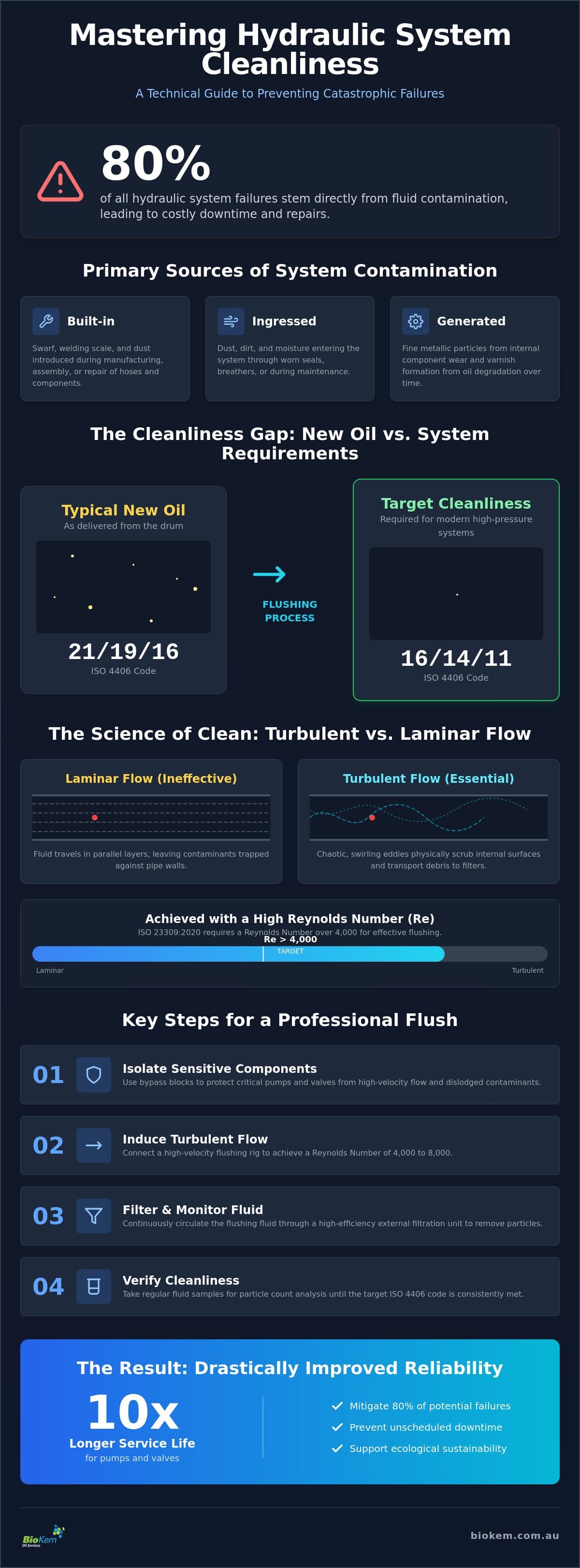
Up to 80% of all hydraulic system failures stem directly from fluid contamination. It’s a sobering statistic for any reliability engineer. For many industrial operations, the difference between a system lasting 10,000 hours or failing at 1,000 hours often comes down to the precision of your hydraulic hose flushing procedure. You’ve likely experienced the frustration of unscheduled downtime or the confusion of differing standards that leave “dead legs” of particulate matter in your lines.
Achieving a target ISO 4406 cleanliness code of 16/14/11 requires more than a simple rinse; it demands a scientific approach to fluid dynamics. This guide outlines how to master the technical requirements and step-by-step protocols necessary for modern compliance. We’ll examine the role of turbulent flow, the implications of the ISO 23309:2020 standard, and how to develop a repeatable maintenance protocol that protects your critical pumps and valves while supporting long-term ecological health.
Key Takeaways
- Understand why new oil often fails to meet modern cleanliness standards and why high-velocity fluid flow is essential for protecting sensitive components.
- Master the science of the Reynolds Number to ensure your system achieves the turbulent flow required to dislodge deep-seated particulates.
- Execute a precise hydraulic hose flushing procedure by utilizing bypass blocks to isolate critical valves and prevent secondary contamination.
- Learn how to reach target ISO 4406 cleanliness codes that can extend the service life of your pumps and valves by up to ten times.
- Evaluate the benefits of professional equipment hire and onsite oil services to maintain regulatory compliance and operational reliability during major shutdowns.
The Critical Necessity of Hydraulic Hose Flushing
A precise hydraulic hose flushing procedure is the primary defense against internal system degradation. In industrial contexts, flushing is defined as the forced removal of particulate matter and chemical contaminants through high-velocity fluid flow. This process relies on generating enough kinetic energy to dislodge debris that has adhered to internal pipe walls or settled in stagnant zones. Simply circulating oil at standard operating pressures rarely achieves this result. To be effective, the fluid must reach a state of turbulence that physically scours the interior surfaces of the system.
Many operators incorrectly assume that hydraulic fluid sourced directly from a new drum is clean enough for immediate use. However, industrial manufacturing and transport processes often introduce contaminants before the seal is even broken. It’s common for new oil to possess a cleanliness level of ISO 21/19/16, which contains significantly more particulate matter than the 16/14/11 target required by modern high-pressure valves. These microscopic particles, often referred to as silt, act as an invisible killer within the system. They cause abrasive wear on precision-machined surfaces and lead to valve sticking, which compromises the reliability of the entire asset. To quantify these risks, the industry relies on ISO 4406 as the global benchmark for measuring fluid cleanliness.
Common Sources of System Contamination
Contamination enters a system through three primary pathways. First, built-in contamination includes swarf, welding scale, and dust introduced during the manufacturing or assembly of hoses and manifolds. Second, ingressed contamination occurs during operation, as dust and moisture enter through breathers, worn seals, or during routine maintenance activities. Finally, generated contamination is the byproduct of internal component wear. As metal surfaces rub together, they release fine metallic particles. Over time, oil degradation can also lead to the formation of varnish, which coats internal surfaces and further traps debris.
The Cost of Neglect: Why Rinsing Isn’t Enough
There is a fundamental difference between a standard oil change and a comprehensive system flush. A simple rinse or drain and fill leaves behind dead legs, which are sections of the system where fluid remains stagnant and contaminants accumulate. Without a dedicated hydraulic hose flushing procedure, these pockets of debris quickly re-contaminate new oil. In the Australian industrial sector, where equipment operates under extreme loads, this neglect leads to catastrophic pump failure and shortened asset longevity. Implementing a proactive hot oil flushing strategy ensures that 80% of potential failures are mitigated before they start. This proactive approach supports environmental sustainability by extending the life of metallic components and reducing the frequency of oil disposal, providing a clear economic and ecological advantage.
The Science of Cleanliness: Turbulent Flow and Reynolds Numbers
Effective cleaning during a hydraulic hose flushing procedure is impossible without achieving turbulent flow. In standard system operation, fluid usually moves in a laminar state. This means the fluid travels in parallel layers with minimal lateral mixing. While laminar flow is efficient for power transmission, it’s ineffective for decontamination because it allows particles to remain trapped in the boundary layer against the pipe wall. To dislodge these contaminants, the flow must become turbulent. Turbulent flow is characterized by chaotic, swirling eddies that physically scrub the internal surfaces of the conduit.
The Reynolds Number is a dimensionless value used to predict flow patterns. To ensure a system is properly cleaned, the industry standard ISO 23309:2020(en) specifies that a Reynolds Number (Re) of at least 4,000 must be achieved. Ideally, for maximum efficiency, technicians aim for a range between 4,000 and 8,000. At these levels, the fluid’s kinetic energy overcomes its internal friction, creating the necessary agitation to lift and transport particulates to the filtration unit.
Achieving Turbulence in Complex Pipework
Calculating the required flow rate is a critical step in the hydraulic hose flushing procedure. The Reynolds Number depends on fluid velocity, pipe diameter, and kinematic viscosity. As pipe diameter increases, the velocity required to maintain turbulence also rises significantly. Most onboard system pumps are designed to maintain laminar flow to prevent cavitation and energy loss. Consequently, they rarely possess the flow capacity needed for effective flushing. This is why specialized high-flow flushing rigs are required. If your internal team lacks this hardware, considering professional equipment hire ensures you have the high-volume pumps necessary to reach the target Re >4,000 across all circuit branches.
The Role of Temperature in Flushing Efficiency
Fluid temperature is the most effective lever for increasing the Reynolds Number. As hydraulic oil heats up, its kinematic viscosity drops. Thinner oil moves more easily into a turbulent state at lower velocities. Hot oil flushing, typically performed between 60°C and 70°C, is far more effective than cold flushing. Beyond viscosity reduction, the heat causes microscopic thermal expansion of the metal surfaces. This slight movement helps crack the bond between stubborn contaminants, such as varnish or scale, and the pipe wall. While high temperatures improve efficiency, safety is paramount. Technicians must use hoses and seals rated for these thermal loads and wear appropriate personal protective equipment to manage the risk of burns or high-pressure injections.
Comparing Flushing Methods: Projectiles vs. Fluid Flushing
Choosing the right decontamination method depends on the complexity of the asset and the stage of its lifecycle. Some operators still rely on blowing compressed air through a line, but this is a dangerous misconception. Compressed air lacks the mass to dislodge adhered particles and often introduces moisture or oil-mist contamination from the compressor itself. Validated hydraulic hose cleanliness methods require physical force, either through mechanical contact or high-velocity fluid dynamics. Implementing a comprehensive hydraulic hose flushing procedure after a major repair or component failure is the only way to guarantee the removal of wear-generated debris.
The 2026 industrial landscape demands a clear distinction between pre-assembly cleaning and system-wide flushing. While mechanical tools have their place, they don’t address the “dead legs” or stagnant zones where silt accumulates in a live system. Relying solely on surface-level cleaning for critical assets often leads to premature component wear and unscheduled downtime.
When to Use Mechanical Projectiles
Mechanical projectiles, often called foam pigs, are highly effective during the fabrication of new hose assemblies. They excel at removing rubber dust and metal swarf generated by cutting and crimping. However, their utility is limited. Projectiles cannot navigate complex internal manifolds, multi-bend rigid tubing, or heat exchangers. There’s also a latent risk: if a projectile becomes lodged or shears, it leaves behind synthetic debris that can clog sensitive orifices. Projectiles are a pre-installation cleaning tool, not a substitute for a full hydraulic hose flushing procedure once the system is fully assembled.
The Superiority of Professional Hot Oil Flushing
High-velocity hot oil flushing is the gold standard for critical assets because it treats the entire fluid circuit as a single ecosystem. Unlike projectiles, which only clean individual lines, fluid flushing removes contaminants from reservoirs, valves, and actuators simultaneously. This method integrates high-performance filtration to capture and retain particles as they are dislodged by turbulent flow. It’s a closed-loop process that ensures no debris is left behind. Verification is empirical rather than anecdotal. Technicians use real-time particle counting and ferrogram analysis to confirm the system has reached the required ISO 4406 code before it returns to service. This level of precision is essential for modern systems where component tolerances are tighter than ever.
Step-by-Step Hydraulic System Flushing Procedure
Executing a hydraulic hose flushing procedure requires a methodical approach to prevent re-contaminating clean zones or damaging precision components. Before the first liter of fluid moves, the system must be prepared through rigorous isolation. This involves draining the reservoir completely and physically wiping down the interior to remove settled sludge and oxidized film. Once the reservoir is clean, technicians establish a closed-circuit loop that connects all hoses and tubes while bypassing the most sensitive parts of the machine. This ensures that the energy of the flushing rig is focused on the conduits rather than being restricted by narrow valve orifices.
Monitoring is the most critical aspect of the modern flushing process. Relying on time-based flushing is no longer sufficient for 2026 reliability standards. Instead, technicians use real-time data to determine when a circuit is truly clean. This shift from “guesswork” to empirical verification is what separates professional maintenance from a simple oil change. If you don’t have the internal capacity for this level of monitoring, partnering with an expert for onsite hot oil flushing ensures that your assets are returned to service with documented cleanliness levels.
Phase 1: Isolation and Bypassing
Sensitive components like servo valves, actuators, and high-pressure pumps cannot withstand the high-velocity, debris-laden fluid used during the initial stages of a flush. These must be isolated using bypass blocks or jumpers. To prevent large particulates from entering the main filtration circuit, technicians install paddle flushing screens at strategic junctions. These screens act as a primary defense, capturing swarf and scale that could otherwise overwhelm the fine filters. It’s vital to ensure that “dead legs”, sections of piping where flow might stagnate, are integrated into the loop through temporary plumbing to ensure a total system clean.
Phase 2: The Flushing Cycle and Filtration
Once the loop is secured, the flushing rig initiates flow. As established in previous sections, achieving a Reynolds Number above 4,000 is non-negotiable for dislodging contaminants. Technicians monitor the filter differential pressure closely; a rapid rise indicates heavy contaminant loading and necessitates a filter element change. Periodically reversing the flow direction or using mechanical vibrators on the piping can help release stubborn particles. This phase continues until the fluid reaches a baseline level of technical clarity, usually verified by an onboard laser particle counter.
Phase 3: Verification and Recommissioning
Verification is where many internal teams fail by relying on visual inspection alone. Professional standards require sampling according to ISO 4021. Technicians use patch test kits and on-line laser particle counters to verify the fluid has met the target ISO 4406 code, such as 16/14/11. Only after these metrics are confirmed can the bypasses be removed and the system reconnected. The final step involves filling the system with oil through a dedicated oil filtration system to ensure no new contaminants are introduced during commissioning.
Implementing Professional Fluid Management in Australia
Managing critical assets in the Australian industrial sector requires a shift from reactive repairs to a data-driven reliability strategy. A correctly executed hydraulic hose flushing procedure serves as the cornerstone of this transition. As Australian regulations for industrial liquid waste management tighten in 2026, companies must prioritize methods that extend oil life rather than relying on frequent, costly disposals. This sustainable approach reduces environmental impact while insulating operations from the price volatility currently affecting global base oil supply chains. Developing a repeatable hydraulic hose flushing procedure is an investment in the long-term service life of your pumps and valves; for those operating modified heavy machinery in the Northern Territory, KME Vehicle Engineering can provide the necessary certification and engineering support to ensure system compliance.
Onsite Service vs. Equipment Hire
The decision to utilize BioKem’s onsite hot oil flushing services versus opting for equipment hire depends on the complexity of the project and the technical capacity of your internal team. For high-stakes shutdowns involving turbines or large-scale mining assets, professional onsite teams bring specialized high-flow rigs and the expertise to handle complex bypass configurations. For routine maintenance or smaller circuits, professional-grade equipment hire provides access to industry-leading hardware without the capital expenditure of a permanent purchase. In both scenarios, personnel must be thoroughly trained in turbulent flow principles and ISO 23309:2020 protocols to ensure safety and regulatory compliance.
Advanced Mitigation: Beyond Simple Flushing
True reliability goes beyond the removal of hard particulates. Chemical degradation, specifically the formation of sub-micron soft contaminants, requires specialized varnish removal systems to prevent valve sticking and heat exchanger fouling. This is especially critical in high-performance heat transfer systems and power generation turbines where thermal stress is constant. By integrating advanced oil analysis and ferrogram reports into your maintenance protocol, you gain a microscopic view of component wear patterns. This predictive insight allows for targeted interventions, moving your facility toward a circular fluid economy where hydraulic oil is managed as a long-term asset rather than a consumable waste product.
Securing Asset Reliability Through Technical Precision
Transitioning from reactive maintenance to a scientifically validated hydraulic hose flushing procedure is the most effective way to safeguard critical assets. By prioritizing turbulent flow and achieving specific Reynolds Numbers, operations can eliminate the microscopic silt responsible for 80% of system failures. This approach doesn’t just protect pumps and valves. It supports a circular fluid economy by extending the functional life of hydraulic oils and reducing the environmental burden of frequent oil disposal. Precision flushing is a technical necessity for modern high-pressure systems where tolerances are increasingly tight; similarly, for those who value specialized care for their professional wardrobe, you can visit Bancrofts Dry Cleaning to ensure your high-end garments receive expert attention.
As the authorized Australian distributor for Filters S.p.A., BioKem specializes in reaching and maintaining stringent ISO 4406 cleanliness standards. Our technical expertise encompasses comprehensive onsite oil analysis and ferrogram reporting to provide empirical proof of system health before recommissioning. We’re dedicated to helping you eliminate unscheduled downtime and optimize your maintenance protocols through expert intervention. Request a technical consultation for your next Hot Oil Flushing project to ensure your systems operate with peak efficiency and environmental responsibility. Your equipment deserves a standard of care that matches its operational importance.
Frequently Asked Questions
How long does a typical hydraulic hose flushing procedure take?
The duration of a flush depends on the total system volume and the initial level of contamination. For most critical industrial assets, the process takes between 24 and 72 hours. The procedure isn’t finished based on a clock; it continues until real-time monitoring confirms that the target ISO 4406 cleanliness code has been reached.
Can I use diesel fuel or solvents to flush my hydraulic system?
You shouldn’t use diesel or solvents for flushing. These substances can damage internal seals, compromise the viscosity of the new oil, and create significant environmental disposal challenges. It’s best to use a compatible flushing fluid or the system’s own hydraulic oil heated to optimal temperatures to ensure chemical stability and safety.
What is the minimum Reynolds Number required for effective flushing?
A minimum Reynolds Number (Re) of 4,000 is required to transition the fluid from laminar to turbulent flow. For a successful hydraulic hose flushing procedure, technicians typically aim for a range between 4,000 and 8,000. This level of agitation is necessary to physically dislodge particulates that have adhered to the internal walls of the pipework.
Is it necessary to flush a brand-new hydraulic system?
Yes, flushing a new system is a critical reliability step. Manufacturing processes often leave behind “built-in” contaminants like swarf, welding scale, and shop dust. Research indicates that standardized flushing can reduce initial startup failure rates from 12% to as low as 1.5%, significantly extending the life of your pumps and valves from day one.
How do I know if my flushing procedure was successful?
Success is determined through empirical verification rather than visual inspection. Technicians use laser particle counters or patch test kits to analyze the fluid according to ISO 4406 standards. The procedure is considered successful only when the fluid consistently meets or exceeds the target cleanliness code, such as 16/14/11 for high-pressure systems.
What is the difference between a system ‘rinse’ and a ‘hot oil flush’?
A system rinse involves circulating oil at standard operating speeds, which only removes loose, suspended debris. A hot oil flush uses specialized high-flow rigs to achieve turbulent flow at temperatures between 60°C and 70°C. This combination of heat and velocity is required to clear “dead legs” and remove stubborn contaminants that a simple rinse leaves behind.
Should I bypass the hydraulic pump during the flushing process?
You must bypass the onboard hydraulic pump and other sensitive components like servo valves. The high-velocity, debris-heavy fluid used during the hydraulic hose flushing procedure can cause internal erosion or catastrophic damage to precision-machined parts. Using bypass blocks ensures the flushing energy is focused on cleaning the conduits without risking the main components.
How often should a hydraulic system be flushed as part of preventive maintenance?
Flushing isn’t typically a calendar-based task but is essential after specific events. You should perform a flush following a major component failure, after significant system modifications, or when oil analysis reveals contamination levels that standard filters can’t manage. Proactive flushing helps maintain the Mean Time Between Failures (MTBF) for your most expensive industrial assets.