

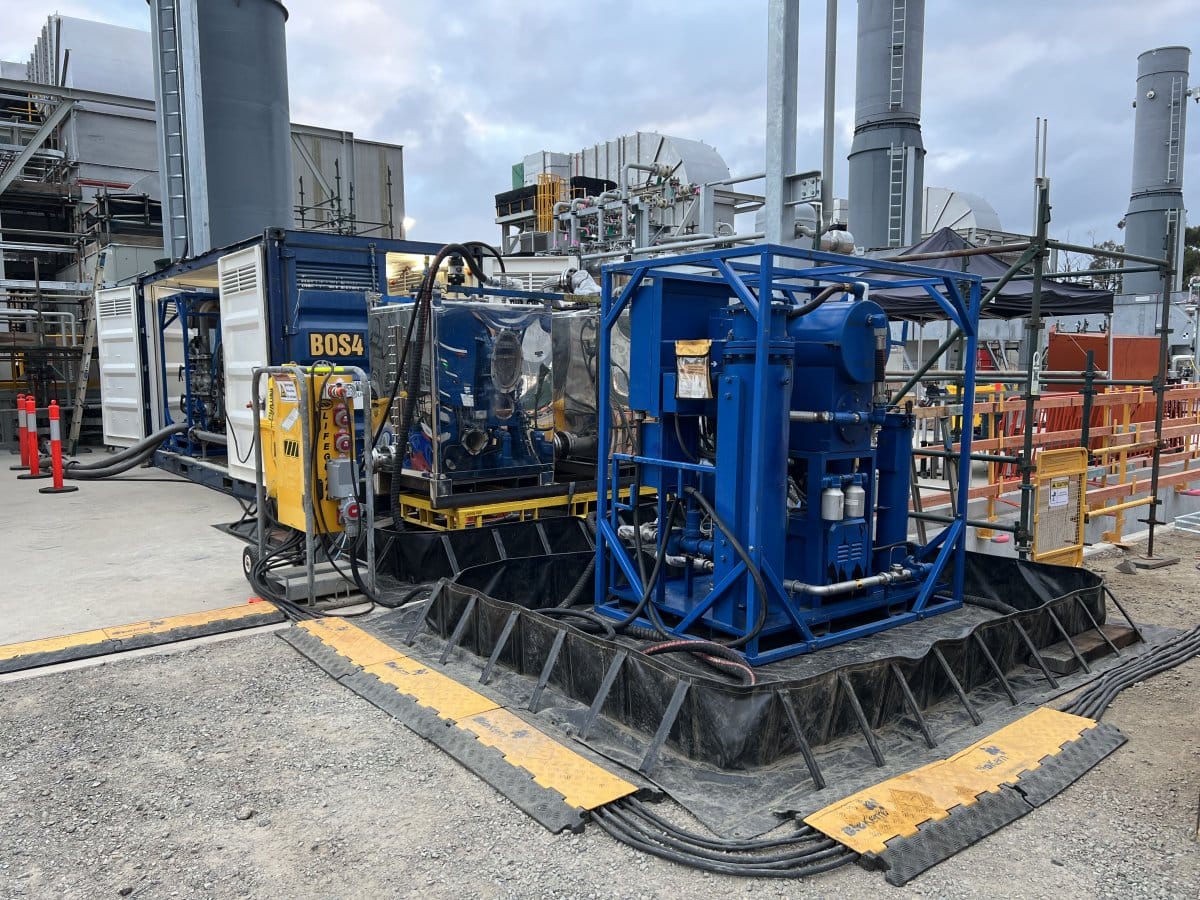
What if the very lubrication system designed to protect your asset became the primary cause of its early failure? In the high-stakes world of industrial power generation, neglecting technical nuances during commissioning often leads to “infant mortality” failures that could have been avoided. Understanding why Solar turbines need to be oil flushed in accordance with Solar ES2184 is the difference between a seamless startup and a catastrophic warranty claim.
You’re likely under immense pressure to meet tight commissioning deadlines while navigating complex OEM specifications. It’s a common challenge to balance speed with the long-term reliability your stakeholders demand. This article demonstrates why adhering to the Solar ES2184 specification is the only way to protect your turbine from early-stage failures and secure your full warranty. We will examine the critical role of turbulent flow, the mechanics of the bathtub failure curve, and how precise cleanliness standards ensure your asset’s operational health.
Key Takeaways
- Learn how proper pre-commissioning mitigates the “infant mortality” phase of the bathtub failure curve, protecting your turbine during its most vulnerable first 100 hours.
- Understand the technical requirements of the ES2184 specification, including why achieving a Reynolds number greater than 4,000 is essential for dislodging sub-micron contaminants.
- Discover why “virgin” oil straight from the refinery often fails to meet Solar Turbines’ cleanliness standards and requires professional filtration before use.
- Gain clarity on why Solar turbines need to be oil flushed in accordance with Solar ES2184 to maintain full warranty protection and prevent unscheduled downtime.
- Explore the step-by-step protocol for a compliant hot oil flush, from component bypassing to real-time verification via onsite ferrogram analysis.
The Engineering Necessity of Pre-Commissioning: Avoiding the Bathtub Failure Curve
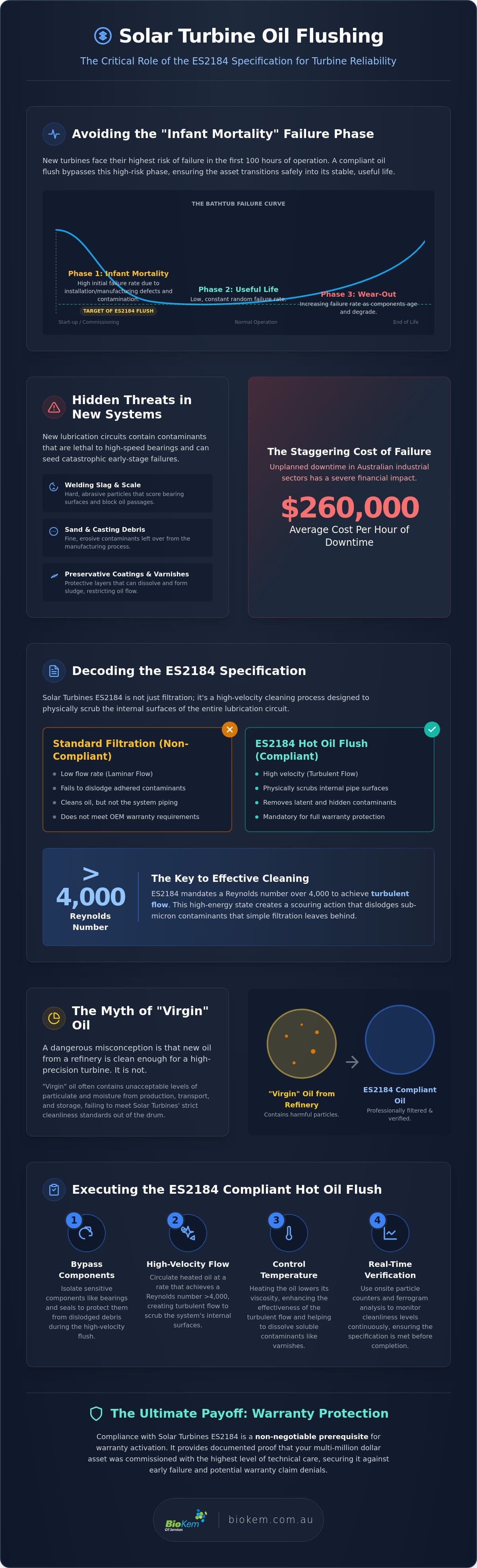
Reliability engineering relies on the bathtub curve to visualize the failure rate of industrial assets over time. This curve consists of three distinct phases: infant mortality, the useful life period, and the wear-out stage. For high-precision machinery, the initial phase is the most dangerous. New turbines face their highest risk of mechanical failure during the first 100 hours of operation. This period of extreme vulnerability is exactly why Solar turbines need to be oil flushed in accordance with Solar ES2184 before they’re ever brought up to full speed.
To better understand the internal complexity of these machines and how the lubrication system supports them, watch this breakdown of the turbine’s oil circuit:
Implementing a professional hot oil flushing service allows operators to bypass the high-risk “infant mortality” peak. By removing the physical catalysts of early failure, the asset transitions safely into its stable useful life phase. This isn’t just a cleaning task; it’s a strategic engineering intervention. It ensures that the turbine isn’t fighting internal contamination during its most sensitive operational hours, effectively flattening the failure curve from day one.
The Risk of Construction Debris in New Lubrication Circuits
Even the most carefully constructed lubrication circuits house hidden threats. New piping systems often contain welding slag, sand, and preservative coatings that are invisible to the naked eye but lethal to high-speed bearings. Adhering to Contamination control principles is vital because these particles act as “seeds” for surface fatigue and abrasive wear. Once the turbine starts, these contaminants circulate through tight clearances, causing damage that can’t be undone. In Australian industrial sectors, where unplanned downtime can cost an average of $260,000 per hour, allowing these particles to remain in the system is a risk no operator should take.
Warranty Protection and OEM Compliance
Decoding the Solar Turbines ES2184 Specification: Beyond Basic Filtration
A common misconception in the field is that a standard oil change or basic kidney-loop filtration is sufficient for turbine commissioning. This oversight is dangerous. Solar Turbines ES2184 is a technical mandate that goes far beyond simple particle removal. It specifies a high-velocity cleaning process designed to ensure the internal surfaces of the lubrication circuit are physically scrubbed clean. This rigorous approach is why Solar turbines need to be oil flushed in accordance with Solar ES2184; it’s the only method that addresses the latent contaminants lodged in pipe bends, stagnant pockets, and dead ends.
The primary differentiator in this specification is the requirement for a specific Reynolds number. While general guidelines like the ASTM D6439 flushing guide provide a baseline for turbine systems, ES2184 demands a Reynolds number exceeding 4,000. This threshold marks the transition from laminar flow to turbulent flow. Standard onboard pumps are sized for operational lubrication, not for cleaning. They typically produce laminar flow, which moves oil in smooth, parallel layers. In this state, the oil at the pipe wall is nearly stationary, leaving heavy particulates and construction debris undisturbed. To dislodge these “stuck” contaminants, an external high-flow flushing rig is required to create the necessary turbulence.
The Physics of Turbulent Flow
Achieving a Reynolds number over 4,000 requires a precise balance of velocity, temperature, and viscosity. As the oil temperature rises to between 50°C and 60°C, its viscosity drops. This lower resistance allows the oil to reach the high velocities needed for turbulent flow. This chaotic movement creates a “scrubbing” action against the pipe walls, lifting welding slag and sand into the main stream where they can be captured by high-efficiency filters. Without this mechanical force, sub-micron contaminants remain in the system, waiting to enter high-speed bearings during the first hours of operation. Our technicians specialize in achieving these critical numbers using dedicated hot oil flushing rigs designed for large-scale industrial circuits.
ISO 4406 and Particle Pal Verification
The success of an ES2184 flush is measured by the ISO 4406 cleanliness code. This standard uses three numbers to represent the concentration of particles at 4, 6, and 14 microns per milliliter of oil. For example, a target of 16/14/11 represents a significantly cleaner fluid than what is typically found in a new oil drum. Relying on laboratory results sent off-site can lead to days of wasted time and potential re-contamination. Utilizing the Particle Pal range for real-time monitoring allows technicians to verify cleanliness levels instantly. This immediate feedback ensures the flush continues until the exact requirements are met, providing the data needed for warranty compliance and long-term asset reliability.
The Hidden Dangers of “Virgin” Oil: Why New Does Not Mean Clean
Many operators assume oil arriving in sealed drums or bulk tankers is ready for immediate injection into a multi-million dollar turbine. This is a costly mistake. Refinery processes, storage tank residues, and the transfer equipment used for delivery often introduce high levels of particulate matter. In many cases, new oil tests at ISO 22/21/18 or higher, which is significantly dirtier than the 16/14/11 target required for Solar packages. This discrepancy is a primary reason why Solar turbines need to be oil flushed in accordance with Solar ES2184. Even if the oil were theoretically “clean,” it still acts as the transport medium that carries loose debris from the piping into the turbine’s most sensitive components.
Conditioning virgin oil during the flush is a critical step in the commissioning process. By utilizing high-performance specialist oil filters, technicians can polish the new fluid while it circulates through the system. This dual-action approach removes the contaminants inherent in the oil while simultaneously capturing the construction debris dislodged by turbulent flow. Without this pre-commissioning conditioning, the “new” oil simply introduces a fresh wave of abrasive particles into the circuit, undermining the entire cleaning effort.
Abrasive Wear and Bearing Damage
High-speed turbine bearings operate on a thin hydrodynamic oil film. When particles enter this space, they cause three-body abrasion. This occurs when a hard contaminant becomes trapped between the rotating shaft and the stationary bearing surface. Particles smaller than 5 microns are particularly dangerous because they’re small enough to bridge the oil film but large enough to score the metal surfaces. Over time, this microscopic damage manifests as increased vibration and elevated bearing temperatures. These conditions shorten overhaul intervals and can lead to catastrophic failure if the surfaces degrade beyond repair. Professional flushing ensures these “film-bridging” particles are eliminated before the shaft ever begins to rotate.
Control System and Governor Instability
The precision of Solar Turbine control valves makes them exceptionally sensitive to silting. Particulate matter tends to settle in low-flow areas of the governor system, creating a “silt” that impedes valve movement. This often results in “sticky” valves and erratic turbine performance during load changes. Additionally, the thermal stress on the oil can lead to the formation of soft contaminants. You can read more about what causes varnish in turbine and hydraulic oils to understand how these sub-micron deposits further degrade system responsiveness. Adhering to the ES2184 standard is the only way to ensure the control system remains responsive and free from the particulate matter that triggers governor instability. Ensuring your team understands why Solar turbines need to be oil flushed in accordance with Solar ES2184 protects the delicate balance of the entire turbine package.
Executing an ES2184 Compliant Hot Oil Flush: The Step-by-Step Protocol
Execution is where theoretical compliance meets field reality. A technical protocol for a Solar turbine flush must be rigid. Any deviation from the established sequence can lead to re-contamination or, worse, damage to the very components you’re trying to protect. This systematic approach is why Solar turbines need to be oil flushed in accordance with Solar ES2184; it provides a repeatable framework that ensures every square inch of the lubrication circuit is verified clean before the first startup.
The process begins with the critical step of bypassing. Sensitive components such as bearings, seals, and control valves are isolated using jumpers. This ensures that construction debris dislodged during the high-velocity cycles doesn’t enter the turbine’s tightest tolerances. Once the circuit is isolated, the oil is heated to between 50°C and 60°C. This temperature range is non-negotiable. Heating the oil reduces its kinematic viscosity, which is the primary lever technicians use to transition the flow from laminar to the turbulent state required by the specification. Without this heat, the oil lacks the kinetic energy to “scrub” the internal pipe walls.
To ensure no particulate is left behind, advanced techniques like pulsation and flow reversal are employed. By rapidly varying the flow rate or changing the direction of the oil, technicians create pressure waves that dislodge stubborn contaminants trapped in pipe joints, dead legs, or stagnant zones. This mechanical agitation is essential for achieving a truly clean system. Final verification involves real-time monitoring with laser particle counters to confirm ISO 4406 targets, followed by physical inspection via return-line screens.
Specialised Flushing Rigs vs. Onboard Systems
A frequent error in commissioning is attempting to use the turbine’s onboard lubrication pumps for the flush. These pumps are engineered for steady-state lubrication during operation, not for the high-velocity demands of a technical flush. They lack the capacity to generate the flow rates needed to exceed a Reynolds number of 4,000. BioKem utilizes hot oil flushing and filtering services that employ external, high-capacity rigs. These units are equipped with 1-micron high-efficiency filters and high-flow pumps capable of circulating oil at multiple times the turbine’s operational flow rate, ensuring a compliant result every time.
Verification with Paddle Screens
While digital particle counters provide essential data, Solar ES2184 often requires a physical “witness” to the cleanliness of the system. This is where paddle flushing screens become indispensable. These fine-mesh screens are inserted into the return lines of the flushing circuit. Technicians inspect them at set intervals to look for visible debris like welding slag or metal shavings. A “pass” is only granted when these screens remain completely clear of contaminants after a sustained period of high-flow circulation. This dual-verification method—combining digital data with physical audits—provides the level of proof required for OEM warranty sign-off. For operators requiring technical support, you can enquire about our hot oil flushing rigs for hire or full-service deployment.
BioKem Oil Services: Your Partner in Solar Turbine Reliability
BioKem Oil Services bridges the gap between OEM requirements and onsite execution. As the leading Australian specialist for turbine commissioning, we provide the technical expertise necessary to protect multi-million dollar assets from early-stage failure. Our team understands that why Solar turbines need to be oil flushed in accordance with Solar ES2184 isn’t just about ticking a box; it’s about ensuring the long-term reliability of critical infrastructure. By integrating advanced project management with specialized hardware, we reduce commissioning timelines without compromising on the rigorous cleanliness standards demanded by Solar Turbines. Our focus on technical oil analysis ensures that every flush is backed by data, providing operators with the confidence that their asset is ready for a lifetime of stable operation.
Equipment Hire and Technical Support
For operators managing their own commissioning teams, access to the right hardware is often the primary bottleneck. BioKem offers flexible equipment hire options for high-velocity flushing and filtration units. As the sole Australian distributor for Filters S.p.A. Products, we provide access to world-class filtration technology designed specifically for industrial lubrication circuits. These systems are capable of maintaining the high flow rates required to achieve a Reynolds number greater than 4,000. If you’re evaluating your procurement options, our Industrial Oil Filtration Equipment Hire Guide offers a comprehensive breakdown of the hardware required for a successful flush.
Real-Time Analysis and Certification
Data is the foundation of any successful commissioning project. BioKem provides onsite laboratory testing and ferrogram analysis to deliver real-time verification of oil cleanliness. We don’t rely on delayed off-site results. Instead, our technicians verify cleanliness to ISO 4406 standards while the flush is in progress. This immediate feedback loop allows for precise adjustments to the flushing protocol, ensuring that every cycle moves the system closer to the target. This level of precision is exactly why Solar turbines need to be oil flushed in accordance with Solar ES2184; it eliminates the guesswork from asset protection. Once the requirements are met, we provide a comprehensive final technical report. This documentation is a vital component of your warranty file, proving that the asset was conditioned to the highest engineering standards. To start your project with a technical partner you can trust, contact BioKem for an ES2184 compliant quote today.
Securing Long-Term Reliability for Your Solar Turbine
Adhering to rigorous technical standards is the most effective way to transition a new turbine from the high-risk commissioning phase into its productive useful life. We’ve explored the mechanics of the bathtub failure curve and the physics of turbulent flow, establishing why Solar turbines need to be oil flushed in accordance with Solar ES2184. This specification provides the necessary framework to eliminate sub-micron contaminants that standard filtration simply cannot reach. By prioritizing these engineering requirements, you protect your multi-million dollar investment from premature wear and ensure your OEM warranty remains fully intact.
BioKem Oil Services brings specialized technical expertise to every project as the sole Australian distributor for Filters S.p.A. hardware. We’re specialists in high-velocity hot oil flushing and provide onsite NATA-aligned oil analysis capabilities for immediate, data-driven results. Our commitment to technical excellence ensures your equipment meets the highest cleanliness standards without unnecessary delays. Ensure your Solar Turbine is ES2184 compliant; contact BioKem today to discuss your commissioning requirements. We look forward to helping you achieve a seamless and reliable startup.
Frequently Asked Questions
What is the specific Reynolds number required by Solar ES2184?
Solar ES2184 mandates a Reynolds number exceeding 4,000 to ensure the transition from laminar to turbulent flow. This high-velocity state is essential for creating the mechanical force needed to lift heavy particulates from the pipe walls. Achieving this number requires precise calculations involving the fluid’s velocity, pipe diameter, and kinematic viscosity. Without reaching this threshold, the oil simply glides over contaminants, leaving the system at risk during startup.
Can I use standard oil filters for a Solar turbine flush?
You shouldn’t rely on standard onboard filters for a technical flush. These components are designed for steady-state operation, not for capturing the high volume of construction debris dislodged during commissioning. We utilize specialist oil filters from Filters S.p.A. that provide the high-efficiency capture rates required to meet stringent ISO 4406 cleanliness targets. These filters are specifically selected to handle the high flow rates and debris loads encountered during a professional flush.
How long does a typical ES2184 hot oil flush take?
A typical hot oil flush can take anywhere from 24 to 72 hours of active circulation once the system reaches the required temperature and flow rate. The total project duration depends on the complexity of the pipework and the initial contamination levels. Professional technicians monitor the system in real-time to ensure circulation continues until the physical and digital verification targets are met. This thorough approach prevents the infant mortality failures associated with rushed commissioning.
Is it necessary to flush a turbine that has only been in storage?
Yes, flushing is mandatory for turbines that have been in storage. Preservative coatings used during shipping can degrade over time, and temperature fluctuations often lead to internal condensation and rust. Performing a flush ensures these storage-related contaminants are removed before they can damage high-speed bearings or sensitive control valves. It’s a critical step to ensure the asset’s internal surfaces remain pristine after any period of inactivity.
What is the difference between ES2184 and API 614 flushing?
API 614 is a broad industry standard for lubrication systems, while ES2184 is Solar Turbines’ specific engineering specification. While they share some principles, ES2184 includes unique requirements tailored to the tolerances and flow characteristics of Solar packages. Understanding why Solar turbines need to be oil flushed in accordance with Solar ES2184 is vital for maintaining OEM warranty compliance. It ensures that the specific engineering nuances of the Solar package are fully addressed.
Does BioKem provide onsite laboratory verification for ES2184?
BioKem provides comprehensive onsite laboratory verification for every project. Our technicians use laser particle counters and ferrogram analysis to provide immediate data on fluid health. This real-time feedback allows us to certify the system to ISO 4406 standards without the delays associated with sending samples to an external lab. It provides the documentation needed to prove compliance and secure your asset’s warranty before the turbine is ever fired.
What happens to the oil used during the flushing process?
The oil used during the flush is typically conditioned and polished until it meets or exceeds the required cleanliness standards. If the fluid remains chemically stable, it’s left in the system for operation. However, if the analysis reveals significant chemical degradation or excessive water content, we may recommend a full fluid replacement. This decision is always based on technical oil analysis to ensure the long-term health of the turbine.
How do I know if my flushing rig is ES2184 compliant?
A compliant flushing rig must be capable of heating the oil to 60°C and delivering flow rates that exceed the 4,000 Reynolds number threshold. It must also incorporate high-efficiency filtration and bypass manifolds. Ensuring your equipment meets these technical specs is why Solar turbines need to be oil flushed in accordance with Solar ES2184 using specialized external units. Standard pumps lack the capacity to generate the turbulent flow required for a successful certification.