

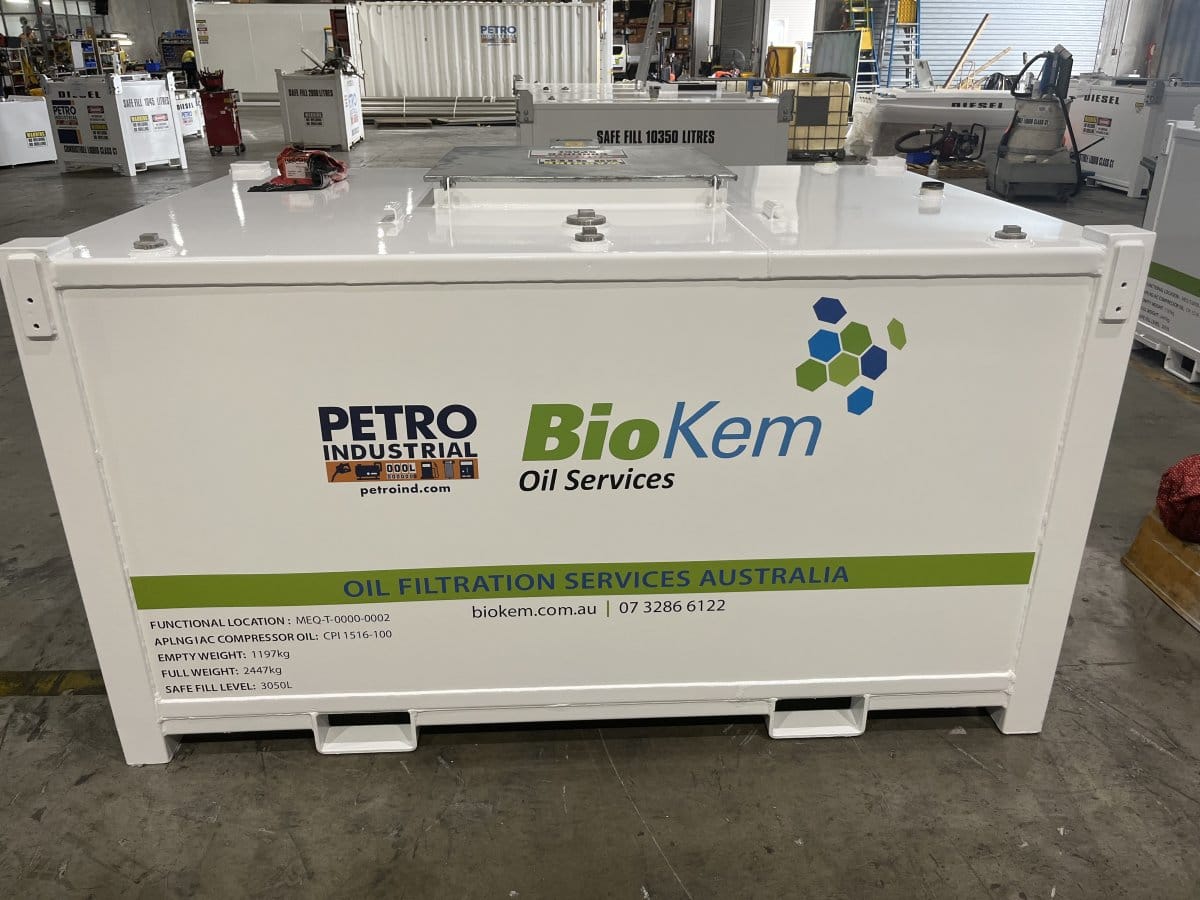
The perceived cost savings of polyethylene storage are rapidly evaporating as crude oil volatility pushed virgin resin costs up by $0.35 per pound earlier in 2026. When evaluating your lube oil tank selection – should you specify steel is no longer just a question of initial budget; it is a strategic decision for long-term asset health. While plastic once offered a clear price advantage, the narrowing gap between materials is forcing industrial operators to reconsider the structural and chemical benefits of steel.
You likely recognize that maintaining oil chemistry is a constant battle against contamination, moisture, and environmental degradation. Discover why tank material selection is a critical factor in maintaining industrial oil cleanliness and long-term asset reliability. This article examines the lifecycle value of steel, its role in preventing varnish, and how recent 2026 regulatory updates regarding petroleum distillate storage influence your local storage requirements. This overview provides the technical clarity needed to ensure full compliance with Australian safety standards while reducing maintenance costs over your equipment’s lifecycle.
Key Takeaways
- Understand why the reservoir is a functional component of the lubrication circuit, essential for thermal management and de-aeration rather than just a static container.
- Evaluate the technical benefits of steel, including superior fire resistance and the ability to customize internals for your specific lube oil tank selection – should you specify steel.
- Compare the mechanical durability and environmental resistance of steel against synthetic alternatives to identify the most stable long-term investment.
- Navigate the complex regulatory landscape for industrial oil storage to ensure your facility meets all current Australian safety and environmental standards.
- Learn how to integrate tank selection into a proactive maintenance strategy that minimizes system downtime and prevents premature oil degradation.
The Role of the Reservoir in Industrial Lubrication Management
In industrial lubrication, the reservoir is often dismissed as a simple vessel for holding fluid. This is a technical oversight. A high-performing lubrication circuit treats the tank as a functional component that actively manages fluid health rather than just a passive storage tank. The reservoir serves as the primary site for thermal regulation, de-aeration, and the settling of heavy contaminants. When you evaluate your lube oil tank selection – should you specify steel is a question that directly impacts the longevity of every downstream component, from high-pressure pumps to critical bearings.
To better understand the practical application of these reservoirs, watch this helpful video:
Storage as an Active Component of Fluid Health
The reservoir facilitates the release of entrained air and moisture, which are the primary drivers of oil oxidation and cavitation. Proper tank design allows for a sufficient residence time, giving bubbles the opportunity to rise to the surface and escape. The internal surface finish of the material also dictates how efficiently particulate matter settles at the bottom of the tank. Maintaining cleanliness at the source reduces the need for frequent hot oil flushing later in the equipment lifecycle. This “cleanliness at the source” philosophy is the foundation of proactive maintenance, ensuring that the oil entering the system is within specified ISO cleanliness codes from the moment it leaves the reservoir.
The Steel vs. Synthetic Debate in 2026
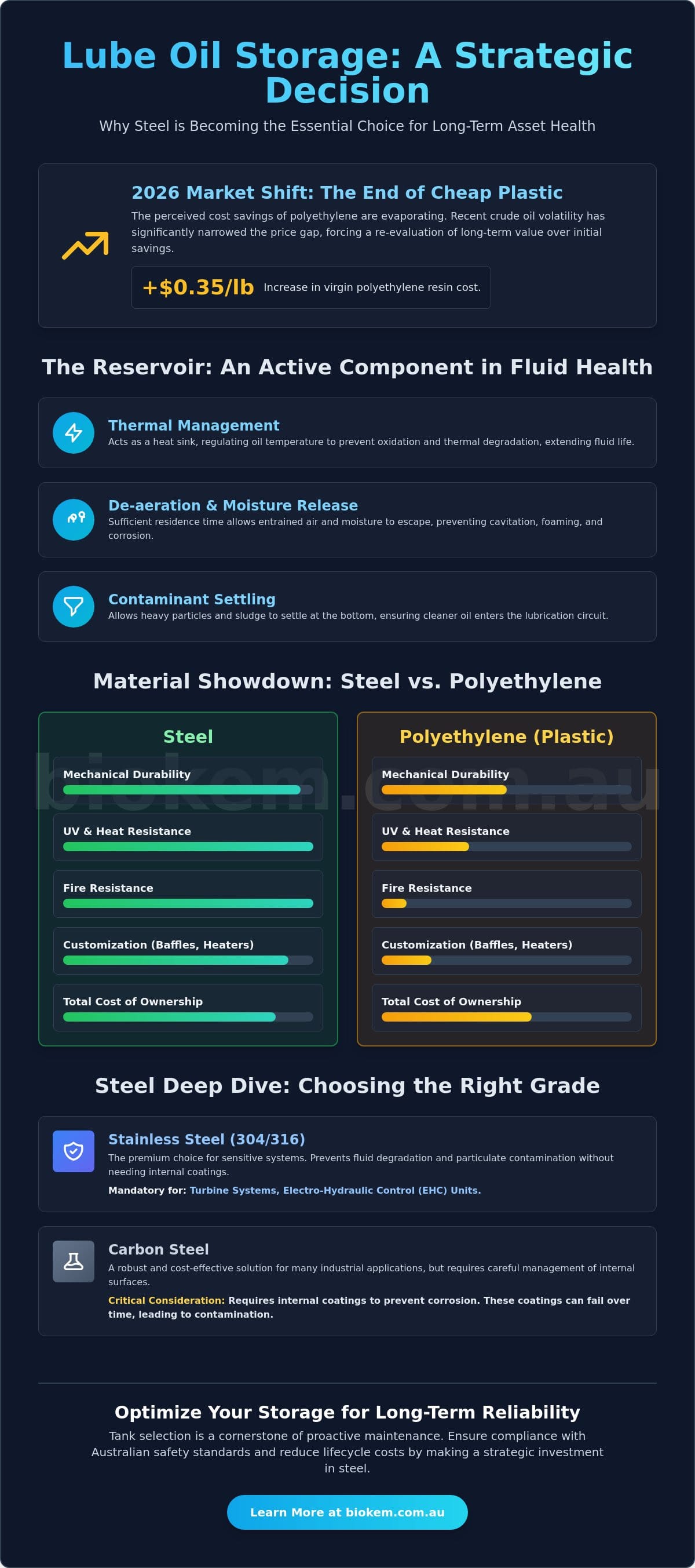
Modern industrial storage primarily utilizes two materials: steel and polyethylene. While polyethylene gained popularity for light-duty applications due to its lower initial cost, the 2026 market has seen a shift. The price of High-Density Polyethylene (HDPE) rose by $0.35 per pound this year, narrowing the cost gap between synthetic and metallic options. In heavy industry, steel remains the standard for its structural integrity in harsh environments. Australian industrial conditions present unique challenges, including extreme heat and high UV exposure, which can cause synthetic tanks to become brittle over time. Steel provides a level of mechanical durability and environmental resistance that plastics struggle to match in high-cycle or high-temperature operations. When considering your lube oil tank selection – should you specify steel, the decision often rests on whether you prioritize immediate savings or the long-term reliability of your lubrication infrastructure.
Technical Advantages of Specifying Steel for Lube Oil Tanks
Steel provides a level of mechanical resilience that synthetic materials cannot replicate in high-stress industrial environments. Beyond structural integrity, steel allows for the seamless integration of internal baffles, heaters, and advanced breather systems that are essential for maintaining oil chemistry. These components work together to manage fluid velocity and temperature, ensuring the lubricant remains within its optimal operating window. A well-specified steel tank often outlasts the machinery it serves, providing a lower total cost of ownership over decades of operation. When refining your lube oil tank selection – should you specify steel, you must consider how the material handles the specific chemical demands of your lubricant and the mechanical rigors of your facility.
Stainless Steel vs. Carbon Steel: Material Compatibility
The choice between stainless and carbon steel depends on the sensitivity of the application. For turbine systems and Electro-Hydraulic Control (EHC) units, specifying 304 or 316 stainless steel is often mandatory to prevent fluid degradation. Carbon steel tanks require internal coatings to resist corrosion, but these coatings can fail over time due to thermal expansion or chemical attack. Internal coating failure often leads to particulate contamination, necessitating intensive hot oil flushing to restore system cleanliness. While stainless steel requires a higher initial investment, it eliminates the risk of coating-related contamination and meets the most stringent federal compliance and design standards for sensitive industrial assets.
Thermal Stability and Oxidation Resistance
Steel tanks exhibit exceptional thermal stability, allowing them to handle rapid thermal cycling without the risk of structural fatigue or “creeping” seen in some polymers. This stability is vital for systems that operate in variable ambient temperatures or involve high-temperature return lines. The material also plays a role in oxidation resistance. Certain metals can act as catalysts for oil oxidation; however, high-grade stainless steel is chemically inert in the presence of most industrial lubricants. By minimizing catalytic reactions between the oil and the tank wall, steel helps preserve the additive package of the fluid. For systems already showing signs of thermal degradation, implementing a varnish removal system can protect your investment while you evaluate long-term storage upgrades. This proactive approach ensures that your lube oil tank selection – should you specify steel serves as a reliable foundation for your entire lubrication strategy.
Evaluating Polyethylene vs. Steel for Industrial Environments
The assumption that polyethylene is a maintenance-free alternative to metallic storage is being challenged by the operational realities of 2026. As Brent Crude prices climbed over $115 per barrel in March 2026, the cost of virgin resin for polyethylene tanks rose by a cumulative $0.35 per pound. This economic shift has narrowed the price gap, making the long-term durability of steel more attractive for Australian mining, power generation, and heavy manufacturing. When you consider your lube oil tank selection – should you specify steel, the decision must account for the mechanical stresses and environmental variables unique to your facility’s location.
Durability and Mechanical Strength in Heavy Industry
Steel provides the structural rigidity necessary for mounting heavy auxiliary equipment such as vacuum dehydration units or specialist oil filters. Polyethylene tanks often require additional external reinforcement to prevent “creeping” or bulging under the weight of these components, especially during thermal cycling. In the harsh Australian climate, outdoor installations face significant UV exposure. While modern polymers include UV stabilizers, they eventually succumb to photo-oxidation, leading to surface cracking and reduced impact resistance. Steel remains the standard for mission-critical applications because it maintains its load-bearing capacity and impact resistance regardless of solar intensity or ambient temperature fluctuations.
Contamination Risks: Permeability and Particulate Ingress
A critical technical difference between materials is the “breathing” phenomenon inherent in synthetic polymers. Polyethylene is semi-permeable; it can allow moisture and atmospheric gases to migrate through the tank walls over time, which compromises oil chemistry. This risk is particularly high in humid coastal regions or dusty mining environments. Steel serves as an absolute barrier, providing a more robust foundation for a oil contamination control strategy. During thermal expansion and contraction, plastic tanks can experience significant dimensional changes, which may stress pipe connections and increase the risk of particulate ingress at seal points. Adopting a comprehensive storage strategy for long-term reliability involves selecting a material that acts as a fortress against the environment. For high-value assets, your lube oil tank selection – should you specify steel ensures that the fluid remains isolated from the external contaminants that drive system downtime and premature component failure.
Compliance and Design Standards for Industrial Oil Storage
Navigating Australian Standards: AS 1940 and AS 1692
The primary benchmark for oil storage in Australia is AS 1940, which outlines the requirements for the storage and handling of flammable and combustible liquids. This standard dictates specific safety distances, ventilation requirements, and spill containment protocols. Complementing this is AS 1692, which focuses specifically on the design and manufacture of steel tanks. Compliance with AS 1692 ensures that the vessel can withstand the internal pressures and external environmental loads typical of mining and power generation sites. Key design features required by these standards include emergency venting systems, dedicated drainage points, and access manways. These manways are essential for facilitating future tank cleaning and internal repairs without compromising the vessel’s structural integrity.
Bunding and Environmental Protection Requirements
Secondary containment is a non-negotiable aspect of modern industrial oil storage. The role of bunding is to capture leaks or catastrophic failures before they reach the surrounding soil or water table. While traditional concrete bunding remains common, self-bunded steel tanks have become the industry standard for their ease of installation and reduced footprint. These tanks must provide a secondary containment capacity of at least 110% of the primary tank’s volume. Following global best practices, such as the inspection intervals suggested by international EPA standards, facilities should conduct formal visual inspections every three to five years. This schedule ensures the longevity of your asset and prevents environmental incidents. If you’re planning a system upgrade, ensure your site layout accommodates industrial oil filtration equipment hire to maintain oil cleanliness during the transition.
If you require assistance in designing a storage solution that meets Australian standards while protecting your oil chemistry, explore our range of specialist oil storage and filtration products.
Optimising Your Storage Strategy for Long-Term Asset Reliability
Selecting the right material is only the first phase of a robust lubrication strategy. While your lube oil tank selection – should you specify steel provides the structural integrity and fire resistance discussed earlier, the vessel’s performance depends on ongoing technical management. A proactive approach integrates the physical reservoir with consistent fluid health monitoring to prevent the contamination issues that lead to system downtime. Maintenance is a continuous requirement that begins the moment the tank arrives at your facility.
The Importance of Initial System Flushing and Cleaning
It’s a common misconception that a new steel tank is ready for service immediately upon delivery. During the fabrication process, new reservoirs often accumulate “built-in” contaminants such as mill scale, weld slag, and anti-corrosive residues. If these particulates aren’t removed before commissioning, they migrate into the circuit and damage sensitive components like high-pressure pumps and critical bearings. High-velocity hot oil flushing services are the most effective method for preparing a new reservoir. This process uses turbulent flow to dislodge internal debris, ensuring the system starts within its target ISO cleanliness code and protecting the initial investment in high-quality lubricants.
Integrating Analysis and Purification with BioKem Solutions
Long-term reliability requires a shift from reactive repairs to data-driven fluid management. Establishing a consistent sampling regime allows you to monitor both the health of the lubricant and the internal condition of the tank. For reservoirs operating in high-heat environments where oxidation is accelerated, utilising varnish removal systems is essential to prevent the accumulation of soft contaminants on internal surfaces. These deposits can interfere with thermal management and de-aeration if left unchecked.
BioKem serves as a technical partner for Australian industry, providing national onsite support and equipment hire to maintain your assets throughout their lifecycle. By combining the right lube oil tank selection – should you specify steel with BioKem’s specialised filtration and analysis services, you secure the chemical stability of your oil and the mechanical reliability of your entire operation. This holistic strategy ensures that your storage solution functions as a protective fortress for your industrial lubricants.
Securing the Future of Your Lubrication Infrastructure
Effective lubrication management begins with a foundation of structural integrity and chemical stability. The reservoir is an active component of your fluid circuit, responsible for thermal regulation and contaminant control. Choosing steel provides the mechanical resilience and fire resistance necessary to meet Australian standards while protecting your oil from atmospheric permeability. When finalizing your lube oil tank selection – should you specify steel, you’re investing in a solution that outlasts the equipment it serves and simplifies future maintenance through dedicated access points and robust internal design.
BioKem provides the technical expertise required to maintain these critical assets. As an authorized distributor for Filters S.p.A. and specialist providers of varnish mitigation and vacuum dehydration, we offer national Australian technical onsite support to ensure your systems remain within target ISO cleanliness codes. Consult with BioKem Oil Services for expert advice on lubrication system reliability and discover how a proactive storage strategy reduces lifecycle costs. Your facility deserves a reliable partner committed to long-term operational health.
Frequently Asked Questions
What is the primary advantage of a steel lube oil tank over polyethylene?
The primary advantage of steel is its superior mechanical durability and fire resistance. Unlike polyethylene, steel doesn’t suffer from structural “creep” or bulging when subjected to high temperatures or the weight of heavy auxiliary equipment. This makes steel the preferred material for high-stress industrial environments where long-term asset reliability and structural integrity are non-negotiable requirements for the facility’s operation.
Does Australian Standard AS 1940 apply to all lube oil storage?
AS 1940 applies to any facility storing flammable or combustible liquids, which includes the vast majority of industrial lubricants and hydraulic oils. This standard mandates specific secondary containment, ventilation, and safety distances to mitigate fire and environmental risks. Compliance is essential for meeting Australian safety regulations and insurance requirements, regardless of whether the storage is for new or waste oil.
Why is stainless steel often specified for turbine oil tanks?
Stainless steel is specified because it’s chemically inert and prevents catalytic oxidation of the lubricant. Turbine oils are highly sensitive to metal-induced degradation that can occur with carbon steel. Using 304 or 316 stainless steel ensures that the tank walls don’t react with the oil’s additive package, preserving the fluid’s chemistry much longer than carbon steel or synthetic alternatives that might allow moisture ingress.
How often should an industrial lube oil tank be cleaned?
Most industrial reservoirs should undergo professional tank cleaning every three to five years, though this interval varies based on oil analysis results. Regular cleaning prevents the accumulation of sludge and particulates that can overwhelm system filters. If your oil analysis shows rising particle counts or moisture levels, an immediate inspection and cleaning cycle is recommended to protect downstream components and maintain system efficiency.
Can I use a carbon steel tank for EHC fluids (phosphate esters)?
Carbon steel is unsuitable for EHC fluids like phosphate esters because these fluids are chemically aggressive and can strip internal coatings or cause rapid corrosion. For EHC fluid maintenance, 316L stainless steel is the industry standard. This material choice prevents fluid contamination and ensures the structural integrity of the reservoir over the system’s operational life, avoiding the catastrophic failures associated with material incompatibility.
What is a self-bunded tank and is it required for lube oil?
A self-bunded tank features an internal primary tank and an external secondary shell to capture leaks, often described as a “tank within a tank.” While not always strictly required for all volumes, it’s the most efficient way to meet secondary containment mandates in Australia. This design eliminates the need for expensive concrete bunding and simplifies site compliance for your lube oil tank selection – should you specify steel.
How does tank material affect the formation of varnish in hydraulic systems?
Tank material influences varnish formation through its ability to manage heat and resist catalytic reactions. Steel tanks provide better thermal dissipation than plastic, which helps keep the oil within a stable temperature range. By preventing localized hotspots and avoiding the catalytic effects of corroded carbon steel, your lube oil tank selection – should you specify steel helps minimize the chemical precursors that lead to varnish accumulation.
Do new steel tanks require flushing before they are put into service?
Every new steel tank requires high-velocity hot oil flushing before commissioning to remove “built-in” contaminants. Manufacturing processes leave behind mill scale, weld slag, and fine metallic dust that can’t be removed by simple draining. A professional flush ensures the system starts at the correct ISO cleanliness level, preventing premature wear on pumps and bearings from the very first hour of operation.