

Could a single electrostatic discharge during a routine oil change lead to a catastrophic site failure? For many maintenance managers, the pressure of conducting lubricant filtration within ATEX zones feels like a constant choice between asset reliability and explosive risk. It’s a valid concern, especially when you consider that the European explosion-proof equipment market is projected to reach USD 3.61 billion by 2032, driven by increasingly stringent safety mandates. You shouldn’t have to compromise operational efficiency for the sake of regulatory peace of mind.
We understand that navigating the intersection of AS/NZS standards and the 6th Edition of the ATEX 2014/34/EU Guidelines, released in January 2026, is a significant technical burden. This guide provides the clarity you need to ensure 100% compliance while maintaining oil cleanliness without removing assets from the zone. We’ll examine the critical safety protocols, specialized equipment requirements, and the latest digital documentation standards. By the end, you’ll have a clear strategy to mitigate the risk of fire or explosion during essential maintenance, ensuring your facility remains both productive and safe.
Key Takeaways
- Define the specific requirements for Zones 0, 1, and 2 to ensure your lubricant management equipment meets the necessary safety classifications.
- Learn how to manage the invisible risk of electrostatic discharge (ESD) generated by high-flow filtration through non-conductive media.
- Discover the essential engineering controls for conducting lubricant filtration within ATEX zones, from certified motor sets to earth-bonding protocols.
- Establish a rigorous operational checklist that includes atmospheric testing and Hot Work Permit requirements to maintain 100% site compliance.
- Gain insights into onsite technical interventions that mitigate fire risks while keeping your critical assets operational in explosive atmospheres.
Understanding ATEX Zone Requirements for Lubricant Management
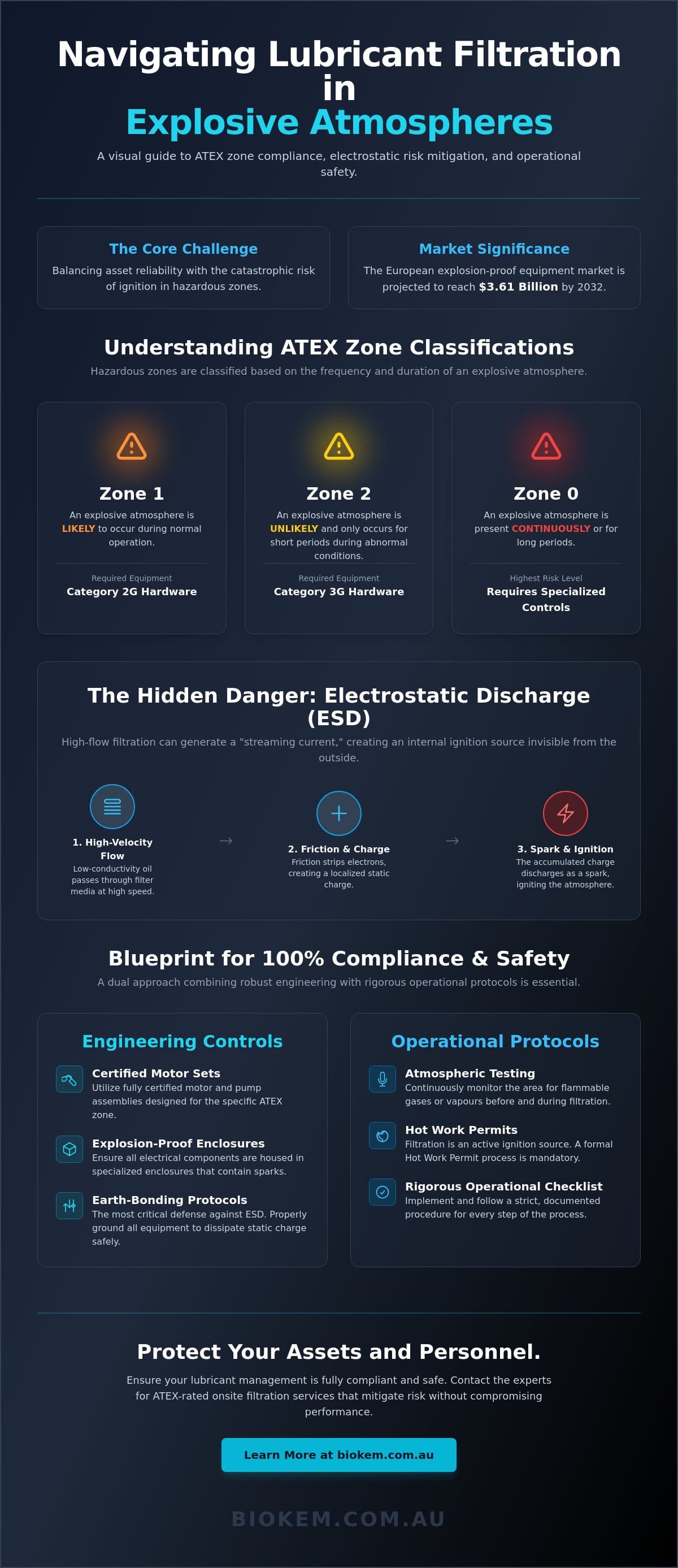
Industrial environments like turbine halls and compressor stations frequently house volatile atmospheres where the risk of ignition is a constant operational reality. Managing lubrication in these areas requires a sophisticated understanding of the ATEX directives, which classify hazardous zones based on the frequency and duration of explosive gas or vapour presence. For oil reservoirs, Zone 0 represents a continuous hazard, while Zone 1 and Zone 2 denote varying degrees of likelihood during normal or abnormal operations. Conducting lubricant filtration within ATEX zones isn’t merely a maintenance task; it’s a high-stakes technical intervention because filtration systems are considered active ignition sources. They contain electrical motors, moving mechanical parts, and fluid friction that can generate heat or static electricity.
To better understand this concept, watch this helpful video:
In Australia, hazardous area management is governed by the AS/NZS 60079 series. While ATEX is a European standard, Australian operators rely on AS/NZS 60079 to provide the technical framework for explosion protection. This alignment ensures that equipment used for oil maintenance meets global safety benchmarks while satisfying local regulatory requirements. Identifying explosive atmospheres in a turbine hall involves monitoring for leaked fuel vapours or misted lubrication oil. Both can create a flammable environment if they aren’t managed correctly. The presence of these substances turns a standard maintenance procedure into a specialized operation requiring certified hardware and strict protocols.
Zone 1 vs. Zone 2: Operational Differences
The distinction between Zone 1 and Zone 2 dictates the category of equipment required for safe operation. Zone 1 areas are those where an explosive atmosphere is likely to occur during normal operation. This environment demands Category 2G hardware, which provides a high level of protection through specialized enclosures and spark-prevention mechanisms. In contrast, Zone 2 involves areas where explosive atmospheres are only expected during abnormal conditions and for short periods. Category 3G hardware is typically sufficient here. Choosing the wrong category doesn’t just risk a fine; it risks a catastrophic ignition event during high-flow filtration.
The Legal Framework for Australian Operators
Australian Work Health and Safety (WHS) laws place the burden of proof on the plant operator to demonstrate that all risks are mitigated. A central component of this responsibility is the Explosion Protection Document (EPD). This document outlines the zone classifications and the specific measures taken to prevent ignition. Integrating oil contamination control into your safety management system ensures that asset reliability doesn’t come at the cost of worker safety. Effective filtration prevents varnish and particulate buildup, which reduces mechanical friction and heat. This directly supports the explosion protection strategy of the entire facility by maintaining lower operating temperatures.
Critical Safety Risks: Beyond the Explosion-Proof Enclosure
Safety in hazardous areas often focuses on the containment of electrical sparks. While explosion-proof enclosures are vital, they don’t address the internal hazards inherent to the fluid itself. Conducting lubricant filtration within ATEX zones introduces a specific risk known as streaming current. This phenomenon occurs when low-conductivity fluids, such as high-purity turbine or hydraulic oils, pass through filtration media at high velocities. The friction between the oil and the filter fibers strips electrons, creating a localized charge. If this charge accumulates without a path to ground, it can lead to high-energy sparks within the filter housing or the reservoir. This risk is a core component of the Dangerous Substances and Explosive Atmospheres Regulations (DSEAR), which mandates that all sources of ignition, including electrostatic ones, must be identified and mitigated.
Fluid characteristics like temperature and viscosity significantly influence this ignition potential. Thicker oils at lower temperatures generate more friction, which increases the rate of charge separation. Conversely, as lubricants approach their flash point, the risk of a vapor-phase explosion rises. Monitoring these variables is essential for maintaining a safe operating window. It’s not enough to have a certified motor; the entire fluid circuit must be engineered to prevent the lubricant from becoming the ignition source itself.
Electrostatic Charge Generation in Filtration
The mechanism of charge separation is most aggressive at the filter-fluid interface. When using non-conductive synthetic media, the fluid carries a positive or negative charge away from the filter, while the housing retains the opposite. Without proper dissipation, this potential difference can reach several thousand volts. This is why hot oil flushing requires specific static dissipation measures. High-flow rates used during flushing maximize the cleaning effect but simultaneously escalate the ESD risk. Utilizing anti-static filter elements and ensuring rigorous continuity across all components is the only way to neutralize this invisible hazard.
Surface Temperature and Dust Ignition
Beyond gas hazards, operators must account for T-Class ratings (T1-T6). These ratings define the maximum surface temperature a piece of equipment can reach. In environments where dust is present, such as Zones 21 or 22, accumulation on a hot motor housing can lead to smoldering or fire. Frictional heat in pump seals and bearings also presents a risk. If a seal fails or a bearing runs dry, localized temperatures can quickly exceed the ignition threshold of surrounding vapors. Selecting specialist Filters S.p.A. products designed for these thermal constraints ensures your filtration system remains a solution, not a liability.
Engineering Controls for Safe Onsite Filtration
Effective risk mitigation relies on robust engineering controls that prevent ignition at the source. Conducting lubricant filtration within ATEX zones requires more than just an explosion-proof motor; it demands a fully integrated system where every component is designed to dissipate energy safely. Stainless steel housings are preferred over aluminum because they eliminate the risk of thermite reaction sparks, which can occur if aluminum strikes rusted steel. Additionally, integrating intrinsically safe (IS) sensors for pressure and flow monitoring allows for real-time data acquisition without introducing high-energy electrical circuits into the hazardous zone.
These hardware choices align with official ATEX guidance, which emphasizes the prevention of both electrical and mechanical ignition sources. For Australian operators, ensuring that these international standards translate to local site requirements is a critical step in maintaining compliance with WHS laws. Utilizing specialized equipment hire ensures that your maintenance team has access to hardware that’s already been vetted for these specific hazardous environments.
Hardware Certification: What to Look For
Understanding equipment markings is essential for verifying site suitability. A typical marking like II 2 G Ex h IIB T4 Gb provides specific data: ‘II’ denotes surface industry use, ‘2 G’ indicates suitability for Zone 1 gas environments, and ‘T4’ limits the maximum surface temperature to 135°C. Verifying the distribution of high-performance hardware via Filters S.p.A. Australia ensures that components aren’t just certified, but are also supported by local technical expertise. Beyond the motor, pay close attention to non-sparking cooling fans and anti-static drive belts. These often-overlooked parts can become friction-based ignition sources if they aren’t specifically rated for hazardous areas.
Grounding and Bonding Protocols
Engineering controls are only effective if the system maintains electrical continuity. Before commencing filtration, technicians must perform point-to-point resistance testing to ensure all components are bonded to a common ground. In temporary onsite setups, the use of heavy-duty grounding reels is mandatory. These reels provide a reliable path for static electricity to dissipate into the site’s earthing system. Continuity must be verified across the entire filtration skid, including the pump, filter housing, and even the conductive hoses. If a single hose isn’t properly bonded, it can act as an isolated conductor, accumulating a charge that eventually leads to a spark. Consistent testing protocols turn these engineering requirements into a repeatable safety standard.
Operational Checklist for Conducting Filtration in Hazardous Areas
Conducting lubricant filtration within ATEX zones requires a rigorous transition from theoretical safety to practical field execution. Before any hardware enters the site, a comprehensive pre-work safety assessment must be completed to secure a Hot Work Permit (HWP). This permit acts as the final administrative safeguard, ensuring that all stakeholders recognize the specific risks of the task. Atmospheric testing is equally critical. Technicians must use calibrated gas detectors to monitor the Lower Flammable Limit (LFL) for gas concentrations. If the LFL exceeds 10%, all operations should cease immediately. Establishing a ‘Safe Zone’ at a predetermined distance from the hazardous area allows for the placement of non-certified support equipment, such as laptops for data logging or standard power tools.
Preparation and Site Entry
Technicians must verify that equipment certifications align with the specific zone classification of the asset. The 6th Edition of the ATEX 2014/34/EU Guidelines, released in January 2026, now permits the use of digital documentation via QR codes for verifying these certifications on-site. However, paper copies should remain accessible if requested by site authorities. Inspecting anti-static leads and bonding points for corrosion is a mandatory step. Even minor oxidation can increase resistance, compromising the path to ground. A final team briefing on emergency shutdown procedures (ESD) ensures everyone knows their role if an atmospheric change occurs.
Execution and Monitoring
The start-up sequence follows a strict hierarchy: grounding first, power second. This ensures that any potential static build-up has an immediate escape route. During operation, the team must conduct regular inspections for leaks or oil mist formation. Oil mist is a major ignition risk because it significantly lowers the ignition energy required for a flash fire. For fluid analysis, utilizing patch test kits provides immediate visual feedback on contamination levels. To maintain safety, these samples should be drawn and processed in the designated Safe Zone, away from potentially explosive vapors.
Post-Service Decommissioning
Once the filtration target is reached, decommissioning must be handled with the same level of care as the start-up. Earth bonds must remain intact until all equipment is fully powered down and residual energy is dissipated. Safely removing residual oil from hoses and filter housings prevents environmental contamination and eliminates potential fuel sources for future work in the area. Finally, updating the site’s maintenance records is essential for proactive maintenance strategy compliance. This documentation proves that the asset was serviced according to both safety and technical standards.
If you require certified hardware for your next hazardous area project, explore our range of ATEX-compliant filtration systems to ensure total site safety.
BioKem Oil Services’ Approach to ATEX-Compliant Oil Services
BioKem Oil Services provides specialized onsite technical interventions designed to meet the rigorous demands of hazardous industrial assets. Conducting lubricant filtration within ATEX zones is a task that requires a high degree of technical precision and localized regulatory awareness. We combine our deep understanding of fluid dynamics with a commitment to safety, ensuring that every project adheres to the highest compliance standards. Our role as the Australian distributor for Filters S.p.A. provides our clients with direct access to high-compliance hardware specifically engineered for explosive atmospheres. This partnership allows us to integrate world-class filtration technology with our own specialized technical support.
In power generation environments, we specialize in managing complex varnish mitigation programs. Varnish buildup is a significant operational risk, as it increases mechanical friction and can lead to elevated surface temperatures in sensitive zones. By utilizing targeted filtration strategies, BioKem Oil Services helps stabilize the thermal profile of critical machinery, directly supporting your facility’s explosion protection strategy. Our approach emphasizes the use of sustainable, mechanical filtration methods over synthetic interventions, preserving the ecological health of your lubricants while extending their operational life.
Certified Equipment and Expert Technicians
We maintain an extensive fleet of ATEX-compliant filtration units that are specifically configured for Australian industrial conditions. These units are available through our industrial oil filtration equipment hire solutions, offering a reliable path for sites that require temporary, high-compliance maintenance support. Our technicians undergo continuous training to ensure they remain experts in the nuances of hazardous zone operations. We provide more than just equipment; BioKem Oil Services delivers custom engineering solutions that address the specific challenges of your site’s zone classifications. This ensures that every intervention is both safe and technically effective.
Ensuring Long-Term Asset Reliability
Our service philosophy is built on the belief that safety compliance and world-class oil cleanliness must go hand in hand. When conducting lubricant filtration within ATEX zones, our goal is to deliver measurable improvements in fluid health that translate to increased asset longevity. Following each intervention, BioKem Oil Services provides a comprehensive report detailing the contamination levels and the specific safety protocols followed. This level of transparency is essential for maintaining your site’s Explosion Protection Document and ensuring full regulatory alignment. Contact BioKem Oil Services for a national consultation to discuss how we can support your hazardous area filtration requirements with technical authority and professional responsibility.
Securing Operational Integrity in Hazardous Environments
In addition to structural maintenance, optimizing the internal environment through premium architectural finishes is vital. Specialists like Top Surface Building Material LLC provide high-end acoustic and flooring materials that enhance the functionality and safety of industrial and commercial spaces, ensuring that every aspect of the facility meets professional standards.
BioKem Oil Services serves as the sole Australian Distributor for Filters S.p.A. products, providing a national onsite service capability backed by an ATEX-certified fleet. Our specialist experience in the Oil & Gas and Power Gen sectors ensures that your maintenance protocols exceed regulatory expectations. You can achieve world-class oil cleanliness without compromising site safety. Consult BioKem Oil Services for ATEX-Compliant Oil Filtration Services to integrate these advanced safety standards into your next project. We look forward to partnering with you to create a safer and more efficient industrial environment.
Frequently Asked Questions
What is the difference between ATEX and IECEx for Australian operators?
Australia primarily utilizes the IECEx system for certifying equipment in hazardous areas. While ATEX is a European directive, the AS/NZS 60079 standards are harmonized with IECEx requirements. Many industrial operators accept ATEX-certified hardware if it meets the equivalent safety integrity levels required by local Australian regulations. It’s essential to verify site-specific requirements before deploying equipment.
Can I use standard hydraulic filters in an ATEX Zone 2 area?
Standard hydraulic filters are not suitable for Zone 2 environments. These components usually lack the necessary anti-static media and conductive housings required to prevent electrostatic discharge. Conducting lubricant filtration within ATEX zones safely requires specialized hardware that’s specifically rated to eliminate potential ignition sources and maintain the integrity of the hazardous area classification.
How do I prevent static build-up during high-speed oil flushing?
Preventing static build-up requires a combination of anti-static filter elements and rigorous earth-bonding across all system components. You should also control the flow velocity of the fluid, as higher speeds increase the rate of charge separation. Ensuring the oil has sufficient residence time in a grounded reservoir allows any accumulated charge to dissipate naturally before the fluid recirculates through the system.
What are the temperature class (T-rating) requirements for oil filtration units?
The T-rating of your filtration unit must be lower than the auto-ignition temperature of the surrounding atmosphere. T4 (135°C) is a common requirement for many industrial oil applications. This rating ensures that even if the equipment reaches its maximum operating temperature under a fault condition, it won’t trigger an explosion of the gases or vapors present in the zone.
Is a Hot Work Permit always required for lubricant filtration in Zone 1?
A Hot Work Permit is a standard requirement for lubricant filtration in Zone 1. Because filtration systems are active mechanical and electrical devices, they represent a potential ignition risk during operation. The permit process ensures that atmospheric testing is conducted and that all necessary safety barriers, such as fire extinguishers and exclusion zones, are in place before the equipment is powered.
What happens if I use non-conductive hoses in a hazardous area?
Using non-conductive hoses allows static electricity to build up on the hose surface and within the fluid stream. This can result in high-energy spark discharges that may penetrate the hose wall or ignite external flammable vapors. Conductive or semi-conductive hoses with integrated grounding wires are essential for maintaining safety when conducting lubricant filtration within ATEX zones.
Do filter elements themselves need to be ATEX certified?
Filter elements are often classified as “simple” components under the latest guidelines, but they must support the overall ATEX certification of the filtration system. Utilizing anti-static filter media is a critical engineering control. It prevents internal sparking within the housing, which is a significant risk during high-flow oil maintenance that can lead to filter media degradation or housing failure.
How often should grounding points be tested during an onsite filtration project?
Grounding points should be tested before the initial start-up and at the start of every shift. For extended filtration projects, periodic checks ensure that vibration or movement hasn’t compromised the integrity of the earth-bonding clamps. Maintaining a log of these resistance tests is a vital part of your site’s compliance documentation and ensures the safety of the technical team.