

With the global synthetic lubricant market projected to reach $14.50 billion by 2034, it’s clear that heavy industry is moving away from traditional mineral oils. However, as prices for these high-performance fluids hit ceilings of 35% increases in early 2026, many plant managers are asking: Should You Change to Synthetic Oils? It’s a valid concern when you’re balancing the rising costs of Group III base oils against the persistent threat of unscheduled downtime and varnish buildup in critical valves.
We understand that navigating the technical differences between base oil groups is complex, especially with new standards like API PC-12 arriving in early 2027. This guide will help you determine if transitioning to synthetic lubricants is the right strategic move for your industrial assets and how to manage the switch without risking system contamination. You’ll discover how a professional approach to this transition leads to extended oil drain intervals, significantly reduced component wear, and the prevention of varnish-related failures that often plague aging systems.
Key Takeaways
- Understand the chemical distinctions between refined mineral stocks and engineered Group IV PAOs to make an informed selection for your specific application.
- Learn how superior oxidation stability and a high Viscosity Index (VI) extend the operational life of both your lubricants and critical machinery.
- Evaluate technical factors like seal compatibility and total cost of ownership to decide: Should You Change to Synthetic Oils?
- Discover why a mandatory flushing protocol is essential to prevent residual mineral oil from contaminating and compromising new synthetic batches.
- Identify how professional maintenance services, such as oil analysis and varnish mitigation, ensure a seamless transition for your industrial assets.
Industrial Lubricant Fundamentals: Mineral vs. Synthetic Base Oils
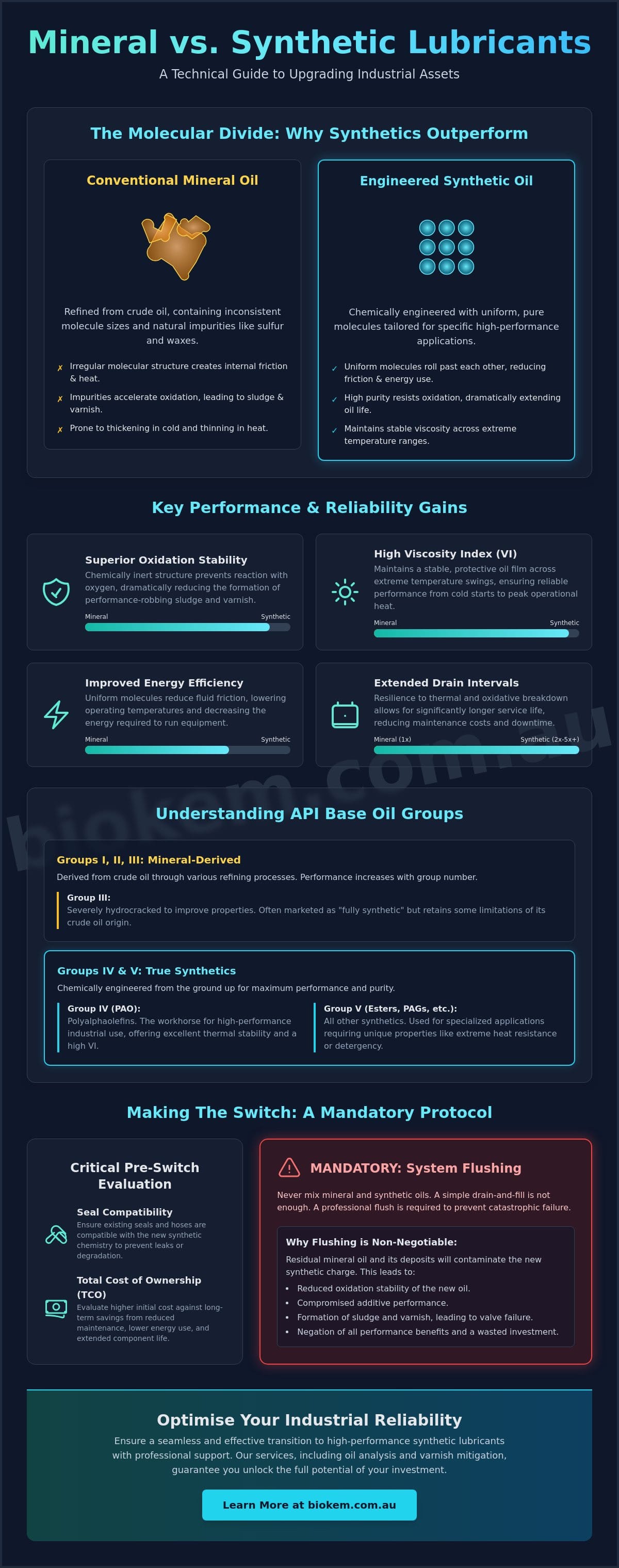
Many plant managers ask: Should You Change to Synthetic Oils? The answer begins with a technical understanding of synthetic oil fundamentals. Unlike mineral oils, which are distilled and refined from crude petroleum, synthetic lubricants are chemically engineered from specific molecular building blocks. This controlled manufacturing process removes the paraffinic waxes and sulfur impurities inherently present in traditional Group I and II stocks. By eliminating these weak links at the molecular level, engineers create a fluid that’s far more resilient to the stresses of heavy industry.
To better understand how these different oil types behave in real-world conditions, watch this helpful comparison:
The American Petroleum Institute (API) categorises base oils into five distinct groups. Groups I through III are derived from crude oil, while Groups IV and V are considered true synthetics. In the Australian market, it’s common to see Group III oils marketed as “fully synthetic” because they undergo severe hydrocracking to improve performance. While Group III offers a cost-effective middle ground, true industrial reliability often demands the molecular uniformity of Group IV Polyalphaolefins (PAO). Identifying exactly what’s in your system currently through professional oil analysis is the first step in deciding your path forward.
Molecular uniformity is the primary driver of operational efficiency. In a mineral oil, molecules vary in size and shape, which creates internal friction as they slide past one another. This friction generates parasitic heat and consumes more energy. Engineered synthetics consist of uniform, spherical molecules that roll over each other with minimal resistance. This structure reduces fluid friction, lowers operating temperatures, and decreases the energy required to move the lubricant through complex industrial circuits.
Understanding Group IV and Group V Synthetics
Group IV PAOs are the workhorse of high-performance industrial applications due to their exceptional thermal stability and low-temperature fluidity. When your assets face extreme pressures or temperatures, Group V fluids like Esters or Polyalkylene Glycols (PAGs) provide specialised solutions. Esters are frequently utilised for their natural detergency and ability to withstand extreme heat, though they require careful management to avoid hydrolysis. Matching the specific chemistry to your equipment requirements is vital for maintaining long-term ecological and operational health.
The Limitations of Conventional Mineral Oils
Conventional mineral oils often struggle under the demands of modern high-pressure hydraulic systems. Their inherent impurities act as catalysts for oxidation, leading to the rapid formation of sludge and varnish. In the fluctuating Australian climate, mineral oils also face significant viscosity challenges. They thin out excessively in the summer heat and thicken during cold starts in southern regions. This instability increases component wear and forces more frequent maintenance intervals compared to their synthetic counterparts. If you’re weighing up whether you Should You Change to Synthetic Oils?, these environmental stressors are often the deciding factor.
The Technical Case for Switching: Performance and Reliability Gains
Deciding whether you Should You Change to Synthetic Oils? involves looking past the initial purchase price to the operational reliability of your machinery. One of the most significant technical advantages is superior oxidation stability. While mineral oils contain unstable molecules that react with oxygen to form acids and sludge, synthetic lubricants are chemically inert by design. This stability prevents the lubricant from thickening prematurely, ensuring that additives remain effective for much longer durations even in high-heat environments.
Another critical factor is the Viscosity Index (VI). Industrial assets often operate under extreme thermal loads where mineral oils lose their ability to maintain a protective film. Synthetics possess a naturally high VI, meaning they resist thinning at high temperatures without relying on heavy doses of polymer additives. This structural integrity ensures consistent lubrication, which directly correlates to reduced component wear and fewer mechanical failures. When you evaluate if you Should You Change to Synthetic Oils?, this ability to maintain film strength under pressure is a primary performance indicator.
Efficiency gains also play a major role in the transition. Because synthetic molecules are uniform in size, they exhibit lower traction coefficients than their mineral counterparts. This reduced fluid friction leads to measurable energy savings with synthetic lubricants, particularly in high-torque applications like large gearboxes and electric motors. Lowering the internal resistance within the fluid reduces the power draw required for operation, aligning technical performance with corporate sustainability goals.
Preventing Varnish in Turbines and Hydraulics
Varnish is a persistent challenge in high-speed turbines and sensitive hydraulic circuits. When mineral oils undergo thermal stress, they create polar degradation products that eventually settle on cool surfaces as a sticky residue. This buildup causes valve sticking and restricts flow, often leading to system trips. Synthetic oils are far more resistant to this thermal degradation. By maintaining chemical stability under high shear, they significantly reduce the need for intensive varnish mitigation efforts, keeping critical control valves responsive.
Extending Drain Intervals and Reducing Waste
The financial justification for a switch often rests on the total cost of ownership. While synthetic products carry a higher per-gallon cost, they can offer drain intervals three to five times longer than conventional oils. This reduction in oil changes lowers labor costs and minimizes the volume of waste oil requiring disposal. To maximize these benefits, we recommend a robust program of regular oil analysis to monitor fluid health. Confirming the lubricant is still providing optimal protection allows you to safely push drain intervals to their limit. For a detailed assessment of your current system health, consider scheduling a comprehensive filter ferrogram to detect early signs of wear.
Addressing the Risks: Compatibility, Seals, and Cost
While the performance advantages are clear, the transition to high-performance fluids isn’t without its complexities. Many operators hesitate when asking: Should You Change to Synthetic Oils? due to fears regarding seal failures and chemical compatibility. These concerns aren’t entirely unfounded, but they’re often misunderstood. A successful transition requires a technical assessment of your system’s elastomers and a clear understanding of the legacy contaminants currently residing in your circuits.
A rigorous cost-benefit analysis is also essential. With synthetic lubricant prices experiencing increases of up to 35% in early 2026, these fluids represent a significant capital investment. For critical assets like high-speed turbines or high-pressure hydraulic systems, the premium is justified by reduced downtime and extended asset life. However, for “once-through” lubrication systems or low-stress equipment where leakage rates are high, mineral oils remain the more logical and economical choice. Don’t feel pressured to upgrade every asset; focus on where the chemical resilience of a synthetic will provide the highest return on investment.
Elastomer and Seal Compatibility
The “seal leak” myth is one of the most common arguments against switching. Mineral oils often cause certain elastomers, like Nitrile (NBR), to swell slightly. If a system has operated on mineral oil for years, the seals have adapted to this swelling. Some synthetic base oils, particularly Polyalphaolefins (PAO), don’t provide the same swell. When you switch, the seal may return to its original size, potentially revealing an existing leak path. Furthermore, the high detergency of synthetic oil often scrubs away the “sludge” that was effectively acting as a secondary seal. Before making the change, it’s vital to cross-reference your seal specifications, such as Viton or Polyurethane, with the proposed lubricant’s compatibility data.
The Danger of Cross-Contamination
Chemical incompatibility is a far greater risk than seal shrinkage. Mixing incompatible base oils can lead to the “Jello effect,” where the fluid mixture becomes a gelatinous mass that quickly blocks specialist oil filters and starves bearings of lubrication. This is particularly prevalent when transitioning to or from Group V Polyalkylene Glycols (PAGs), which are notoriously incompatible with both mineral oils and PAOs. Simply draining the reservoir is insufficient, as up to 10% of the old fluid often remains trapped in cylinders, coolers, and dead legs. To ensure your new investment isn’t compromised, we recommend using patch test kits to verify the cleanliness and compatibility of the system during the transition. If residual mineral oil is detected, a professional hot oil flushing service is the only reliable way to purge the system of legacy chemistry.
The Mandatory Switchover Protocol: Why You Must Flush
Many operators view a lubricant transition as a simple drain-and-fill procedure. This is a high-risk assumption for industrial machinery. When you evaluate whether you Should You Change to Synthetic Oils?, you must account for the legacy chemistry trapped within your system. Residual mineral oil acts as a primary contaminant that can “poison” a fresh charge of synthetic fluid. Even a small percentage of leftover mineral oil can compromise the oxidation stability of the new lubricant, effectively negating the performance benefits you’ve paid for.
Industrial circuits are complex. Large reservoirs, heat exchangers, and long piping runs often retain significant volumes of fluid after a standard drain. This residual oil often contains high concentrations of wear metals and oxidation precursors. If these aren’t purged, they’ll immediately begin degrading the new synthetic base stock. High-velocity flushing is the only technical solution to ensure the internal surfaces of your machinery are chemically clean and ready for the upgrade.
The Benefits of Hot Oil Flushing
A successful transition relies on achieving turbulent flow within the piping. Standard operation is usually laminar, meaning contaminants settle on the pipe walls. By utilising professional hot oil flushing, we increase the fluid velocity to a point where it physically scours the internal surfaces. This process removes built-up varnish and particulates that have accumulated over years of mineral oil service. It ensures your system meets or exceeds ISO 4406 cleanliness standards before the final synthetic charge is introduced, protecting your high-precision components from day one.
Verification Through Oil Analysis
Once the flush is complete and the new fluid is in place, verification is mandatory. We use patch test kits to visually and chemically verify the absence of cross-contaminants. This step provides a “fingerprint” or baseline of the new fluid’s health. Establishing this baseline is critical for future monitoring, as it allows you to track the rate of additive depletion and fluid degradation accurately. If you’re still weighing up if you Should You Change to Synthetic Oils?, remember that the success of the move depends entirely on the cleanliness of the starting environment.
To ensure your transition is managed with technical precision, contact us to discuss a tailored hot oil flushing program for your facility.
Optimising Industrial Reliability with BioKem Oil Services
Determining whether you Should You Change to Synthetic Oils? is a strategic decision that requires more than just a change in procurement. At BioKem, we provide the technical consultancy and onsite support necessary to ensure your transition is both seamless and scientifically sound. Our team operates across Australia, delivering specialised services that bridge the gap between legacy mineral oil systems and high-performance synthetic environments. We don’t just supply lubricants; we engineer the reliability of the entire fluid circuit.
Our approach centres on a steady, logical sequence: identify the contamination risks, implement the technical solution, and verify the operational results. By positioning BioKem as your partner, you gain access to a solution-oriented specialist that values long-term ecological health and regulatory compliance. We help you navigate the complexities of API base oil groups and elastomer compatibility, ensuring that your investment in synthetic technology translates into measurable reductions in unscheduled downtime. If you’re still asking if you Should You Change to Synthetic Oils?, our data-driven oil analysis will provide the definitive answer for your specific assets.
Specialised Flushing and Purification
Specialised flushing is a cornerstone of our switchover protocol. When managing large-scale heat transfer systems or critical hydraulic flushes, we utilise high-velocity techniques to purge the system of varnish and residual mineral residues. To prevent the risk of hydrolysis in new synthetic charges, we often deploy vacuum dehydration units to remove moisture during the commissioning phase. This meticulous attention to detail minimises the risk of system contamination and significantly reduces the downtime typically associated with major lubricant changes.
High-Performance Filtration Solutions
Maintaining the purity of your new synthetic fluid is a continuous process. As an authorised distributor for Filters S.p.A. products, BioKem integrates world-class filtration hardware directly into your assets. For facilities requiring short-term purification projects or emergency decontamination, our equipment hire service provides access to specialist oil filters and dehydration units without the need for capital expenditure. This proactive maintenance model ensures your synthetic oil remains in peak condition, extending your asset life and optimising your total cost of ownership. Contact BioKem to plan your industrial lubricant upgrade and secure the future of your critical infrastructure.
Securing Industrial Asset Reliability
Transitioning from mineral stocks to high-performance synthetics represents a significant shift in maintenance philosophy. By prioritising the molecular uniformity and thermal stability of Group IV PAOs, you can effectively mitigate varnish formation and extend the operational life of your most critical assets. However, the decision regarding Should You Change to Synthetic Oils? must be supported by a rigorous switchover protocol. Without high-velocity flushing and baseline oil analysis, residual mineral chemistry will inevitably compromise your new investment.
BioKem provides the technical expertise required to manage these complex transitions across Australia. As the sole Australian distributor for Filters S.p.A. and specialists in maintaining ISO 4406 cleanliness standards, we offer onsite deployment to ensure your systems are chemically clean and ready for commissioning. Whether you’re managing large-scale heat transfer systems or sensitive hydraulic circuits, our proactive approach secures the long-term health of your infrastructure.
Take the first step toward superior system performance by choosing a partner that values technical precision and environmental responsibility. Consult with BioKem on your industrial oil transition to develop a tailored reliability strategy for your facility. We’re ready to help you achieve a cleaner, more efficient industrial future.
Frequently Asked Questions
Can I mix synthetic oil with mineral oil in an emergency?
Mixing is technically possible but highly discouraged for industrial applications. While most Polyalphaolefin (PAO) synthetics are miscible with mineral oils, the resulting mixture creates a fluid with unpredictable chemical stability. Additives from the two different base stocks may clash, leading to additive dropout or the formation of sludge. If an emergency top-up occurs, the entire system should be drained and flushed as soon as possible to restore lubricant integrity and protection.
Will switching to synthetic oil cause my industrial seals to leak?
Synthetic oil doesn’t directly cause leaks, but it can reveal existing leak paths. Mineral oils often cause seals like Nitrile (NBR) to swell slightly. When you transition to a synthetic that doesn’t provide the same swell, the seal may return to its original size, potentially allowing fluid to bypass. Additionally, the superior detergency of synthetics often scrubs away the sludge and varnish that was effectively acting as a secondary seal in older systems.
How much longer will synthetic oil last compared to mineral oil?
Synthetic lubricants typically offer a service life three to five times longer than conventional mineral oils. This longevity is due to their superior oxidation stability and resistance to thermal breakdown. While mineral oils often require changing every 5,000 to 10,000 kilometres in mobile equipment or at specific hourly intervals in pumps, synthetics can often reach 15,000 to 25,000 kilometres or significantly extended operational hours in industrial environments before requiring replacement.
Is a system flush always necessary when changing to synthetic lubricants?
A professional system flush is mandatory for maintaining industrial reliability. Residual mineral oil and legacy contaminants can “poison” a new synthetic charge, reducing its effective lifespan and performance. When asking Should You Change to Synthetic Oils?, you must also factor in the requirement for hot oil flushing. This process ensures the internal surfaces are scoured clean of varnish and particulates before the new, expensive fluid is introduced to the circuit.
Which industrial assets benefit most from a change to synthetic oil?
Critical assets operating under extreme temperatures or high pressures see the greatest benefit from an upgrade. This includes high-speed steam and gas turbines, sensitive hydraulic control systems, and gearboxes subject to heavy torque loads. These systems rely on the high Viscosity Index and shear stability of synthetics to maintain protection where mineral oils would thin out. Assets prone to varnish-related valve sticking are also prime candidates for a transition to synthetic chemistry.
Does synthetic oil improve the energy efficiency of hydraulic systems?
Yes, synthetic lubricants improve energy efficiency by reducing internal fluid friction. Because synthetic molecules are uniform in size and shape, they exhibit lower traction coefficients than the varied molecules found in mineral oil. This reduces the energy required to pump the fluid and move mechanical components. In large-scale industrial operations, this reduction in parasitic heat and friction leads to measurable decreases in the electrical power consumption of large motors.
How do I know if a synthetic oil is compatible with my existing system components?
Determining compatibility requires a thorough review of your Original Equipment Manufacturer (OEM) specifications and seal elastomer data. You must cross-reference the proposed synthetic base stock, such as a Group IV PAO or Group V Ester, against the materials used in your seals and hoses. Conducting a professional oil analysis and compatibility test is the safest way to ensure the new chemistry won’t react negatively with residual fluid or system components during the transition.