


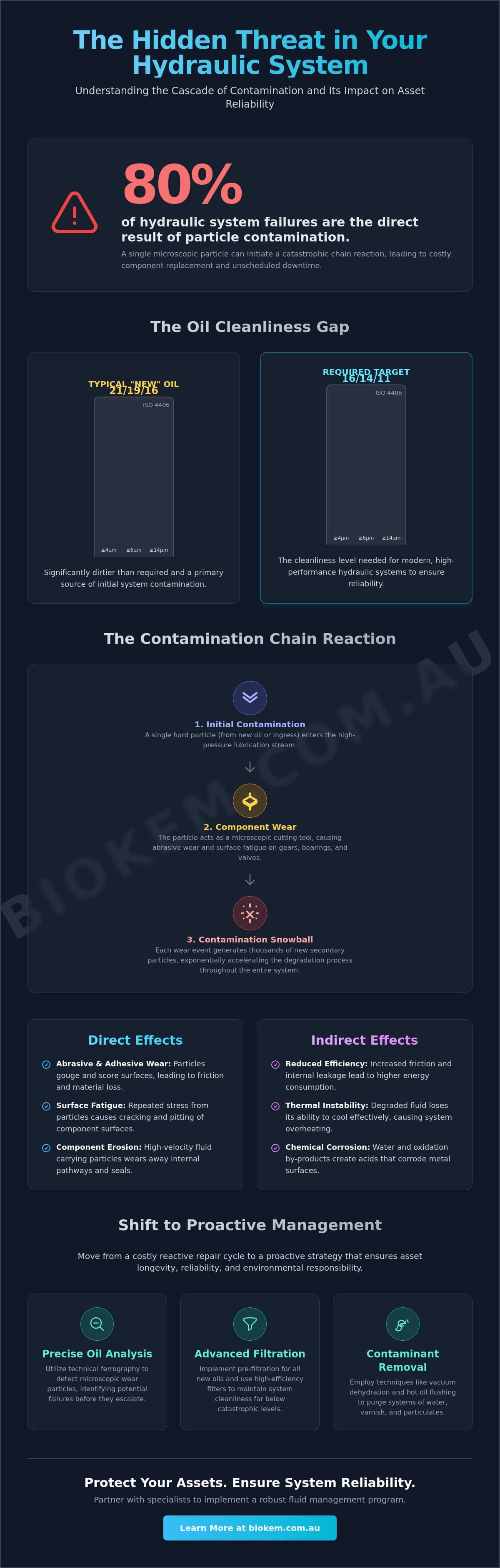
Up to 80% of hydraulic system failures are the direct result of particle contamination. It’s a sobering statistic for any operator facing the high costs of component replacement and the frustration of unscheduled downtime. You likely recognize that fluid health is vital, yet the specific Effects of contamination often manifest as a catastrophic chain reaction rather than a single event. While new oil from a drum might appear pristine, it often carries an ISO 4406 cleanliness code as high as 21/19/16; this is significantly dirtier than the 16/14/11 target required for modern, high-performance machinery.
We understand that maintaining operational reliability while meeting evolving standards, such as the EPA’s June 2026 Final Rule, is a complex responsibility. This article provides a technical overview of how microscopic particulates and moisture degrade your assets and impact your bottom line. You’ll gain a clear understanding of contamination mechanisms and the proactive strategies required to ensure long-term equipment health. We explore how rigorous oil analysis and advanced mitigation techniques, such as vacuum dehydration and varnish removal, can extend your asset lifespan and improve system reliability.
Key Takeaways
- Identify the specific mechanical mechanisms, such as abrasive and adhesive wear, that transform microscopic particulates into macroscopic system failures.
- Evaluate the long-term economic Effects of fluid neglect, comparing the high cost of unscheduled downtime against the efficiency of proactive purification.
- Understand how moisture contamination compromises oil film thickness and load-bearing capacity, leading to accelerated component degradation in critical assets.
- Discover how technical interventions like hot oil flushing and vacuum dehydration purge systems of contaminants to restore an optimal operational baseline.
- Shift from reactive repairs to a proactive maintenance culture that utilizes precise oil analysis to ensure asset longevity and environmental responsibility.
Table of Contents
-
Defining the Effects of Contamination in Industrial Lubrication
-
The Chain Reaction: How Contaminants Effect System Performance
Defining the Effects of Contamination in Industrial Lubrication
Understanding the distinction between a mechanical cause and an operational effect is fundamental to professional asset management. A cause is the physical presence of common contaminants in industrial oils, such as solid particulates, water, or entrained air. Conversely, the Effects are the resulting performance losses and mechanical degradations that compromise equipment reliability. Microscopic particles, often invisible to the naked eye, lead to macroscopic failures in massive turbines and gearboxes by disrupting the protective lubricant film that separates moving metal surfaces.
Industry professionals utilize the ISO 4406:2021 standard to quantify these risks. This code measures particulates at three specific micron levels: ≥4 µm, ≥6 µm, and ≥14 µm. When these levels exceed the manufacturer’s recommended threshold, the probability of mechanical failure increases exponentially. New oil often carries a cleanliness code as high as 21/19/16, which is far too contaminated for sensitive hydraulic systems requiring a 16/14/11 target. This discrepancy highlights why pre-filtration is a technical necessity rather than an optional step.
To better understand the complex interactions within fluid systems and the broader industrial context, watch this helpful video:
Direct vs. Indirect Effects on Machinery
Direct effects manifest as immediate physical damage to internal components. Surface fatigue, abrasive wear, and component erosion occur when hard particulates bridge the narrow clearance between moving parts. Indirect effects are more subtle but equally damaging to the bottom line. These include a measurable loss of mechanical efficiency, increased energy consumption, and thermal instability. Over time, subtle changes in oil chemistry can even affect long-term metallurgy. Oxidation by-products and acidic compounds react with metal surfaces, leading to leaching or chemical corrosion that weakens the structural integrity of the asset.
The Cumulative Nature of Fluid Degradation
Contamination creates a destructive snowball effect within closed systems. A single abrasive particle doesn’t just cause one scratch; it can generate thousands of secondary wear fragments as it passes through high-pressure zones. This chain reaction accelerates component wear and shortens the interval between required maintenance cycles. Implementing regular oil analysis allows operators to detect these microscopic warning signs before they escalate into catastrophic system shutdowns. By identifying the specific nature of wear debris through technical ferrography, managers can move from reactive repair to a strategy that prioritizes long-term ecological and operational health.
The Chain Reaction: How Contaminants Effect System Performance
Contamination is rarely a static presence. It functions as a catalyst for a destructive chain reaction that compromises every aspect of system performance. When hard particulates enter the lubrication stream, they initiate abrasive wear, acting as microscopic cutting tools that gouge metal surfaces. Adhesive wear follows as friction increases, causing localized welding and tearing between moving components. These physical Effects are compounded by chemical shifts within the fluid itself.
Water contamination is particularly hazardous because it directly impacts the oil film thickness. In high-pressure zones, water cannot support the same loads as lubricant molecules. This leads to boundary lubrication conditions where metal-on-metal contact occurs, significantly reducing the load-bearing capacity of bearings and gears. Simultaneously, the presence of oxygen and heat triggers oxidation. This chemical process increases lubricant viscosity and depletes vital anti-wear additives, leaving the system vulnerable to accelerated degradation. If you suspect these chemical shifts are occurring, a detailed oil analysis can identify the specific degradation markers before failure occurs.
Particulate Contamination and Component Erosion
High-precision hydraulic valves often operate with internal clearances as small as 1 to 5 microns. Because these tolerances are so tight, oil that appears clean to the naked eye can still contain enough silt to cause catastrophic failure. Hard particles sized similarly to these clearances become trapped, causing erosion and "stiction" in valve spools. This erosion alters the flow characteristics of the system, resulting in sluggish response times and a loss of fine operational control.
Varnish Formation: The Silent Effects on Turbines
Thermal stress significantly affects the solubility of oil additives and base stock components. As oil reaches its thermal limit, degraded molecules become insoluble and precipitate out of the fluid as a sticky, resinous substance known as varnish. This silent contaminant coats internal surfaces, acting as an unintended insulator on heat exchangers and causing critical servo valves to seize. These cumulative Effects on thermal efficiency and component movement can lead to total system trips. Implementing a specialized varnish removal system is essential for restoring the solubility of the lubricant and purging the system of these harmful deposits.
Economic and Operational Effects: The Cost of Neglect
The financial consequences of fluid contamination aren’t always immediate. They often manifest as a steady erosion of operational margins. In heavy industry, the most significant economic Effects are found in lost production capacity. When a critical asset fails, the hourly loss can be substantial. These costs are exacerbated by the unique logistical challenges of the Australian market. Long lead times for specialized components mean that a single failure can lead to weeks of inactivity if parts aren’t readily available in-country. Proactive management isn’t just about repair; it’s about avoiding the $2.5 trillion annual loss the global economy faces due to corrosion and related degradation.
Choosing frequent oil changes over advanced purification is a common but expensive error. While a drum of new oil has a known price, the labor, disposal fees, and procurement costs of constant replacement create a hidden financial burden. Beyond direct costs, poor lubrication negatively impacts a facility’s carbon footprint. Increased mechanical friction requires more energy to overcome, directly conflicting with modern ESG targets and sustainability goals. Maintaining fluid health is also a factor in managing insurance premiums. Insurers increasingly view proactive contamination control as a risk-mitigation strategy for high-value assets. This aligns with broader regulatory shifts, such as the EPA’s April 2026 technical reconsiderations designed to reduce industry burdens while maintaining standards.
Downtime and Lost Production Revenue
Unscheduled downtime is the most visible result of fluid neglect. A turbine trip caused by varnish deposits doesn’t just stop production; it requires a lengthy cooling and cleaning cycle before a restart is possible. Proactive maintenance is a strategic financial decision that protects against these outages. By investing in onsite purification and regular analysis, operators can extend the life of their lubricants and their machinery. This turns maintenance from a cost center into a reliability asset, ensuring that equipment stays online when production demands are at their peak.
Environmental Effects and Waste Management
The ecological consequence of excessive waste oil disposal is a growing concern for industrial leaders. Traditional "drain and fill" methods generate thousands of liters of hazardous waste that must be transported and processed. This linear consumption model is becoming obsolete as regulatory pressures and corporate responsibility shift toward the circular economy. Implementing professional heat transfer system maintenance and purification services allows facilities to reuse oil indefinitely. This approach reduces environmental risk and ensures compliance with regional standards while supporting long-term ecological health.
Mitigating Adverse Effects through Proactive Management
Transitioning from a reactive repair model to a proactive maintenance culture is the most effective way to safeguard industrial assets. This shift requires more than just better filters; it necessitates a comprehensive contamination control programme designed to neutralize threats at the source. By stabilizing system health through high-efficiency filtration, operators can mitigate the adverse Effects of particulate ingress and moisture before they trigger the mechanical chain reactions described earlier. A robust programme focuses on exclusion and removal. It’s much cheaper to keep contaminants out than to remove them once they’ve circulated through sensitive components. High-efficiency filtration acts as the primary defense, ensuring that fluid cleanliness remains within the strict tolerances required by modern ISO 4406:2021 standards.
The Power of High-Performance Filtration
Selecting the correct micron rating is critical for targeting specific wear mechanisms. Using Filters S.p.A. products allows facilities to achieve superior cleanliness by capturing particles that standard filters often miss. While surface filters might stop large debris, depth filtration is essential for removing sub-micron varnish precursors. These microscopic soft contaminants are the primary drivers of valve stiction and heat exchanger fouling. By implementing specialist oil filters with high dirt-holding capacities, you ensure that the lubricant remains chemically stable and mechanically effective over a longer service life.
Condition Monitoring and Predictive Analysis
Regular oil analysis provides a technical ‘window’ into the internal state of your machinery. It allows you to observe the cumulative Effects of wear on various metals without dismantling the equipment. Analytical ferrography is particularly useful here; it identifies the shape, size, and composition of wear particles to pinpoint exactly which components are degrading. However, a single-point sample only offers a snapshot. The real value lies in trending data over time. By monitoring shifts in particle counts and moisture levels, managers can predict potential failures weeks or months in advance. Linking these technical insights to a proactive maintenance strategy transforms raw data into actionable reliability gains.
To start protecting your critical assets from the inside out, explore our range of specialist filtration products and analysis services.
BioKem’s Approach to Effecting System Reliability
Reversing the mechanical and economic damage caused by fluid contamination requires more than standard maintenance; it demands specialized technical intervention. BioKem Oil Services provides the engineering expertise and hardware necessary to restore systems to their optimal operational baseline. By utilizing high-velocity hot oil flushing, we purge internal pipework of the abrasive particulates and construction debris that traditional filtration cannot reach. This process uses turbulent flow to lift and carry contaminants to high-efficiency filter banks, ensuring the entire fluid path meets strict cleanliness standards. The long-term operational Effects of this approach include a significant reduction in startup failures and a measurable extension of component service life.
For systems plagued by moisture, BioKem Oil Services employs onsite vacuum dehydration. This technology offers a distinct technical advantage by removing dissolved water, which is chemically bonded to the oil molecules and invisible to the naked eye. While standard centrifugal separators only address free water, vacuum dehydration lowers the partial pressure within the unit to boil off moisture at low temperatures. This preserves the chemical integrity of the lubricant and prevents the additive depletion and oxidation discussed in previous sections. Australian industries trust this methodology because it provides a localized, high-tech solution to the unique environmental challenges found in remote mining and power generation sites.
Onsite Technical Interventions
Total system cleanliness is achieved through a meticulous sequence of high-velocity flushing and real-time monitoring. BioKem Oil Services deploys specialized machinery directly to your site, regardless of how remote the location is in the Australian interior. During system commissioning or post-overhaul restarts, ensuring zero-contaminant entry is vital. Our teams use high-flow pumps to achieve the Reynolds numbers required for turbulent cleaning, effectively scouring the internal diameters of hydraulic and lubrication lines. This proactive step prevents the initial wear that often leads to catastrophic failure during the first few hundred hours of operation.
Equipment Hire and Product Distribution
Maintaining a proactive posture often requires immediate access to world-class hardware. Through the industrial oil filtration equipment hire service provided by BioKem Oil Services, facilities can scale their contamination control efforts during outages or emergency events without the capital expenditure of a full purchase. We support local maintenance teams by providing high-performance Filters S.p.A. products and Swift Filters hardware. These components are selected for their specific beta ratings and dirt-holding capacities, allowing operators to mitigate the negative Effects of contamination with surgical precision. Partnering with BioKem Oil Services ensures your assets remain protected by the latest advancements in lubrication science and ecological responsibility.
Securing the Future of Industrial Asset Health
Transitioning toward high-performance lubrication management is a technical necessity for modern industry. We’ve analyzed how microscopic contaminants trigger a destructive chain reaction, leading from internal component erosion to total system shutdowns. These Effects represent a significant risk to both operational profitability and environmental compliance. By moving away from a traditional drain and fill mentality, you’re embracing a more sustainable, circular approach to asset management. This strategy reduces hazardous waste and optimizes energy efficiency across your entire facility.
BioKem Oil Services provides the specialized tools and knowledge required to maintain these high standards. As the sole Australian distributor for Filters S.p.A., we’ve delivered authoritative technical expertise since 2011. Our teams specialize in critical interventions like varnish mitigation and hot oil flushing to restore system integrity. Maximise your asset reliability with BioKem Oil Services’ specialist oil services. Investing in precise fluid health today is the most effective way to protect your infrastructure and ensure long-term operational success.
Frequently Asked Questions
What are the primary effects of water in hydraulic oil?
Water primarily impacts the lubrication film, reducing its load-bearing capacity and leading to metal-on-metal contact. It also triggers chemical Effects such as the depletion of anti-wear additives and the acceleration of base oil oxidation. Over time, moisture promotes microbial growth and internal corrosion, which compromises the structural integrity of hydraulic components. Utilizing vacuum dehydration is the most effective technical method for removing both free and dissolved water from the system.
How does varnish effect the operation of a gas turbine?
Varnish acts as a sticky, resinous coating that adheres to internal turbine surfaces, particularly in low-flow areas. It significantly impacts the operation of high-precision servo valves, causing sluggish response times or total seizure that leads to system trips. Because varnish is an insulator, it also reduces the efficiency of heat exchangers. This leads to higher operating temperatures and accelerated thermal degradation of the lubricant, creating a self-sustaining cycle of equipment failure.
Can the effects of oil oxidation be reversed?
The chemical damage caused by oxidation is permanent and it’s not possible to reverse the process. Once the base oil molecules have reacted with oxygen to form acids and sludge, the lubricant’s original chemical properties are lost. However, the negative Effects on the system can be mitigated. Varnish mitigation and tank cleaning remove the resulting deposits, while partial oil replacement or the addition of fresh additives can stabilize the fluid. Proactive monitoring is essential to catch oxidation early.
What is the difference between particulate and chemical effects in oil?
Particulate contamination causes physical, mechanical damage through abrasive and adhesive wear mechanisms. These hard particles physically gouge metal surfaces and erode component tolerances. Chemical degradation involves shifts in the oil’s molecular structure, such as oxidation or additive depletion. While particulates destroy the machinery, chemical shifts destroy the lubricant’s ability to protect that machinery. Both processes are interlinked, as metal wear particles often act as catalysts for further chemical oxidation and fluid breakdown.
How do I know if the effects of contamination are already occurring in my system?
Operators often notice physical symptoms like increased operating temperatures, unusual noise from pumps, or sluggish hydraulic responses. However, these are lagging indicators of damage that’s already occurred. The only way to identify early-stage contamination is through regular oil analysis. Professional testing reveals microscopic wear debris and chemical shifts long before they manifest as audible or visible system failures. Monitoring ISO 4406 cleanliness codes provides a clear baseline for tracking these internal changes accurately.
What are the long-term effects of using low-quality oil filters?
Low-quality filters often lack the necessary beta rating and dirt-holding capacity to protect sensitive components effectively. Over time, this allows sub-micron particulates and varnish precursors to circulate freely, leading to cumulative component erosion. These filters may also reach their saturation point quickly, triggering bypass valves that allow completely unfiltered oil into the system. This neglect results in shortened asset lifespans, higher maintenance costs, and a significantly increased risk of catastrophic failure during peak production periods.
How does hot oil flushing effect the cleanliness of a new system?
Hot oil flushing uses high-velocity, turbulent flow to purge a new system of construction debris, such as welding slag and metal shavings. By reaching high Reynolds numbers, the process lifts particulates that standard circulation can’t move. This ensures the system begins its operational life at a cleanliness level far superior to the "as-built" condition. Starting with a pristine fluid path prevents the initial wear that frequently compromises high-performance machinery during the critical commissioning phase.
What economic effects should I consider when planning maintenance?
You must account for the total cost of ownership, which includes unscheduled downtime, energy consumption, and waste disposal fees. Frequent oil changes are often more expensive than a single purification event when labor and procurement are factored in. Poorly lubricated systems also consume more electricity to overcome internal friction. Additionally, proactive contamination control can positively impact insurance premiums and regulatory compliance costs, which are vital Effects to consider as industrial standards become more stringent.