

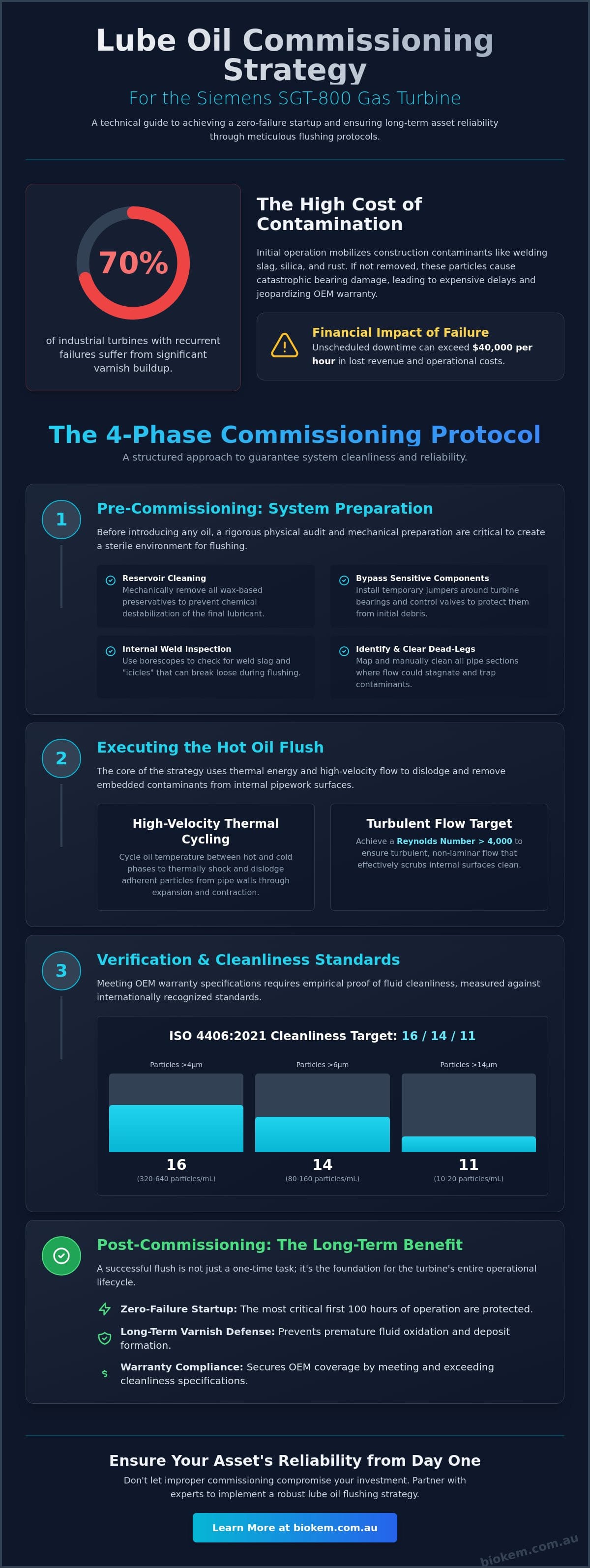
More than 70% of industrial turbines that experience recurrent failures are found to have significant varnish buildup, a problem that can originate from improper initial cleaning. A successful Lube Oil Commissioning Strategy for the Siemens SGT-800 must treat the lubrication system as a sterile environment from the moment it’s installed. If you don’t eliminate construction-phase contaminants through high-velocity oil flushing, you risk catastrophic bearing damage and expensive delays a the time of first fire.
We understand the immense pressure on Tier One Contractors of meeting strict OEM cleanliness specifications while staying on a tight commissioning schedule. It’s a high-stakes process where compliance with Siemens warranty requirements isn’t just a hurdle; it’s the foundation of your client’s long-term reliability. This guide provides the technical roadmap you need to master flushing protocols and achieve a zero-failure startup. You’ll learn how to reach the ISO 4406:2021 target of 16/14/11 or cleaner, ensuring your SGT-800 operates with the efficiency and ecological responsibility that modern energy infrastructure demands.
Key Takeaways
- Understand why the first 100 hours of operation are the most critical for bearing integrity and how proper reservoir preparation prevents early-stage failures.
- Master a Lube Oil Commissioning Strategy for the Siemens SGT-800 that utilizes high-velocity thermal cycling to dislodge construction-phase contaminants.
- Learn the technical requirements for achieving a turbulent Reynolds Number above 4,000 to ensure effective cleaning of internal pipework surfaces.
- Identify the specific ISO 4406 cleanliness targets and visual verification methods required to meet strict OEM warranty specifications.
- Discover how a rigorous initial flushing protocol serves as a long-term defense against varnish formation and catalytic fluid oxidation.
Table of Contents
The Role of Lubrication in Siemens SGT-800 Reliability
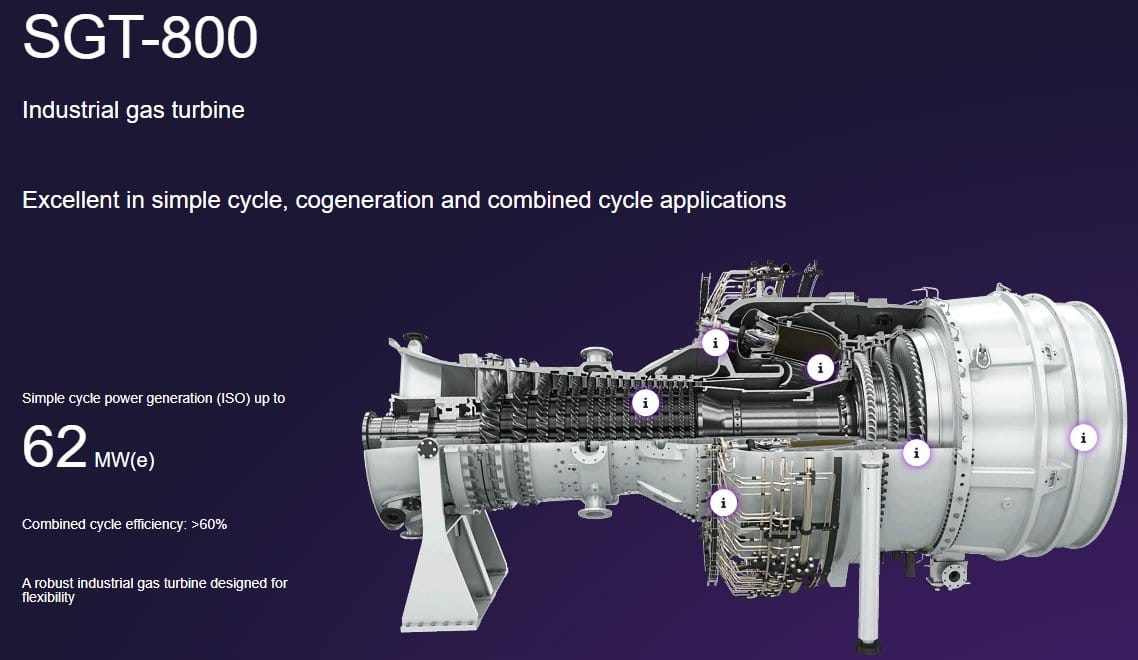
The Siemens SGT-800 is a sophisticated piece of rotating machinery that relies on a constant, clean supply of lubricant to maintain its 60-MW-class output. The Role of Lubrication here extends beyond simple friction reduction; it acts as the primary cooling medium and hydraulic power source for the turbine’s most sensitive internals. Establishing a robust Lube Oil Commissioning Strategy for the Siemens SGT-800 is essential because the most hazardous period for any new turbine is its first 100 hours of operation. During this window, the system is most vulnerable to the legacy of the manufacturing and installation process. See our article on bathtub curve failures.
Initial operation often mobilizes construction-related contaminants like welding slag, silica, and atmospheric rust that have settled in dead-legs or pipe walls. If these hard particles aren’t removed through a professional flushing protocol before the first fire, they act as grinding paste within the tight clearances of the bearings. This sets a negative baseline for the asset’s entire lifecycle. It often leads to the premature varnish formation that affects 70% of turbines experiencing recurrent failures, making early-stage fluid health a non-negotiable priority for plant operators.
To better understand the scale and complexity of this industrial gas turbine, watch this overview of its design and capabilities:
Critical Components Protected by the Lube Oil System
The lube oil circuit supports several high-load areas where metal-to-metal contact would be instantaneous without adequate hydrodynamic pressure. Journal and thrust bearings require absolute fluid purity to prevent scoring during high-speed rotation. In power generation configurations, the SGT-800 often utilizes a gearbox to step down turbine speeds for the generator; these gears are particularly susceptible to micropitting if the oil contains particulate matter. Additionally, the same oil supply often powers the hydraulic start and control systems, where even minor blockages in servo valves can lead to erratic performance or unexpected trips.
The Financial Impact of Improper Commissioning
Cutting corners during the flushing phase is a false economy that creates long-term operational risk. For peaking power plants, unscheduled downtime caused by issues like varnish-induced valve sticking can exceed $40,000 per hour in lost revenue and operational costs. Beyond immediate repairs, failing to meet Siemens’ strict cleanliness standards can jeopardize warranty coverage, leaving operators responsible for the full cost of component replacement. The SGT-800 is a high-precision machine where micron-level particles cause catastrophic failure.
Pre-Commissioning: System Inspection and Preparation
Before the first drop of flushing oil enters the circuit, a rigorous physical audit of the entire lubrication system is required. A successful Lube Oil Commissioning Strategy for the Siemens SGT-800 begins in the reservoir. Manufacturers often apply wax-based preservatives to internal surfaces to prevent corrosion during sea transit or onsite storage. These coatings must be mechanically removed. If left behind, they can chemically destabilize the final lubricant charge, leading to premature additive depletion and unwanted changes in fluid viscosity.
Inspecting the pipework involves more than a cursory glance. You must verify the removal of all temporary construction blanks and ensure that weld joints are free from internal oxidation. This phase also requires the installation of temporary jumpers. These jumpers redirect the flow around sensitive components like the turbine bearings and hydraulic control valves. This ensures that the initial wave of construction debris is captured by external filtration rather than being forced into high-precision clearances where it could cause immediate scoring.
Mechanical Readiness Checklist
A comprehensive checklist ensures that no section of the circuit is bypassed by the cleaning process. Pay particular attention to these mechanical factors:
-
Internal Weld Quality: Use borescope inspections to confirm that no slag or "icicles" remain inside the piping. Hard particles can break loose during thermal cycling and damage downstream assets.
-
Dead-Leg Identification: Map out every section of pipe where flow may stagnate. These areas often require manual cleaning or the use of specialized paddle flushing screens to ensure total debris removal.
-
Venting and Drainage: High-point vents are essential for removing trapped air, which can cause pump cavitation. Low-point drains must be fully functional to allow for the complete removal of flushing fluids and any captured moisture.
Chemical and Environmental Controls
In many Australian regions, high humidity and coastal salt spray present significant risks for moisture ingress during the pre-commissioning phase. Water in the lube oil system promotes microbial growth and accelerates the oxidation of the base oil. Choosing a flushing fluid is equally critical. It must be chemically compatible with the final turbine oil to avoid solubility issues or the precipitation of additives. Utilizing high-quality BioKem products for temporary filtration hardware helps maintain the integrity of the system during this sensitive period.
Effective preparation reduces the duration of the actual flush and ensures that the system is chemically primed for long-term operation. If you’re concerned about the internal state of your reservoir, professional tank cleaning and inspection services can provide the necessary baseline for a successful startup.
Executing the Hot Oil Flushing Strategy
A successful Lube Oil Commissioning Strategy for the Siemens SGT-800 requires moving beyond simple oil circulation. The execution phase is a rigorous, multi-step process designed to mobilize and capture every trace of construction-phase debris. This procedure relies on four primary mechanisms: high-velocity turbulent flow, thermal cycling, mechanical agitation, and high-efficiency external filtration. By following a structured sequence, operators ensure the lubrication circuit is chemically and physically prepared for the turbine’s high-speed rotation.
-
Step 1: Flow Establishment. High-flow pumps are connected to the system to achieve a flow rate significantly higher than the turbine’s nominal operating flow.
-
Step 2: Thermal Cycling. Where possible a process of temperature cycling can assist. The oil is heated and cooled in rapid successions to induce physical stress on the pipework.
-
Step 3: Filtration and Capture. External filtration units, often utilizing high-beta-ratio elements, continuously remove mobilized particles.
-
Step 4: Mechanical Agitation. Pneumatic or vibratory tools are used on external pipe surfaces to help dislodge stubborn welding slag or scale.
-
Step 5: System Reinstatement. Once cleanliness targets are verified, temporary jumpers are removed, and the system is restored to its final configuration for oil analysis.
The Science of Turbulent Flow
Laminar flow, where oil moves in smooth, parallel layers, is insufficient for removing construction-phase contaminants. To effectively scrub the internal walls of the SGT-800 pipework, the fluid must reach a state of turbulence. This is defined by achieving a Reynolds Number greater than 4,000. Velocity, not just pressure, is the key to a successful flush. When the fluid moves with enough speed and chaos, it creates the necessary shear stress to lift heavy particles and move them toward the filtration units. Calculating the specific flow rates required for various SGT-800 pipe diameters is a critical pre-execution step that prevents "dead zones" where debris might otherwise remain trapped.
Thermal Cycling Protocols
Thermal cycling introduces a "thermal shock" effect that is vital for dislodging adhered scale. During the hot phase, oil temperatures are typically raised to a range of 60-70°C. This causes the metal piping to expand. When the temperature is subsequently dropped, the piping contracts, a process that physically breaks the bond between the pipe wall and any brittle contaminants like mill scale or rust. Repeating this cycle multiple times ensures that even the most stubborn particulates are released into the turbulent stream. For projects requiring high-precision execution, engaging professional Hot Oil Flushing services ensures that these temperature swings and flow parameters are monitored with scientific accuracy, guaranteeing the system meets the required cleanliness standards without unnecessary delays.
Verification and Cleanliness Standards (ISO 4406)
Successful execution of the flushing phase is only half the battle. To complete a Lube Oil Commissioning Strategy for the Siemens SGT-800, you must provide empirical evidence that the system has reached the necessary cleanliness levels. Verification is a multi-layered process that combines real-time digital monitoring with laboratory-grade physical inspections. It’s the only way to ensure that the construction-phase contaminants discussed in previous sections have been fully evacuated from the circuit.
Real-time monitoring during the flush is best achieved through online particle counters. These devices provide a continuous stream of data, allowing the team to see the immediate impact of thermal cycling and mechanical agitation. However, digital data alone isn’t enough for final sign-off. A physical patch test, often called a Millipore test, is required to visually identify the types of debris remaining. This helps distinguish between harmless air bubbles and dangerous metallic slivers or silica that could compromise turbine bearings.
Interpreting ISO 4406 for Gas Turbines
The ISO 4406:2021 standard is the global benchmark for quantifying fluid contamination. For the SGT-800, the industry-accepted target is typically a code of 16/14/11 or cleaner. These three numbers represent the quantity of particles larger than 4µm, 6µm, and 14µm per milliliter of fluid. Because the SGT-800 operates with incredibly tight clearances, even a slight deviation from these targets can lead to surface fatigue. For a deeper understanding of particle morphology, BioKem Oil Analysis provides ferrogram-level detail that identifies the exact nature of the contaminants, whether they’re environmental dust or wear-related metals.
Verification Hardware and Methods
Final verification requires sampling from multiple points in the circuit, not just the reservoir. This ensures that "dead zones" haven’t harbored pockets of debris. Before removing temporary bypasses, many engineers utilize paddle flushing screens as a final physical check. These fine-mesh screens capture any remaining large particulates that might have escaped the primary filtration units. Documenting these results is critical for OEM warranty validation; it creates a "birth certificate" for the fluid that proves the system was clean at the moment of commissioning.
To ensure your fluid meets these rigorous standards before first-fire, schedule a comprehensive oil analysis to validate your system’s health.
Post-Commissioning: Long-Term Varnish and Fluid Health
The transition from a successful Lube Oil Commissioning Strategy for the Siemens SGT-800 to routine operation marks a shift from intensive cleaning to long-term fluid preservation. While the initial flush removes the bulk of construction-phase debris, the microscopic particles that remain can act as catalysts for oil oxidation. These metallic fines accelerate the chemical breakdown of the lubricant, especially under the high thermal loads typical of the SGT-800’s 60-MW output. When these particles aren’t managed from day one, they facilitate the formation of varnish precursors that eventually plate out on cooler surfaces.
Varnish is not merely an age-related issue; it’s often a direct consequence of the "birth defects" left behind during commissioning. As the turbine operates, the lubricant undergoes constant thermal stress. If the oil contains residual silt or metallic catalysts, the oxidation process speeds up significantly. Transitioning from the commissioning phase to a proactive maintenance strategy ensures that these chemical precursors are managed before they manifest as operational failures.
Preventing the Varnish Cycle
The SGT-800’s thermal profile creates a demanding environment for modern Group II base oils. While these oils offer superior stability, they have a lower solvency for oxidation by-products. This means that as varnish precursors form, they’re quickly pushed out of the oil and onto sensitive components. Fine particulates, or "silt," contribute to this by providing a nucleus for varnish to grow. This leads to the sticking of servo valves and erratic control system behavior, which can cost operators over $40,000 per hour in unscheduled downtime. Implementing Varnish Removal Systems early in the asset’s life helps maintain the solubility of the oil and protects the turbine’s operational longevity.
Ongoing Monitoring and Support
Maintaining the cleanliness achieved during a Lube Oil Commissioning Strategy for the Siemens SGT-800 requires a disciplined monitoring cadence. Monthly or quarterly oil analysis is essential to track the Membrane Patch Colorimetry (MPC) value, which measures varnish potential. Standard filtration often misses the smallest particles that drive oxidation. Utilizing high-performance Filters S.p.A. products within your operational circuit provides the level of fine filtration necessary to keep the fluid within its target ISO 4406 parameters.
The reliability of your SGT-800 depends on the health of its lifeblood. Ensure your turbine starts clean and stays clean by partnering with BioKem’s technical services for your next commissioning or maintenance project.
Securing the Operational Future of Your SGT-800
A successful startup transforms a complex assembly of components into a reliable power generation asset. By prioritizing high-velocity thermal cycling and rigorous ISO 4406 verification, you eliminate the construction-phase contaminants that catalyze long-term varnish formation. This proactive approach protects your bearings during the critical first 100 hours and establishes a baseline for sustained reliability. It’s a strategic commitment to operational efficiency that prevents the costly downtime associated with fluid degradation and valve sticking.
Executing a comprehensive Lube Oil Commissioning Strategy for the Siemens SGT-800 requires specialized technical expertise and high-performance hardware. BioKem supports these requirements as an authorized distributor for Filters S.p.A. and specialists in high-velocity hot oil flushing for the power generation sector. Our team provides comprehensive onsite oil analysis and verification to ensure your system meets strict OEM cleanliness standards before the first fire. Consult with BioKem’s technical team for your SGT-800 commissioning project to secure your facility’s performance. Proper preparation ensures your turbine remains a high-precision asset for its entire lifecycle.
Frequently Asked Questions
How long does a typical hot oil flush take for a Siemens SGT-800?
A typical hot oil flush for a Siemens SGT-800 usually takes between three to seven days of active circulation for each major curcuit. The exact duration depends on the initial state of the pipework and how quickly the system achieves the target ISO 4406 cleanliness levels. It’s a condition-based process rather than a fixed timeframe. Components such as the coolers can significantly alter the flushing duration, and the complexity of the temporary bypasses (jumpers) also influence the final schedule. All up, a flushing window of up to 21 days is considered realistic.
What ISO 4406 cleanliness level does Siemens specify for SGT-800 commissioning?
The industry-accepted target for Siemens SGT-800 commissioning is an ISO 4406:2021 code of 16/14/11 or cleaner. Some specific site requirements or sensitive components may demand an even stricter 15/13/10 rating. Achieving this baseline is the primary goal of any Lube Oil Commissioning Strategy for the Siemens SGT-800. It ensures that the lubricant is free from microscopic particulates that could otherwise cause surface fatigue on high-speed bearings.
Can we use the turbine’s own lube oil pumps for the commissioning flush?
You shouldn’t use the turbine’s internal lube oil pumps for a commissioning flush. These pumps are designed for steady-state operation and rarely provide the high-velocity flow required to reach a Reynolds Number greater than 4,000. External high-flow flushing units are necessary to create the turbulent flow needed to dislodge construction debris. Using the onboard pumps also risks damaging them before the turbine has even reached its first-fire stage.
Why is thermal cycling necessary during the lube oil commissioning strategy?
Thermal cycling is necessary because the resulting "thermal shock" helps dislodge brittle contaminants like mill scale and welding slag from pipe walls. By rapidly shifting the oil temperature between 60°C and 40°C, the metal piping expands and contracts. This physical movement breaks the bond between the substrate and adhered particles. Without this cycling, many contaminants would remain trapped in the system until the turbine reached full operational temperature.
What are the risks of skipping a professional hot oil flush during SGT-800 installation?
Skipping a professional hot oil flush introduces the risk of catastrophic bearing damage and immediate varnish formation. Hard particulates like silica or weld slag can act as a grinding paste, scoring precision-machined surfaces during the first few hours of rotation. This leads to unscheduled downtime that can exceed $40,000 per hour in costs. Additionally, failing to meet cleanliness specifications can lead to the rejection of warranty claims by the OEM.
How does BioKem verify that the system is ready for first-fire?
BioKem verifies system readiness through a multi-stage verification protocol that includes onsite oil analysis and Millipore patch testing. We utilize online particle counters to monitor real-time trends during the flush. Once the digital data stabilizes, we take physical samples for laboratory-grade analysis. This ensures the fluid meets ISO 4406 standards and is free from moisture or chemical contaminants that could compromise the Lube Oil Commissioning Strategy for the Siemens SGT-800.
Is it necessary to flush the SGT-800 control oil system separately?
Yes, the control oil system requires separate attention due to the extreme sensitivity of its servo valves and actuators. While it often shares the same reservoir, the control loop has smaller diameter piping and tighter tolerances. It must be flushed through specialized bypasses to ensure that no debris enters the hydraulic control components. This prevents the erratic behavior or "sticking" that often leads to unexpected turbine trips during startup.
What type of filtration media is recommended for SGT-800 commissioning?
We recommend high-efficiency, synthetic microglass fiber media with a high beta ratio for SGT-800 commissioning. This media provides the structural integrity needed to handle high-velocity turbulent flow without collapsing or bypassing. Specialist oil filters, such as those from the USA Swift Filter & Italian Filters S.p.A. range, are ideal for capturing contaminants during commissioning. Using the correct media ensures that the flushing process is both efficient and capable of reaching stringent cleanliness targets.