

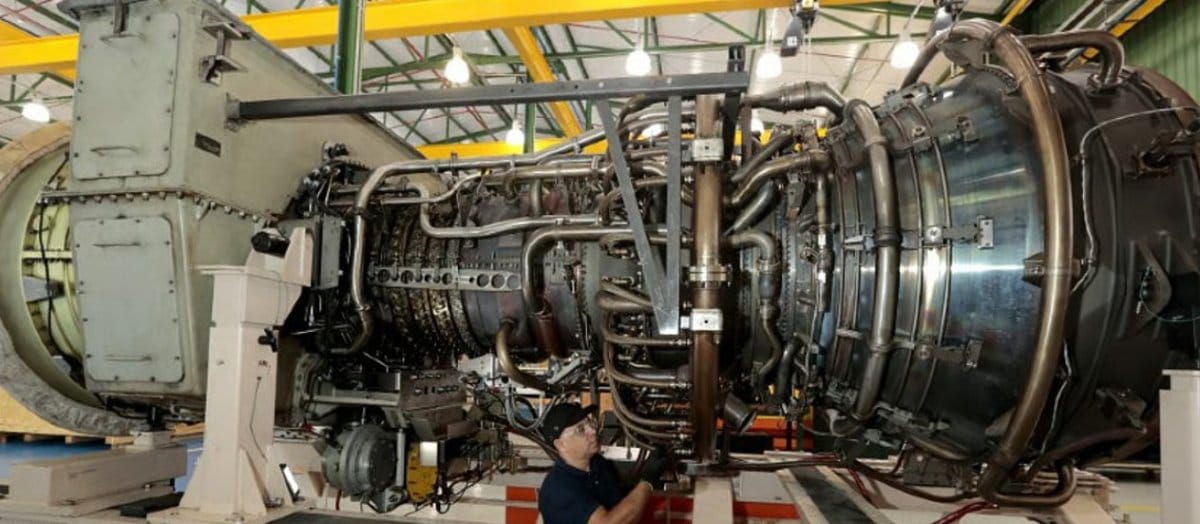
Approximately 80% of hydraulic system failures in heavy industry are a direct result of particle contamination. For operators, this risk is never higher than during the critical window of commissioning. Achieving first-fire success with GE Vernova LM2500 series gas turbines using GEK 110483b requires an uncompromising approach to fluid cleanliness. You likely understand that even microscopic debris can jeopardize high-value aeroderivative bearings, leading to failed inspections and expensive project delays that stall your path to power generation.
It’s possible to eliminate this uncertainty by strictly adhering to the technical requirements and flushing protocols outlined in the latest GEK 110483 Revision G standards. By prioritizing these benchmarks, you can ensure your system meets ISO 4406:2021 cleanliness levels on the first attempt. This article provides a technical overview of the procedures necessary to satisfy GE Vernova inspection criteria and explains how specialized hot oil flushing protects your asset for its long-term operational life, minimizing downtime while securing turbine reliability.
Key Takeaways
- Learn why the GEK 110483b Revision G specification is the essential benchmark for protecting sensitive aeroderivative bearings from particulate damage during initial startup.
- Understand the technical distinction between standard filtration and high-velocity hot oil flushing, specifically how achieving turbulent flow dislodges contaminants that passive systems miss.
- Identify the precise technical requirements for achieving first-fire success with GE Vernova LM2500 series gas turbines using GEK 110483b to avoid costly commissioning delays.
- Master the critical preparation steps, including the identification of dead-legs and the execution of a rigid mechanical cleaning sequence, to ensure total system integrity.
- Discover how integrating specialized high-flow flushing equipment and expert oil analysis secures long-term asset reliability and meets stringent environmental standards.
Understanding the Criticality of GEK 110483b for LM2500 First-Fire
Achieving first-fire success with GE Vernova LM2500 series gas turbines using GEK 110483b isn’t merely an operational milestone. It’s a calculated technical requirement designed to protect your investment from the moment of ignition. GE Vernova establishes these standards to ensure every internal surface contacting lubrication oil is purged of the debris inherent in industrial construction. If you ignore these protocols, you risk more than just a schedule slip. Microscopic particles can score high-speed bearings in seconds, potentially causing catastrophic failure before the unit even synchronizes with the grid.
Non-compliance with these standards often results in expensive startup delays that stall power delivery. When an inspection team identifies contamination on target screens, the entire flushing process must restart, causing project costs to spiral. Beyond the immediate delay, failing to meet GEK 110483b can void OEM warranties, leaving operators responsible for the multi-million dollar cost of bearing replacements. This specification marks the critical boundary between construction-level cleanliness and operational readiness, ensuring the system is purified for the unique demands of high-speed aeroderivative operation.
To better understand the mechanical complexity of these systems, watch this overview of gas turbine operation:
What is GEK 110483b?
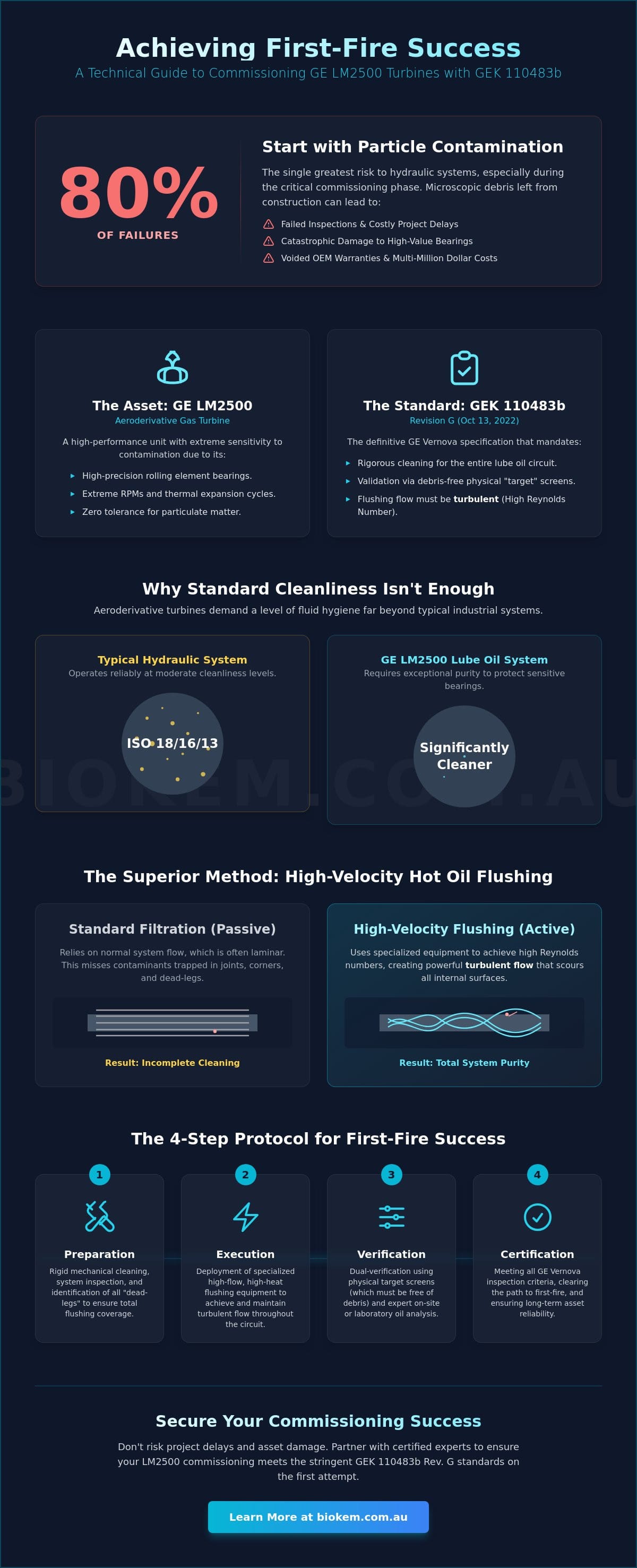
GEK 110483b, specifically Revision G released on October 13, 2022, is the definitive GE Vernova specification for cleaning and flushing lube oil systems. It applies during initial commissioning and after major maintenance intervals. The document defines the hygiene requirements for the entire oil circuit, from the reservoir to the critical bearing headers. Compliance relies on the use of “target” screens; these are physical mesh filters that must remain debris-free during validation. The scope mandates that flushing must reach a high Reynolds number to ensure turbulent flow, which is the only physical mechanism capable of dislodging particles trapped in piping joints.
Why Aeroderivative Units Have Stricter Requirements
The GE LM2500 gas turbine is a high-performance aeroderivative unit that demands higher cleanliness than traditional frame turbines. While heavy-duty units often use large journal bearings, the LM2500 relies on high-precision rolling elements. These bearings operate at extreme RPMs and face significant thermal expansion during cycles. The GE LM2500 family has accumulated approximately 140 million operating hours, a testament to its design when maintained to these exacting standards. Because of this sensitivity, a specialized hot oil flushing procedure is the only reliable way to meet the zero-tolerance requirements of the GEK specification.
Cleanliness Standards: ISO 4406 and the GEK Specification
Precision is mandatory when preparing high-performance assets for service. ISO 4406 provides the numerical framework required to quantify fluid hygiene, yet achieving first-fire success with GE Vernova LM2500 series gas turbines using GEK 110483b demands a level of stringency that exceeds standard industrial applications. While a typical hydraulic system might operate reliably at an ISO 18/16/13 level, aeroderivative turbines require significantly cleaner oil to protect their specialized rolling-element bearings. These components are intolerant of the particulate matter that construction and piping assembly inevitably leave behind.
Adhering to Turbomachinery commissioning best practices involves a dual-verification approach. You cannot rely solely on laboratory reports or field-based laser counters. GEK 110483b Revision G mandates that numerical data must be supported by physical evidence of system hygiene. Meeting these benchmarks in a field environment is a logistical challenge that requires specialized contamination control equipment and a deep understanding of fluid dynamics. Without this technical rigor, you risk the integrity of the entire lubrication circuit before the turbine reaches full speed.
Decoding ISO 4406 for Turbine Engineers
The ISO 4406:2021 standard utilizes a three-digit code to represent the quantity of particles at 4, 6, and 14 microns per milliliter of fluid. For an LM2500 system governed by GEK 110483b, engineers typically aim for an ultra-clean target such as 14/12/10. Reaching this level of purity is the foundation of effective oil contamination control. It ensures that the fluid film between high-speed rotating parts remains free of abrasive materials that cause surface fatigue or scoring.
The Role of Physical Patch Testing
Electronic particle counters are efficient, but they don’t provide a complete picture of system hygiene for GE compliance. These devices can’t always distinguish between air bubbles, water droplets, and actual metal fragments. This is why the use of patch test kits is essential for immediate field verification. By drawing a fluid sample through a specialized membrane, technicians can visually inspect the actual contaminants under a microscope. To pass a flushing screen inspection under GEK 110483b, the mesh must be free of any visible debris that could indicate a failure in the cleaning process. If you’re preparing for a critical commissioning phase, our precision hot oil flushing ensures your system meets these visual and numerical standards on the first attempt.
Strategic Hot Oil Flushing: Surpassing Minimum Requirements
Passive filtration methods are insufficient for the stringent demands of commissioning. While standard filters remove suspended particles already in circulation, they can’t dislodge heavy debris stuck in the recesses of complex piping. Achieving first-fire success with GE Vernova LM2500 series gas turbines using GEK 110483b depends on an active, high-velocity intervention known as hot oil flushing. This process goes beyond simple cleaning; it’s a mechanical scrubbing of the system’s internal surfaces using the oil itself as the cleaning agent.
Thermal cycling is a critical component of this strategy. By fluctuating the oil temperature, technicians cause the piping to expand and contract. This mechanical movement helps release stubborn mill scale and welding slag that would otherwise remain dormant until the turbine reaches full operational heat. To achieve the necessary velocities without risking the turbine’s internal hardware, external high-flow pumps are utilized. These rigs bypass the turbine’s integrated lubrication pumps, ensuring that high-velocity oil doesn’t damage sensitive internal seals or bearings before they’ve been properly purified.
The Mechanics of Turbulent Flow
Effective cleaning requires more than just movement; it requires turbulence. A Reynolds number greater than 4000 is the technical benchmark for ensuring the oil flow is chaotic enough to scrub internal pipe walls. High temperatures are essential here because they reduce oil viscosity, which allows for higher velocities at the same pump pressure. BioKem’s specialized hot oil flushing services for the LM2500 series are engineered to maintain these precise parameters, ensuring every square inch of the lubrication circuit meets GE Vernova hygiene standards.
Bypassing Critical Components
Protecting the asset is as important as cleaning it. During the flush, all bearings and sensitive instrumentation must be bypassed to prevent damage from the very debris you’re trying to remove. Technicians utilize paddle flushing screens at strategic points to capture and monitor the particulate load in real-time. By following a clean-to-dirty flow path strategy, you ensure that contaminants are systematically pushed toward the filtration unit rather than being recirculated through the system’s critical headers. This methodical approach is vital for achieving first-fire success with GE Vernova LM2500 series gas turbines using GEK 110483b without risking premature component wear.
A Step-by-Step Protocol for Successful LM2500 Commissioning
Execution of a rigid protocol is the only way to satisfy GE Vernova hygiene standards. Achieving first-fire success with GE Vernova LM2500 series gas turbines using GEK 110483b requires more than just high-flow equipment; it requires a disciplined sequence of mechanical and chemical cleaning. Preparation is as critical as the flush itself. If you fail to account for dead-legs or leave construction debris in the reservoir, the high-velocity oil will simply redistribute the contamination rather than removing it. Final verification must be witnessed by an OEM representative to secure the warranty and ensure the unit is ready for its 140 million operating hour potential.
Phase 1: System Inspection and Mechanical Cleaning
Before any oil enters the system, a thorough physical inspection is mandatory. Technicians must verify the reservoir is free of standing water and construction debris like rags or metal shavings that often accumulate during site assembly. Every temporary jumper and bypass must be inspected for integrity to prevent leaks during high-pressure cycles. Once the system is sealed, an initial oil charge is introduced, followed by a baseline oil analysis to establish the starting contamination level.
Phase 2: High-Velocity Hot Oil Flush
The active cleaning phase involves circulating oil at 60-70°C. This temperature range is optimal for maximizing particulate suspension and ensuring the fluid reaches turbulent flow regimes. To maintain this purity, we utilize high-performance Filters S.p.A. elements, which are specifically designed for rapid cleanup of industrial systems. Technicians perform incremental screen inspections, comparing results against the GEK 110483b “pass” criteria until the system is demonstrably clean.
Phase 3: Final Certification and Handover
The final phase transitions the turbine from a flushing configuration to an operational state. This involves a final ISO 4406 particle count verification to confirm the fluid meets the 14/12/10 target. Once the OEM representative approves the results, bypasses are removed, and the system is restored to its operational configuration. All data, including patch tests and temperature logs, is compiled into a formal commissioning data package. This documentation is vital for achieving first-fire success with GE Vernova LM2500 series gas turbines using GEK 110483b while securing long-term warranty protection. If first-fire isn’t immediate, post-flush preservation steps must be taken to prevent moisture ingress. For professional support in executing this protocol, consider our specialist hot oil flushing services to guarantee your project stays on schedule.
Partnering for Reliability: BioKem Oil Services’ Specialized LM2500 Support
BioKem Oil Services provides the technical bridge between construction and reliable power generation. We maintain a fleet of high-flow flushing rigs engineered specifically to meet the high Reynolds number requirements of aeroderivative systems. Achieving first-fire success with GE Vernova LM2500 series gas turbines using GEK 110483b isn’t just about high-velocity movement; it’s about the technical oversight that ensures compliance with Revision G standards. By integrating specialized varnish mitigation early in the process, we ensure the system remains chemically stable through first-fire and beyond. For projects requiring onsite autonomy, BioKem Oil Services offers industrial oil filtration equipment hire, providing the same professional-grade hardware used by our field teams.
Australian Expertise in Aeroderivative Systems
Our experience with the LM2500 family across Australian power plants allows for a nuanced understanding of local operational challenges. BioKem Oil Services doesn’t just provide equipment; we provide a localized technical partnership that understands regional safety and environmental regulations. Rapid mobilization is a core component of our service, ensuring that your commissioning schedule doesn’t stall while waiting for international support teams. This local expertise anchors global technical standards in a dependable, responsive context, helping you meet GE Vernova’s stringent cleanliness criteria without the logistical overhead of overseas contractors.
Beyond Commissioning: Proactive Maintenance
The successful completion of a hot oil flush is only the beginning of an asset’s journey. Transitioning from the initial cleanup to a proactive maintenance strategy is essential for long-term reliability. Continuous oil analysis and high-efficiency filtration prevent the accumulation of soft contaminants that lead to varnish-related valve sticking. By maintaining the system at the ISO 14/12/10 levels achieved during commissioning, you protect the high-value bearings and ensure the turbine’s 39.3 percent thermal efficiency remains uncompromised. Achieving first-fire success with GE Vernova LM2500 series gas turbines using GEK 110483b is a significant milestone, but sustained performance requires a commitment to fluid hygiene throughout the turbine’s lifecycle. Contact BioKem Oil Services today for a technical consultation to secure the reliability of your next LM2500 project.
Securing Operational Readiness for the LM2500
Success in gas turbine commissioning is defined by the transition from mechanical assembly to reliable power generation. Adhering to the technical rigor of GEK 110483b Revision G ensures that every internal surface is purified. This process protects high-speed aeroderivative bearings from the abrasive debris that causes premature wear. By prioritizing turbulent flow and thermal cycling, you’ll eliminate the risks associated with particle contamination. Achieving first-fire success with GE Vernova LM2500 series gas turbines using GEK 110483b is a deliberate result of precise engineering and disciplined execution.
BioKem Oil Services supports this objective as the sole Australian distributor for Filters S.p.A. products, utilizing specialized high-flow flushing equipment tailored for aeroderivative requirements. Our national onsite technical support provides the expertise necessary to meet OEM hygiene standards on the first attempt. Ensure your LM2500 first-fire success with BioKem Oil Services’ expert flushing services. With the right technical partner, it’s possible to maintain maximum efficiency from the very first ignition.
Frequently Asked Questions
What is the primary difference between GEK 110483b and standard flushing?
GEK 110483b mandates a specific Reynolds number to ensure turbulent flow, whereas standard flushing may only provide laminar flow. The GE Vernova specification also requires physical validation through target screens. These screens must remain free of particulate matter under high-velocity conditions. This rigorous approach is necessary to dislodge construction debris that standard filtration methods often leave behind in complex piping joints.
Can I achieve GEK 110483b compliance using the turbine’s onboard pumps?
Onboard pumps don’t have the capacity to generate the high-velocity, turbulent flow required by GEK 110483b. Using them for flushing also risks circulating contaminants through sensitive internal seals. External high-flow rigs are essential to bypass the turbine’s internal components. This setup protects the asset while providing the mechanical scrubbing force needed to meet the stringent cleanliness standards required for a successful commissioning.
How long does a typical hot oil flush take for an LM2500 system?
While system complexity varies, a typical hot oil flush for an LM2500 usually spans 48 to 72 hours of active circulation. This timeframe accounts for the necessary thermal cycling and the period required to reach equilibrium at high temperatures. It also includes the time needed for technicians to perform incremental screen inspections and for laboratory analysts to verify the final ISO 4406 particle counts.
Is varnish mitigation necessary for a brand-new LM2500 unit?
Varnish mitigation is vital even for new units because the high thermal gradients experienced during initial startup can accelerate oil oxidation. These soft contaminants often deposit on sensitive servo valves, leading to operational instability. Implementing varnish removal systems during the early stages of a turbine’s life prevents these deposits from forming. It’s a proactive step that secures the reliability of the lubrication circuit from day one.
What happens if the target screens fail the GEK 110483b inspection?
A failed screen inspection means the system is not yet clean enough for safe operation. Technicians must continue the high-velocity flush and investigate the source of the debris. Achieving first-fire success with GE Vernova LM2500 series gas turbines using GEK 110483b requires a completely clean target screen. Without this validation, the OEM representative won’t authorize the startup, and the project will face costly schedule delays.
Does BioKem provide the jumpers and bypasses for the flushing process?
BioKem provides the high-flow flushing rigs and specialized equipment hire, but the specific jumpers and bypasses are typically coordinated based on the project’s mechanical layout. We work closely with site engineers to ensure all temporary connections can withstand the high pressures and temperatures of the flush. This collaboration ensures the system is safely isolated and the flow paths are optimized for maximum contaminant removal.
How often should oil analysis be performed after the first-fire?
After the initial startup, you should perform oil analysis at least quarterly or every 2000 operating hours. This schedule allows for the early detection of particle ingress, moisture, or chemical degradation. Consistent monitoring is the foundation of a proactive maintenance strategy. It ensures the turbine’s lubrication system maintains the ultra-clean standards achieved during the commissioning phase, protecting the long-term health of the aeroderivative bearings.
What ISO 4406 cleanliness code is required for LM2500 gas turbines?
Achieving first-fire success with GE Vernova LM2500 series gas turbines using GEK 110483b requires an ISO 4406:2021 cleanliness code of 14/12/10. This target is much cleaner than the 18/16/13 levels seen in standard hydraulic systems. The precision rolling-element bearings in the LM2500 family have a zero-tolerance policy for particulate matter. Reaching this level of purity is essential to prevent surface fatigue and ensure operational longevity.