

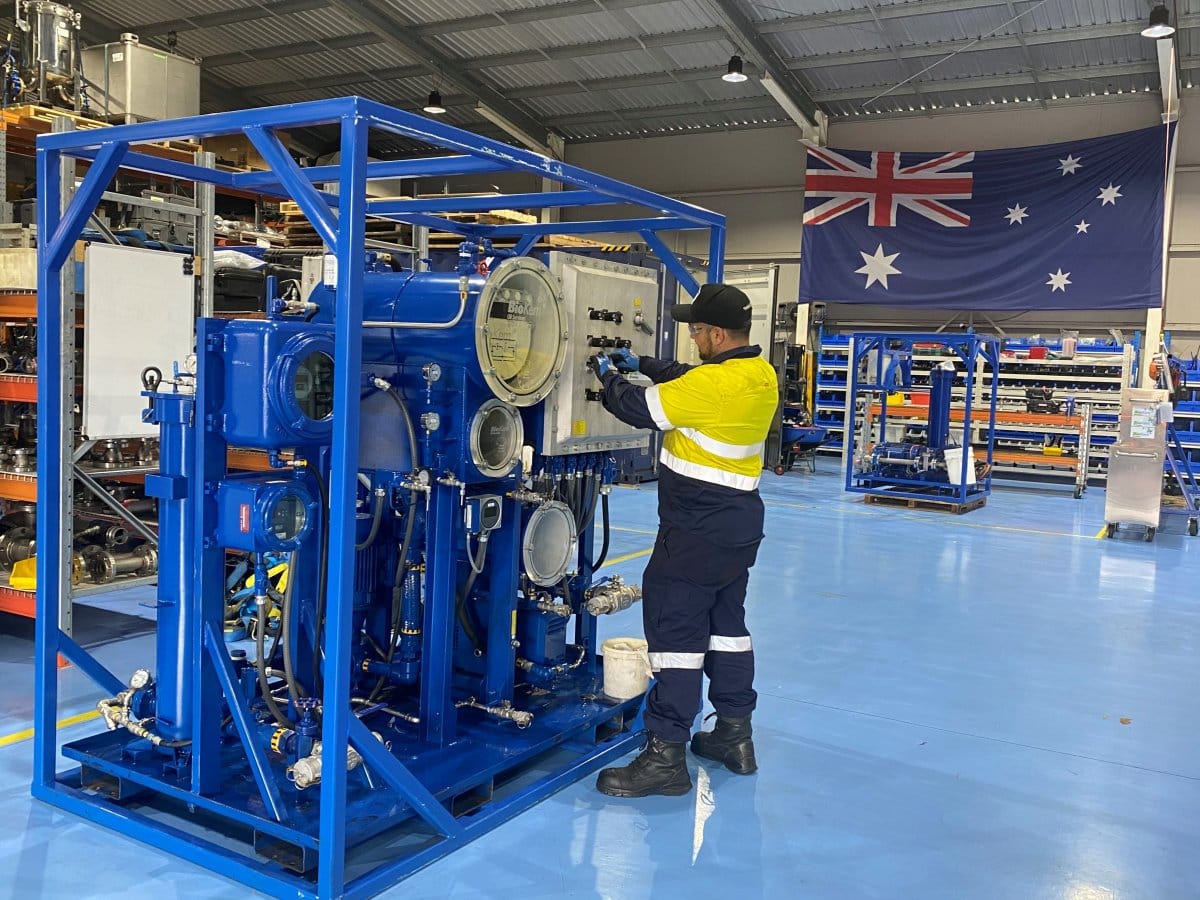
Did you know that traditional centrifugal systems often leave behind the most damaging form of contamination: dissolved water? As the Australian market for oil purification units reaches a projected AUD $35 million in 2026, industrial leaders are realizing that standard filtration isn’t enough to prevent catastrophic component failure. Utilizing a specialized vacuum dehydration oil purification service australia wide has become the gold standard for operators who can’t afford the high cost of oil replacement or the risk of unscheduled downtime. It’s the only reliable method to pull moisture, gases, and particulates out of solution without compromising the lubricant’s chemical integrity.
You’re likely facing the pressure of meeting strict ISO 4406 cleanliness standards while managing the rising costs of premium synthetic fluids. We understand that maintaining continuous operation is your priority, and you need a solution that works while your machinery stays online. This 2026 guide provides the technical expertise you need to master vacuum dehydration and achieve sub-saturation moisture levels. We’ll explore the latest AICIS regulatory shifts taking effect in September 2026, the impact of the January 2026 AMSA guidance updates, and how to leverage modern VDOPS technology to significantly extend the service life of your critical lubricants.
Key Takeaways
- Identify the three states of water in oil and why removing dissolved moisture is critical for preventing long-term internal corrosion and fluid degradation.
- Compare the technical mechanisms of centrifugal force versus vacuum mass transfer to determine which method delivers the fastest return to ISO 4406 standards.
- Explore how a tailored vacuum dehydration oil purification service australia wide addresses the unique humidity and dust challenges found in local heavy industry environments.
- Determine the optimal procurement strategy for your facility by weighing the benefits of long-term equipment hire against the rapid response of onsite specialist services.
- Leverage Gen 3 VDOPS technology features like live telemetry and remote control integration to maintain continuous, verifiable oil health without manual intervention.
Understanding Vacuum Dehydration and Its Role in Oil Purification
Vacuum dehydration is a sophisticated mass transfer process designed to extract water and gases from lubricating oils by manipulating thermodynamic properties. This method relies on creating a low-pressure environment, which significantly reduces the boiling point of water. By treating oil under a deep vacuum, moisture can be removed at temperatures as low as 50°C, ensuring the base oil and its additive packages remain thermally stable. Understanding Vacuum Dehydration is essential for modern asset management because traditional methods, like simple filtration or centrifugation, often fail to address the most destructive forms of moisture.
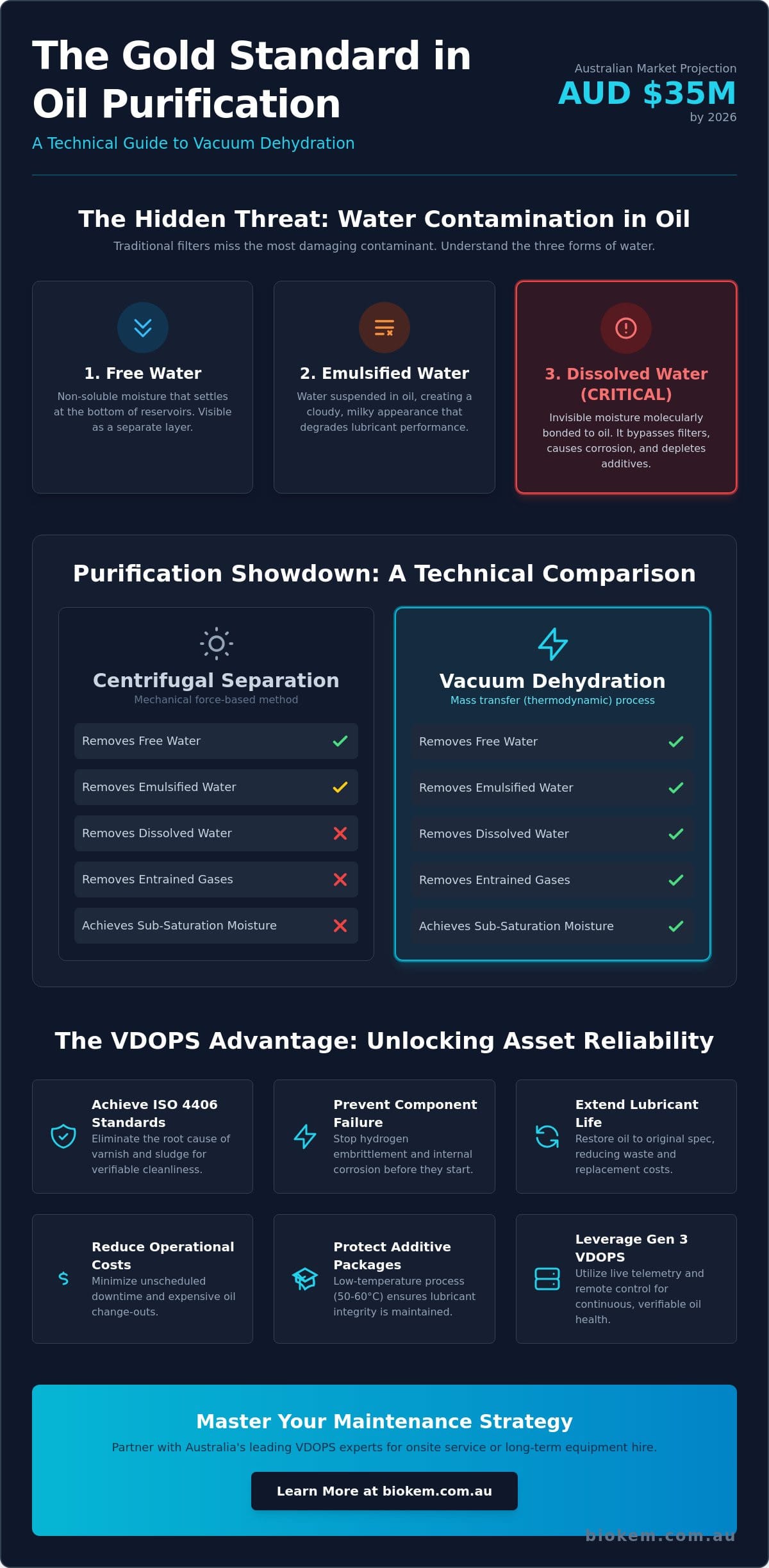
Water exists in oil in three distinct states:
- Free water: This is non-soluble moisture that settles at the bottom of tanks or reservoirs.
- Emulsified water: This occurs when water is mixed into the oil, creating a cloudy or milky appearance.
- Dissolved water: This is water chemically bonded to the oil at a molecular level, remaining invisible to the naked eye.
Dissolved water is the most insidious contaminant because it bypasses standard filters while accelerating oil oxidation and depleting essential anti-wear additives. It also causes hydrogen embrittlement on bearing surfaces, leading to micro-cracking and eventual component failure. Choosing a professional vacuum dehydration oil purification service australia wide allows operators to remove all three states of water before they cause permanent damage. This proactive approach offers a significant environmental advantage. By restoring oil to its original specification, businesses reduce their carbon footprint by avoiding the energy-intensive process of manufacturing new synthetic lubricants and the logistical burden of hazardous waste disposal.
To better understand this concept, watch this helpful video:
The Science of Vapor Pressure and Moisture Removal
The core of this technology is the relationship between pressure and vaporisation. In a standard atmosphere, water boils at 100°C, a temperature that would cause many industrial oils to oxidise and degrade. By reducing the internal pressure within a specialized flash chamber, we allow water to vaporise at 50-60°C. This flash chamber uses a high-surface-area medium to spread the oil into a thin film, maximizing the exposure to the vacuum and accelerating evaporation. Vacuum dehydration is the gold standard for achieving sub-saturation moisture levels in 2026, often reaching levels below 50 ppm.
Why ISO 4406 Cleanliness Codes Matter
Maintaining strict ISO 4406 cleanliness codes is impossible if water is present in the system. Moisture acts as a catalyst for chemical reactions that lead to the formation of varnish and sludge. These soft contaminants coat internal components, restrict flow through specialist oil filters, and trap hard particulates that score metal surfaces. When water is removed through the vacuum dehydration oil purification service australia based technicians provide, the underlying cause of this chain reaction is eliminated. This ensures that your system doesn’t just look clean on a report but remains functionally reliable under heavy load.
Vacuum Dehydration vs. Centrifugal Separation: A Technical Comparison
Choosing between mechanical separation and mass transfer is a critical decision for plant reliability. Centrifugal separators utilize high-speed rotation to force heavier contaminants, like free water and large particles, to the outer walls. While this is effective for bulk water removal, it’s limited by the laws of physics. Vacuum dehydration uses a thermodynamic approach. It creates a low-pressure environment where water and gases are vaporized and removed at a molecular level. This is why a professional vacuum dehydration oil purification service australia wide is superior for critical systems where even 100 ppm of moisture can lead to catastrophic failure.
A common industry myth suggests that centrifuges are always faster. While they process high volumes of free water rapidly, they cannot remove emulsified or dissolved moisture. Once the oil reaches its saturation point, the centrifuge stops being effective. In contrast, BioKem’s VDOPS technology continues to work until the oil reaches sub-saturation levels. It also removes entrained air and gases, which centrifuges ignore. Removing these gases prevents cavitation in pumps and reduces the rate of oil oxidation.
Efficiency in Removing Dissolved Contaminants
Centrifuges struggle as oil thickness increases. They often require the oil to be heated to dangerous levels to lower viscosity enough for separation to occur. Vacuum mass transfer handles high-viscosity gear and turbine oils with much higher efficiency. The biggest operational benefit is the ‘Kidney Loop’ configuration. This allows the purification unit to connect directly to your reservoir while the plant remains online. You don’t need to shut down production to achieve international fluid cleanliness standards. It’s a continuous process that maintains oil health without interrupting your workflow.
Protecting Additive Packages
High-speed centrifugal force can inadvertently strip out high-density additives like molybdenum or certain anti-foam agents. This compromises the lubricant’s performance and leaves your components vulnerable. Our approach is designed to be gentle. By using vacuum instead of extreme mechanical force, we preserve the chemical integrity of the fluid. To maintain this balance, we often integrate high-efficiency Filters S.p.A. products into the purification circuit. This ensures that only contaminants are removed, leaving the essential additive package intact. If you’re unsure which method fits your current oil condition, you can request a technical consultation with our engineering team.
Critical Applications for Oil Purification in Australian Heavy Industry
Australia’s environmental conditions are notoriously harsh for industrial lubricants. In northern tropical regions, seasonal humidity often exceeds 80%, leading to rapid moisture ingress in vented reservoirs through natural “breathing” cycles. Conversely, the arid mining regions of Western Australia and Queensland introduce fine silica dust that acts as a catalyst for oil oxidation. Utilizing a vacuum dehydration oil purification service australia wide is essential for protecting high-value assets like steam turbines and 5,000-tonne hydraulic presses. These machines require ultra-pure oil to function; even minor contamination can lead to millions in lost revenue from a single day of downtime.
A significant advantage of modern VDOPS technology is its ability to operate in a ‘Kidney Loop’ configuration. Unlike traditional methods that might require a system flush during a scheduled shutdown, vacuum dehydration integrates into the live lubrication circuit. This means purification occurs while the equipment remains fully operational. It eliminates the need for costly downtime and ensures the oil’s moisture content stays below the saturation point throughout the production cycle. This continuous processing is what differentiates high-tier maintenance from reactive, “break-fix” approaches that often fail to meet 2026 reliability targets.
Power Generation and Turbine Reliability
Turbine systems are highly sensitive to moisture and dissolved gases. Water in the lube oil doesn’t just cause rust; it promotes the formation of soft contaminants that lead to ‘stuck valves’ and governor instability. By removing hydrogen and other entrained gases, vacuum dehydration stabilizes the fluid’s bulk modulus and prevents cavitation. For a complete solution, this is often paired with varnish removal systems to address the chemical degradation products that water leaves behind. In the 2026 energy sector, maintaining EHC fluid health is vital for grid stability as power plants face more frequent cycling.
Mining and Mineral Processing
In remote Australian mining sites, the logistics of oil management are a significant operational burden. Transporting bulk oil to sites in the Pilbara can account for over 35% of the total lubricant cost when factoring in freight and storage. Onsite purification allows mines to extend the life of their hydraulic and gearbox oils indefinitely, effectively turning a consumable into a permanent asset. This reduces the need for frequent oil deliveries and the environmental risk of transporting waste oil back to coastal hubs. Operators often utilize paddle flushing screens alongside vacuum units to monitor particulate levels in real-time, ensuring that both moisture and solid contaminants stay within strict limits without removing the asset from service.
Strategic Maintenance: Choosing Between Equipment Hire and Onsite Services
Deciding how to access advanced purification technology depends on your facility’s operational maturity and the severity of the contamination. Equipment hire is the preferred route for routine maintenance schedules where internal teams are already familiar with fluid handling. It suits long-term projects where a unit can be integrated into a permanent kidney-loop setup to manage ongoing moisture ingress. Conversely, engaging a full vacuum dehydration oil purification service australia wide is the logical choice for resolving critical system failures or managing complex flushing requirements. This turnkey model shifts the technical responsibility to BioKem’s specialists, ensuring the project meets strict compliance targets without straining your internal resources.
BioKem’s rental fleet features ‘Gen 3’ telemetry, allowing for remote monitoring and real-time data logging of moisture levels and particle counts. This level of transparency is essential for 2026 industrial standards, providing a digital audit trail of the purification process. Because we maintain a national presence, we can deploy these units rapidly to any Australian site, reducing the impact of emergency downtime. These units are designed for harsh environments and include robust filtration stages to handle the high particulate loads often found in mining and power generation reservoirs.
When to Opt for Professional Technical Intervention
Certain scenarios demand more than just hardware. Post-overhaul commissioning or sudden, massive water ingress from a heat exchanger failure requires immediate, expert oversight. In these high-stakes situations, we often combine dehydration with hot oil flushing and filtering to remove both moisture and the physical debris generated during maintenance. BioKem technicians provide a formal ‘Certificate of Cleanliness’ upon completion. This document serves as verifiable proof that your lubricants meet the required specifications for warranty protection and insurance compliance.
Maximising Value from Equipment Rental
To ensure a seamless deployment of a rental unit, site preparation is essential. We recommend a simple checklist for your maintenance team:
- Confirming power supply availability, typically 415V/32A for larger units.
- Allocating a stable, level footprint near the reservoir to minimize suction lift.
- Mapping hose runs to reduce flow resistance and prevent trip hazards.
Our rental units come equipped with high-precision monitoring instruments that provide immediate feedback on purification progress. This allows your team to see the transition from emulsified oil to a clear, bright fluid in real-time. If you need to scale your internal capabilities for a specific project, you can explore our equipment hire options to secure the latest VDOPS technology for your site.
BioKem’s VDOPS Technology: The Gold Standard for Australian Asset Reliability
BioKem stands at the forefront of the Australian market, operating the nation’s largest and most technologically advanced fleet of vacuum dehydration units. In 2026, asset reliability is inextricably linked to data transparency and technical precision. Our Vacuum Dehydration Oil Purification System (VDOPS) technology addresses these requirements by providing a level of automation previously unseen in the region. A critical feature of this fleet is the integrated ‘Auto-Water Drain’ system. This mechanism allows for 24/7 unattended operation, which is vital for remote sites where the shortage of qualified field service engineers remains a significant industry challenge. By automating the discharge of collected moisture, the system maintains peak vacuum efficiency without the need for manual intervention. This innovation supports our firm commitment to Australian regulatory standards, including the rigorous AICIS Industrial Chemicals Categorisation Guidelines updated in September 2026.
Choosing a vacuum dehydration oil purification service australia wide through BioKem ensures that your lubricants are managed by equipment designed for the specific rigors of local heavy industry. Our systems are engineered to exceed international standards such as IEC 60422 for mineral insulating oils. This technical edge is not just about moisture removal. It’s about the ecological health of your plant. By extending the life of mineral and synthetic lubricants, we help facilities reduce their environmental footprint and avoid the legal complexities of hazardous waste disposal regulated by the 1989 Hazardous Waste Act.
Advanced Monitoring and Telemetry
Modern industrial operations require real-time visibility to manage risk effectively. Our ‘Gen 3’ VDOPS units feature live telemetry and remote control integration, allowing oil health data to stream directly to your central control room. We integrate high-precision particle counters and moisture-in-oil sensors directly into the VDOPS circuitry. This setup provides a continuous data loop that monitors the purification progress as it happens. Detailed data logging facilitates comprehensive predictive maintenance audits, giving engineers the verifiable evidence needed to justify extending oil drain intervals or to satisfy insurance compliance requirements.
Distributor Partnerships and Component Quality
The effectiveness of a purification system is only as good as its filtration components. BioKem maintains strategic partnerships with world-class manufacturers to ensure superior particulate removal. We utilize high-efficiency Filters S.p.A. products and Swift Filters to capture the fine silt and wear debris that standard filters miss. This ‘best of breed’ hardware approach leads to significantly faster processing times and a lower total cost of ownership for our clients. By combining American-manufactured VDOPS technology with European filtration expertise, we deliver a service that is unmatched in the Australian landscape. To secure your facility’s operational future, contact BioKem for a tailored oil purification strategy today.
Securing Asset Reliability Through Advanced Fluid Management
The transition to 2026 industrial standards demands a shift from reactive oil changes to proactive fluid restoration. You’ve learned that removing dissolved moisture and entrained gases is the only way to prevent hydrogen embrittlement and additive depletion in critical assets. By choosing a specialized vacuum dehydration oil purification service australia wide, you ensure that your lubricants remain a high-performance asset rather than a disposal liability. BioKem provides the technical infrastructure to make this possible; we operate Australia’s largest fleet of Gen 3 vacuum dehydrators and serve as the sole Australian distributor for Filters S.p.A. products.
Our expert technicians possess national deployment capabilities, ensuring that your site receives the highest level of technical oversight regardless of its location. It’s time to move beyond the limitations of centrifugal separation and embrace the precision of VDOPS technology. Request a quote for Vacuum Dehydration Services or Equipment Hire to protect your machinery and optimize your total cost of ownership. We look forward to helping you achieve a cleaner, more sustainable operational future.
Frequently Asked Questions
What is the difference between vacuum dehydration and centrifugation?
Centrifugation uses mechanical force to separate free water based on density differences between the oil and the water. Vacuum dehydration uses low pressure to vaporize moisture at temperatures as low as 50°C. While centrifuges handle bulk free water, they cannot touch dissolved water. Vacuum units provide a more comprehensive solution by removing free, emulsified, and dissolved moisture in a single pass.
Can vacuum dehydration remove dissolved water from oil?
Yes, vacuum dehydration is the only effective method for removing dissolved water below the oil’s saturation point. It works by creating a partial vacuum that lowers the boiling point of water. This allows the moisture to boil off as vapor without damaging the lubricant’s chemical structure or stripping essential additives. It’s the most reliable way to achieve sub-saturation levels below 50 ppm.
Does the oil purification process require a system shutdown?
No, a professional vacuum dehydration oil purification service australia wide typically utilizes a kidney loop configuration. This setup allows the equipment to draw oil from the reservoir, purify it, and return it while the plant remains fully operational. It eliminates the need for costly production stops and maintains continuous asset reliability throughout the purification cycle.
How long does it take to purify a typical 5,000-litre lube oil system?
A typical 5,000-litre system can usually be purified within 24 to 48 hours, depending on the initial moisture concentration. If the oil is heavily emulsified with over 5,000 ppm of water, the process may take longer to reach target levels. BioKem’s Gen 3 units use high-flow rates to accelerate this timeline compared to older technology versions used in previous decades.
What ISO cleanliness levels can be achieved with vacuum dehydration?
Vacuum dehydration consistently achieves ISO 4406 cleanliness levels as low as 14/12/9. By removing moisture, the system prevents the formation of soft contaminants like varnish that often trap hard particles. Integrating specialist oil filters into the vacuum circuit ensures that both water and particulate targets are met simultaneously to satisfy 2026 warranty requirements and insurance audits.
Is vacuum dehydration safe for all types of industrial oils and additives?
Yes, the process is safe for almost all industrial mineral and synthetic oils. Because the temperature is kept between 50°C and 60°C, there’s no risk of thermal degradation or additive shearing. This is a “green” alternative to oil replacement, as it restores the fluid’s original properties without the environmental cost of disposing of thousands of litres of hazardous waste oil.
What are the power requirements for an onsite vacuum dehydration unit?
Most mobile vacuum dehydration units in Australia require a 415V, 32A three-phase power supply to run the high-capacity vacuum pumps and heaters. Smaller units may operate on 240V, but these are generally less effective for large-scale industrial reservoirs. Site managers should ensure a stable power source is within 20 metres of the unit’s footprint to avoid voltage drops during operation.
How do I know if my oil requires vacuum dehydration or just standard filtration?
Standard filtration only removes solid particles and some free water. If your oil analysis reports moisture levels above the saturation point, which is typically 200 to 500 ppm for most industrial oils, you need a vacuum dehydration oil purification service australia based provider. Visual signs like cloudiness or a milky appearance indicate emulsified water that standard filters cannot capture.