

The assumption that new lubricant arriving in a sealed drum is “clean” is one of the most expensive misconceptions in modern maintenance. In reality, new oil often carries particulate loads that exceed the strict tolerances of advanced machinery, leading to the unexplained infant mortality failures of bearings and turbines. You’ve likely experienced the frustration of a voided OEM warranty or the logistical headache of trying to polish oil after it’s already contaminated your system. It’s an inefficient, reactive cycle that compromises asset longevity from day one.
Discover how end users benefit from BioKem Oil Services’ program for filtering & certifying new lubricants to be clean before delivery. By adhering to the latest ISO 4406:2021 standards before the fluid reaches your site, we guarantee a true “Zero-Hour” cleanliness state for your critical assets. This article outlines how pre-delivery certification simplifies compliance, protects equipment from microscopic particles smaller than 40 microns, and lowers your total cost of ownership through our technically authoritative and eco-friendly fluid management protocols.
Key Takeaways
- Understand why virgin lubricants often exceed ISO 4406 contamination limits and how this discrepancy impacts the reliability of your high-precision components.
- Discover how end users benefit from BioKem Oil Services’ program for filtering & certifying new lubricants to be clean before delivery to prevent premature failures during equipment commissioning.
- Identify the technical advantages of high-beta ratio filtration in achieving “Zero-Hour” cleanliness for critical bearings, pumps, and valves.
- Learn how to integrate pre-certified fluid standards into your procurement process to simplify OEM warranty compliance and reduce your total cost of ownership.
- Align your maintenance strategy with sustainability goals by utilizing certified clean oil to extend drain intervals and minimize your facility’s hydrocarbon footprint.
The Critical Myth of ‘New’ Oil Cleanliness
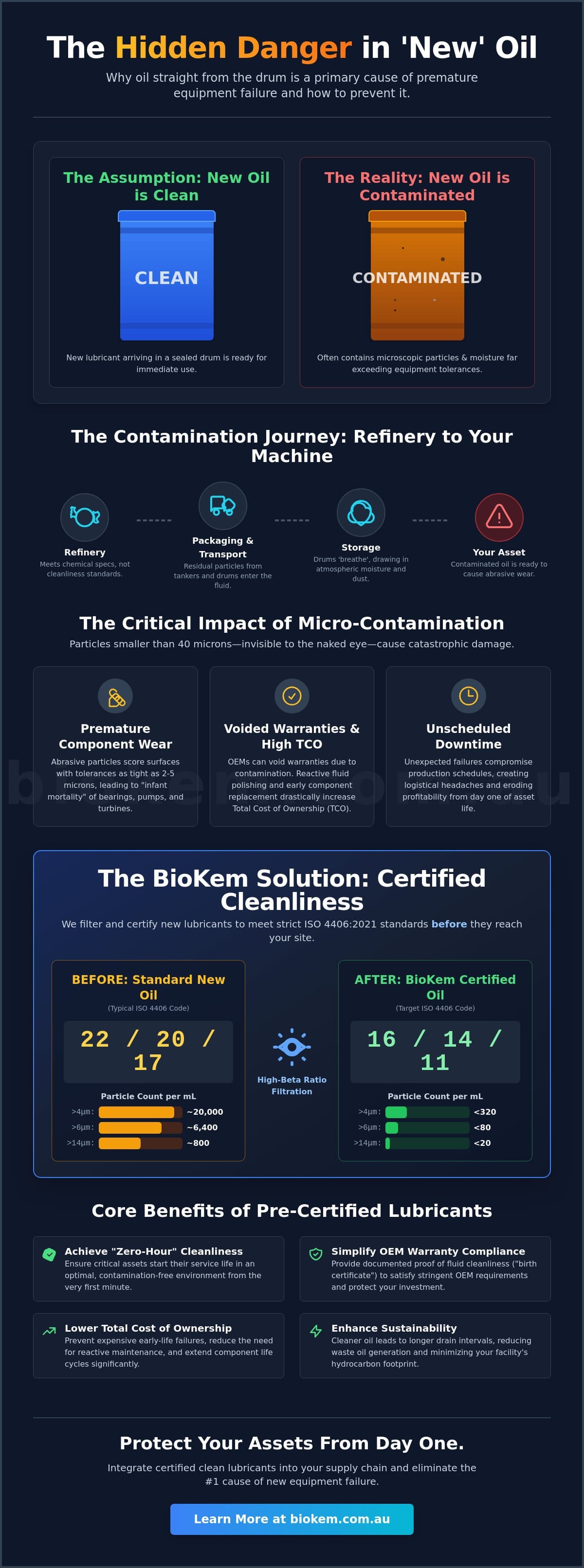
The belief that virgin lubricants are ready for immediate use in high-precision machinery is a dangerous fallacy. New oil contamination refers to the presence of microscopic particulates and moisture in lubricants that have never been used. While refineries produce lubricants that meet strict ASTM chemical specifications, these standards focus on viscosity and additive packages rather than particle counts. This creates a significant “cleanliness gap” between the refinery and your machinery sump. High-precision assets often require ISO 4406:2021 cleanliness levels that are several magnitudes cleaner than what is typically found in a standard delivery drum. Understanding The Critical Myth of ‘New’ Oil Cleanliness is the first step toward achieving “Zero-Hour” reliability, where every component starts its service life in an optimal environment.
To better understand the impact of starting with clean fluid, watch this helpful video:
This is precisely how end users benefit from BioKem Oil Services’ program for filtering & certifying new lubricants to be clean before delivery. By closing the gap between refinery output and operational requirements, we eliminate the primary cause of early-life failures. You can verify these cleanliness levels yourself using patch test kits to see the physical evidence of contamination that often bypasses standard intake inspections.
Why Industrial Lubricants Pick Up Contaminants
Lubricants are vulnerable from the moment they leave the blending kettle. Contamination occurs during the packaging process, where non-dedicated transport tankers or standard 205L drums introduce residual particulates. Even in storage, thermal cycling causes drums to “breathe” through their bungs. This draws in atmospheric moisture and fine dust. Over time, these contaminants settle or remain suspended, ready to enter your system and cause abrasive wear on surfaces with tolerances as tight as 2 to 5 microns.
The Australian Logistics Challenge
The geography of Australia adds a layer of risk to lubricant integrity. Long-distance transport across harsh environments, from the Pilbara to the Central Highlands, exposes bulk oil deliveries to extreme temperature swings and vibration. These conditions accelerate moisture ingression and the movement of settled particles. For remote mining and power sites, “off-the-shelf” oil rarely meets the technical demands of modern close-tolerance assets. Standard logistics chains aren’t designed for fluid hygiene; they’re designed for volume. This makes pre-delivery filtration a strategic necessity rather than a luxury for maintaining asset health in isolated regions.
BioKem’s Filtration & Certification Programme Explained
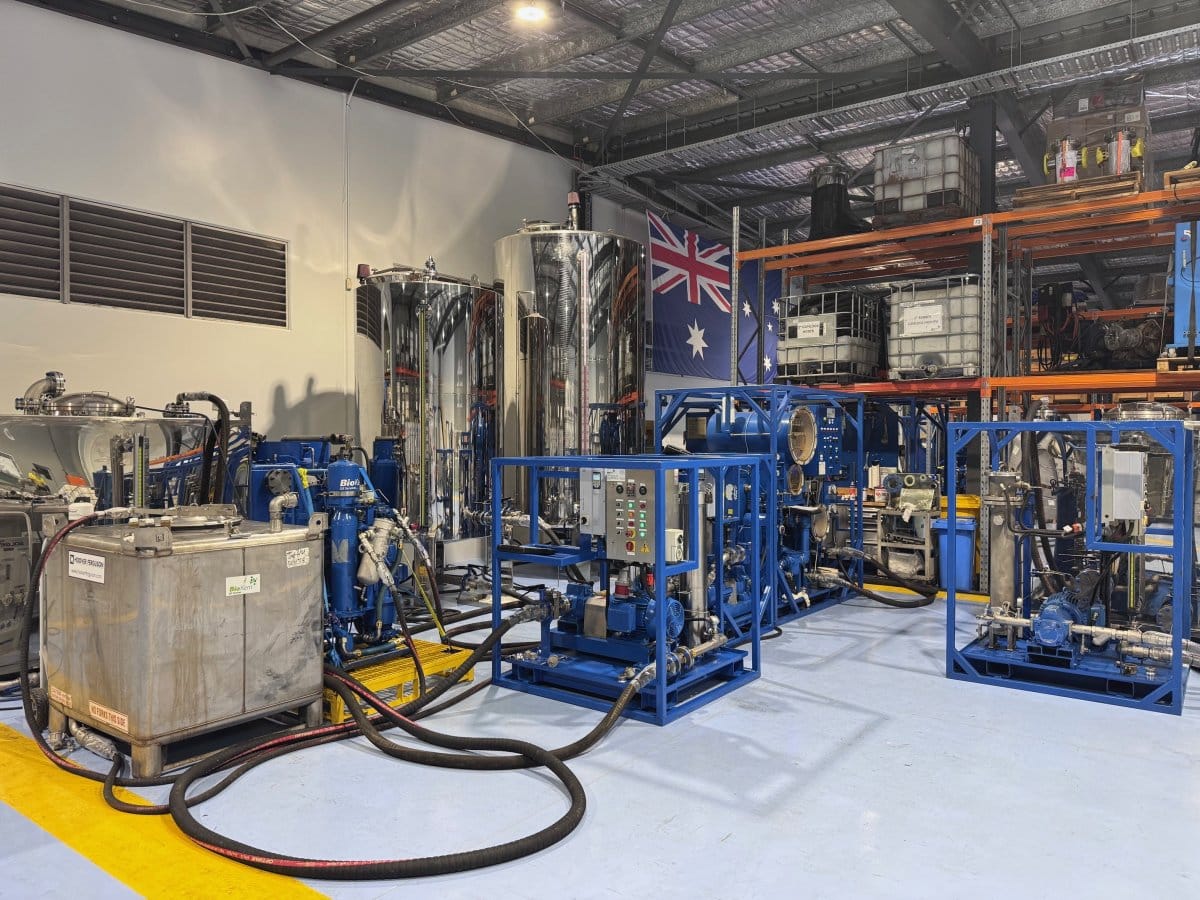
The transition from a standard lubricant delivery to a certified clean fluid system requires a rigorous, multi-stage technical intervention. BioKem’s Batch Filtration process occurs within a controlled environment at our specialized depot, where virgin oil undergoes high-efficiency polishing before it ever reaches your site. This methodology ensures that the fluid meets the specific requirements of modern, close-tolerance machinery. This meticulous preparation is exactly BioKem’s Filtration & Certification Programme Explained through the lens of international hygiene standards. By utilizing high-beta ratio filtration, we remove the microscopic threats that standard refinery processes often overlook, providing a verified baseline for asset reliability.
Every batch processed through our system receives a comprehensive certification document. We view this as a “birth certificate” for your oil, providing documented evidence of its cleanliness state at the point of dispatch. To provide immediate visual validation on-site, we utilize patch test kits. These kits allow maintenance teams to see the physical results of the filtration process, turning an invisible technical specification into a tangible quality assurance metric. This transparency is a core reason why end users benefit from BioKem Oil Services’ program for filtering & certifying new lubricants to be clean before delivery, as it eliminates the guesswork often associated with fluid procurement.
The Batch Filtration Mechanism
BioKem polishes virgin oil using dedicated, clean-room standard filtration equipment to exceed OEM requirements. Standard refinery filters are designed for high-volume throughput, which often leaves sub-micron particles suspended in the fluid. Our process targets these specific contaminants using multi-pass filtration cycles. By removing particles as small as 1 to 3 microns, we ensure the lubricant is compatible with the most sensitive hydraulic and turbine components. This technical precision prevents the abrasive wear that typically occurs during the first few hours of a new component’s life.
Verification and ISO 4406 Certification
The certification process involves a step-by-step laboratory analysis to confirm the fluid meets the ISO 4406:2021 standard. This international code uses a three-digit format to represent the number of particles sized at 4μm, 6μm, and 14μm per milliliter of fluid. Our technicians verify these counts using calibrated particle counters before issuing the final certificate. Once the target code is achieved, BioKem utilizes sealed, dedicated delivery vehicles to ensure the oil stays clean during transit. This closed-loop system maintains the integrity of the “Zero-Hour” state from our filter to your sump. If you’re looking to establish a robust baseline for your machinery, consider optimising your fluid health with our certified delivery programs.
Core Benefits: Why Pre-Certified Oil is a Strategic Asset
Deploying pre-certified lubricants is a strategic financial decision rather than a simple maintenance task. This proactive approach is exactly how end users benefit from BioKem Oil Services’ program for filtering & certifying new lubricants to be clean before delivery. By ensuring the oil meets target ISO codes before it enters the machine, you effectively eliminate the primary cause of “infant mortality” in new bearings and turbines. This is critical because, as the Society of Tribologists and Lubrication Engineers on contamination control highlights, abrasive particles often arrive from the manufacturer at no extra charge. Eliminating these particles at the source secures long-term asset reliability and protects your capital investment from day one.
One of the most immediate financial gains is the avoidance of onsite hot oil flushing. Polishing oil after it has already contaminated a 5,000-litre sump is remarkably more expensive than batch filtering it at the depot. By starting clean, you bypass the labour-intensive recovery processes that often delay commissioning by several days. Precision matters. Every hour saved during commissioning translates directly into production revenue, making pre-certified oil a form of performance insurance for critical assets.
Maximising Equipment Reliability and Longevity
Certified clean oil prevents the “chain reaction of wear” that begins the moment a system is first energized. When you introduce contaminated oil, the particles act as grinding media, creating more wear debris. This quickly overwhelms your system’s onboard filters. By starting with a “Zero-Hour” cleanliness state, you reduce the initial burden on your filtration hardware. This leads to a measurable increase in Mean Time Between Failures (MTBF) for high-speed turbines and compressors. It’s a logical progression. Cleaner oil equals less friction, which results in a longer service life for every internal component.
The Paper Trail: Warranty Protection and Compliance
BioKem’s certification provides a verifiable audit trail that protects your business during warranty disputes. Most OEMs now mandate specific fluid cleanliness levels to maintain coverage. If a component fails within its early service life, the “Certificate of Cleanliness” acts as your primary evidence that the failure wasn’t caused by poor fluid hygiene. This documentation shifts the liability back to the lubricant supply chain rather than your maintenance team. For heavy industry, where insurance and regulatory audits are frequent, having a digital record of cleanliness via the Particle Pal range of monitoring tools simplifies compliance. It transforms fluid management from a technical hurdle into a documented corporate asset.
Implementation: Integrating Certification into Your Supply Chain
Integrating fluid hygiene into your existing supply chain transforms lubricant procurement from a commodity purchase into a precision engineering service. This procedural shift is a primary way how end users benefit from BioKem Oil Services’ program for filtering & certifying new lubricants to be clean before delivery. To start, you’ll need to mandate “BioKem Certified” as a specific line item in your lubricant purchase orders. This ensures the oil supplier coordinates delivery directly to the BioKem depot for technical polishing rather than shipping unverified drums straight to your facility. You should only accept delivery on-site when the fluid is accompanied by a BioKem analysis report that matches your pre-defined cleanliness specifications.
Setting Your Target Cleanliness Levels
Every asset has a unique tolerance for contamination. High-pressure hydraulic and EHC systems require much lower particle counts than basic gearboxes. You should determine your target ISO 4406 codes based on these specific sensitivities. Consulting with BioKem experts allows you to define “clean” for your application, which prevents over-specifying for simple assets or under-protecting critical ones. For a detailed framework on setting these benchmarks, reference the Oil Contamination Control Guide for target setting.
The Logistics of Pre-Delivery Filtration
BioKem manages the “depot-to-site” chain of custody to prevent re-contamination. This involves ensuring all tankers are pre-cleaned and certified before loading the filtered lubricant. It’s a closed-loop system that eliminates risks associated with standard transport. At your site gate, your team can perform a final verification using patch test kits to confirm the oil remains within certified limits. This ensures that how end users benefit from BioKem Oil Services’ program for filtering & certifying new lubricants to be clean before delivery is fully realized. To streamline your facility’s fluid hygiene, you might consider implementing dedicated filtration systems for your bulk storage tanks.
The BioKem Advantage: Australian Expertise in Fluid Health
BioKem functions as a proactive technical partner rather than a simple service provider. This distinction is central to how end users benefit from BioKem Oil Services’ program for filtering & certifying new lubricants to be clean before delivery. We provide more than just filtration; we deliver a complete ecosystem of fluid health management. As the Australian distributor for Filters S.p.A., we provide local access to world-class hardware designed to meet the most stringent ISO 4406:2021 standards. This technical edge allows us to position Proactive Maintenance as the ultimate goal for every industrial site. In a global industrial lubricants market projected to reach USD 74.3 billion by 2029, the ability to secure asset reliability through superior fluid hygiene is a significant competitive advantage.
Technical Authority and Local Support
BioKem’s technical authority is rooted in a deep understanding of Australian regulatory and industrial standards. Our specialists recognize the unique challenges posed by local climates, where fine iron ore dust and extreme thermal cycles can compromise lubricants within hours of exposure. By utilizing Lube Oil Analysis, we close the loop on fluid management; we provide empirical data that validates the effectiveness of our pre-delivery certification. This regional expertise ensures that your assets remain compliant with both OEM requirements and local safety regulations. It’s another example of how end users benefit from BioKem Oil Services’ program for filtering & certifying new lubricants to be clean before delivery by having a partner who manages the technical details of fluid hygiene. We anchor our global scientific aspirations in a dependable, regional context, providing support that global generalist suppliers often lack in remote Australian operations.
Sustainability Through Fluid Life Extension
Starting with certified clean oil is a fundamental step toward industrial sustainability. When lubricants are introduced in a “Zero-Hour” state, they maintain their additive packages longer and experience less oxidative stress. This directly reduces the frequency of oil changes. Such an approach lowers both your procurement costs and your total hydrocarbon waste. A BioKem-certified lubrication programme minimizes the environmental impact of your operations by extending the service life of every litre of oil. This is especially relevant in the Asia Pacific region, which holds 34.1% of the global market share and faces increasing pressure for eco-friendly industrial practices. BioKem is committed to delivering nature-based, sustainable industrial solutions that prioritize long-term ecological health alongside operational excellence.
Securing Your Asset Future with Certified Fluid Hygiene
Shifting from reactive onsite polishing to proactive batch filtration is a fundamental requirement for any reliability-focused operation. You’ve seen that the “new oil” myth leads to avoidable infant mortality failures. Implementing a certified supply chain ensures your assets operate at peak efficiency from the first start. This process is exactly how end users benefit from BioKem Oil Services’ program for filtering & certifying new lubricants to be clean before delivery. It transforms oil procurement from a commodity purchase into a strategic asset protection plan.
As specialists in ISO 4406 compliance and verification with over 10 years of experience in Australian heavy industry, we provide the technical expertise required for high-stakes environments. Our position as the sole Australian distributor for Filters S.p.A. ensures your facility has access to the most advanced hardware available. We’re ready to help you lower your total cost of ownership while reducing your environmental footprint. Secure your asset reliability by requesting a BioKem Batch Certification quote today. Protecting your machinery and the environment starts with a single, data-driven decision.
Frequently Asked Questions
Is new oil from the refinery really not clean enough for my machines?
New oil from a refinery is rarely clean enough for modern, high-pressure machinery. Refineries focus on chemical properties like viscosity and additive balance rather than particulate counts. Standard new oil often arrives with an ISO 4406:2021 code of 21/19/16, which contains up to 20,000 particles larger than 4 microns per millilitre. This level of contamination is far too high for sensitive components with tolerances of 2 to 5 microns.
What exactly does a BioKem ‘Cleanliness Certificate’ include?
A BioKem Cleanliness Certificate provides a comprehensive technical audit of the fluid batch. It documents the batch identification, the specific ISO 4406:2021 particle counts at 4μm, 6μm, and 14μm, and the moisture content measured in parts per million (ppm). This document serves as a verified baseline for your asset’s fluid health and is essential for satisfying OEM warranty requirements during commissioning.
How much does it cost to filter and certify a batch of new lubricant?
The cost varies based on the total volume of fluid and the specific target ISO code required for your application. While we don’t publish flat rates due to the technical variables involved, the investment is a small fraction of the cost of a single bearing failure or a multi-day system flush. We recommend requesting a quote to see how these proactive services fit into your maintenance budget.
Can BioKem certify oil that is already stored in my on-site tanks?
Yes, we provide onsite filtration and certification for oil already in bulk storage. We utilize mobile high-efficiency filtration units to polish the oil until it reaches your target cleanliness levels. This service is a key part of how end users benefit from BioKem Oil Services’ program for filtering & certifying new lubricants to be clean before delivery, as it ensures your entire inventory meets strict hygiene standards.
Does the certification cover moisture content as well as particulate matter?
Moisture control is a fundamental component of our certification process. We use Karl Fischer titration to measure water content in parts per million (ppm) to ensure it stays below your specified saturation limits. This prevents the hydrogen embrittlement and additive dropout that occur when water contaminates industrial lubricants, especially in harsh Australian environments where thermal cycling is common.
How does pre-delivery filtration affect my OEM equipment warranty?
Pre-delivery filtration significantly strengthens your warranty position by providing empirical proof of fluid hygiene. Most major OEMs mandate specific cleanliness codes for their equipment to remain under warranty. Our certification acts as a legal “birth certificate” for the oil, confirming that you’ve met these standards before the fluid ever enters the machinery sump, which protects you during failure investigations.
What is the typical lead time for BioKem to filter and certify a bulk delivery?
Typical lead times for batch filtration and certification range from 24 to 72 hours. This duration depends on the initial contamination level of the virgin oil and the volume being processed. We coordinate closely with your lubricant suppliers to ensure that the “polishing” stage doesn’t delay your project timelines or commissioning schedules.
Which ISO 4406 code should I target for a high-pressure hydraulic system?
High-pressure hydraulic systems with sensitive servo-valves generally require a target code of ISO 16/14/11 or better. This ensures that the particle count is low enough to prevent abrasive wear on components with extremely tight tolerances. We help you determine the correct code by referencing the sensitivity of your specific pumps and valves to ensure maximum asset longevity.