

The Limits of Traditional Filtration in Fixed Plant Maintenance
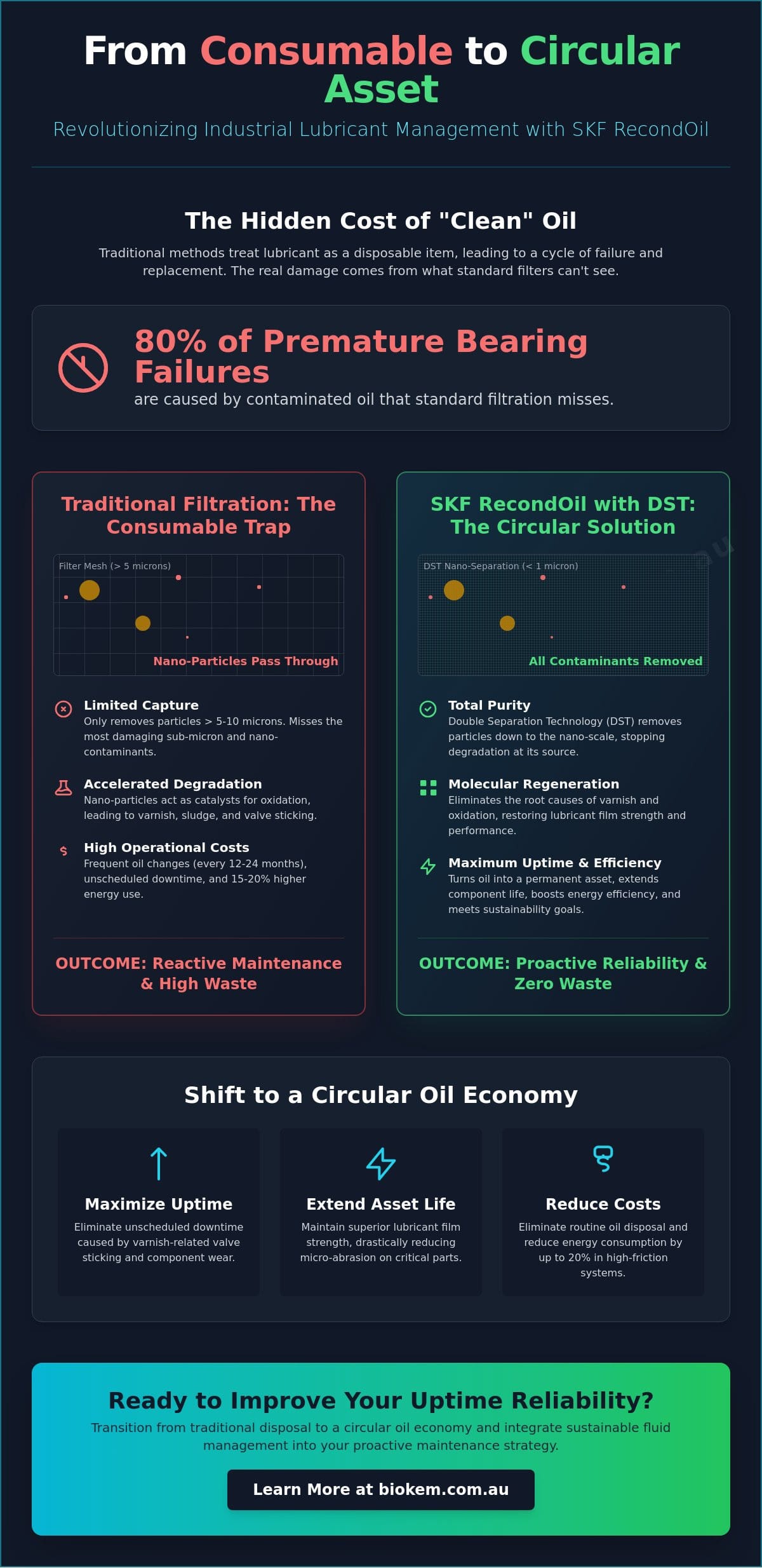
For decades, maintenance strategies for fixed plant assets have treated industrial oil as a consumable. The standard approach involves using conventional mechanical filters and performing scheduled oil changes. However, this model fails to address the root causes of lubricant degradation, leading to unforeseen costs and reliability issues.
- Why conventional mechanical filters fail: Standard filtration systems are effective at removing larger particles but are incapable of stopping the chemical processes of oil aging and oxidation. They cannot capture the sub-micron contaminants that act as catalysts for degradation.
- The “consumable oil” trap: Frequent oil changes introduce significant hidden costs, including the purchase of new oil, disposal of used oil, labour, and the associated production downtime. This reactive cycle treats the symptom, not the cause of contamination.
- How sub-micron contaminants cause wear: Particles smaller than one micron can easily bypass standard filtration. These nano-scale contaminants embed themselves in component surfaces, compromising film strength and accelerating abrasive wear in critical systems.
- Preparing systems for advanced reconditioning: Before implementing a reconditioning system, it is often essential to perform a thorough system clean. Services like hot oil flushing are critical for removing legacy contamination and ensuring the new technology can perform optimally from day one.
The Problem with Sub-Micron Contamination
The most significant threat to lubricant health and equipment reliability comes from contaminants too small to be seen. These particles are often missed by standard ISO 4406 tests, yet they are the primary drivers of oil failure.
According to centrifugal water-oil separator, this is a well-documented area of ongoing research and practical application.
- Defining “invisible” particles: Sub-micron or nano-particles (less than 1 micron) include soot, sludge precursors, and oxidation by-products. While standard analysis focuses on particles larger than 4, 6, and 14 microns, these smaller agents do the most damage.
- Catalysts for oxidation: Nano-particles provide a vast surface area that acts as a catalyst, dramatically accelerating the oil’s oxidation rate. This process leads to the formation of varnish, sludge, and corrosive acids.
- Impact on high-tolerance components: In high-precision systems like turbines and hydraulic controls, contaminants like silt and soot can clog fine tolerances, leading to sluggish performance and component failure.
Fixed Plant Vulnerabilities
Large-scale fixed plant assets, common in Australian mining, power generation, and manufacturing sectors, are uniquely vulnerable to the effects of oil degradation. The sheer volume of oil and the critical nature of the equipment demand a more advanced approach to fluid maintenance.
- Risks for turbines and compressors: In large-scale turbines and compressors, stable lubricant chemistry is paramount. Oil degradation can lead to bearing damage, overheating, and catastrophic, unscheduled shutdowns.
- The link to hydraulic valve sticking: Varnish, a direct result of oil oxidation, is a primary cause of hydraulic valve sticking. This can cause control system failures, turbine trips, and significant production losses.
- A necessary shift in philosophy: Proactive maintenance requires moving beyond simple filtration. It demands a new philosophy that treats oil as a long-term asset, focusing on preserving its chemical and physical properties indefinitely.
Understanding SKF RecondOil and Double Separation Technology (DST)
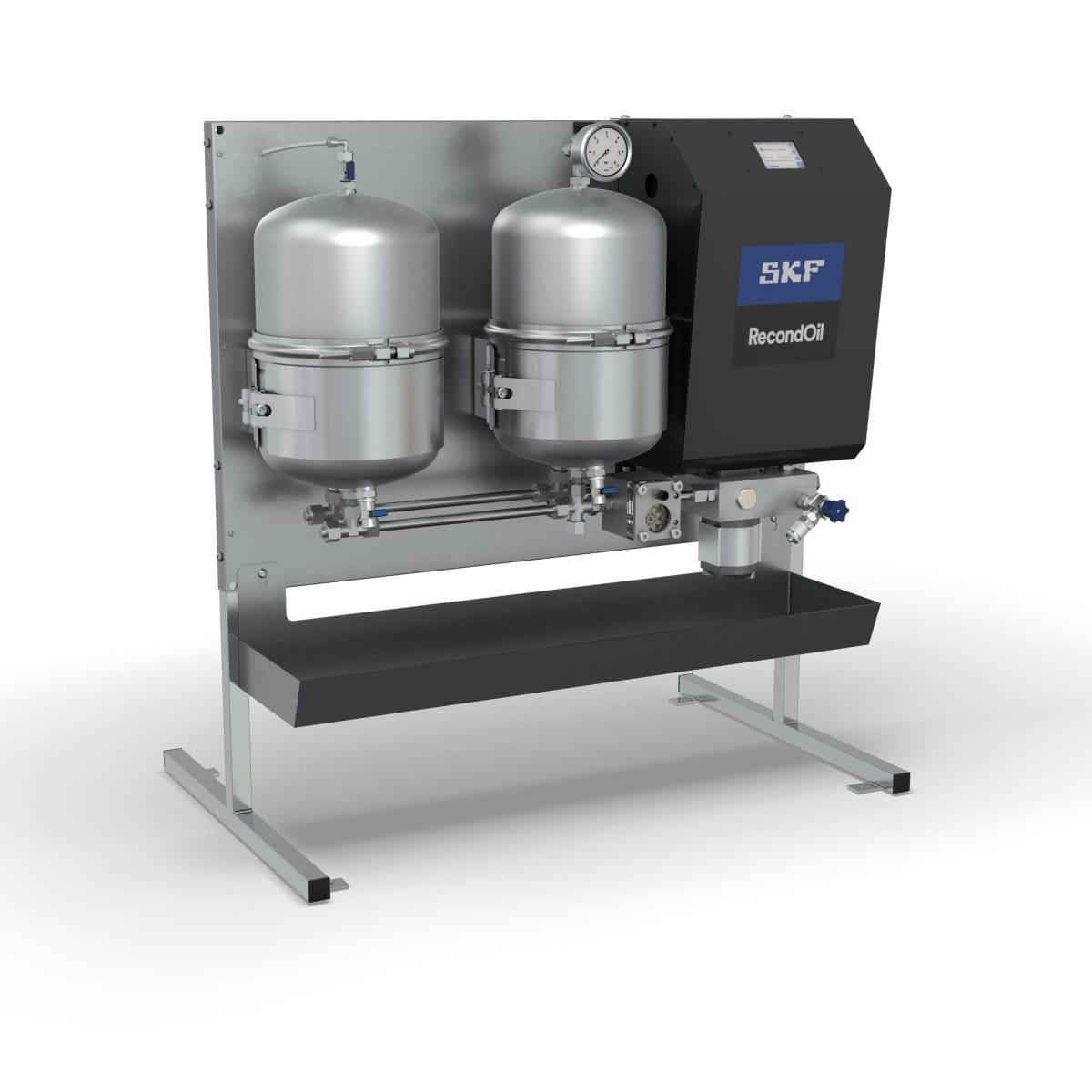
SKF RecondOil is not just another filter; it is a circular recovery system designed to stop oil degradation at its source. By continuously removing the nano-scale contaminants that traditional filters miss, it transforms oil from a consumable into a permanent asset. The core of this system is SKF’s patented Double Separation Technology (DST).
- A circular recovery system: RecondOil enables a true circular economy for industrial lubricants, eliminating the need for oil changes and drastically reducing waste, transport, and disposal requirements.
- Beyond bypass filtration: Unlike standard bypass or kidney-loop filters that only remove particles, DST uses a sophisticated process to remove the full spectrum of contaminants, including oxidation products and water.
- A chemical-mechanical process: DST combines mechanical separation with a unique chemical process to attract and remove contaminants down to the nano-level, something impossible to achieve with filtration media alone.
- Double Separation Technology (DST) is a system that removes particles <1 micron via adsorption.
How Double Separation Technology Works
DST operates in a two-stage process that targets the full range of contaminants, from larger particles down to the soluble oxidation by-products that cause varnish.
Research published by circular economy for lubricants shows that this is a well-documented area of ongoing research and practical application.
- Stage 1: Mechanical separation of larger particulate matter. In the first stage, the system removes larger particles and free water. It is important to note that this process does not affect the oil’s additive package. Additives are dissolved within the oil on a molecular level and are not physical particulates, meaning they cannot be inadvertently removed by this separation process.
- Stage 2: Chemical separation using specialised additives. A specialised chemical additive (a “booster”) is introduced, which causes the nano-scale impurities and soluble contaminants to agglomerate. These larger, newly formed clusters are then captured and removed by the system.
- The result: Oil that remains in “as new” condition indefinitely. By continuously removing the catalysts of degradation, DST keeps the oil chemically stable and physically clean, maintaining its original performance characteristics for years.
Removing the Root Causes of Oxidation
The true value of DST lies in its ability to halt the chemical aging of oil, preventing the formation of harmful by-products like varnish and sludge before they can impact the machinery.
- Halting varnish formation: By removing the soluble oxidation catalysts, DST prevents the chain reaction that leads to varnish. The oil remains clean, and critical components like valves and bearings are protected.
- Maintaining chemical stability: The system ensures the oil’s key chemical properties, such as acid number (AN) and oxidative stability, remain within specification, preserving the integrity of the lubricant and the equipment it protects.
- Real-world results on oil longevity: Case studies from various industries have demonstrated that oil processed by a RecondOil system can be kept in service for years beyond its expected life, with analysis consistently showing it to be in “as new” condition.
How RecondOil Directly Improves Uptime and Reliability
By transforming oil into a clean, stable, and permanent asset, the SKF RecondOil system delivers tangible improvements in fixed plant reliability and uptime. The connection is direct: cleaner oil leads to more reliable machinery.
- Eliminating unscheduled downtime: A significant portion of unscheduled downtime is caused by lubricant-related failures, such as stuck valves, blocked filters, and bearing wear. RecondOil mitigates these risks at their source.
- Reducing mechanical wear: Ultra-clean oil maintains superior film strength, providing better protection between moving parts. This directly reduces component wear and extends the operational life of critical assets.
- Improving component reliability: With varnish and sludge eliminated, critical components like hydraulic valves, actuators, and servo controls operate with greater precision and reliability, reducing process deviations.
- Long-term asset life extension: By creating an optimal lubrication environment free from harmful contaminants, RecondOil contributes to the long-term health and extended life of the entire fixed plant asset.
Varnish Mitigation and Valve Reliability
Varnish is one of the most persistent challenges in modern industrial lubrication. RecondOil offers a definitive solution by preventing its formation, directly enhancing the reliability of hydraulic and turbine control systems.
- Preventing the “varnish cycle”: The system breaks the cycle of oxidation, catalyst formation, and varnish deposition. By keeping the oil pristine, varnish has no opportunity to form and accumulate on internal surfaces.
- Reducing turbine trips and system sluggishness: Clean, varnish-free oil ensures that control valves in turbines and large hydraulic systems respond instantly and accurately, eliminating the sluggishness and sticking that can lead to costly trips.
- For systems with existing contamination, RecondOil can be complemented by BioKem’s dedicated varnish removal system to restore system cleanliness before long-term reconditioning begins.
Predictable Maintenance Intervals
Implementing a RecondOil system allows maintenance teams to move from a reactive to a truly proactive and predictable maintenance model.
- From reactive changes to scheduled health checks: The focus shifts from scheduling costly oil changes to conducting simple, periodic checks of the RecondOil system and routine oil analysis to confirm lubricant health.
- Simplifying oil analysis interpretation: With nano-scale “noise” and degradation products removed, oil analysis reports become much clearer and more effective for trend analysis and early fault detection.
- Improving MTBF: There is a direct, proven correlation between ISO cleanliness levels and Mean Time Between Failures (MTBF). By maintaining oil in an ultra-clean state, RecondOil significantly extends the MTBF for lubricated components.
Strategic Implementation: Transitioning to a Circular Oil Economy
Adopting SKF RecondOil is more than a maintenance upgrade; it is a strategic decision that delivers powerful environmental and economic advantages. It marks a fundamental shift away from the linear consumption of lubricants to a sustainable, circular model.
- The benefits of never changing your oil: The economic case is compelling, with ROI driven by the elimination of new oil purchases, waste oil disposal fees, and associated labour and downtime costs.
- Integration into proactive maintenance: RecondOil becomes a cornerstone of a proactive maintenance strategy, turning lubrication management from a cost centre into a driver of reliability and efficiency.
- Reducing the carbon footprint: By eliminating the need to transport, refine, and dispose of vast quantities of oil, organisations can significantly reduce the carbon footprint of their fixed plant operations.
- Calculating the ROI: A complete return on investment calculation must factor in the direct savings on oil and disposal, as well as the significant financial benefits of increased production uptime and extended asset life.
Sustainability as an Operational Advantage
In today’s business climate, sustainability is a key performance indicator. RecondOil provides a practical way to achieve environmental goals while simultaneously improving operational performance.
- Meeting Australian ESG requirements: Reducing hydrocarbon waste and consumption helps organisations meet their Environmental, Social, and Governance (ESG) targets and strengthens their corporate reputation.
- From “buy-use-dispose” to circular management: This technology facilitates a genuine shift from a linear economic model to a circular one, where a critical resource is preserved and reused indefinitely.
- Supporting ISO 14001 compliance: The reduction in waste generation and resource consumption directly supports the objectives of an ISO 14001 environmental management system.
Fixed Plant Integration Steps
Successfully integrating a RecondOil system into a fixed plant environment involves a structured approach to ensure seamless operation and maximum benefit.
- Evaluating system compatibility: The first step is a technical assessment to determine the correct system size based on oil volume, type, and operational parameters like flow rate requirements.
- Onsite vs. offsite reconditioning: Depending on the asset and operational constraints, RecondOil can be permanently installed for continuous reconditioning or used as a mobile service during planned shutdowns.
- Monitoring the transition: In the first 1000 hours of operation, regular oil analysis is used to monitor the rapid improvement in oil cleanliness and chemical stability as the system cleans the oil and the internal machinery.
Optimising Your SKF RecondOil Deployment with BioKem
While SKF RecondOil provides the technology, successful implementation requires specialised expertise in fluid management and industrial applications. BioKem provides the technical partnership needed to maximise the reliability and financial returns of your investment.
- Technical site assessment and system sizing: BioKem’s experts conduct thorough site assessments to ensure the selected RecondOil system is perfectly matched to your fixed plant’s specific requirements.
- Combining with advanced fluid management: We integrate RecondOil into a holistic fluid management program, ensuring all aspects of your lubrication practices are aligned with world-class reliability standards.
- Onsite support for installation and commissioning: Our national team provides hands-on support for the installation and commissioning of RecondOil systems on fixed plant across Australia.
- Ongoing monitoring and analysis: We provide the crucial ongoing support, including particle monitoring and detailed chemical analysis, to verify system performance and document the improvements in asset health.
Technical Support and Expertise
BioKem’s deep experience in industrial lubrication provides the foundation for a successful RecondOil deployment, from initial consultation to long-term performance management.
- Australian industry experience: With extensive experience providing oil filtration systems to major industrial sectors across Australia, we understand the unique challenges of your operating environment.
- Customised maintenance plans: We develop tailored maintenance and monitoring plans to ensure your RecondOil system continues to deliver peak performance and protect your assets.
- Team training and awareness: We can train your maintenance teams on the principles of sub-micron cleanliness and how to interpret oil analysis data in the context of a reconditioned system.
Next Steps for Plant Reliability
Transitioning to a circular oil economy is the next frontier in improving uptime reliability. The first step is to understand the current state of your lubricant and system health.
- Request a site audit: Contact BioKem to schedule a technical site audit, where our specialists will assess your application and determine the suitability and potential ROI of a RecondOil system.
- Establish a baseline: Use simple tools like our patch test kits to get a quick visual baseline of your current oil health and contamination levels.
- Contact BioKem for a technical consultation to explore how SKF RecondOil can be integrated into your reliability strategy.