

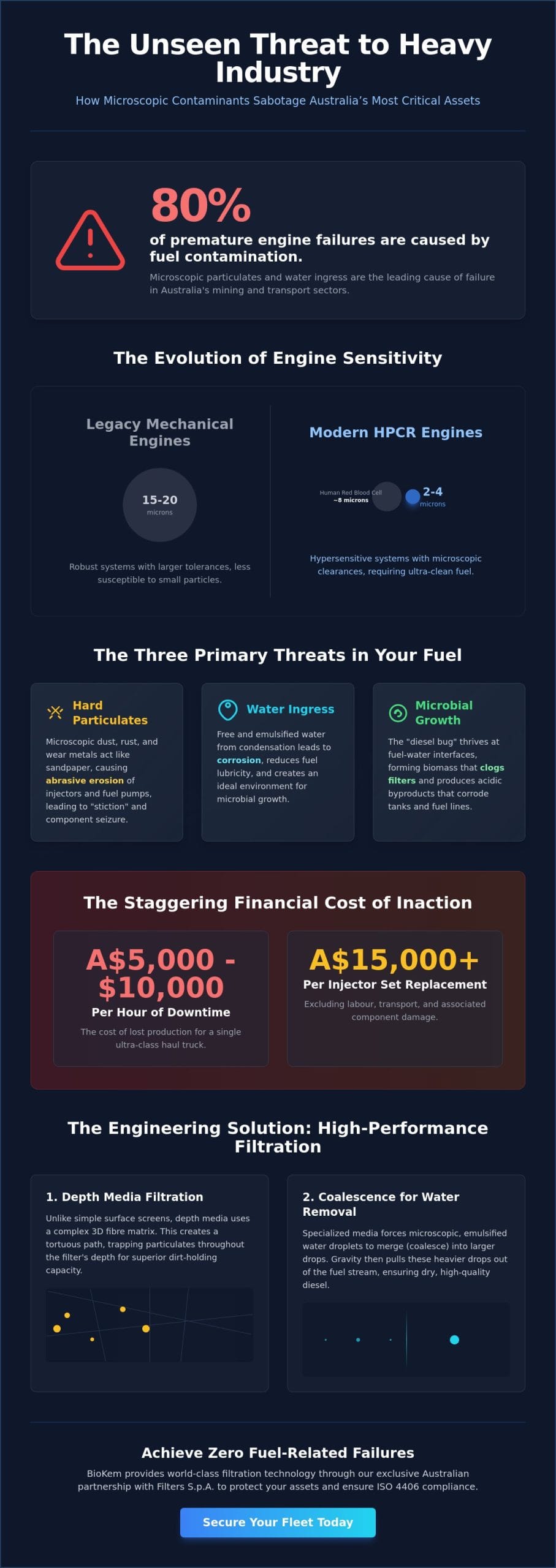
Did you know that 80% of premature engine failures in Australia’s mining and transport sectors are traced back to microscopic particulates and water ingress? It’s a staggering figure that highlights a critical vulnerability in bulk storage and mobile equipment. You likely already recognise that modern high-pressure common rail engines are increasingly sensitive to even minor deviations in hydrocarbon quality. Effective fuel filtration is no longer a routine maintenance task; it’s a strategic necessity for operational continuity in harsh environments from the Pilbara to the Bowen Basin.
We’ll show you how to master the technical requirements of fluid management to achieve zero fuel-related failures and maintain strict compliance with ISO 4406 standards. By implementing a robust, scientifically backed approach to contamination control, you’ll extend component life and reduce the environmental waste associated with premature part disposal. This guide explores the engineering precision and strategic oversight required to transform your fuel systems into a reliable foundation for asset longevity.
Key Takeaways
- Understand why modern High-Pressure Common Rail (HPCR) engines demand unprecedented cleanliness to prevent costly component failure and operational downtime.
- Learn the technical physics behind effective fuel filtration, specifically how depth media and coalescence work together to eliminate both particulates and emulsified water.
- Discover strategic methods for maintaining bulk fuel hygiene in large-scale Australian storage farms, mitigating the risks of condensation and microbial growth.
- Implement a proactive quality strategy by using ISO 4406 analysis to establish baseline cleanliness across your most critical heavy assets.
- Gain access to world-class filtration technology through BioKem’s exclusive Australian partnership with Filters S.p.A., ensuring compliance with local industrial standards.
Understanding the Critical Role of Industrial Fuel Filtration
Industrial fuel filtration is the process of removing solid particulates, water, and microbial growth from bulk fuel supplies to ensure they meet the stringent cleanliness standards required by modern machinery. In Australia’s demanding mining and heavy industrial sectors, fuel quality isn’t just a maintenance concern; it’s a prerequisite for operational survival. High-volume operations often process millions of litres of diesel annually, where even a minor percentage of contamination can lead to systemic asset failure. A high-quality fuel filter serves as the primary barrier against the abrasive contaminants that compromise engine integrity.
To better understand the mechanics of fluid purification in high-stakes environments, watch this helpful video:
The transition to High-Pressure Common Rail (HPCR) technology has redefined fuel filtration requirements. These engines operate at pressures exceeding 30,000 psi, making them hypersensitive to three primary threats: hard particulates, free water, and the “diesel bug” (microbial growth). Particulates cause physical erosion, while water triggers corrosion and reduces the fuel’s lubricity. Microbial colonies, often thriving at the fuel-water interface in storage tanks, can rapidly clog filters and produce acidic byproducts that eat through metal components. Maintaining fuel hygiene is the only way to prevent catastrophic injector failure and ensure long-term asset reliability.
The Evolution of Engine Tolerances
Legacy mechanical injection systems were robust and often tolerated particles up to 15 or 20 microns. In contrast, modern electronic HPCR systems feature clearances as tight as 2 to 4 microns. To put this in perspective, a human red blood cell is approximately 8 microns wide. When microscopic particles enter these tight spaces, they cause “stiction,” where valves become sluggish or seize entirely. This degradation directly impacts Australian ADR 80/03 emissions compliance and can reduce fuel economy by as much as 5%. Utilising specialised equipment from an Australian distributor for Filters S.p.A. allows operators to capture these microscopic threats before they reach the combustion chamber.
The True Cost of Fuel Contamination
The financial impact of poor fuel quality extends far beyond the price of a replacement element. In a typical Australian open-pit mine, the downtime for a single ultra-class haul truck can cost between A$5,000 and A$10,000 per hour in lost production. Replacing a full set of HPCR injectors can easily exceed A$15,000 in parts alone, excluding labour and transport. Water ingress further complicates this by facilitating the growth of Hormoconis resinae, which degrades fuel chemistry and leads to rapid tank corrosion. Total Cost of Ownership in relation to fuel system health is the sum of filtration hardware investment, fuel efficiency gains, and the mitigation of the extreme financial risks associated with unplanned mechanical downtime.
Technical Mechanics: How High-Performance Filtration Works
High-performance fuel filtration relies on the physics of fluid dynamics and contaminant capture to protect modern High-Pressure Common Rail (HPCR) systems. It’s not just about blocking particles; it’s about managing the flow to ensure every drop of diesel meets stringent cleanliness standards. Industrial systems typically use two types of media: surface and depth. Surface media acts like a screen, trapping particles on a single plane. In contrast, depth media utilizes a complex 3D matrix of fibres. This structure creates a tortuous path for the fuel, trapping contaminants throughout the entire thickness of the material. This significantly increases the dirt-holding capacity, which is vital for Australian mining and transport sectors where dust ingress is a constant threat.
Water removal is the second pillar of mechanical filtration. Diesel often contains free water and emulsified water, both of which cause corrosion and microbial growth. Effective systems employ coalescence. This process uses specialized media to slow down the fuel flow, allowing tiny, microscopic water droplets to collide and merge into larger drops. Because water is denser than diesel, these larger droplets sink to the bottom of the filter housing for safe drainage. Maintaining fuel integrity requires strict adherence to OSHA fuel handling and storage standards to mitigate the risks of microbial growth and particulate ingress during bulk transfers.
Critical assets must utilize a multi-stage approach. A primary filter, usually rated at 10 to 25 microns, serves as the first line of defence by removing large debris and bulk water. The secondary filter then targets the fine silt and remaining moisture. Skipping the primary stage leads to rapid clogging of the fine media, while omitting the secondary stage allows abrasive particles to reach the injectors, leading to premature component failure.
Micron Ratings and Beta Ratios
In industrial settings, a nominal micron rating is often misleading. A 10-micron nominal filter might only capture 50% of particles at that size. For critical reliability, you must look for absolute ratings, which imply an efficiency of 98.7% or higher. This efficiency is expressed through the Beta Ratio.
A Beta Ratio of 1000 (represented as β10=1000) indicates that for every 1,000 particles of 10 microns or larger that enter the filter, only one passes through. This equates to 99.9% efficiency. When selecting media, your goal is to achieve specific ISO 4406 cleanliness targets, such as 18/16/13, which are often required by engine manufacturers to maintain warranty compliance. Using a lower-rated filter might save a few dollars initially, but it increases the risk of a A$50,000 injector replacement down the track.
Advanced Separation Technologies
For bulk fuel management, coalescing filters provide an essential barrier against water contamination in large storage tanks. These systems are designed to handle high flow rates without sacrificing the delicate process of water separation. In applications where fuel is heavily contaminated with heavy solids, centrifugal separation is often used before media-based filtration. Centrifuges use G-force to sling heavy contaminants to the outer wall of a bowl, significantly extending the life of downstream filters.
In mining or offshore operations, specialist oil filters engineered for extreme pressure and temperature are required. These specialized components ensure that even in the harshest environments, the fluid remains within its designated cleanliness window. To accurately assess your current fluid health and determine if your filtration is performing to these technical standards, you can monitor your systems in real-time with an advanced particle counter.
Bulk Fuel Management and Storage Hygiene
Maintaining high-volume fuel stores requires more than a secure tank. In Australia, ambient temperature swings of 20°C or more between day and night create a “lung” effect. This breathing pulls humid air into the headspace, where it condenses into free water. Once water settles at the bottom, it creates a breeding ground for microbial contamination, often called “diesel bug.” This sludge accelerates corrosion and blocks fuel filtration systems downstream. It’s a silent killer of asset reliability that begins long before the fuel reaches the engine.
Regular industrial tank cleaning is essential to remove these accumulated layers of scale and bio-sludge. Without it, even high-performance filters will reach saturation prematurely. For continuous protection, kidney-loop systems circulate fuel through high-efficiency media. These systems ensure the bulk supply remains at or below ISO 18/16/13 cleanliness standards, acting as a constant dialysis for your fuel farm.
Tank Breathing and Contamination Entry
Desiccant breathers are the first line of defense against atmospheric ingress. They use silica gel to strip moisture and fine particulate filters to stop dust down to 3 microns. Without them, moisture leads to “dead bottoms,” which are areas of stagnant water where bacteria thrive on the hydrocarbon interface. Asset managers should use patch test kits to monitor for these invisible threats before they migrate into the supply line.
Use this checklist for monthly storage inspections:
- Verify breather desiccant color; replace it if it has turned pink.
- Test for free water using water-finding paste at the lowest tank point.
- Inspect manway gaskets for dry rot or cracking.
- Check pump seals for weeping, which indicates potential air or dust ingress.
Point-of-Use vs. Bulk Filtration
Mining operations often debate whether to filter at the fuel farm or on the machine. The “clean-to-clean” strategy argues that fuel should be purified at every transfer point. This approach is more efficient because bulk filters have a much higher dirt-holding capacity than small, expensive on-engine filters. It’s about protecting the most sensitive components by removing the bulk of the load earlier in the chain.
A 2022 study by the Machinery Failure Prevention Technology (MFPT) society suggests that maintaining fuel at ISO 14/12/11 can increase the life of fuel system components by 400% compared to standard delivery levels. By delivering clean fuel to the machine, operators reduce the risk of unexpected downtime in remote locations where a single injector failure can cost upwards of A$5,000 in parts and lost production. Implementing robust fuel filtration at the bulk level is the only way to achieve these efficiency gains reliably.
Designing a Proactive Fuel Quality Strategy
Transitioning from reactive repairs to a proactive fuel quality strategy requires a structured framework that prioritises prevention over correction. This approach ensures that fuel filtration isn’t just a peripheral task but a core driver of asset uptime. The process begins with a comprehensive fuel audit. By establishing a baseline using ISO 4406 particle counts, operators can quantify the current contamination levels within their storage infrastructure. This data informs the second step: categorising critical “at-risk” assets. High-pressure common rail engines, for example, often require cleanliness levels as stringent as 18/16/13 to prevent injector erosion and premature failure.
Effective implementation involves three subsequent tactical actions:
- Multi-stage filtration: Install high-efficiency filters at both the bulk storage inlet and the point-of-dispense. This prevents “dirty” deliveries from entering the system and catches environmental ingress before it reaches the vehicle tank.
- Scheduled Analysis: Move beyond visual checks. Establish a rigorous laboratory sampling schedule to track chemical degradation and microbial growth.
- Continuous Optimisation: Review filter change-out frequencies and component wear data every six months to refine the system’s efficiency.
Sampling and Analysis Protocols
Consistent sampling points are vital for obtaining representative data. If you pull samples from different heights in a tank, the results will fluctuate. For immediate onsite visual confirmation, many Australian mining and transport sites utilise patch test kits. These tools provide a rapid snapshot of particulate matter before formal lab results arrive. Integrating these protocols into a broader proactive maintenance strategy ensures that fuel hygiene aligns with overall lubrication management and Australian environmental compliance standards.
Hire vs. Buy: Strategic Equipment Selection
The decision to invest in capital equipment or opt for a service-based model depends on the project’s scope. For short-term tank decontaminations or system flushes, industrial oil filtration equipment hire offers a cost-effective solution without the long-term depreciation of assets. Permanent capital investment is generally reserved for high-turnover fuel hubs where hygiene is a constant requirement. If water ingress becomes a recurring emergency, the ROI of vacuum dehydration is superior. It removes dissolved and emulsified water that standard coalescing filters often miss, protecting assets from catastrophic corrosion.
BioKem’s Technical Advantage in Fuel Filtration
BioKem stands as the primary Australian authority on high-performance industrial fuel filtration and fluid management. We focus on the intersection of asset longevity and environmental responsibility. As the sole distributor for Filters S.p.A. in Australia, we provide local access to world-class Italian engineering designed specifically for the rigorous demands of the Australian mining, marine, and power generation sectors. Our role is that of a “green” problem-solver. We prioritize the extension of fluid life, which directly reduces the environmental impact of industrial waste. By maintaining fuel and oil at peak cleanliness, we help operators avoid the premature disposal of thousands of litres of hydrocarbons every year.
Expert Onsite Technical Services
Effective fuel filtration requires more than just high-quality hardware; it demands precise execution in the field. BioKem deploys specialized technicians across the continent to manage complex fuel system cleaning and critical system commissioning. We integrate advanced hot oil flushing techniques to ensure that new or overhauled systems meet stringent ISO 4406 cleanliness standards before they begin operation. Our national service delivery model ensures that remote sites in the Pilbara or the Bowen Basin receive the same technical precision as metropolitan facilities. For companies requiring temporary solutions, our equipment rental fleet provides immediate access to industrial-grade filtration units. This allows for rapid response to contamination events without the immediate capital expenditure of a permanent installation.
Sustainability and Regulatory Compliance
Meeting Australian environmental standards is a core component of our service delivery. We help companies navigate the complexities of hydrocarbon management through a biological lens. By utilizing nature-based alternatives and microbial treatments for bioremediation, we reduce the reliance on harsh chemical detergents that often complicate waste disposal. This biological approach to waste reduction doesn’t just lower the environmental footprint; it often results in a measurable reduction in total fluid disposal costs by reclaiming usable product from contaminated streams. We’ve seen projects where better fluid management reduced waste volumes by over 25% within the first year of implementation. BioKem remains dedicated to providing the quiet confidence required to maintain industrial reliability while protecting the Australian landscape.
Future-Proofing Your Assets with Strategic Fuel Management
Achieving long-term reliability for heavy machinery starts with a commitment to rigorous fuel filtration and storage hygiene. Proactive management isn’t just about avoiding downtime; it’s about meeting strict ISO 4406 cleanliness codes to protect sensitive high-pressure common rail systems. BioKem bridges the gap between technical complexity and operational efficiency. As the authorized Australian distributor for Filters S.p.A., we provide the precision engineering required to manage hydrocarbons responsibly. Our team delivers national onsite technical support and specialized equipment hire to ensure your facility meets Australian regulatory standards. By prioritizing biological stability and mechanical purity, you’re investing in the longevity of your fleet and the health of the local environment. We’re ready to help you transition from reactive repairs to a sophisticated, data-driven hygiene strategy that preserves your capital assets. Take the first step toward total fluid integrity today. Your equipment deserves a standard of care that matches its industrial workload.
Consult with a BioKem Specialist for a Fuel Hygiene Audit
Frequently Asked Questions
What is the standard ISO 4406 cleanliness code for modern diesel engines?
Modern diesel engines require a fuel cleanliness level of ISO 18/16/13 or better to protect sensitive fuel system components. This standard measures the number of particles at 4, 6, and 14 microns per millilitre of fluid. Maintaining these levels ensures that high-pressure components remain within operational tolerances, reducing the risk of premature wear and expensive downtime.
How often should industrial fuel filters be replaced in high-dust environments?
Industrial fuel filters in high-dust environments like the Pilbara region typically require replacement every 250 to 500 operating hours. This frequency depends on the specific dust loading and the efficiency of the pre-filtration system. Monitoring differential pressure is critical; once it reaches 15 to 25 psi, the filter is saturated and bypass may occur, risking downstream contamination.
Can fuel filtration remove “diesel bug” or microbial growth entirely?
Mechanical fuel filtration removes the physical biomass and sludge produced by microbial growth, but it can’t eliminate the underlying biological infection. While a 1-micron filter captures the debris, microscopic spores remain in the fuel and tank walls. Effective treatment requires a combination of high-efficiency filtration and nature-based biocides to neutralise the “diesel bug” at a cellular level.
What is the difference between a primary and secondary fuel filter?
A primary filter sits on the suction side of the pump to remove large particulates and bulk water before they reach the transfer system. Secondary filters are located on the pressure side, designed to capture microscopic contaminants as small as 2 microns. This dual-stage approach ensures that the primary unit protects the pump while the secondary unit protects the injectors.
How does water in fuel affect high-pressure common rail (HPCR) systems?
Water in high-pressure common rail systems causes immediate component failure through cavitation and hydrogen embrittlement at pressures exceeding 30,000 psi. Even 200 parts per million of dissolved water can trigger corrosion on injector tips and fuel pumps. Effective fuel filtration must include water separation to prevent these catastrophic mechanical breakdowns and maintain asset reliability in Australian conditions.
Is it better to hire or buy fuel filtration equipment for a one-off tank cleaning?
Hiring fuel filtration equipment is the most cost-effective choice for a one-off tank cleaning project in Australia. Rental costs for a professional-grade mobile filtration unit start around A$500 per day, compared to a capital outlay of A$15,000 or more for a permanent system. Hiring also provides access to the latest technical specifications without the burden of long-term maintenance or storage.
What is a Beta Ratio and why does it matter for fuel filters?
A Beta Ratio measures a filter’s capture efficiency by comparing the particle count upstream and downstream of the media. A Beta 1000 rating at 4 microns means the filter captures 999 out of 1,000 particles of that size, representing 99.9% efficiency. This metric is more reliable than “nominal” ratings because it provides a verified mathematical performance standard under laboratory conditions.
How do coalescing filters differ from standard particulate filters?
Coalescing filters use specialized media to merge small water droplets into larger drops that settle at the bottom of the housing for drainage. Standard particulate filters only remove solid contaminants like rust or silica. Using a coalescer is essential for bulk fuel storage because it addresses the 10% to 15% of water that remains suspended in diesel fuel after transport.