

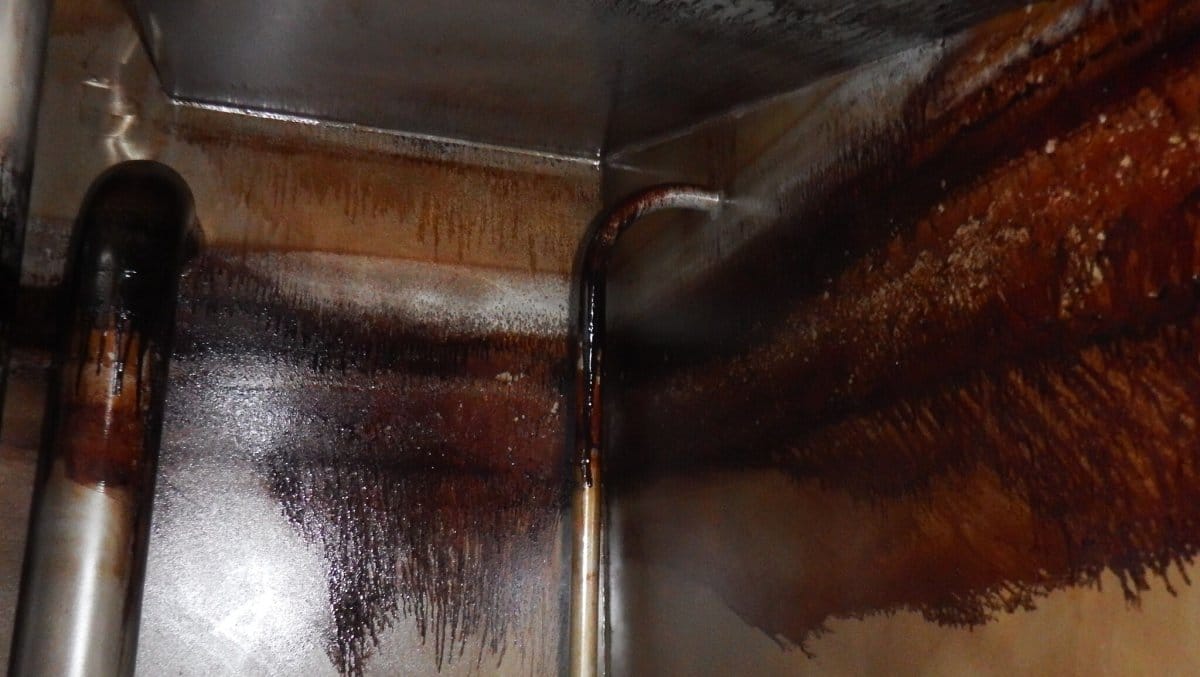
Industry data indicates that 40% of unscheduled turbine outages in Australian power plants stem from lubricant-related failures. You’ve likely experienced the frustration of a sudden trip or a sluggish servo-valve that refuses to respond during critical load changes, which can cost an operator over A$250,000 in a single day. These operational disruptions often trace back to a single culprit, a thin, sticky film that coats your internal components. Understanding what is varnish in turbine oil is the first step toward preventing the catastrophic failure of assets that cost millions to maintain.
You don’t have to accept the high cost of frequent oil changes or the environmental burden of disposing of thousands of litres of hydrocarbon fluid. We’ll show you how to identify the chemical root causes of oxidation while adhering to Australian regulatory standards. You’ll learn to choose precise testing methods beyond basic site checks and implement a mitigation strategy that cleans your system while it’s still running. The solution isn’t always a full oil change. By focusing on sustainable restoration, you’ll protect your equipment’s efficiency and your bottom line.
Key Takeaways
- Understand what is varnish in turbine oil, identifying the insoluble film deposits that compromise critical assets and lead to costly unscheduled downtime.
- Identify the chemical drivers of lubricant degradation, focusing on how oxidation and thermal stress create the “hot spots” that compromise oil molecule integrity.
- Recognise why standard ISO 4406 particle counts often fail to detect sub-micron varnish and why Membrane Patch Colorimetry (MPC) is the essential standard for accurate assessment.
- Evaluate the limitations of mechanical filtration and explore how specialised adsorption media effectively remove dissolved varnish molecules from turbine systems.
- Leverage BioKem Oil Services’s technical expertise in Australia to implement analysis-driven interventions that protect your operational budget from unnecessary A$ expenditure on oil replacements.
Table of Contents
- Defining Varnish in Turbine Oil Systems
- The Chemical Evolution of Lubricant Degradation
- Detecting Varnish Potential: Beyond Standard Oil Analysis
- Mitigation Strategies: Solubility vs. Mechanical Removal
- Professional Varnish Mitigation and Oil Purification in Australia
Defining Varnish in Turbine Oil Systems
Understanding what is varnish in turbine oil requires looking beyond simple contamination. It isn’t external dust or grit that has found its way into the reservoir. Instead, varnish is a thin, insoluble film deposit that forms from the internal chemical degradation of the oil itself. These deposits typically manifest as a brown, orange, or black enamel-like coating on metal surfaces. Research from the International Council for Machinery Lubrication (ICML) indicates that oxidation products can begin to precipitate out of solution when oil temperatures fluctuate by as little as 5 to 10 degrees Celsius. This makes the Australian climate, with its extreme ambient temperature swings, a particularly challenging environment for maintaining lubricant stability.
This substance is a complex byproduct of molecular breakdown within the lubricant matrix. When the base oil and additive packages are stressed by heat, pressure, or aeration, they create polar degradation precursors. These precursors remain soluble while the oil is hot and moving. However, as the oil reaches saturation or cools in specific zones, these sub-micron particles agglomerate and plate out onto internal components. This process targets high-clearance zones like bearings and critical, tight-tolerance components such as servo-valves, where clearances are often less than 5 microns. Because these particles are smaller than 1 micron, they pass through standard 10-micron filters, allowing the “silent” buildup to continue undetected by traditional maintenance checks.
Varnish vs. Sludge: What is the Difference?
While both are degradation products, they behave differently within a turbine system. Sludge is typically soft, gummy, and found in cooler zones like the bottom of reservoirs or filter housings. Varnish is a different animal; it’s often hard, tenacious, and effectively “baked on” to hot surfaces. Both originate from the same degradation precursors, but varnish undergoes a polymerization process that turns it into a tough, resinous layer. In Australian power plants, technicians often find sludge in the tank but discover hard varnish on the actual bearing pads where temperatures are highest.
Why Varnish is a “Silent Killer” for Turbines
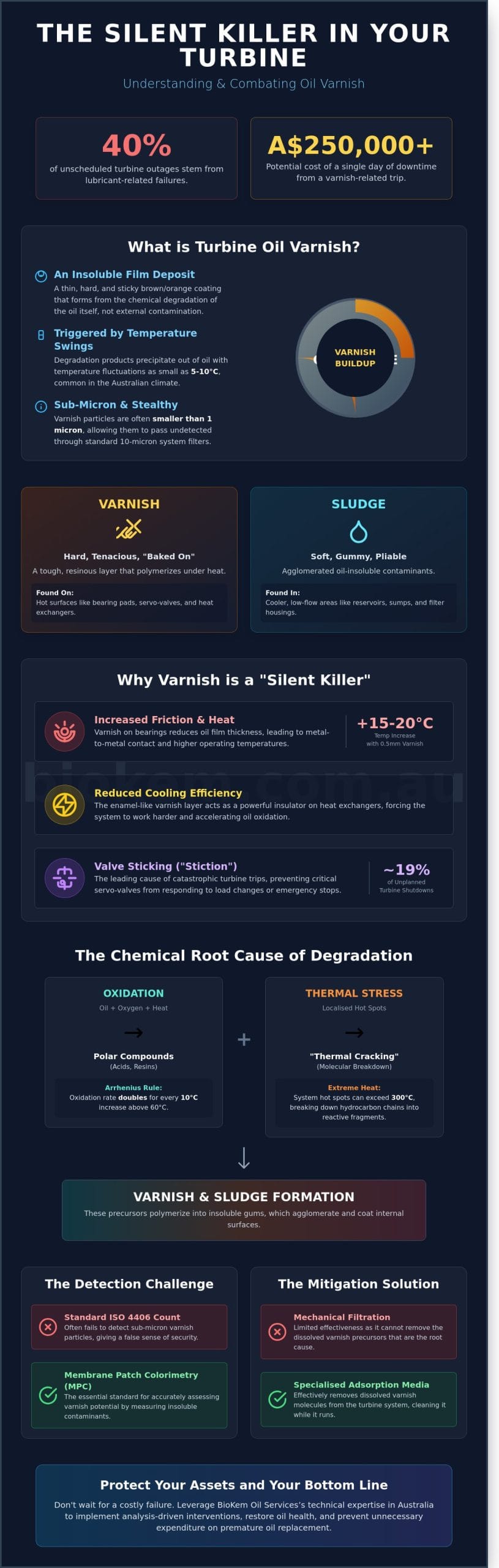
Varnish is particularly dangerous because it doesn’t show up on standard ISO particle counts. It’s a “silent killer” that causes three primary failures that can cost an Australian facility upwards of A$50,000 per day in lost production. First, it increases friction in bearings. This leads to higher operating temperatures; a 0.5 mm layer of varnish can increase bearing temperatures by 15 to 20 degrees Celsius. Second, it acts as an insulator on heat exchanger surfaces, which drastically reduces cooling efficiency and forces the system to work harder. Finally, it causes valve sticking, or “stiction.” This is a leading cause of catastrophic turbine trips. Industry data suggests that valve stiction accounts for nearly 19% of unplanned turbine shutdowns in large-scale industrial facilities. By the time a technician notices the physical coating, the chemical health of the oil has usually been compromised for months.
- Friction Increase: Varnish coatings on bearings reduce the oil film thickness, leading to metal-to-metal contact.
- Heat Insulation: The “enamel” layer prevents efficient thermal transfer in coolers, leading to oil oxidation cycles.
- Operational Risk: Stiction in a single servo-valve can prevent a turbine from responding to load changes or emergency stop commands.
The Chemical Evolution of Lubricant Degradation
Understanding what is varnish in turbine oil requires a look at the molecular shift that occurs during extended operation. It isn’t a single contaminant but a complex byproduct of chemical degradation. This process begins with oxidation, a reaction where oxygen molecules interact with hydrocarbons. In high-performance turbines, this reaction is accelerated by heat. According to the Arrhenius rate rule, the rate of oxidation typically doubles for every 10°C increase in oil temperature above 60°C. As the oil oxidises, it produces polar compounds like organic acids and resins. These precursors are the building blocks of the sludge that eventually hardens into a tenacious film.
Thermal stress plays an equally critical role. Localised hot spots within the system, often exceeding 300°C, cause “thermal cracking.” This process breaks the long-chain hydrocarbon molecules into smaller, unstable fragments. These fragments are highly reactive and quickly polymerise into insoluble gums. Research published in Varnish Formation and Removal in Lubrication Systems indicates that these chemical pathways are often simultaneous, creating a cocktail of degradation products that the oil must manage.
The movement of these contaminants is governed by the solubility cycle. Lubricating oil acts like a sponge; it can hold a specific amount of dissolved degradation products based on its temperature and chemical makeup. When the oil is hot and moving, these precursors remain in a dissolved state. However, as the oil cools in reservoirs or low-flow zones, it reaches a saturation point. At this stage, the oil can no longer hold the polar compounds, and it begins “shedding” them. These suspended particles eventually precipitate onto metal surfaces, forming the characteristic golden or dark brown varnish layer.
Primary Causes: Heat, Air, and Pressure
Adiabatic compression, or micro-dieseling, is a frequent driver of degradation in Australian industrial environments. This occurs when entrained air bubbles are rapidly compressed in high-pressure zones, such as pump discharges, reaching temperatures over 1,000°C instantly. This intense heat chars the surrounding oil film. Additionally, electrostatic discharge occurs in high-flow filtration systems when friction generates static charges exceeding 10,000 volts. These sparks “cook” the oil from the inside out. In regions like Western Australia or Queensland, where ambient summer temperatures frequently peak above 45°C, the cooling capacity of systems is often stretched, further reducing the margin for error and accelerating oxidation rates.
The Role of Base Oils (Group II and III)
The shift toward modern Group II and Group III base oils has changed how we define what is varnish in turbine oil today. While these refined oils offer superior oxidative stability compared to older Group I oils, they possess lower natural solubility for polar contaminants. They’re “purer,” meaning they have fewer aromatic components to keep degradation products in suspension. Once the additive package depletes, which can happen 25% faster in high-stress environments, the oil quickly becomes saturated. Without the natural solvency of traditional oils, these modern lubricants shed varnish onto critical components much earlier in their lifecycle. Implementing a proactive fluid management strategy is essential to ensure these high-purity oils don’t compromise system reliability through premature saturation.
Detecting Varnish Potential: Beyond Standard Oil Analysis
Standard ISO 4406 particle counts are the traditional baseline for fluid health, yet they consistently fail to identify the sub-micron precursors that lead to varnish. These tests focus on particles 4 microns and larger. Varnish precursors are typically smaller than 0.1 microns, allowing them to remain invisible to traditional laser counters even when the oil is heavily contaminated. Relying solely on ISO cleanliness codes creates a false sense of security for Australian plant managers. Research into Managing Varnish of Turbine Oil indicates that chemical degradation products must be isolated through specialized laboratory techniques to prevent sudden equipment failure. Understanding what is varnish in turbine oil requires looking at the chemistry of the fluid, not just the physical debris.
The industry gold standard for identifying these risks is Membrane Patch Colorimetry (MPC), governed by ASTM D7843. This test measures the color intensity of organic deposits left on a 0.45-micron membrane. To get an accurate reading, technicians must “age” the sample at room temperature for approximately 68 to 72 hours. This step is vital because varnish is often dissolved in the oil at operating temperatures. Cooling allows these soft contaminants to precipitate so they can be captured and measured. When evaluating your results, the ΔE (Delta E) value provides a clear roadmap. A ΔE below 15 suggests a stable system, but once values exceed 30, the risk of deposition becomes critical. At a ΔE of 40 or higher, immediate intervention is required to prevent a forced outage.
Advanced Testing Methods for Reliability
Beyond colorimetry, the Remaining Useful Life Evaluation Routine (RULER) test provides a proactive look at the oil’s chemical health. It measures the concentration of antioxidant additives like phenols and amines. When these levels drop below 25% of the original baseline, the oil loses its ability to resist oxidation. For a more granular view of system contaminants, using a Filter Ferrogram allows technicians to distinguish between metallic wear debris and the organic sludge characteristic of varnish. This distinction is critical for determining whether a problem is mechanical or chemical. Following strict ASTM D7843 protocols ensures that these results are repeatable and reliable for long-term trend analysis.
Visual Indicators of System Varnish
While laboratory data is essential, physical signs often appear during routine inspections. You might notice oil that has darkened significantly or carries a distinct “burnt” odor, which signals thermal degradation. Another common red flag is premature filter plugging. If your 5-micron or 10-micron filters are clogging frequently but your ISO particle counts remain within spec, it’s likely that sub-micron varnish is “blinding” the filter media. Maintenance teams should also inspect paddle flushing screens for any sticky, amber-colored residue. This residue is a physical manifestation of what is varnish in turbine oil, indicating that the fluid has reached its saturation point and is now depositing solids onto critical components like servo valves and bearings.
Mitigation Strategies: Solubility vs. Mechanical Removal
Understanding what is varnish in turbine oil requires a shift from traditional filtration mindsets. Standard mechanical filters, even those rated at 3 microns, are ineffective against dissolved varnish. These filters are designed to capture hard, particulate contamination like metal shavings or silica. Varnish precursors exist in a dissolved state within the oil’s molecular structure. They’re polar molecules, while the base oil is non-polar. Because they stay in solution at operating temperatures, they simply flow through standard filter media without being trapped.
Effective mitigation relies on adsorption. This process uses specialised media, such as cellulose-based depth filters or ion exchange resins, to create a molecular attraction for polar contaminants. Instead of physically blocking a particle, the media chemically bonds with the varnish molecules. This doesn’t just clean the fluid; it creates a solubility void. When the oil is stripped of its varnish load, it becomes undersaturated. This allows the oil to act as a solvent, naturally re-dissolving the varnish deposits currently baked onto your bearings and valves. It’s a systemic cleaning process that prioritises the health of the entire machine over the appearance of the oil alone.
Varnish Removal Systems (VRU)
A BioKem Varnish Removal System provides continuous, online protection through kidney-loop processing. By circulating oil through ion exchange resins or cellulose media at a steady flow rate, these units maintain the oil’s MPC (Membrane Patch Colorimetry) values well below the critical threshold of 20 to 30. This online approach prevents the temperature swing effect where varnish precipitates as the oil cools during shutdowns. Maintaining low MPC levels ensures that internal components stay free of the sticky films that cause servo-valve stiction, which is a common cause of unplanned trips in Australian power assets.
Restorative Measures: Hot Oil Flushing
When a system is heavily contaminated, a hot oil flushing service is the most effective restorative path. This process involves circulating oil at high velocities to achieve a Reynolds number greater than 4,000, creating turbulent flow that scours the internal pipework. We raise the oil temperature to between 60°C and 75°C to maximise solubility, allowing the fluid to carry away stubborn deposits. While a mechanical flush removes debris, a chemical flush using targeted cleaners can be significantly more effective at stripping aged varnish from complex geometries. This is essential during a major outage or after a catastrophic oil failure to ensure the new lubricant charge isn’t immediately compromised by residual what is varnish in turbine oil deposits.
Reliable turbine operation in the Australian industrial sector demands a proactive stance. If your MPC levels are rising or you notice sluggish valve response, don’t wait for a system trip. Contact Biokem for a technical consultation on integrating varnish mitigation into your maintenance schedule.
Professional Varnish Mitigation and Oil Purification in Australia
Managing industrial lubricants in Australia requires a shift from reactive replacement to technical preservation. BioKem provides analysis-driven interventions that address the core of the issue. When operators ask what is varnish in turbine oil, they’re usually seeing the end result of thermal degradation; a sticky, resinous film that compromises tight tolerances. Our approach focuses on removing these sub-micron precursors before they settle on critical components. By implementing a proactive lubrication management programme, Australian facilities can extend the service life of their fluids by up to 10 years. This strategy ensures compliance with local environmental guidelines and prevents the unnecessary disposal of thousands of litres of hydrocarbon products.
BioKem’s onsite services are designed to function without interrupting plant operations. We utilize Membrane Patch Colorimetry (MPC) testing to establish a baseline for varnish potential, following ASTM D7843 standards. In a 2023 case study for a regional power station, our technical team reduced MPC values from a critical 45 to a “normal” 12 within a single treatment cycle. This intervention saved the client approximately A$180,000 in oil replacement costs and associated labour. We prioritise Australian regulatory and environmental standards, ensuring all waste handling and purification processes meet strict local compliance requirements.
BioKem’s Onsite Technical Solutions
Every power generation asset has a unique thermal profile. BioKem develops customised varnish mitigation plans that target the specific chemistry of your turbine oil. We don’t believe in one size fits all solutions. Our technicians deploy specialized kidney-loop systems that extract polar contaminants which standard filters cannot capture. We are the Australian distributor for Filters S.p.A. high-performance hardware. This partnership allows us to integrate world-class filtration technology into our service delivery.
For facilities that don’t require permanent installations, we offer equipment hire for short-term purification projects. This flexibility is essential for annual outages or emergency cleanup after a thermal event. Our hire fleet includes:
- Electrostatic Oil Cleaners (EOC) for sub-micron particle removal.
- Vacuum dehydrators for moisture and dissolved gas extraction.
- High-flow flushing units for post-overhaul system cleaning.
- Real-time oil condition monitoring sensors for 24/7 data logging.
The Result: Maximised Reliability and Sustainability
Investing in oil purification is a commitment to both operational uptime and environmental stewardship. By removing the oxidation products that define what is varnish in turbine oil, we eliminate the primary cause of unscheduled downtime. In the Australian energy market, where a single day of lost production can cost upwards of A$50,000, predictive maintenance isn’t just a luxury; it’s a financial necessity. Our processes reduce the environmental footprint of your facility by minimising the frequency of oil changes and the subsequent need for waste oil processing.
BioKem’s methodology ensures that 90% of the oil remains in the system for its maximum theoretical lifespan. This reduces the demand for virgin base oils and lowers the carbon intensity of your maintenance operations. We invite you to contact BioKem for a comprehensive system health check. Our technical team will provide a detailed analysis of your current varnish levels and a roadmap for long-term lubricant stability. Protect your assets and your bottom line with Australia’s experts in oil purification.
Securing Turbine Longevity Through Proactive Varnish Management
Varnish isn’t just a maintenance nuisance; it’s a silent threat to your turbine’s 25-year lifecycle. Understanding what is varnish in turbine oil is the first step, but detection requires moving beyond standard ISO 4406 particle counts. Since these sub-micron soft contaminants are often invisible to traditional tests, Membrane Patch Colorimetry (MPC) remains the essential benchmark for identifying degradation before a trip occurs. Effectively managing these deposits requires a dual approach that addresses both chemical solubility and mechanical removal.
BioKem provides the technical infrastructure to eliminate these risks throughout Australia. As the sole Australian distributor for Filters S.p.A., we leverage world-class technology to restore lubricant health. Our teams specialize in high-velocity hot oil flushing and onsite technical deployment, ensuring your systems meet strict OEM specifications. Don’t let oxidation byproducts lead to A$100,000 in avoidable repair costs or unplanned outages. Taking proactive steps today ensures your machinery operates at peak performance for years to come.
Request a Varnish Potential Analysis and Mitigation Plan from BioKem
Frequently Asked Questions
Can I remove varnish with standard 10-micron oil filters?
No, standard 10-micron filters can’t remove varnish because most oxidation by-products are smaller than 0.1 microns. These filters capture hard particles but miss the soft, polar contaminants that form what is varnish in turbine oil. By the time varnish reaches a size large enough for a 10-micron filter to catch, it’s already precipitated out of the oil and onto your machine’s internal surfaces.
How does MPC testing (ASTM D7843) actually measure varnish?
MPC testing measures the color intensity of insoluble contaminants extracted from an oil sample via a 0.45-micron nitrocellulose patch. A spectrophotometer assigns a Delta E value between 1 and 100 to the patch. In Australian power plants, an MPC value over 30 indicates a high risk of deposit formation. This ASTM D7843 standard provides a reliable metric for assessing the concentration of soft contaminants before they cause a trip.
Is varnish in turbine oil reversible without changing the oil?
You can reverse varnish accumulation without a full oil change by using kidney-loop systems like ion-exchange or depth filtration. These technologies remove soluble and insoluble precursors while the turbine remains operational. Biokem’s sustainable approach focuses on restoring the oil’s solubility, which helps the fluid re-absorb existing deposits from the metal surfaces. This process extends the life of a 10,000-litre oil charge, reducing waste and disposal costs.
What are the first signs that my turbine is developing varnish?
The first signs of varnish are often a 5 to 10-degree Celsius rise in bearing temperatures or erratic servo valve movements. You might notice “stiction” where valves fail to respond to small signal changes. These operational hiccups occur because a layer of varnish as thin as 5 microns can increase friction and impede heat transfer. Monitoring these trends helps operators identify what is varnish in turbine oil before it leads to an unscheduled outage.
Why do newer Group II turbine oils seem more prone to varnish?
Group II base oils have a higher purity and better oxidation stability but a lower natural solubility for polar degradation products. Since these oils are more refined and have fewer aromatic compounds, they can’t hold as many oxidation by-products in solution. Once the oil reaches its saturation point, the contaminants drop out as varnish. This shift in oil chemistry since the early 2000s has made varnish management a critical priority for modern turbine operators.
How often should I test for varnish potential in a gas turbine?
You should test for varnish potential at least every 3 months during normal operation. For peaking units that cycle frequently, monthly testing is a safer strategy to catch rapid degradation. Consistent MPC monitoring allows you to track trends over a 12-month period. This frequency aligns with Australian industry best practices for maintaining asset reliability and meeting environmental compliance standards for long-term fluid health.
Does hot oil flushing remove the varnish “baked” onto bearings?
Hot oil flushing alone rarely removes “baked-on” varnish from bearings because the flow velocity isn’t enough to dislodge chemically bonded deposits. While it removes loose debris, it doesn’t solve the underlying solubility issue. Effective removal requires chemical cleaning agents or specialized varnish removal units that work over 48 to 72 hours. These eco-friendly solutions break down the molecular bond of the varnish, ensuring surfaces are clean before new oil is introduced.
What is the cost impact of ignoring varnish in a power plant?
Ignoring varnish can cost an Australian power plant between A$50,000 and A$500,000 per day in lost revenue and emergency repairs. A single fail-to-start event caused by a stuck valve can lead to immediate penalties from the Australian Energy Market Operator (AEMO). Beyond direct costs, the environmental impact of disposing of 20,000 litres of premature oil waste contradicts modern corporate sustainability goals. Investing in proactive management saves significant capital over a 10-year turbine lifecycle.