

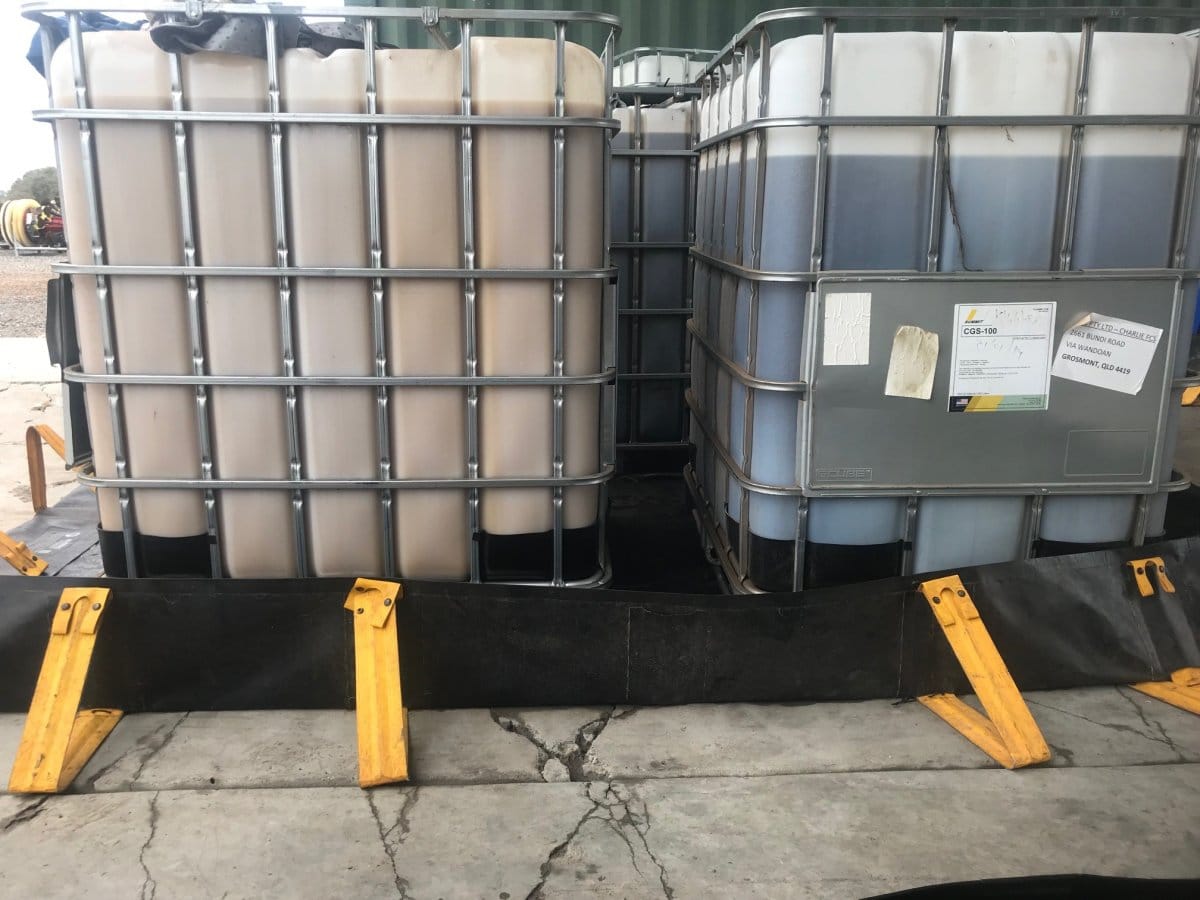
Industrial operations across Australia are currently grappling with a 15% to 25% surge in bulk lubricant prices compared to the first quarter of 2023. You’ve likely felt the financial pressure of these rising costs, particularly when they’re compounded by the escalating fees required for compliant hazardous waste disposal. It’s a frustrating cycle where you’re forced to purchase expensive new oil, only to pay again to have it hauled away after it reaches its traditional service limit. Focusing on oil longevity is the most effective way of ensuring that the current increase in oil costs has less of an impact on your lubricant expenditure while maintaining 100% asset uptime.
Discover how to insulate your maintenance budget from these volatile market conditions by shifting from a replacement-based model to a high-precision purification strategy. This article outlines the technical mechanisms of oil life extension and demonstrates how local facilities are slashing their annual lubricant spend by up to 40% through advanced contamination control. We’ll explore the transition from viewing oil as a consumable to treating it as a high-value, reusable asset that meets strict Australian regulatory standards and environmental expectations.
Key Takeaways
- Transition from a reactive “drain and fill” philosophy to a proactive purification model to combat the volatility of oil prices within the Australian industrial sector.
- Identify the significant ROI of onsite precision purification versus bulk oil replacement, ensuring that the current increase in oil costs has less of an impact on your lubricant expenditure.
- Gain technical insights into the science of oil degradation and how chemical purification effectively restores lubricant properties that standard mechanical filtration cannot reach.
- Learn to establish a data-driven mitigation strategy using professional oil analysis and ISO 4406 cleanliness standards to extend the operational life of your assets.
- Discover how BioKem’s local Australian expertise and distribution of world-class filtration brands provide a sustainable, high-precision alternative to traditional lubricant management.
The 2026 Oil Crisis: Why Traditional Lubricant Management is Failing
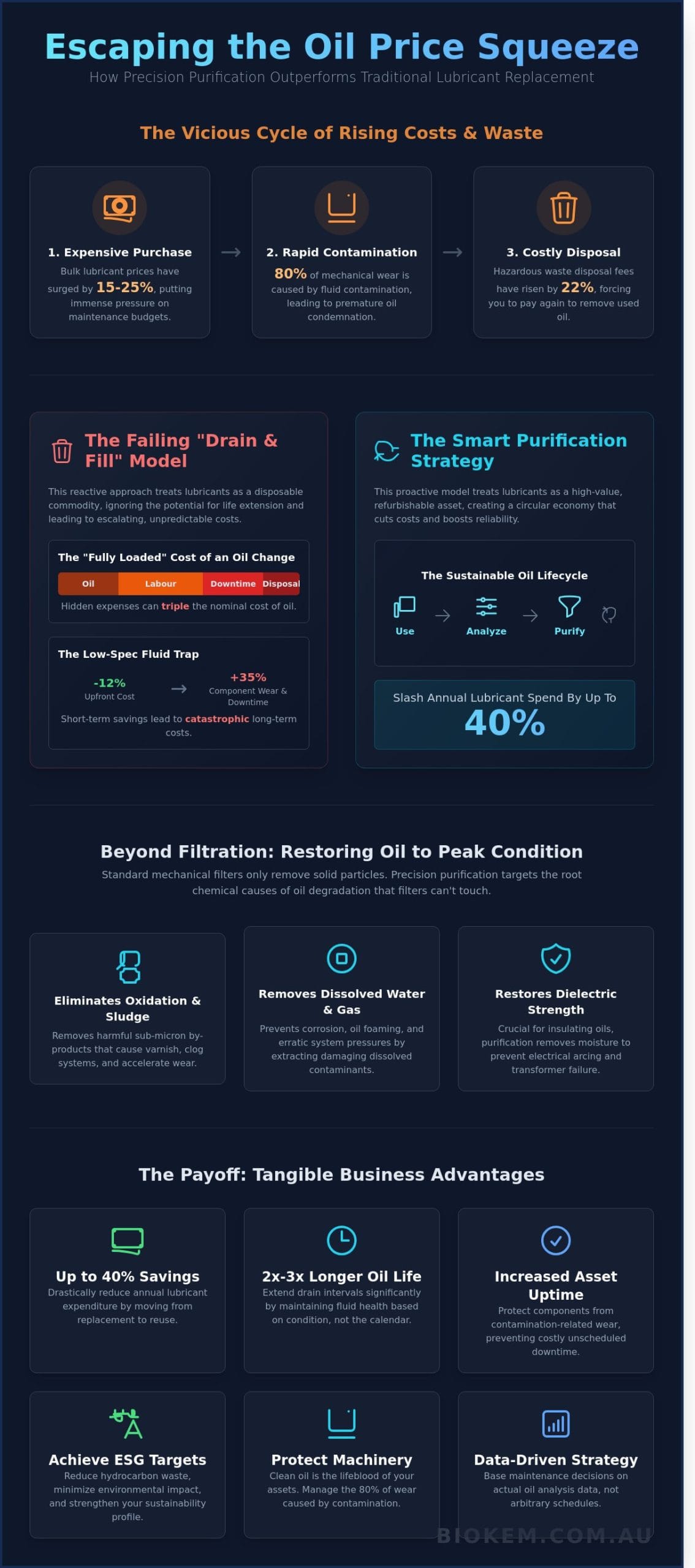
Global supply chain disruptions and shifting geopolitical alliances have pushed Australian base oil prices to record highs in early 2026. Industrial operators face a volatile market where Tapis crude fluctuations directly dictate operational margins. Relying on the legacy “drain and fill” philosophy is no longer viable for lubricants; it treats a complex chemical asset as a disposable commodity. This approach ignores the reality that 80% of mechanical wear stems from fluid contamination, which can be managed through biological and technical intervention.
Understanding the mechanics of oil degradation is the first step toward operational resilience and cost stability. To better understand this concept, watch this helpful video:
Procurement departments often attempt to mitigate these spikes by switching to cheaper, lower-spec fluids. This short-term fix frequently backfires. Reducing upfront purchase costs by 12% can lead to a 35% increase in component wear and unscheduled downtime. Focusing on the technical health of the fluid is the only sustainable method for ensuring that the current increase in oil costs has less of an impact on your lubricant expenditure. When you maintain the molecular integrity of the oil, you protect the machine and the bottom line simultaneously.
The True Cost of Lubricant Replacement
An oil change costs significantly more than the invoice price of the drum. In Australia, the “fully loaded” cost includes technician labour at roughly A$140 to A$190 per hour, the loss of production revenue during downtime, and waste oil disposal fees that have risen by 22% since 2024. Market volatility makes it impossible to set accurate annual budgets when high-performance synthetic prices jump 10% in a single quarter. These hidden expenses often triple the nominal cost of the oil itself.
Moving Toward a Circular Oil Economy
Australian industrial sectors must view oil as a refurbishable asset. Transitioning to a circular model involves using advanced filtration to remove contaminants before they trigger oxidative breakdown. This shift supports ESG targets by reducing hydrocarbon waste and carbon footprints. Moving away from scheduled changes requires implementing patch test kits to base maintenance on actual fluid condition rather than arbitrary calendar dates. This proactive stance stops the cycle of unnecessary waste and protects local ecosystems from industrial runoff.
Extending Lubricant Life Through Precision Purification
Most industrial oils don’t actually “wear out” in the traditional sense. While base oils are chemically robust, they’re often condemned because of contamination or additive depletion. Research from the Purdue University Mechanical Engineering Tribology Laboratory shows that maintaining the physical and chemical properties of a lubricant is the primary factor in component longevity. Mechanical filtration removes solid particulates, but it fails to address the chemical degradation caused by water and oxidation. Precision purification moves beyond simple straining. It targets the root causes of fluid failure:
- Elimination of sub-micron oxidation by-products that cause sludge
- Removal of dissolved gases that lead to oil foaming and erratic pressure
- Restoration of dielectric strength in insulating oils to prevent arcing
This approach is vital for ensuring that the current increase in oil costs has less of an impact on your lubricant expenditure, as it allows for the indefinite reuse of high-value base stocks. By focusing on fluid chemistry rather than just particle counts, asset managers can effectively double or triple drain intervals.
The Role of Vacuum Dehydration
Water is a lubricant’s greatest enemy. Even at levels as low as 500 ppm, dissolved moisture triggers a catalytic reaction that accelerates oxidation. Vacuum dehydration effectively removes 100% of free and emulsified water, and up to 90% of dissolved water. This process is critical for maintaining the Total Base Number (TBN), which represents the oil’s ability to neutralise acidic by-products. Without moisture control, additives drop out of suspension, leaving metal surfaces vulnerable to corrosion. In hydraulic systems, removing moisture restores fluid bulk modulus. This improves responsiveness and protects expensive components from cavitation. It’s a proactive strategy that keeps your systems running at peak efficiency while reducing the need for costly oil replacements.
Varnish Mitigation: Preventing Premature Oil Condemnation
Standard 10-micron filters cannot capture sub-micron oxidation by-products. These “soft contaminants” eventually plate out on cool metal surfaces, forming a sticky residue known as varnish. This leads to “black oil” syndrome and causes valves to stick, often resulting in expensive shutdowns. By implementing specialised systems, you can remove these precursors before they solidify. This technique is essential for ensuring that the current increase in oil costs has less of an impact on your lubricant expenditure by extending the life of the fluid beyond its standard rating. You can learn how varnish removal systems protect your turbines and prevent unexpected downtime in critical Australian infrastructure. Monitoring your fluid health with patch test kits provides the data needed to justify these life-extension protocols.
Cost-Benefit Analysis: Purification vs. Replacement
Industrial operators in Australia face a stark choice as bulk lubricant prices climb toward A$7.00 per litre for high-grade turbine and hydraulic fluids. The decision to replace oil versus purifying it onsite is now a critical factor in ensuring that the current increase in oil costs has less of an impact on your lubricant expenditure. While a total oil change for a 5,000-litre system can exceed A$35,000 in fluid costs alone, professional purification services typically operate at 40% of the cost of new oil. This financial gap widens when you account for the A$2,000 to A$5,000 disposal fees required for waste hydrocarbons under Australian environmental regulations.
Live filtration offers a distinct advantage by maintaining system cleanliness without halting production. By implementing kidney-loop systems, plants avoid the A$10,000 per hour downtime costs associated with draining and refilling large reservoirs. Data from large-scale hydraulic operations shows that maintaining fluid at an ISO 4406 cleanliness level of 16/14/11 through purification can extend component life by 200%; this effectively defers future capital outlays for pumps and valves.
The ROI of Hot Oil Flushing
Attempting to save money by skipping a flush during commissioning is a high-risk strategy. New systems often contain “built-in” contaminants like welding scale, metal shavings, and silica. These particulates cause immediate oxidation and additive depletion in fresh oil. By investing in the financial benefits of hot oil flushing and filtering, operators remove these catalysts before they can degrade expensive lubricants. In a 2023 turbine overhaul project, a pre-commissioning flush prevented the premature degradation of A$80,000 worth of oil, delivering a full return on investment within the first 48 hours of operation.
Equipment Hire: A Flexible Solution for Cost Control
Managing cash flow requires a shift from capital expenditure (CAPEX) to operational expenditure (OPEX). Purchasing high-end filtration rigs can cost upwards of A$50,000, which is a significant burden for temporary contamination events. Hiring specialized equipment allows sites to access Filters S.p.A. technology without the upfront debt. This model ensures that ensuring that the current increase in oil costs has less of an impact on your lubricant expenditure remains a priority through scalable, performance-based costs rather than fixed asset depreciation. Using Tier 1 technology ensures compliance with strict Australian mining and energy sector standards while keeping budgets lean.
Implementing an Oil Expenditure Mitigation Strategy
Reducing operational costs requires a shift from reactive maintenance to a data-driven fluid management model. Australian industrial operations often face high logistics costs for remote sites, making oil longevity a primary financial driver. By establishing a baseline through ISO 4406 standards, you’re ensuring that the current increase in oil costs has less of an impact on your lubricant expenditure. Target cleanliness levels must be precise. For instance, moving a hydraulic system from an ISO 21/19/16 to 16/14/11 can double the expected life of sensitive components and the fluid itself.
The Foundation: Professional Oil Analysis
Basic lab tests often miss the sub-micron particles that strip additives from your oil. Advanced ferrography provides a microscopic look at wear debris, allowing you to catch mechanical failure before it contaminates the entire sump. Integrating advanced filter ferrogram services for predictive maintenance identifies invisible wear patterns that consume expensive additive packages. This approach shifts your maintenance from a “drain and fill” cycle to precision management. In 2023, Australian sites utilizing these methods reported saving between A$5,000 and A$20,000 per year on large-scale gearbox maintenance alone.
Upgrading Your Filtration Hardware
Standard OEM filters are designed for component protection, not necessarily for extreme fluid life extension. They frequently lack the high-beta ratio required to remove the smallest, most abrasive silt particles. Upgrading to high-performance elements in critical circuits ensures fluid stays within specification for three to five times longer than traditional estimates. You can explore our range of Filters S.p.A. industrial products to find high-efficiency solutions tailored for the Australian mining and manufacturing sectors. High-performance glass media filters provide the structural integrity needed to maintain cleanliness under variable flow conditions.
Audit and adjustment cycles are the final step in ensuring that the current increase in oil costs has less of an impact on your lubricant expenditure. Don’t rely on calendar-based changes. Use trend analysis to monitor the depletion of antioxidants and the rise in acid numbers. A 2023 case study of a Queensland processing plant showed a 35% reduction in annual oil consumption by using real-time particle counting to determine the actual end-of-life for their lubricants. This transition from schedule-based to condition-based changes directly offsets the rising price of base oils.
Ready to extend the life of your industrial fluids? Book a professional filtration audit with BioKem to start your expenditure mitigation strategy.
BioKem Oil Services: Your Partner in Cost Mitigation
BioKem delivers technical interventions across Australia that prioritize oil longevity over disposal. By maintaining fluid chemistry at a molecular level, we help national assets reduce their reliance on volatile virgin oil markets. We’re the authorized distributor for world-class filtration brands including Filters S.p.A. and Swift Filters, providing the hardware necessary to keep contaminants below ISO 4406 cleanliness targets. Our work with Tier 1 mining and power generation firms has demonstrated that proactive contamination control is the most effective method for ensuring that the current increase in oil costs has less of an impact on your lubricant expenditure.
Our Technical Capabilities
Our field teams deploy nationwide to execute high-velocity hot oil flushing and vacuum dehydration. These processes remove particulate matter and dissolved water that otherwise accelerate oxidation. For the power industry, we specialize in EHC fluid maintenance; we manage the acidic by-products that compromise steam turbine reliability. BioKem also maintains a fleet of rental equipment for emergency and planned maintenance. This allows sites to respond to moisture ingress or varnish issues without the capital expenditure of purchasing specialized filtration rigs. Our technical interventions include:
- Onsite vacuum dehydration to remove 100% of free and emulsified water.
- High-velocity flushing to eliminate built-up debris in hydraulic circuits.
- Specialist resin-based EHC fluid conditioning for phosphate ester systems.
- Nationwide rental of kidney-loop filtration units and particle counters.
Get a Lubricant Expenditure Audit
Optimizing your budget starts with a data-driven assessment. BioKem’s consultative audit identifies immediate saving opportunities by analyzing current change-out intervals and fluid degradation rates. We’ve helped national infrastructure assets achieve a 15% reduction in annual lubricant volume through targeted reclamation. This approach transitions your site from reactive purchasing to strategic reliability. It’s a proven framework for ensuring that the current increase in oil costs has less of an impact on your lubricant expenditure while meeting Australian environmental compliance standards. We don’t just supply filters; we engineer long-term fluid stability.
Take control of your operational costs today. Contact BioKem to discuss your lubricant cost-saving strategy and schedule a technical audit of your critical assets.
Future-Proof Your Operations Against Volatile Lubricant Markets
The transition toward a circular oil economy is no longer optional for Australian industry. By adopting precision purification technologies, facilities can extend the functional life of their lubricants by up to 300%, effectively decoupling operational reliability from global supply chain shocks. This strategic shift is vital for ensuring that the current increase in oil costs has less of an impact on your lubricant expenditure as we approach the market volatility predicted for 2026. BioKem brings over 15 years of industrial oil management expertise to every project, serving as the sole Australian distributor for Filters S.p.A. technology. Our nationwide onsite service capability ensures your assets remain protected without the need for costly downtime or premature fluid replacement. We’ve proven that technical precision and environmental responsibility go hand in hand, helping companies meet strict Australian regulatory standards while slashing A$ overheads. You don’t have to be at the mercy of rising commodity prices when you have the right purification partner. Request a technical consultation for your lubricant cost mitigation strategy and take control of your fluid assets today. It’s time to build a more resilient and sustainable industrial future together.
Frequently Asked Questions
How much can I actually save by purifying oil instead of replacing it?
You can reduce your annual lubricant procurement costs by up to 80% through purification instead of replacement. For a standard 2,000 litre reservoir, oil replacement might cost A$12,000; however, purification services often cost less than A$2,400. This approach is a key strategy for ensuring that the current increase in oil costs has less of an impact on your lubricant expenditure. By extending oil life indefinitely, you also eliminate disposal fees and reduce your carbon footprint.
Is purified oil as reliable as brand-new lubricant for high-pressure systems?
Purified oil is completely reliable for high-pressure systems and often exceeds the cleanliness levels of brand-new lubricant. New oil typically arrives with an ISO 4406 code of 21/19/16, while our purification processes achieve 14/12/9. We use high-efficiency filtration to remove microscopic particulates that cause component wear. This ensures your hydraulic pumps and valves operate with 100% efficiency, preventing the premature failure often associated with contaminated fluid.
What are the first signs that my oil needs purification rather than a change?
The first indicators are a rise in the ISO 4406 particle count or a moisture level exceeding 200 ppm. You’ll also notice a change in fluid colour or a slight burnt odour, suggesting the onset of oxidation. Regular oil analysis identifies these chemical shifts before physical damage occurs. Monitoring these metrics allows for proactive purification, ensuring that the current increase in oil costs has less of an impact on your lubricant expenditure by avoiding total fluid degradation.
Can vacuum dehydration remove water from all types of industrial oils?
Vacuum dehydration effectively removes water from almost all industrial oils, including turbine, gear, and hydraulic fluids. The process lowers the atmospheric pressure to boil off water at 50°C, which prevents thermal degradation of the oil’s additive package. It removes 100% of free and emulsified water and up to 90% of dissolved water. This is critical in Australia’s humid mining environments where water ingress reduces bearing life by 75% at 500 ppm concentration.
How does varnish mitigation impact my annual maintenance budget?
Varnish mitigation reduces your annual maintenance budget by approximately 30% by preventing valve sticking and cooler fouling. Removing soft contaminants stops the formation of sticky deposits that cause unplanned outages. A single day of downtime on a gas turbine can cost A$50,000 in lost production. By implementing cellulose-based chemical filtration, you protect your infrastructure and ensure components reach their full 20,000-hour design life without mid-cycle overhauls.
What ISO 4406 cleanliness code should I aim for to maximize oil life?
You should aim for an ISO 4406 cleanliness code of 14/12/11 to maximize oil life and component reliability. Achieving this level can extend the mean time between failures for pumps and bearings by 200%. Most Australian industrial standards specify 16/14/11, but pushing for cleaner fluid ensures a higher safety margin. This precision filtration removes the 2-5 micron particles that are most destructive to tight-tolerance hydraulic clearances.
Do you provide onsite oil analysis services for remote mining locations?
Biokem provides comprehensive onsite oil analysis for remote mining locations across Western Australia and Queensland. Our mobile laboratories deliver results within 4 hours, bypassing the 5-day delay of traditional laboratory shipping. We track 24 distinct wear metals and chemical markers to provide immediate actionable data. This local expertise ensures your machinery remains compliant with Australian environmental regulations while maintaining peak operational performance in harsh, dusty conditions.
Can hot oil flushing be performed while the system is operational?
Hot oil flushing requires the system to be offline to achieve the high Reynolds numbers necessary for effective cleaning. We circulate fluid at 2 to 3 times the normal operational flow rate to create turbulence that dislodges internal debris. This process typically takes 24 to 48 hours depending on the pipework complexity. While it requires a scheduled shutdown, the resulting system cleanliness prevents 90% of start-up failures in newly commissioned or overhauled equipment.