

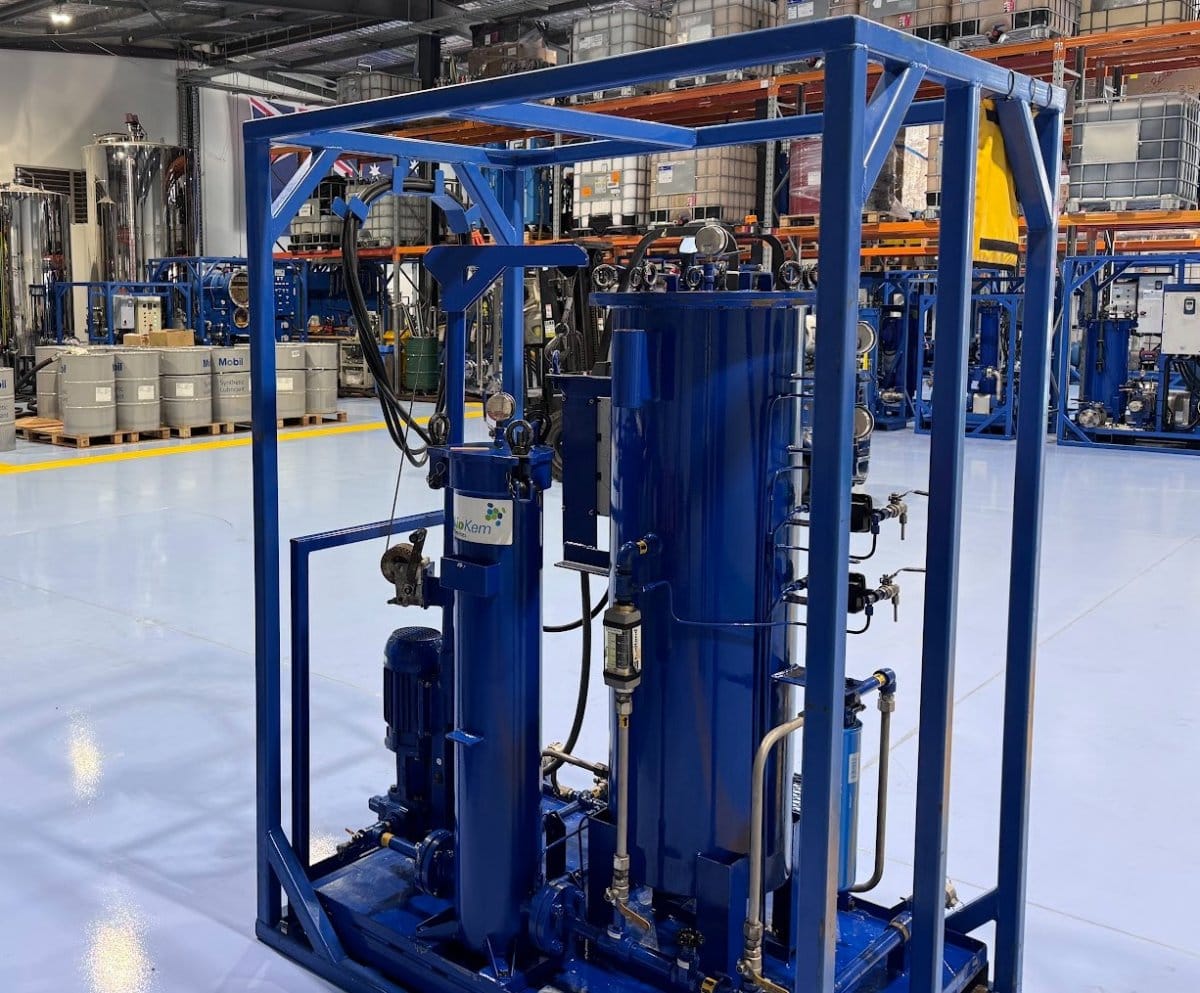
Did you know that an estimated 40% of unscheduled turbine shutdowns in Australian power generation facilities are directly linked to lubricant varnish accumulation? It’s a silent operational threat. While your standard mechanical filters might capture particles down to 3 microns, they’re powerless against the sub-micron oxidation products that eventually bake onto your valve surfaces. This is where an electrostatic oil cleaner for varnish becomes essential. By utilizing high-voltage molecular attraction, these systems remove the precursors that traditional methods miss, ensuring your hydraulic components remain responsive and reliable.
Key Takeaways
- Understand how an electrostatic oil cleaner for varnish utilizes Coulomb’s Law to capture sub-micron oxidation by-products that traditional mechanical filters cannot detect.
- Learn why standard ISO 4406 cleanliness codes can be misleading and how charge-based purification addresses the root causes of varnish potential.
- Discover how to integrate Membrane Patch Colorimetry (MPC) and Ultra-Centrifuge (UC) testing into a proactive maintenance strategy to protect critical industrial assets.
- Identify the operational advantages of kidney-loop purification in preventing unscheduled downtime and extending the service life of high-value lubricants.
- Explore flexible varnish mitigation options for the Australian market, including specialized equipment distribution and short-term industrial filtration hire.
What is an Electrostatic Oil Cleaner for Varnish?
An electrostatic oil cleaner for varnish acts as a dedicated kidney-loop purification system designed to maintain oil chemistry. It targets insoluble oxidation by-products that conventional systems overlook. These units apply a high-voltage charge to the fluid, attracting contaminants to collection zones. This process mirrors the fundamental physics of an electrostatic precipitator, ensuring that even the smallest polar molecules are removed before they can settle on critical components.
To better understand this concept, watch this helpful video:
Standard mechanical filtration often proves insufficient for modern industrial needs. Most pleated filters are rated for 3 to 10 microns, yet varnish precursors are frequently smaller than 0.8 microns. These sub-micron particles pass through traditional media effortlessly. Without an electrostatic oil cleaner for varnish, these contaminants accumulate until the oil reaches its saturation point. This leads to costly downtime in Australian power plants; a single turbine trip can result in losses exceeding A$50,000 per hour in lost generation and grid instability.
The Silent Killer: How Varnish Forms
Lubricant degradation starts when heat and oxygen trigger a chemical breakdown of the base oil. This cycle produces soft contaminants, which differ from hard particles like metal shavings or dust because they remain dissolved in hot oil. As the oil cools or experiences pressure changes, these molecules become insoluble. Varnish is the polar byproduct of oil degradation that plates out on cold surfaces. Once these deposits harden, they increase friction and insulate heat exchangers, reducing thermal efficiency by up to 20% in some hydraulic systems.
Key Applications in Australian Industry
In the Australian energy sector, gas and steam turbines rely on a varnish removal system to prevent servo-valve sticking. High-precision hydraulic presses in manufacturing also use electrostatic technology to maintain tight tolerances and prevent jerky movements. For EHC (Electro-Hydraulic Control) fluid maintenance, removing these oxidation products is critical for system safety. Implementing these solutions helps facilities meet local environmental standards while significantly reducing the volume of waste oil generated annually across the site.
How Electrostatic Precipitation Removes Varnish
Electrostatic precipitation relies on Coulomb’s Law. This fundamental principle of physics dictates that particles with an electrical charge are attracted to surfaces of the opposite polarity. In an electrostatic oil cleaner for varnish, the system creates a high-voltage DC field within the treatment chamber. As oil flows through this field, suspended contaminants like polar oxidation products receive a charge. These particles then migrate toward a collection media, typically a pleated cellulose element, where they are trapped and removed from the fluid stream. This process is highly effective because it targets the polar nature of degraded hydrocarbons.
Traditional mechanical filtration relies on a physical barrier to catch debris. If a particle is smaller than the filter’s pore size, it passes through. Electrostatic efficiency is independent of particle size. Because the force is based on electrical attraction rather than physical size, an EOC effectively captures contaminants down to 0.01 microns. This capability is vital for Varnish Removal in high-pressure hydraulic systems and turbines where soft contaminants often bypass standard 3-micron or 5-micron elements. By removing these precursors, the system prevents the formation of hard deposits on critical valve surfaces.
The Kidney-Loop Mechanism
These systems operate as a kidney-loop, meaning they pull oil from the reservoir, treat it, and return it without interrupting the main lubrication flow. This independent operation allows for continuous, low-flow purification. Steady processing maintains chemical stability and prevents the spikes of contamination often seen during filter bypass events. For comprehensive maintenance, engineers often integrate these units with hot oil flushing protocols to ensure the entire system meets ISO 4406 cleanliness standards during commissioning or after a major overhaul.
Sub-Micron Capture Efficiency
Varnish typically exists in the sub-micron range, specifically between 0.01 and 1 micron. These tars, resins, and sludges are too small for conventional filters but represent the majority of the particle count in degraded oil. As the EOC removes these particles, the oil’s saturation level drops below its equilibrium point. This transformation turns the oil into a potent solvent that actively strips and dissolves existing varnish deposits from internal pipework and reservoir walls. This chemical restoration is a sustainable alternative to aggressive chemical flushes that can damage seals. If you’re managing critical assets in the Australian energy or mining sectors, consider a varnish removal system to extend fluid life and protect sensitive components.
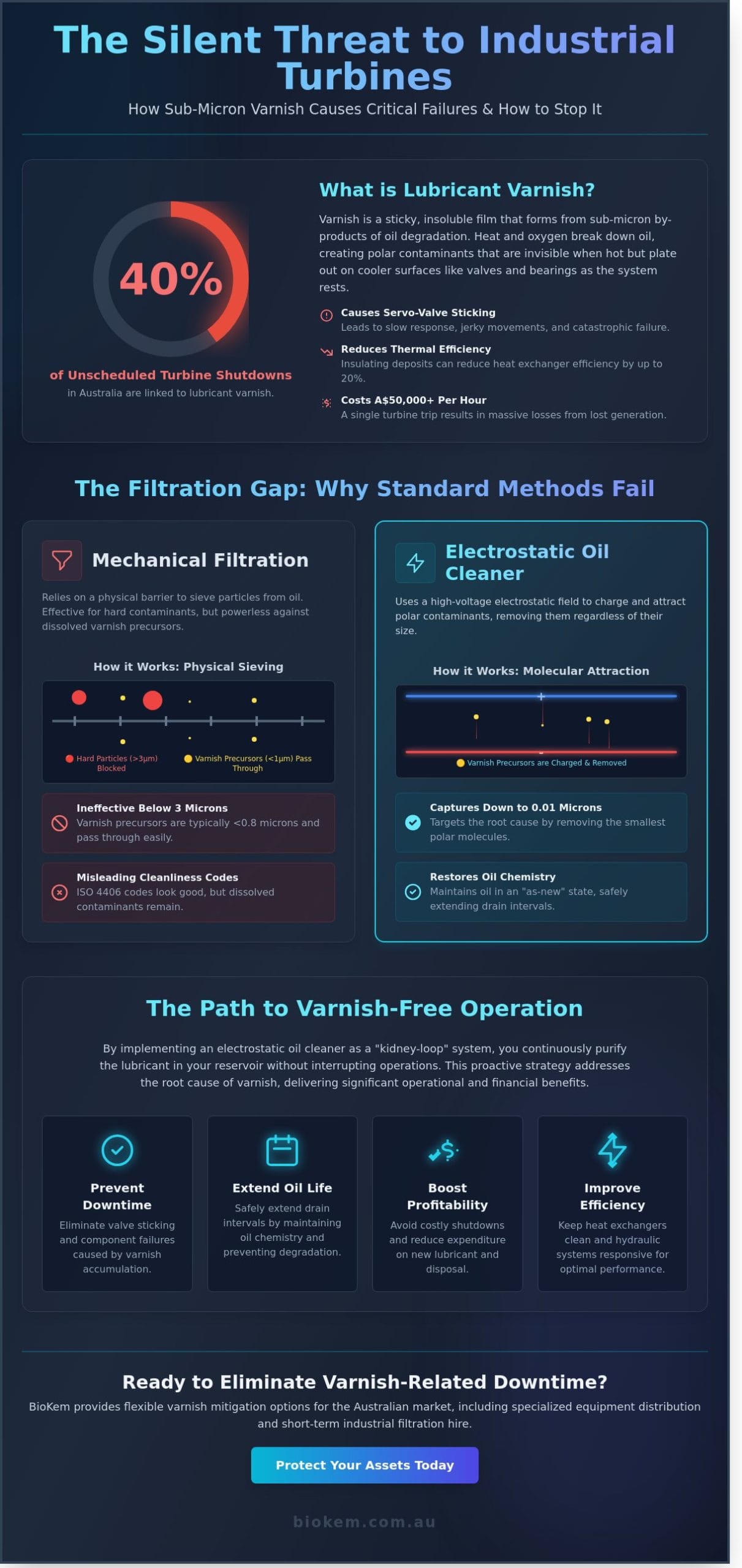
Mechanical Filtration vs. Electrostatic Oil Cleaners
Traditional mechanical filtration relies on physical pore size to trap contaminants. This method effectively captures hard particles like silica or metal shavings, but it struggles with sub-micron oxidation products. Most industrial filters are rated for 3 to 10 microns. Varnish precursors are often smaller than 0.8 microns, allowing them to pass through standard media effortlessly. An electrostatic oil cleaner for varnish operates on a different principle; it uses high-voltage discharge to create an electromagnetic field. This field attracts polar contaminants to a collection media regardless of their physical size. While mechanical filters act as a sieve, electrostatic systems act as a magnet for the chemical byproducts of oil degradation.
The ISO 4406 Blind Spot
Relying solely on ISO 4406 cleanliness codes creates a false sense of security for maintenance managers. A hydraulic system might return an impressive ISO code of 15/13/10, yet still suffer from sticking valves or high operating temperatures. This occurs because ISO codes only count hard particles at 4, 6, and 14 microns. They don’t detect the soft, soluble contaminants that lead to sludge. You need specialized oil analysis, specifically Membrane Patch Colorimetry (MPC), to identify varnish potential. High-velocity mechanical filtration can also be counterproductive. As oil forced through tight cellulose or synthetic pores creates friction, it generates static electricity. This internal sparking accelerates molecular cracking and contributes to the very varnish issues you’re trying to prevent.
Protecting Your Additive Package
A common misconception in the Australian heavy industry sector is that electrostatic systems strip beneficial additives from the oil. Scientific studies on lubricant varnishing demonstrate that electrostatic attraction is highly selective. It targets polar degradation products, which are chemically different from the non-polar base oils and stable additive molecules. By removing these precursors early, an electrostatic oil cleaner for varnish actually extends the life of your antioxidant reserve. When varnish precursors remain in the fluid, they consume antioxidants at an accelerated rate. Removing these contaminants reduces the chemical workload on the oil, allowing the original additive package to protect the machinery for a longer duration.
The long-term financial benefits for Australian operations are significant. Consider these factors:
- Oil Longevity: High-quality turbine oil can cost upwards of A$15 per litre. Extending its life by 50% or 100% saves tens of thousands in procurement costs.
- Disposal Costs: Reducing oil changes lowers the volume of waste oil, which carries high environmental levy costs in many Australian states.
- Component Life: Eliminating varnish prevents the “sandpaper effect” on bearings, reducing the frequency of A$20,000+ component overhauls.
Implementing a Varnish Mitigation Strategy
Successful varnish control isn’t a one-off event. It’s a continuous process. To achieve long-term asset reliability, you must integrate an electrostatic oil cleaner for varnish into a proactive maintenance strategy. This shift moves your maintenance team from reactive “firefighting” to a state of controlled reliability. Sizing the unit correctly is the first step. For a standard 10,000-litre reservoir, a unit should ideally process the entire volume at least once every 24 to 36 hours. If the oil is a high-viscosity gear lubricant, flow rates must be adjusted downward to maintain the efficiency of the electrostatic field.
MPC Testing and Varnish Potential
You can’t manage what you don’t measure. Traditional ISO particle counts often show “clean” oil while varnish is actively destroying components. We rely on Membrane Patch Colorimetry (MPC) testing and Ultra-Centrifuge (UC) values to see the invisible. By using specialised patch test kits, technicians quantify the concentration of insoluble degradation products.
- MPC 0-15: Low risk. The system is stable and the oil is healthy.
- MPC 15-35: Moderate risk. Varnish is accumulating; start the EOC immediately.
- MPC 35+: High risk. Critical action is required to prevent valve sticking and unplanned outages.
Temperature plays a decisive role in these readings. Varnish is thermodynamic. It stays dissolved in hot oil but precipitates as the oil cools. If your turbine oil operates at 70°C, the varnish might remain in solution, only to coat your servos the moment the system shuts down and cools to 30°C. An electrostatic oil cleaner for varnish removes these precursors before they have the chance to solidify.
System Setup and Maintenance
The EOC works best in a kidney-loop configuration. Position the suction line at the lowest point of the reservoir to capture settled contaminants. Ensure the return line is submerged to prevent aeration and foaming. For Australian turbine halls, the unit should be located in a well-ventilated area where oil temperatures stay below 60°C. If the oil is too hot, the varnish stays in liquid form and the electrostatic plates can’t trap it effectively.
Troubleshooting usually involves two factors: moisture and conductivity. If water levels exceed 500 ppm, the electrostatic field will short out. Similarly, some modern additives increase oil conductivity, which can reduce the EOC’s efficiency. Monitor your collector elements every 1,000 hours. In heavily contaminated systems, you might need to replace elements every 2,500 hours until the baseline MPC score finally stabilises.
Establish a baseline for your fleet today. Explore our varnish removal systems to protect your critical infrastructure.
BioKem Solutions: Electrostatic Hire and Distribution
BioKem serves as the primary Australian distributor for Filters S.p.A. and specialized hardware designed for high-precision oil purification. We provide the industry with the electrostatic oil cleaner for varnish technology required to maintain high-value assets in demanding environments like power generation and mining. Our role extends beyond distribution. We act as technical partners who understand the specific chemical and thermal stresses placed on lubricants in the Australian climate. This local expertise ensures that every solution is tailored to the specific operational demands of the site.
Equipment Hire vs. Capital Purchase
Deciding between a capital purchase and a rental depends on your specific maintenance cycle and budget. For emergency varnish cleanup or one-off system flushes, a per-day rental provides immediate results. BioKem facilitates industrial oil filtration equipment hire to allow facilities to address contamination without the significant upfront investment of a permanent system. If an asset is critical to production and prone to consistent varnish formation, permanent installation offers a better long-term ROI. We deploy equipment and technicians across Australia to provide onsite interventions that restore oil chemistry to its original specifications.
Comprehensive Fluid Management
Effective varnish mitigation requires a multi-faceted approach. We often combine the electrostatic oil cleaner for varnish with a varnish removal system that utilizes vacuum dehydration. This dual approach removes both sub-micron varnish precursors and dissolved water, which are often the root causes of oxidation. Our commitment to nature-based oil life extension focuses on reducing waste and improving reliability. We offer custom engineering for high-temperature or high-volume applications where standard off-the-shelf filters struggle to perform. This ensures that even the most complex hydraulic systems remain compliant with Australian environmental and safety standards.
Proactive fluid management is the only way to prevent costly downtime. Our team doesn’t just supply hardware; we provide the scientific oversight needed to extend the life of your lubricants indefinitely. To determine the best strategy for your facility, Contact BioKem for a Varnish Mitigation Audit.
Optimising Industrial Reliability Through Precision Varnish Control
Effective lubrication management requires moving beyond standard mechanical filtration to address the root cause of component wear. While traditional filters often fail to capture particles below 3 microns, an electrostatic oil cleaner for varnish removes sub-micron oxidation products before they settle on critical valves and bearings. This process maintains oil health according to ASTM D7843 standards, ensuring your machinery operates without the risk of thermal trips or sticking components. It’s a proactive approach that reduces waste and extends the lifecycle of expensive synthetic fluids across Australian industrial sites.
BioKem serves as the authorized Australian distributor for Filters S.p.A., providing local access to world-class precipitation technology. Our specialist onsite technicians manage national projects with a focus on technical precision and environmental compliance. We validate every treatment through advanced laboratory MPC and ferrogram analysis to confirm your oil’s chemical stability. You’ll receive clear data that proves the effectiveness of the mitigation strategy, allowing your team to focus on production rather than emergency repairs.
Consult BioKem for Professional Varnish Mitigation Services
Taking control of fluid chemistry today ensures a more resilient and sustainable operation for years to come.
Frequently Asked Questions
What is the difference between a varnish mitigation system and a standard oil filter?
A varnish mitigation system targets sub-micron, polar oxidation by-products that pass through standard 3-micron or 10-micron mechanical filters. While traditional filters rely on physical pore size to trap solid debris, an electrostatic oil cleaner for varnish uses high-voltage fields to attract and capture soft contaminants. This process removes the precursors of varnish before they can precipitate onto critical turbine components.
Can an electrostatic oil cleaner remove water from the system?
Electrostatic oil cleaners aren’t designed to remove bulk or emulsified water from industrial lubricants. High moisture levels, typically exceeding 500 ppm, interfere with the electrostatic field and can cause the system to short-circuit or shut down. You should use a vacuum dehydrator or centrifugal separator to address water contamination before deploying electrostatic technology for varnish control.
How long does it take for an electrostatic cleaner to remove existing varnish from a reservoir?
A complete system cleanup typically requires 3 to 6 weeks of continuous operation, depending on the reservoir size and the initial Membrane Patch Colorimetry (MPC) score. Because varnish exists in a state of equilibrium between the oil and metal surfaces, the cleaner must first strip contaminants from the fluid. Once the oil’s solvency improves, it begins re-absorbing deposits from the internal tank walls and pipes for eventual removal.
Will an electrostatic oil cleaner affect the oil additives in my turbine?
Electrostatic cleaners don’t strip essential additives like anti-wear agents or rust inhibitors from turbine oil. These additives are chemically dissolved in the base stock and lack the polar characteristics of oxidation by-products. Research from independent laboratories indicates that maintaining clean oil through electrostatic means actually extends additive life. This happens by reducing the overall oxidative stress on the fluid and preventing the formation of sludge.
Is an electrostatic oil cleaner effective for phosphate ester (EHC) fluids?
Electrostatic technology is effective for phosphate ester fluids, though the high conductivity of these synthetic lubricants requires specialized equipment configurations. In Australian power generation facilities, EHC fluids often face rapid thermal degradation. Using an electrostatic oil cleaner for varnish helps manage the acidity and resistivity of these fluids, preventing the servo-valve sticking often associated with phosphate ester breakdown.
What MPC score indicates that I need an electrostatic oil cleaner?
You should implement varnish mitigation when your Membrane Patch Colorimetry (MPC) score, measured via ASTM D7843, exceeds a value of 30. Scores between 30 and 40 represent a borderline condition where varnish starts to precipitate. If your laboratory report shows an MPC score above 40, the risk of critical component failure or stiction in valves increases by approximately 75% without immediate intervention.
Can I hire an electrostatic oil cleaner for a one-time system cleanup?
Many Australian industrial service providers offer electrostatic oil cleaners for short-term hire during planned maintenance shutdowns. This approach is useful for a one-time polishing of the oil to bring MPC levels back to the normal range, which is typically below 15. However, continuous operation is usually recommended for systems prone to high thermal stress to prevent the rapid return of oxidation precursors.
What happens if the oil temperature exceeds 60 degrees Celsius in an EOC?
If oil temperatures exceed 60 degrees Celsius, the efficiency of the electrostatic cleaning process decreases because varnish precursors become more soluble in the oil. At these higher temperatures, contaminants don’t form the polar clusters necessary for electrostatic attraction. For optimal results, the oil should be cooled to a range between 40 and 50 degrees Celsius before entering the cleaning chamber.