


How clean turbine oil actually needs to be depends on the turbine manufacturer’s requirement and the work being carried out. During flushing, the target should be cleaner than the manufacturer’s specified limit; ISO 4406 class 17/15/13 is one example, not a universal target. Hydrodynamic flushing typically achieves cleanliness much better than class 14/13/10.
Cleanliness matters because dirt, water, wear debris and oil-degradation byproducts can compromise lubrication and contribute to component wear. The oil must also suit the specific turbine model, especially when flushing and replacing the existing fill. This article explains how compatibility and contamination affect oil condition, why particle size matters, and how analysis and flushing help assess and achieve an appropriate cleanliness level.
Key Takeaways
- Set the cleanliness target against the turbine manufacturer’s requirement; an example class is not a universal specification.
- Account for oil compatibility and existing contamination when planning a flush and selecting the replacement oil.
- Small particles can still threaten lubricated components, so cleanliness assessment should consider particle size as well as overall oil condition.
- Oil analysis and appropriate flushing or tank cleaning can help identify contamination and support a cleaner final fill.
Oil compatibility and contamination
Start with the turbine model and its specified lubricant to assess oil compatibility. Flushing with incompatible oil can create a mismatch in the system. When changing oil, flushing removes residual oil and helps prevent it from mixing with the fresh fill. Pre-flush oil analysis identifies contamination and degradation, helping determine the cleaning required. Post-flush analysis assesses contaminant removal and the condition of the final fill.
Dirty oil can threaten bearings and valves because dirt and wear debris contribute to component wear. Excess water can cause additive fallout, increased wear, foaming and filter plugging. These effects can reduce lubrication protection and disrupt oil flow through the turbine system. Oil condition involves more than visible dirt: water and degraded lubricant byproducts matter too.
Heat and pressure can drive oxidation, which produces sludge and varnish. Those deposits can interfere with clean oil circulation and leave surfaces coated. Where oxidation products are present, varnish in lube oil is one contamination concern to assess. Depleted additives can also reduce wear protection and increase foaming, so analysis helps distinguish lubricant degradation from external contamination.
Compatibility matters in practice. In an example involving hydraulic fluid for a ship’s pitch propeller, oil life fell to three years after the first drain and refill without flushing the sump. This illustrates how residual oil can affect a fresh fill. For a turbine, the specific model, existing oil condition, type of contamination and manufacturer’s recommendations shape the flushing approach. Using compatible oil and assessing the system before and after flushing supports a cleaner, more reliable final fill.
Particle sizes that can damage lubricated components
Particle size matters because small debris can enter the contact zones where lubrication separates moving surfaces. Particles smaller than 40 microns can still be dangerous to lubricated components. Their limited size doesn’t make them harmless: circulating debris can contribute to wear, while wear particles left in the system can create further contamination.
In a turbine gearbox, damage depends on more than the visible amount of dirt. Particle shape, hardness, concentration and contact conditions affect how debris interacts with bearing and gear surfaces. A sample that looks clear can still contain particles that contribute to component wear. Assessing oil cleanliness therefore requires particle-count information, not visual inspection alone.
Flushing criteria provide another way to assess debris removal. One hydrodynamic procedure uses 100-micron mesh strainers at strategic locations and specifies that no solid particles greater than 150 microns should be deposited on them. These figures describe the strainer and its flushing criterion; they aren’t a universal operating cleanliness target or proof that smaller particles are harmless.
Particle findings also help explain why contamination can persist after a flush. Debris trapped in the system may become mobile when oil circulates, so a clean-looking discharge doesn’t establish that all components are free of particles. Post-flush oil analysis can assess the final fill, while wear-debris analysis can help interpret evidence of component wear. Together, those results support decisions about continued lubrication and follow-up maintenance. The relevant target remains the turbine manufacturer’s requirement, interpreted alongside the equipment and test results. To discuss turbine oil condition and particle contamination, contact BioKem Oil Services.
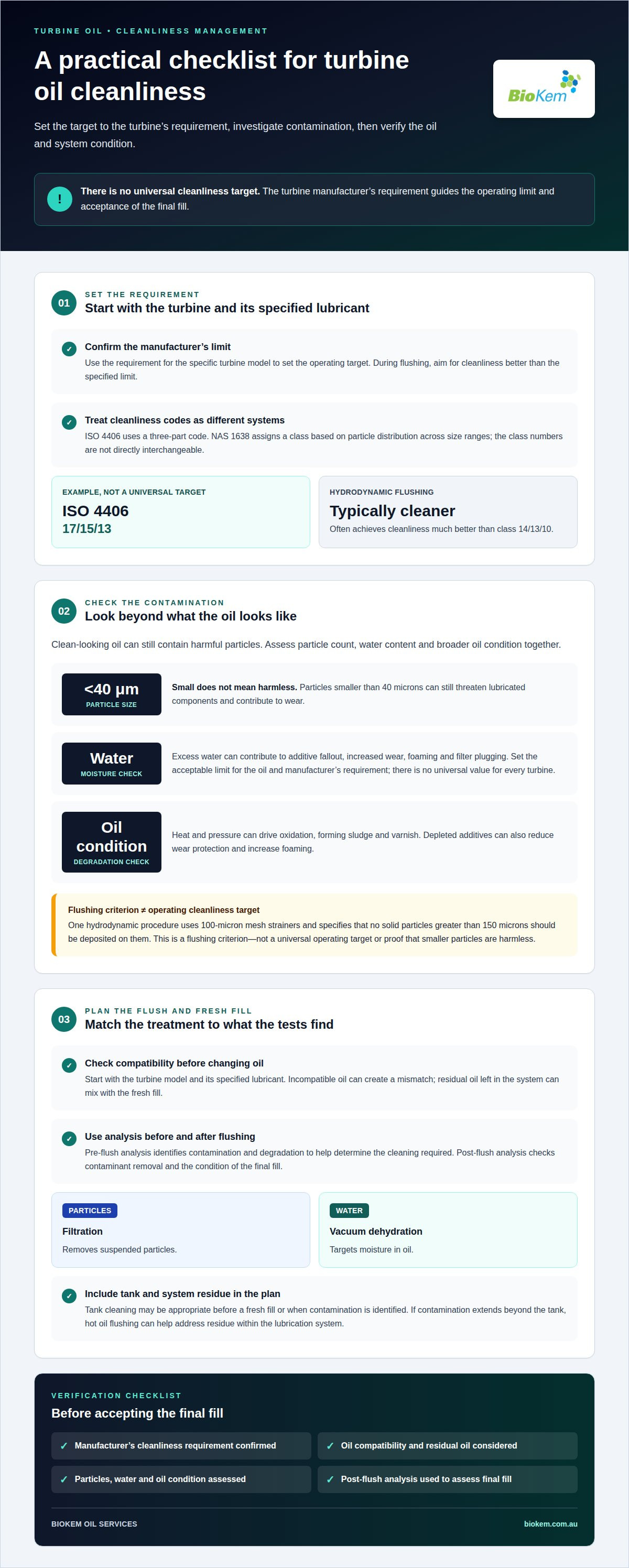
Turbine oil cleanliness requirements
Set the operating target according to the turbine manufacturer’s requirement, and make sure flushing achieves cleanliness better than that limit. Assess particle counts, water content and the oil’s condition together.
Particle Count and Cleanliness Classifications
ISO 4406 expresses particle contamination as a three-part cleanliness code, while NAS 1638 assigns a class using particle distribution across size ranges. They use different classification systems, so their class numbers aren’t directly interchangeable. ISO 4406 class 17/15/13 is an example, not a universal target. The manufacturer’s operating requirement should guide interpretation and acceptance.
Water Content Limits
A turbine oil water limit is the maximum moisture level allowed for that lubricant and system. There is no universal ppm or percent-saturation value for every turbine: the applicable target depends on the oil and the manufacturer’s requirement. Excess water can contribute to additive fallout, wear, foaming and filter plugging, so moisture control is part of cleanliness management.
Cleanliness and Water Testing
Particle-count testing evaluates solid contamination, while oil analysis can assess water and broader lubricant condition. Regular servicing provides opportunities to track changes; sampling is also relevant after maintenance, suspected contamination or flushing. Set the sampling schedule according to operating conditions and manufacturer guidance. Comparing results over time helps distinguish a persistent trend from a short-term change.
Filtration and Dehydration Methods
Filtration removes suspended particles, while vacuum dehydration targets water in oil. These methods address different contaminants, so the selected treatment should match the test results and required final condition. Vacuum dehydration can address moisture as part of turbine oil maintenance. For an assessment of cleanliness and treatment options, contact BioKem Oil Services.
BioKem Oil Services: Tank Cleaning
BioKem Oil Services provides tank cleaning when residue or settled contamination could compromise turbine oil cleanliness. Tank cleaning can form part of a broader maintenance approach, particularly before a fresh fill or after contamination is identified. The appropriate work depends on the oil’s condition and the equipment’s needs.
When contamination extends beyond the tank, hot oil flushing can help address residue within the lubrication system. Vacuum dehydration treats water contamination, while varnish mitigation addresses oil-degradation deposits. These services target different conditions, so oil analysis findings help guide the response instead of relying on a single cleaning method.
If turbine oil cleanliness or tank condition is affecting maintenance planning, contact BioKem Oil Services to discuss your requirements.
Make oil condition part of planned maintenance
The question of how clean turbine oil actually needs to be is most useful when it guides maintenance decisions, not just a single acceptance check. Relate the cleanliness target to the equipment’s operating needs, then use oil-condition results to determine the next action. This helps teams plan treatment around the contamination present and the system’s condition.
BioKem Oil Services provides Hot Oil Flushing, Varnish Mitigation and Vacuum Dehydration for different oil and system conditions. Selecting the appropriate intervention supports a considered maintenance plan and a clear basis for assessing the oil afterwards.
Plan your next turbine oil maintenance step with BioKem Oil Services. Contact the team to discuss your requirements and develop a practical plan for your equipment.
Frequently Asked Questions
What ISO 4406 cleanliness code is recommended for turbine oil?
The practical answer to how clean turbine oil actually needs to be depends on the turbine manufacturer’s requirement. There isn’t one ISO 4406 code that applies to every turbine. Class 17/15/13 is an example, not a universal recommendation. During flushing, the target should be cleaner than the manufacturer’s specified limit. This keeps an example from being mistaken for an operating specification.
What cleanliness levels do turbine manufacturers specify for different turbine types?
Specified cleanliness levels depend on the turbine and its lubrication system, so do not automatically apply a code for one type of equipment to another. The applicable manufacturer’s documentation for the equipment and lubricant determines how clean the oil needs to be. For example, a gearbox and another turbine lubrication circuit may have different requirements. Use the relevant specification when assessing oil condition or planning maintenance.
What causes particulate and water contamination in turbine oil?
Particulate contamination can come from dirt, component wear and debris left in the lubrication system. Water can enter or accumulate in the oil, while heat and pressure can contribute to degradation and deposits. These contaminants may occur together, so an oil sample can identify the condition more reliably than appearance alone. Use the findings to guide suitable maintenance or treatment.
What Australian standards, manufacturer guidance or maintenance practices apply to turbine oil cleanliness?
For Australian turbine maintenance, use the equipment manufacturer’s cleanliness requirement as the operating reference. ISO 4406 provides a particle cleanliness classification, but it doesn’t set one universal target for every turbine. Regular oil-condition monitoring can track changes, while analysis before and after flushing helps assess the oil and treatment outcome. The maintenance plan should reflect the turbine’s requirements and service conditions.
How often should turbine oil be sampled and tested for cleanliness?
Sample and test during regular servicing, and after maintenance, suspected contamination or flushing. Set the schedule according to operating conditions and the manufacturer’s guidance.

Article by
James McAllister
James McAllister is an industry professional with BioKem Oil Services, specialising in lubrication reliability, oil filtration, contamination control and asset performance. Drawing on BioKem's extensive field experience across turbines, compressors, hydraulic systems and critical rotating equipment, James writes practical, insight-driven articles that help maintenance and reliability teams improve equipment performance, extend asset life and reduce operational risk.