


A lubrication credential is most useful when it matches the work you do. ICML certification is helpful for lube techs who want to build structured knowledge in lubrication practice and demonstrate relevant skills. The right pathway depends on whether your role focuses on hands-on lubrication, machinery analysis or laboratory oil analysis.
For technicians who already work with lubricants, formal recognition can complement practical experience, but it does not replace it. This guide explains the International Council for Machinery Lubrication (ICML), the maintenance roles its certifications serve and how these credentials are recognised across industries and regions. It also outlines the Machine Lubricant Technician pathway and how lubrication knowledge connects to equipment reliability and oil condition management.
Key Takeaways
- Match an ICML pathway to your day-to-day responsibilities, whether they centre on lubrication tasks, machinery analysis or laboratory work.
- Consider how an internationally oriented credential may support your professional profile across industries and regions.
- Review the certification’s defined body of knowledge to understand which practical skills and technical topics it assesses.
- Connect staff capability with equipment care by understanding how oil filtration and certification can support lubricant condition management.
Course audience and relevant maintenance roles
ICML certifications are intended for people working in machinery lubrication, including technicians, engineers, operators, tradespeople and chemical managers. A technician responsible for lubricant selection may need different knowledge from an engineer interpreting condition-monitoring results. ICML’s vendor-neutral, not-for-profit approach supports learning across equipment and lubricant brands. Its courses cover practical tasks such as contamination prevention, sampling and handling, helping workers connect routine lubrication with asset condition.
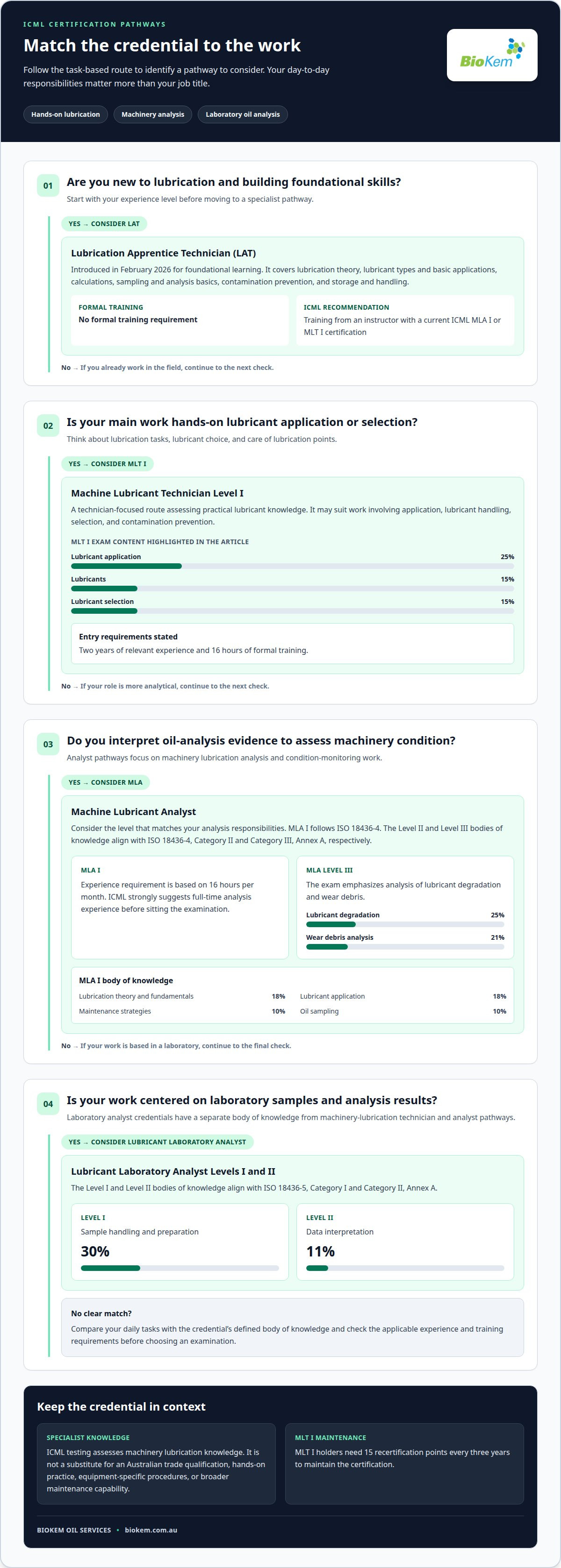
Prerequisites depend on the credential. Most ICML certification programs require one or two years of experience in the field for which certification is sought. For Machine Lubricant Technician Level I (MLT I), candidates need two years of relevant experience and 16 hours of formal training. The Machine Lubricant Analyst Level I experience requirement is based on 16 hours per month, and ICML strongly suggests full-time analysis experience before candidates sit that examination.
Newer entrants can consider the Lubrication Apprentice Technician (LAT) certification, introduced in February 2026. LAT covers lubrication theory, lubricant types, basic applications and calculations, sampling and analysis basics, contamination prevention, and storage and handling. It has no formal training requirement, although ICML recommends training delivered by instructors holding a current ICML MLA I or MLT I certification. This pathway can help a trainee master foundational practices before taking on more independent duties.
Choose a pathway based on your tasks, not your job title alone. A tradesperson managing grease points may benefit from technician-focused training, while staff who interpret oil reports may need an analyst pathway. Chemical managers can apply lubrication and storage principles to inventory and handling decisions. Before choosing an examination, compare your daily tasks with the credential’s subject matter and consider the relevant experience and training requirements.
Industry and regional recognition
The International Council for Machinery Lubrication (ICML) has provided credentials for lubrication maintenance and management personnel since 2001. Its vendor-neutral, not-for-profit focus gives the credential a defined connection to machinery lubrication, oil analysis and condition monitoring. Employers can use that shared body of knowledge to assess technical fundamentals across different equipment and lubricant brands.
ICML certification is a specialist credential, not a substitute for an Australian trade qualification. The two serve different purposes: a trade qualification recognises broader occupational training, while ICML testing assesses machinery lubrication knowledge. Australian employers may value certification for roles involving lubricant selection, contamination control, analysis or reliability. Its relevance still depends on the job’s requirements and how closely the credential matches the daily duties.
Pay outcomes aren’t a fixed Australian measure. Studies cited for ICML MLT I holders suggest salary increases of 15-25% within two years of certification, but that figure does not establish an Australian outcome. Job prospects depend on experience, responsibilities and employer needs; the credential can demonstrate relevant knowledge, not guarantee a role or pay rise.
There are limits to consider. Certification doesn’t replace hands-on practice, equipment-specific procedures or broader maintenance capability. MLT I also requires relevant experience and training, and holders need 15 recertification points every three years to maintain it. ICML’s 2020 John R. Battle Award for Lubrication Excellence, earned by Blue Buffalo’s Heartland Pet Food plant, illustrates recognition of lubrication programs, not a guarantee that every credential receives identical employer recognition. For teams linking engine lubrication and oil analysis with asset reliability, discuss your machinery lubrication priorities.
What does ICML certification cover for lubrication technicians?
ICML offers skill certification testing in machine condition monitoring, lubrication and oil analysis. For hands-on technicians, the Machine Lubricant Technician Level I (MLT I) exam assesses practical lubricant knowledge. Lubricant application accounts for 25% of its content. Lubricants and lubricant selection each account for 15%, linking product choice with correct use.
The analyst pathways focus on different levels of technical assessment. The Machine Lubricant Analyst Level I program follows ISO 18436-4. The Level II and Level III Machinery Lubrication Analyst bodies of knowledge align with ISO 18436-4, Category II and Category III, Annex A, respectively. Level III places 25% on analysing lubricant degradation and 21% on wear debris analysis. Those topics help analysts interpret evidence of lubricant and machine condition.
Laboratory analysis has a separate pathway. The Level I and Level II Lubricant Laboratory Analyst bodies of knowledge align with ISO 18436-5, Category I and Category II, Annex A. Level I allocates 30% to sample handling and preparation, while Level II allocates 11% to data interpretation. These distinctions matter: technicians managing lubrication points need different emphasis from laboratory staff handling samples and results.
Use the exam’s defined body of knowledge to match certification level with actual duties. For example, a technician responsible for lubricant application may focus on MLT I, while an analyst interpreting degradation indicators may consider advanced analyst content. Certification assesses knowledge; applying it consistently still depends on sound sampling, equipment procedures and workplace practice. To connect oil-condition findings with asset maintenance, discuss your oil analysis requirements.
ICML Level I MLA body of knowledge allocates 18% to lubrication theory and fundamentals, 18% to lubricant application, 10% to maintenance strategies and 10% to oil sampling. Level III MLA allocates 20% to lubrication fundamentals. The LAT exam is based on a defined Body of Knowledge outlining core concepts.
BioKem Oil Services: Batch Oil Filtration & Certification
BioKem Oil Services provides Batch Oil Filtration & Certification when stored or in-service lubricant needs filtration and certification as part of its management. This operational support complements technician knowledge: training develops skills, while filtration addresses oil condition. Where equipment needs a different treatment, Hot Oil Flushing, Varnish Mitigation and Vacuum Dehydration address distinct oil-maintenance requirements.
Consider oil treatment or analysis when oil condition or contamination raises concerns about lubricant use in critical machinery. The appropriate approach depends on the oil and equipment requirements, not an employee’s certification alone. Filtration can form part of a broader maintenance response alongside monitoring and sound handling practices.
For help with an oil-maintenance requirement, contact BioKem Oil Services.
Turn lubrication knowledge into practical action
For lube techs, ICML certification is helpful when its knowledge supports daily decisions and equipment care. Connect training with the condition of the machinery you maintain, then identify where oil treatment or analysis could support your maintenance plan. Training and practical oil management work best as complementary parts of a reliability strategy.
BioKem Oil Services offers Hot Oil Flushing, Varnish Mitigation and Vacuum Dehydration for specific lubricant and equipment needs. The suitable approach depends on the issue being addressed and the system involved. If you’re assessing an oil-maintenance requirement, contact BioKem Oil Services to discuss the work. Build on your skills with a practical focus, and keep equipment reliability at the centre of your next decision.
Frequently Asked Questions
What Is ICML?
ICML stands for the International Council for Machinery Lubrication, an organisation that develops credentials for machinery lubrication and related technical work. Its certification tests assess knowledge in areas such as lubricant management and oil analysis. For technicians, the credential can demonstrate assessed subject knowledge, while practical competence also develops through experience with equipment and site procedures.
Which ICML certifications are relevant to lube technicians?
The Machine Lubricant Technician (MLT) credential suits roles centred on lubricant application and routine lubrication tasks. ICML certification can help lube techs demonstrate knowledge relevant to this work. Technicians who interpret oil-condition data may consider the Machinery Lubrication Analyst (MLA) pathway, while laboratory staff who handle samples may find the Lubricant Laboratory Analyst (LLA) pathway more relevant. Choose based on job tasks, not title alone.
Do Australian employers require or prefer ICML certification for lubrication technicians?
Whether ICML certification is helpful for lube techs in Australia depends on the employer and role. A position focused on lubrication analysis may value relevant analytical knowledge, while hands-on maintenance work may prioritise practical experience and task-specific capability. Read the role’s stated criteria and treat certification as evidence of specialist knowledge, not an automatic substitute for other qualifications or experience.

Article by
James McAllister
James McAllister is an industry professional with BioKem Oil Services, specialising in lubrication reliability, oil filtration, contamination control and asset performance. Drawing on BioKem's extensive field experience across turbines, compressors, hydraulic systems and critical rotating equipment, James writes practical, insight-driven articles that help maintenance and reliability teams improve equipment performance, extend asset life and reduce operational risk.