

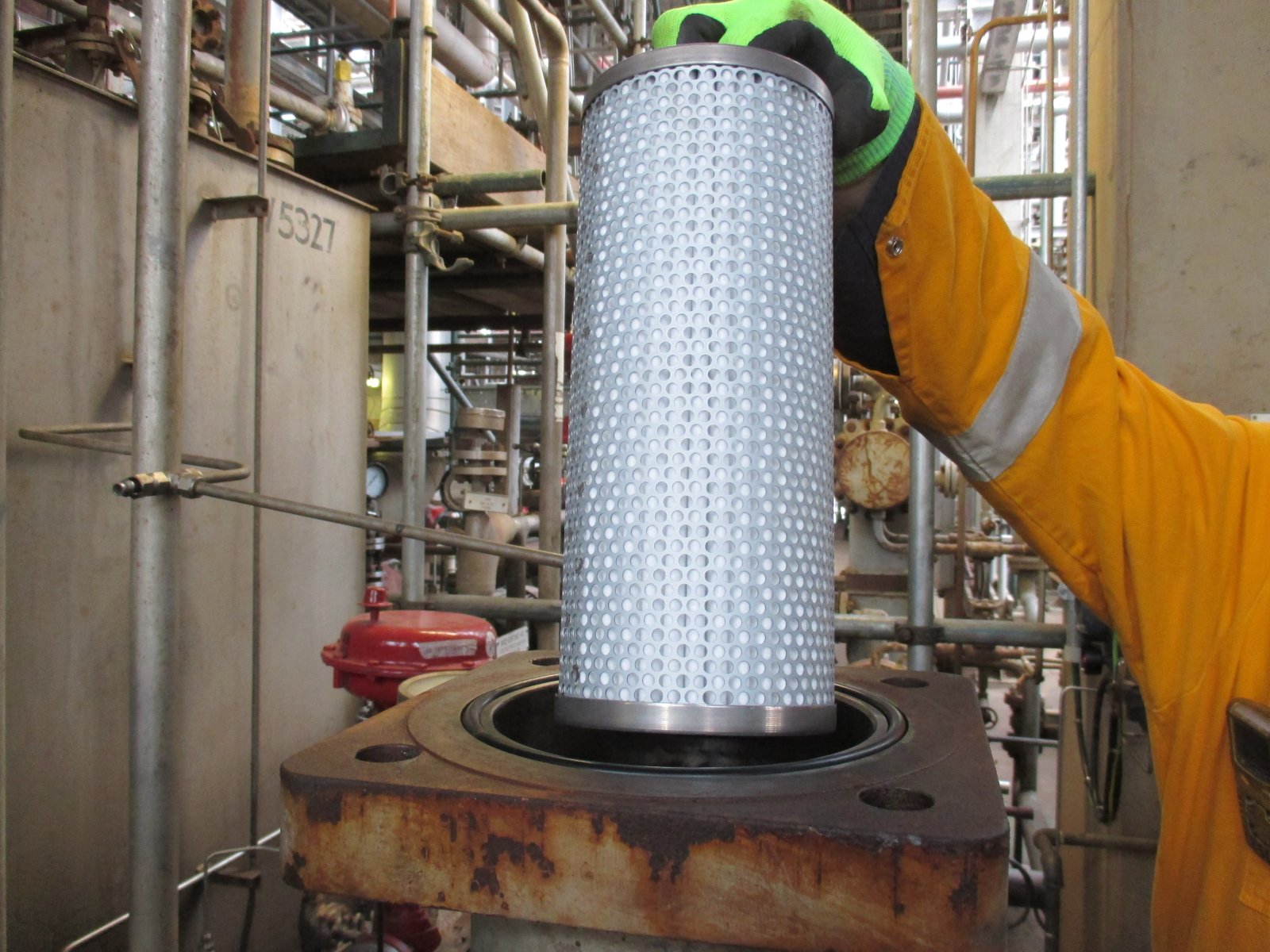
Clean oil depends on separating droplets, not just trapping solids. The working principle of an industrial oil coalescer is to capture fine liquid droplets on specialised fibres, where they combine into larger droplets that separate from the surrounding fluid and drain under gravity. This helps reduce water or oil carryover that can affect equipment and product quality.
If you know fine contamination can cause downstream problems, the key is understanding how coalescence turns droplets that are difficult to separate into larger ones. This article explains how droplets are collected, combine and drain, and why the process matters for equipment protection and product purity. It also distinguishes liquid-liquid coalescers from systems that remove liquid aerosols from gas, helping you see where the principle applies in industrial operations.
Key Takeaways
- Understand how particulate removal, droplet coalescence and separation work together in a filtration system.
- See how operating conditions influence droplet growth and gravity drainage, including the role of electrostatic coalescence.
- Learn why effective liquid separation can help protect equipment and maintain product purity downstream.
- Recognise when oil flushing or related fluid-maintenance support can complement filtration in an industrial oil system.
What Is a Coalescing Filter & How Does It Work?
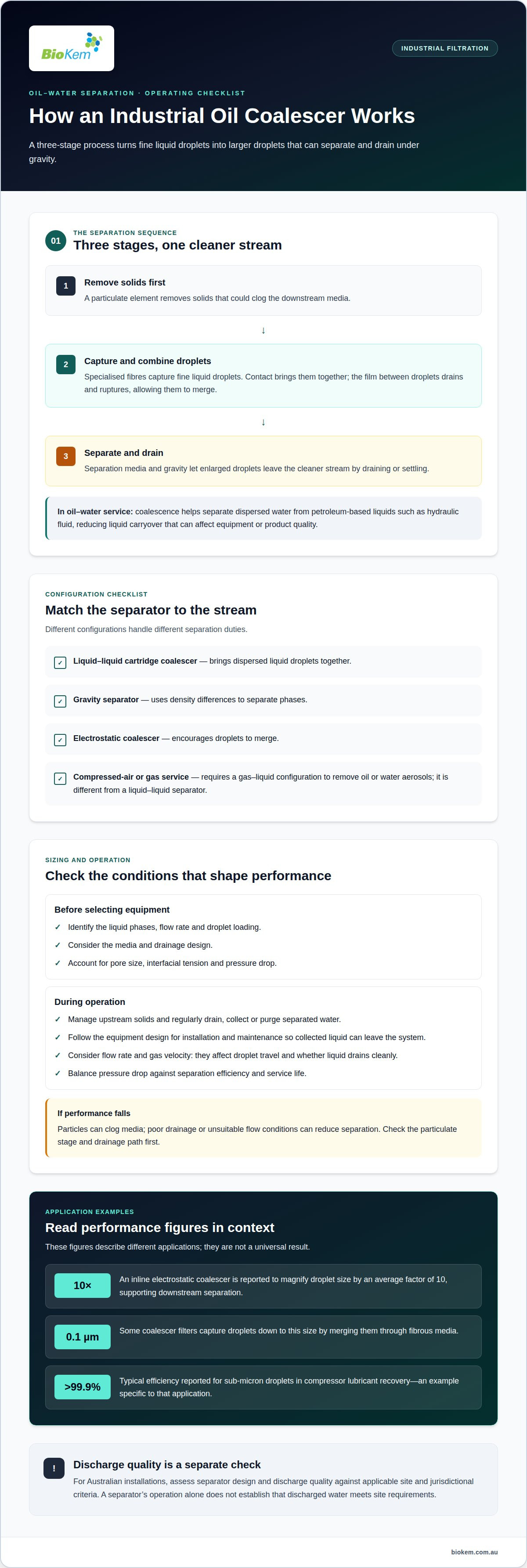
Industrial coalescing filtration typically has three stages. First, a particulate element removes solids that could clog downstream media. Next, fibres capture fine liquid droplets and help them combine. Finally, separation media and gravity allow the larger droplets to drain from the cleaner stream. In an oil-water system, this process can help separate dispersed water from petroleum-based liquids such as hydraulic fluid.
Common configurations include liquid-liquid cartridge coalescers, gravity separators and electrostatic coalescers. Cartridges bring dispersed droplets together, gravity separators use density differences, and electrostatic units encourage droplets to merge. Compressed-air systems use a different liquid-gas configuration to remove oil or water aerosols.
The principle is straightforward: droplets approach and contact the media, the film between them drains, then it ruptures so the droplets coalesce. Larger droplets separate more readily from the surrounding liquid and drain or settle under gravity.
For Australian installations, assess separator design and discharge quality against the applicable site and jurisdictional discharge criteria. A separator’s operation alone does not establish that discharged water meets site requirements.
Size an oil coalescer to suit the liquid phases, flow rate, droplet loading, media and drainage design. Pore size, interfacial tension and pressure drop also affect separation performance.
During operation, manage upstream solids and regularly drain, collect or purge separated water. Follow the equipment design for installation and maintenance to ensure collected liquid can leave the system.
Clogging from particles, poor drainage or unsuitable flow conditions can reduce performance. Check the particulate stage and drainage path first; where varnish also affects lubricant cleanliness, varnish in lubricant oil is a related oil-quality concern.
Droplet collection, coalescence and gravity drainage
Flow conditions affect whether collected droplets drain or remain entrained. In liquid-liquid service, coalescence helps turn dispersed water into separable droplets.
Droplet Capture and Coalescence
A coalescing filter captures dispersed droplets on fibrous media. Contact lets them approach, deform, drain the intervening film, then merge when it ruptures. The National Center for Biotechnology Information reports that an inline electrostatic coalescer can magnify droplet size by an average factor of 10, supporting downstream separation. Larger droplets separate more readily from the continuous liquid, limiting water carryover in petroleum-based applications.
Gravity Drainage and Droplet Sizes
Gravity drainage occurs when enlarged droplets move out of the flowing phase. Some coalescer filters capture droplets down to 0.1 micron by merging them through fibrous media. In compressor lubricant recovery, coalescing filters typically achieve greater than 99.9% efficiency for sub-micron droplets. These examples describe different applications, so droplet size and equipment function matter when interpreting performance.
Flow rate and gas velocity affect how droplets travel through media and whether liquid drains cleanly. Face velocity may affect coalescer performance. Lower continuous-phase viscosity can shorten film-drainage time, helping droplets merge. In gas production, liquid aerosols require a gas-liquid configuration rather than a liquid-liquid separator. Pressure drop should also be weighed against separation efficiency and service life. Discussing flow, loading and drainage with BioKem’s team can help relate the mechanism to a specific filtration application.
Equipment protection and product purity
In fuel-gas service, coalescers remove water aerosols, oil mist and sub-micron particles from the process stream. Cleaner, drier gas helps protect gas-turbine combustion chambers from corrosion and fouling. Contaminants carried downstream can affect equipment condition and disrupt subsequent operations.
Compressed-air systems face a different risk: oil and water aerosols can accumulate on pipes, joints and fixtures. Removing these liquid contaminants helps prevent them from travelling through the distribution network. In refining and petrochemical processes, gas-liquid separation can help manage liquid contamination and support equipment protection.
Oil-water separation supports equipment and environmental protection. In refining, keeping dispersed water out of petroleum-based liquid can help maintain product quality, while separating oil from water reduces the risk of oil reaching waterways. Because oil is less dense than water, heavier oil droplets can rise to the surface; the separated phases still need appropriate management.
Microfiltration using coalescers can achieve product purity of up to 95%, while coalescing filters can remove contaminants from downstream oil and gas assets with efficiencies of up to 99.98%. These figures describe different applications, not a universal result. A useful selection step is to identify which contaminant threatens the asset or product, then match the separation duty to the stream. For help connecting filtration needs with equipment protection, discuss your application with BioKem.
For compressed-air systems, coalescer filters remove oil and water aerosols, helping prevent lubricants, condensed water and oils from accumulating on pipes, joints and fixtures.
BioKem Oil Services: Hot Oil Flushing
BioKem Oil Services provides Hot Oil Flushing for industrial oil systems that need cleaning beyond droplet separation. It may be relevant when contamination in piping or equipment threatens oil cleanliness, such as during maintenance or commissioning. Coalescers separate liquid phases; flushing addresses cleanliness within the oil circuit, so the processes serve different purposes.
For ongoing oil-condition concerns, Oil Analysis can help assess the fluid, while Vacuum Dehydration and Varnish Mitigation address other oil-maintenance needs. The right approach depends on the issue affecting the system and the intended maintenance outcome. These services can complement a filtration strategy without changing how coalescence works.
Explore Hot Oil Flushing or contact BioKem Oil Services to discuss your industrial oil system.
Plan Your Next Oil-Maintenance Step
Understanding the industrial oil coalescer working principle can help guide your next maintenance decision: identify the oil-quality issue, then match the response to the system’s needs. Separation equipment addresses liquid carryover, while broader oil care may require a complementary approach.
BioKem Oil Services provides Hot Oil Flushing, Varnish Mitigation and Vacuum Dehydration for industrial oil maintenance. Each service addresses different fluid and system concerns, so the appropriate next step depends on the problem you need to resolve. Clear information about the equipment and oil condition helps make the discussion practical.
Discuss your oil-maintenance requirements with BioKem Oil Services and move forward with a considered plan for your equipment.
Frequently Asked Questions
How does an oil water separator work?
An oil-water separator directs a mixed stream into a chamber where the liquids separate according to their different densities. Free oil tends to rise while water settles; coalescing media can help dispersed oil droplets form larger drops. The separated phases need appropriate collection and handling to reduce the risk of oil entering waterways.
What are the key characteristics that differentiate coalescers and separators?
A coalescer promotes droplet growth; a separator provides space or a mechanism to remove the resulting liquid phase. A vessel using gravity relies on density differences, while a cartridge coalescer uses specialised media. Some gas filter-separators combine stages, first removing bulk liquid and solids, then treating finer aerosols.
What are the principles and mechanisms of coalescers and separators?
Coalescers bring dispersed droplets into contact so they can merge, while separators use differences between phases to move them apart. Performance depends on factors such as media pore size and the liquids’ interfacial tension. For oil and water, which do not readily mix, these properties influence how easily droplets combine and separate.
Where are coalescers used?
Coalescers are used in oil and gas processing, manufacturing, marine operations and compressed-air systems. For example, a liquid-liquid unit can remove dispersed water from petroleum-based hydraulic fluid, while a gas-liquid configuration can capture lubricant or water aerosols downstream of a compressor. The process stream determines the equipment arrangement.
How does an industrial oil coalescer work step by step?
An industrial oil coalescer guides contaminated fluid through a sequence: dispersed droplets encounter coalescing media, make contact and merge, then separate from the main stream. In an oil-water application, the enlarged water droplets can settle or drain into a collection area. Effective operation also depends on keeping the drainage path clear.

Article by
James McAllister
James McAllister is an industry professional with BioKem Oil Services, specialising in lubrication reliability, oil filtration, contamination control and asset performance. Drawing on BioKem's extensive field experience across turbines, compressors, hydraulic systems and critical rotating equipment, James writes practical, insight-driven articles that help maintenance and reliability teams improve equipment performance, extend asset life and reduce operational risk.