

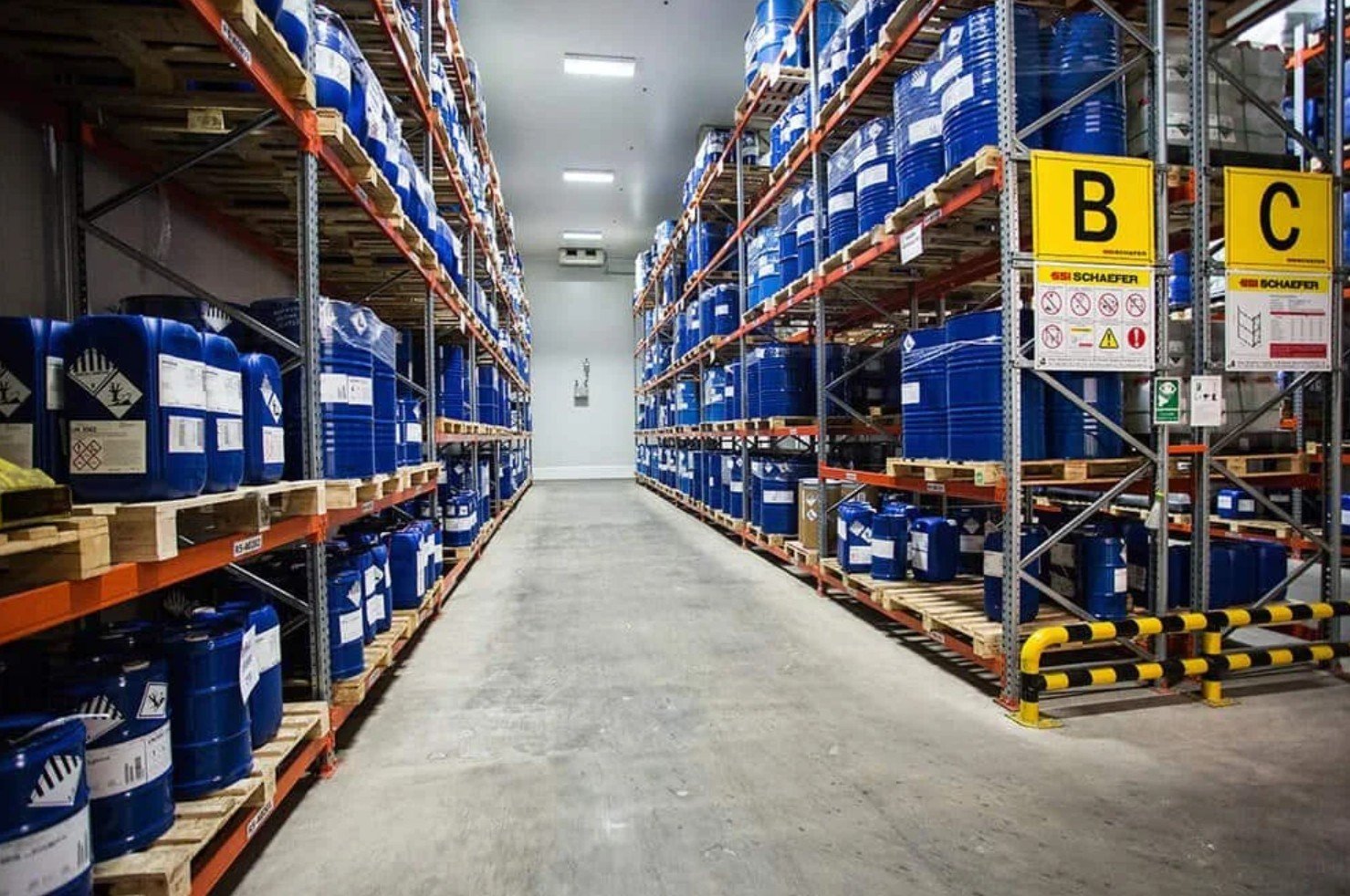
Re-qualify subcontractors annually or every two years. There is no universal regulatory cycle, so set the timing of your pre-qualification checklist for industrial service providers according to each project’s risks and requirements. Keep credentials and insurance current, and review the assessment when the work or site conditions change.
Paperwork is only one part of a reliable assessment. Specialist work can involve hazardous chemicals and equipment, so induction should cover safe handling, storage and use, along with general, job-specific and site-specific requirements. This checklist outlines what to review across qualifications, licences, registrations, insurance, safety systems and training, and how to set a practical re-qualification schedule. It helps you assess capability before work begins and keep safety controls relevant throughout the project.
Key Takeaways
- Use contractor risk assessments to identify and prioritise workplace hazards, then define controls before work begins.
- Review ISO 9001 certificate scope and expiry, and consider ISO 14001 evidence when assessing environmental management arrangements.
- Collate safety history, written policies and procedures, training records, and evidence of the contractor’s capability and resources.
- Make induction relevant to the job and site, including safe chemical handling, specialised equipment use, and clear communication channels.
Qualifications, licences, registrations and insurance
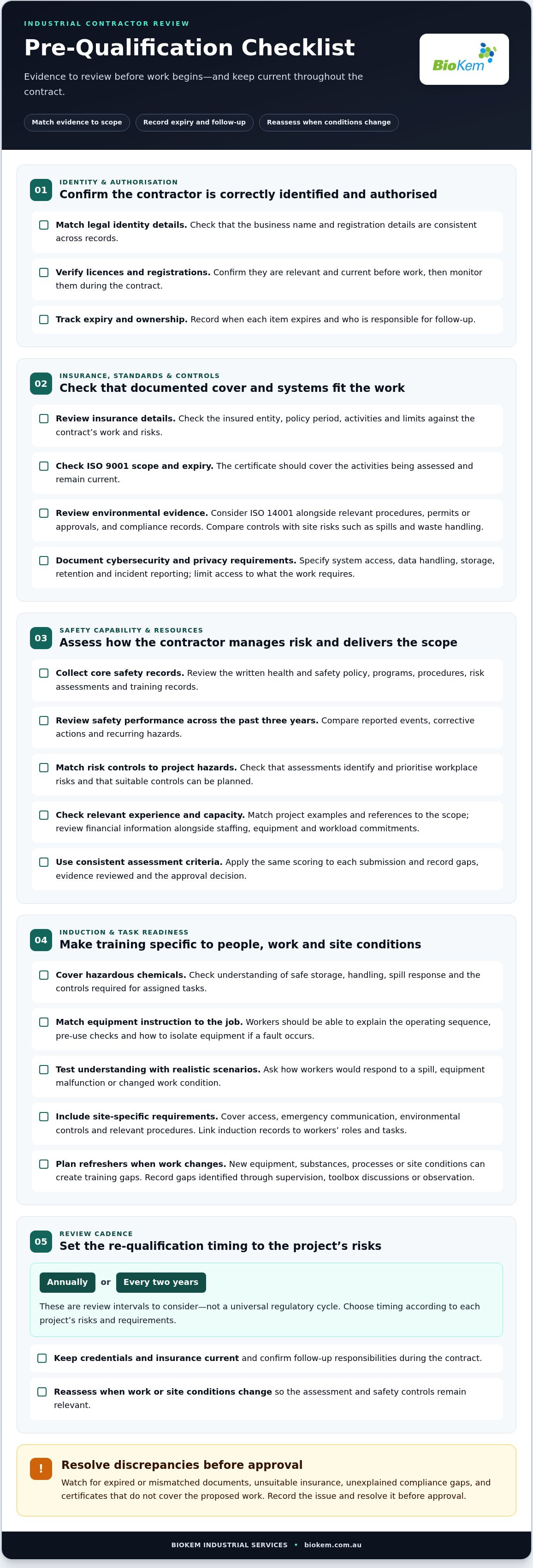
Check each contractor’s legal identity, work credentials and risk controls against the proposed scope. Record what you reviewed, when each item expires and who is responsible for follow-up during the contract.
- Match the business name and registration details across its records. Consistent details help connect licences, insurance and certificates to the entity performing the work.
- Confirm relevant licences and registrations are current before work and during the contract. Changes or expiry can affect whether the contractor remains appropriately authorised for its scope.
- Review insurance documents for the insured entity, policy period, activities and limits. Compare the cover with the contract’s risks and work, rather than relying on a certificate alone.
- Check ISO 9001 certificates for scope and expiry. The stated scope should cover the activities being assessed, and the certificate should remain current.
- Review ISO 14001 evidence alongside environmental procedures and compliance records. These documents help assess environmental management arrangements and how the contractor controls relevant impacts.
For environmental management, request the contractor’s ISO 14001 certificate, environmental procedures, relevant permits or approvals, and compliance records tied to the work. Compare the documented controls with the site’s environmental risks, such as spill prevention and waste handling.
For cybersecurity and privacy, document requirements for system access, data handling, storage, retention and incident reporting. Limit access to what the work requires, and record responsibilities in the contract and induction.
Red flags include expired or mismatched documents, unsuitable insurance, unexplained compliance gaps and certificates that do not cover the proposed work. Resolve discrepancies before approval, as they may indicate gaps in capability or risk controls.
Collating contractors’ credentials and qualifications
Create a separate evidence file for each contractor and match documents to the proposed work. A pre-qualification checklist should assess capability, capacity, resources and performance, as well as whether records are accurate and current.
For Australian industrial work, request the contractor’s written health and safety policy, safety programs, procedures, risk assessments and training records. Include pre-project hazard analyses, toolbox meeting records, new-worker safety orientations and evidence of ongoing training.
- Review safety performance and incident history across the past three years. Compare reported events, corrective actions and recurring hazards to understand how risks are managed.
- Assess controls against the hazards identified for the project. Contractor risk assessments should identify and prioritise workplace risks so suitable mitigation measures can be planned.
- Match experience and references to the actual scope. Relevant project examples and past-performance feedback provide evidence of delivery capability.
- Assess capacity and financial resilience using consistent records. Review available financial information alongside staffing, equipment and workload commitments to judge whether resources match the project.
Apply the same scoring criteria to each submission, then record any gaps, the evidence reviewed and the approval decision. A contractor safety pre-qualification questionnaire can structure checks on regulatory compliance history, written safety systems and work practices.
Pre-qualify against the scope, assess risks, compare evidence, document approval and reassess when circumstances change. An annual review of the contractor safety program can cover qualification processes, multidisciplinary risk classification and controls for hazards contractors bring to manufacturing sites.
For industrial oil-system work, discussing project requirements with BioKem Oil Services can help clarify the service scope and supporting evidence needed for your assessment.
Hazardous chemicals and specialised equipment training
Induction should address general, job-specific and site-specific training needs. For hazardous chemicals, assess whether workers understand safe storage, handling, spill response and the controls required for their assigned tasks. Training should reflect the actual substances and processes involved, rather than rely on a generic site presentation.
For specialised equipment, match instruction to the equipment operators will use and the hazards they may encounter. Check that workers can explain the operating sequence, identify pre-use checks and describe how to isolate equipment if a fault occurs. Practical demonstrations can help distinguish familiarity from task-ready competence.
- Compare training records with the work scope. Confirm each worker’s training covers the chemicals, equipment and tasks assigned to them.
- Test understanding with realistic scenarios. Ask workers to describe how they would respond to a spill, equipment malfunction or changed work condition.
- Review site-specific induction content. Include access arrangements, emergency communication, environmental controls and relevant site procedures.
- Plan refresher instruction when work changes. New equipment, substances, processes or site conditions can create training gaps that the original induction did not address.
Link induction records to workers’ roles and the tasks they perform. During the job, supervisors can reinforce controls through toolbox discussions and observation, then record any gaps for follow-up. Clear communication channels also help workers raise hazards before conditions escalate.
Where industrial oil filtration requires equipment, discuss the project’s equipment needs through a conversation about oil filtration equipment.
BioKem Oil Services: Hot Oil Flushing
BioKem Oil Services provides Hot Oil Flushing for industrial oil systems when flushing is required for maintenance or preparation for operation. Consider the service when system condition, contamination concerns or project requirements make flushing relevant to equipment reliability and clean-oil objectives.
Oil Analysis can help assess fluid condition, while Varnish Mitigation and Vacuum Dehydration address other oil-maintenance needs. The right service depends on the issue identified and the system’s requirements, so define the scope, equipment and desired outcome before planning the work. Clear project information helps align the service with site procedures and contractor controls.
To discuss Hot Oil Flushing for your industrial system, contact BioKem Oil Services.
Turn qualification into a stronger maintenance plan
Make your assessment an active part of project planning, rather than a file that goes untouched after approval. A pre-qualification checklist for industrial service providers can connect contractor capability to the operational outcome you need, from preparing equipment for service to addressing oil-condition concerns. Keep the intended result clear so technical discussions focus on the work that matters.
For industrial oil systems, BioKem Oil Services provides Hot Oil Flushing, Varnish Mitigation and Vacuum Dehydration. These services address different maintenance needs. Describe the system concern and project objective to give the conversation a practical starting point, without assuming one solution fits every situation.
Contact BioKem Oil Services to discuss your oil-system requirements, and move forward with a maintenance plan grounded in your operational needs.
Frequently Asked Questions
How often should subcontractors be re-qualified?
Schedule a review annually or every two years, and reassess sooner if the work scope, site conditions or risk profile changes. A serious incident, extended break in work or change in key personnel can also prompt a focused review. Record the review date and approval status in the contractor register so project teams know when reassessment is due.
What insurance should a subcontractor have?
Choose insurance cover that matches the subcontractor’s work and the contract’s allocation of risk. Common categories to assess include public liability, workers’ compensation and, when the scope includes professional advice or design, professional indemnity. For equipment-intensive work, consider how the contract addresses damage to equipment or property. Record the policy period, insured entity and relevant exclusions.
What information should an industrial service provider pre-qualification checklist include?
Include business identity, scope-specific experience, available personnel and equipment, subcontracting arrangements, safety systems, environmental controls and insurance details. Add project interfaces, escalation contacts and corrective-action records so the assessment reflects how work will be delivered on your site. A pre-qualification checklist for industrial service providers is most useful when each requested document has an owner and review date.
What Australian licences, permits, and certifications are required for industrial service providers?
Requirements depend on the work activity, site and applicable jurisdiction, so list the authorisations relevant to the contract scope rather than using one generic register. Record licence or permit scope, issuing details and currency. ISO 9001 and ISO 14001 certificates can support capability and environmental-management reviews, but certification should not be treated as a substitute for task-specific authorisations.
What insurance cover and minimum policy limits should industrial service providers have in Australia?
Set insurance types and limits against the contract, potential loss exposure, work location and equipment involved. There is no single figure that suits every industrial service contract. Specify required limits in procurement documents, then compare policy wording, exclusions and insured activities with the actual scope. Confirm that subcontracted work is covered by the insurance arrangements too.

Article by
James McAllister
James McAllister is an industry professional with BioKem Oil Services, specialising in lubrication reliability, oil filtration, contamination control and asset performance. Drawing on BioKem's extensive field experience across turbines, compressors, hydraulic systems and critical rotating equipment, James writes practical, insight-driven articles that help maintenance and reliability teams improve equipment performance, extend asset life and reduce operational risk.