

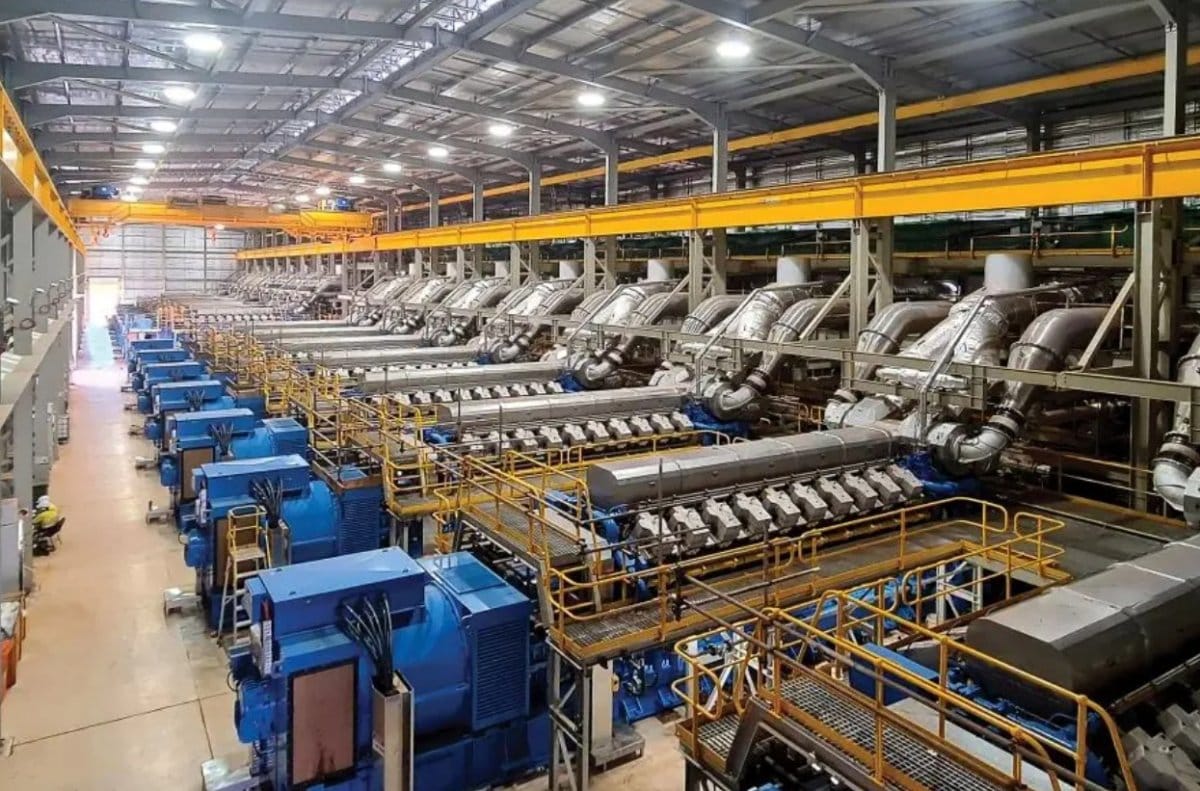
In 2026, unplanned IT downtime averages roughly $15,000 per minute, and it’s common for major outages to exceed $1 million. In this high-stakes environment, commissioning lube oil systems on new Bergen B36:45V20 gas-fired reciprocating engines data centres power generation teams deploy requires absolute technical precision from day one.
You already know you can’t afford bearing scoring, turbocharger damage, or voided OEM warranties when meeting strict Tier III and Tier IV handover deadlines. Managing construction debris, weld slag, and mill scale across complex external piping circuits presents a serious risk if your flushing velocity fails to dislodge bound contaminants.
This technical guide shows you how to establish high-velocity turbulent flushing protocols, achieve target Reynolds numbers, and validate fluid cleanliness against ISO 4406:2021 standards before the first engine crank. We examine the exact hydrodynamic mechanisms, ISO 16889-certified filtration practices, and verification steps necessary to ensure complete commercial power reliability.
Key Takeaways
- Understand why commissioning lube oil systems on new Bergen B36:45V20 gas-fired reciprocating engines data centres power generation assets deploy is essential for protecting tight journal clearances.
- Discover the specific baseline ISO 4406:2021 particle counts and OEM criteria needed to eliminate catastrophic bearing wipe before initial cranking.
- Learn why external high-velocity hot oil flushing skids outperform low-pressure mechanical engine pumps at lifting construction particulate and mill scale.
- Follow a step-by-step commissioning methodology covering mechanical bypasses, thermal cycling, dynamic flushing, and inline condition monitoring.
- Gain insight into how specialized Australian pre-commissioning teams deploy ISO 16889-certified filtration hardware to guarantee immediate commercial readiness.
Why Bergen B36:45V20 Lube Oil Cleanliness Governs Data Centre Power Reliability
Enterprise data centres demand uncompromised electrical uptime. With the Bergen B36:45V20 medium-speed engine generating up to 11.8 MW of responsive, highly efficient power, it serves as a critical pillar for facilities operating under Tier III and Tier IV uptime mandates. A single trip caused by an erratic oil pressure sensor or wiped journal bearing during a grid failure breaches service level agreements. For this reason, commissioning lube oil systems on new Bergen B36:45V20 gas-fired reciprocating engines data centres power generation assets rely on requires ruthless fluid purity before the fuel rack ever opens.
To visualize how these lubrication circuits protect rotating elements during initial operation, watch this engineering breakdown:
The Mechanical Demands of High-Output Medium-Speed Gas Engines
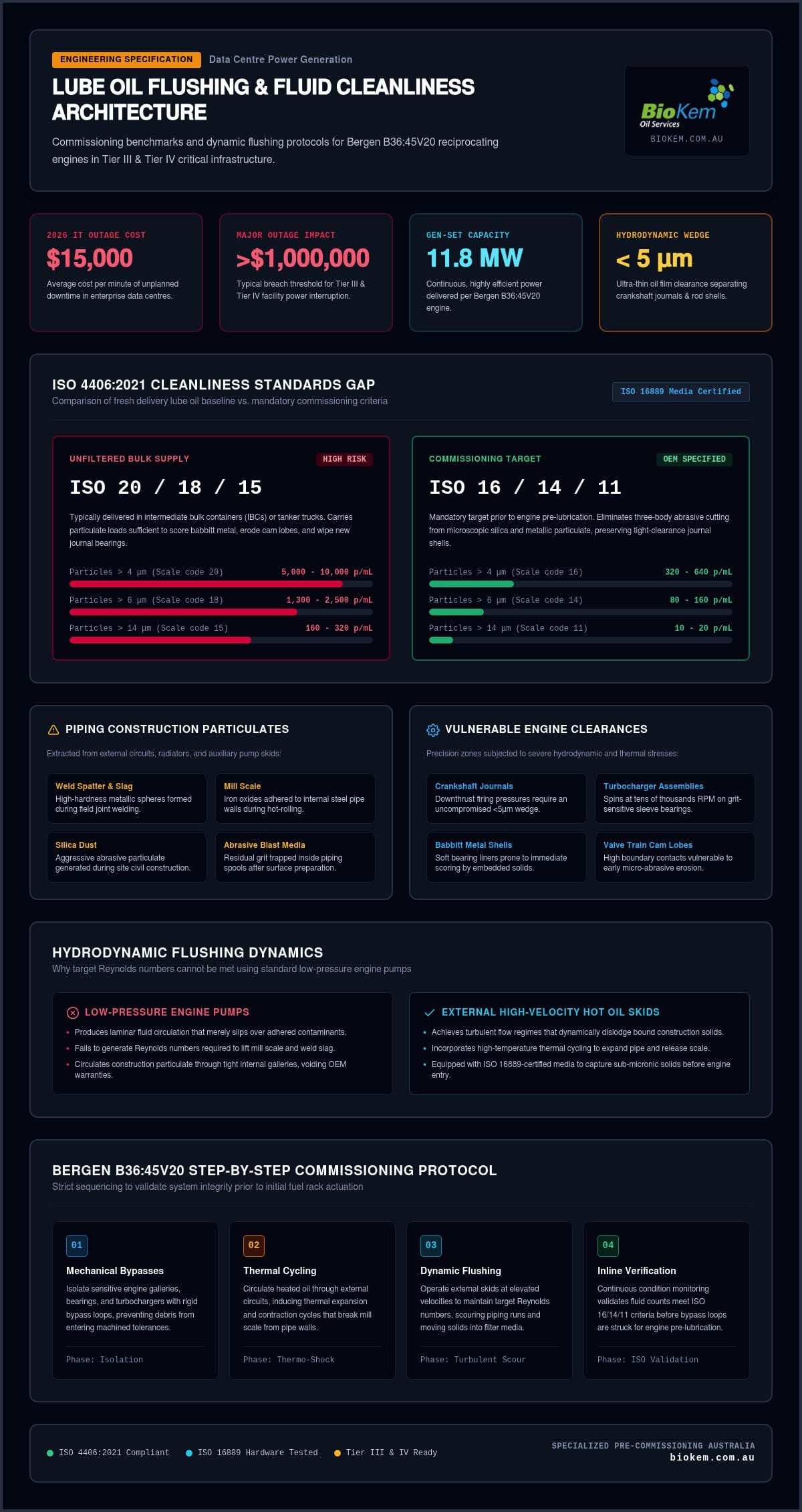
The Bergen B36:45V20 operates under extreme mechanical and thermal stresses. High peak cylinder firing pressures exert massive downward thrust onto crankshaft journals and connecting rod shells. These surfaces rely entirely on an ultra-thin hydrodynamic oil wedge, often measuring less than five microns thick. Turbocharger assemblies, spinning at tens of thousands of RPM, run on tight-clearance sleeve bearings that are acutely sensitive to sub-micronic grit. Contaminants entering through assembly joints or complex automatic lubrication systems rapidly score babbitt metal, erode valve train cam lobes, and trigger premature wear cycles on fresh surfaces.
Construction Contamination Hazards in New Power Generation Builds
New power island construction introduces aggressive particulate matter into external lubricating circuits. Long piping runs between the engine base, remote lubricating oil radiators, and auxiliary pump skids inevitably capture weld spatter, mill scale, abrasive blast media, and silica dust. When fluid begins to circulate, these loose solids migrate directly toward the engine header. Without advanced pre-filtration from an Australian distributor for oil filtration systems equipped with ISO 16889-certified media, hard particles embed directly into precision bearing galleries. The result is catastrophic bearing wiping, turbocharger seizure, and immediate cancellation of manufacturer warranties.
Critical Standards and Target Cleanliness for Bergen Reciprocating Engine Lubrication
Rigorous cleanliness baselines protect large medium-speed engines against early equipment degradation. When commissioning lube oil systems on new Bergen B36:45V20 gas-fired reciprocating engines data centres power generation projects mandate, fluid validation must surpass general industrial assumptions. Pristine pre-fill filtration coupled with dynamic, verified fluid circulation forms the only defensible barrier against early operational wear.
ISO 4406 Cleanliness Benchmarks for Commissioning
Fresh oil delivered in intermediate bulk containers or tanker trucks rarely satisfies engine commissioning standards. Delivered lube typically registers particle counts around ISO 20/18/15, which carries enough particulate load to destroy fresh journal bearings. Commissioning protocols for the Bergen B36:45V20 require filtering fluids down to at least ISO 16/14/11 prior to engine pre-lubrication. Using ISO 16889-certified filtration elements during dynamic circulation ensures that three-body abrasive cutting from microscopic silica and metallic particles cannot initiate.
Turbulent Flow Dynamics and Reynolds Number Requirements
Laminar fluid circulation merely slips past adhered contaminants. True mechanical cleaning demands turbulent flow within all interconnecting balance-of-plant pipe runs, oil coolers, and pre-lube distribution loops. Achieving a Reynolds number above 4,000 (Re > 4,000) generates the shear stress required to dislodge pipe scale and blast grit:
- Elevate fluid temperature: Heating the oil to 60°C to 70°C lowers kinematic viscosity, making high fluid velocity achievable.
- Boost linear velocity: Pumping rates must exceed normal operational flow by at least 20% to reach turbulent scouring velocities.
- Verify boundary agitation: Sustained turbulence breaks the boundary layer at the pipe wall, keeping dislodged particles suspended until they reach return filters.
Moisture, Varnish, and Chemical Integrity Parameters
Dynamic flushing must protect the physical and chemical properties of the lubricant. Thermal stress during prolonged circulation can initiate premature oxidation if flow isn’t managed carefully. Engineering studies like the Texas A&M research on In-Service Condition Monitoring of Turbine Oils demonstrate that establishing baseline chemical profiles is critical before initial operation. Relative humidity should stay well below 40% saturation to inhibit additive depletion and rust formation. If your facility requires independent testing or certified flushing hardware to verify these parameters, you can consult BioKem’s engineering team for turnkey site validation.
Comparing Commissioning Flushing Methodologies for Large Reciprocating Gen-Sets
Onboard Pump Circulation vs Dedicated External High-Flow Skids
Factory-fitted pre-lube pumps lack the mechanical displacement to generate turbulent scouring velocities through expanded external circuits. These standard pumps provide low-pressure laminar movement intended only for pre-start engine wetting. In contrast, purpose-built external rigs deliver elevated volumetric throughput combined with integrated heating systems. Deploying dedicated high-flow flushing skids equipped with ISO 16889-certified filtration elements ensures dynamic fluid shear, lifting dense weld spatter and drawing it out to external filter housings without starving remote pipe loops.
The operational differences between these two strategies are stark:
- Velocity control: Onboard pumps operate at fixed, lower flow rates; external rigs modulate flow to hit specific Reynolds numbers.
- Thermal management: Engine pre-heaters rarely elevate fluid above 40°C under flushing conditions, whereas external heat exchangers reach 70°C to drop viscosity.
- Filtration capacity: Standard onboard cartridge housings fill quickly with initial debris, creating bypass risks; external rigs utilize high-surface-area vessels designed for rapid element changeouts.
Direct Flushing vs Engineered Component Bypassing
Circulating flushing fluid directly through an assembled engine block carries extreme financial risk. Industry coverage of Bergen B36:45V20 Engines for AI Data Centers highlights the continuous duty cycles required of these massive machines. Forcing construction debris from unwashed field balance-of-plant lines across fresh crankshaft babbitt metal will score journals before the unit ever produces a megawatt.
Rigorous pre-commissioning demands engineered spool pieces and temporary jumper hoses. Technicians mechanically isolate turbochargers, piston-cooling oil nozzles, and main journal headers before circulation begins. By looping supply and return headers directly back to the flushing skid, external piping receives aggressive hydrodynamic scrubbing while internal engine assemblies remain isolated. Only after external fluid samples meet cleanliness criteria are jumpers removed for final, controlled loop verification.
Step-by-Step Commissioning Protocol for Bergen B36:45V20 Lube Oil Systems
Executing an orderly flushing program protects capital assets from human error and particulate carryover. When commissioning lube oil systems on new Bergen B36:45V20 gas-fired reciprocating engines data centres power generation assets depend on, engineering teams must maintain strict step-gate criteria. Skipping procedural steps to satisfy condensed site construction schedules risks transferring unmanaged field debris straight into critical bearing interfaces.
Phase 1: System Isolation, Mechanical Bypassing, and Sump Preparation
Preparation begins by mechanically segregating the engine’s internal running gear from the interconnecting field pipework. Technicians install rigid spool jumpers around main bearing headers, camshaft circuits, and turbochargers. At the same time, confined-space technicians enter the fabricated engine sump to execute complete manual wiping and debris extraction, eliminating residual blast media and manufacturing dust. All temporary high-pressure hoses, valves, and blind flanges receive pressure verification matching test loops before introducing any fluid.
Phase 2: High-Velocity Hot Oil Flushing and Thermal Cycling
Flushing begins with thermal circulation to loosen adhered matter from internal pipe walls. Specialized heating modules elevate lubricant temperatures to 65°C, dropping fluid viscosity to initiate Reynolds numbers above 4,000. While high-capacity pumps drive turbulence through coolers and balance-of-plant manifolds, technicians employ pneumatic or non-marking mechanical pipe rapping at elbows and joints. Continuous bypass circulation routes the heated fluid through advanced lubrication oil filtration vessels fitted with ISO 16889-certified media to capture liberated slag and grit.
The core flushing actions follow an orderly rhythm:
- Thermal cycling: Shift fluid temperatures between 45°C and 65°C to induce pipe thermal expansion and break loose stubborn scale.
- Flow reversal: Alternate circulation vectors where manifold valving permits, dislodging solids settled behind internal weld backings.
- Differential pressure tracking: Monitor filter element delta-P continuously to confirm high particle capture rates without media breakthrough.
Phase 3: Verification Sampling, Reconnection, and Final Fluid Fill
Engine reintegration occurs only after fluid cleanliness meets specification. Engineers install 100-mesh stainless steel verification screens across critical return points, running full-flow circulation for two uninterrupted hours. If the screens show zero detectable metallic particles, technicians take live-stream samples from primary headers for on-site optical analysis and laboratory sign-off. Once verified, bypass spools are removed under strict dust-controlled protocols, and the system receives its final certified charge. To ensure your on-site engineering team meets every ISO target, book BioKem’s commissioning support specialists to manage your complete pre-commissioning program.
Turnkey Lube Oil Commissioning Solutions with BioKem Across Australia
Data centre infrastructure teams cannot afford mechanical compromises during critical site handovers. When commissioning lube oil systems on new Bergen B36:45V20 gas-fired reciprocating engines data centres power generation facilities install, partnering with an experienced Australian specialist eliminates execution bottlenecks. BioKem delivers nationwide, full-scope pre-commissioning solutions that safeguard multi-megawatt reciprocating gas platforms from day one.
Engineering Expertise in Gas Reciprocating Engine Platforms
BioKem brings over 70 years of combined industry experience across its technical staff, with a documented track record commissioning lube oil circuits on Bergen and Rolls-Royce reciprocating engines. Our team understands the narrow hydrodynamic oil film tolerances and high peak firing pressures unique to medium-speed gas gensets. By coordinating bypass alignments and flushing stages directly with manufacturer specifications, we eliminate bearing contamination risks and keep your facility on track for commercial energisation.
National Mobilisation and Specialist Equipment Capability
We mobilise high-flow flushing skids and high-temperature systems to project sites right across Australia. Our fleet includes mobile filtration rigs and specialized heating modules that maintain oil temperatures between 60°C and 70°C, lowering viscosity to generate turbulent flow across expansive pipe geometries. Through project service delivery and flexible equipment hire packages, BioKem supplies ISO 16889-certified filtration hardware that captures particulate loads without media migration, protecting coolers, manifolds, and remote radiators.
Safety Excellence and Quality Assurance
Working in mission-critical facilities requires an uncompromising approach to site safety and transparent quality verification. BioKem maintains a proven safety culture, holding a verified record of Zero Lost Time Injuries (LTI) since establishment in 2012. Our technicians provide end-to-end fluid cleanliness verification, using on-site membrane patch testing alongside comprehensive laboratory oil analysis. When you engage BioKem’s commissioning support, your data centre secures verified oil purity, OEM warranty compliance, and uninterrupted power generation capacity.
Securing Mission-Critical Reliability for Your Power Generation Fleet
Executing precise pre-commissioning fluid cleanliness protects your power plant against costly startup failures and unbudgeted commercial delays. Rigorous turbulent flushing, proper mechanical isolation, and verified ISO cleanliness benchmarks prevent abrasive wear on delicate babbitt bearings and turbochargers. When commissioning lube oil systems on new Bergen B36:45V20 gas-fired reciprocating engines data centres power generation assets require, cutting corners on fluid preparation simply isn’t an option.
BioKem brings over 70 years of combined industry experience across its specialist team, backed by a documented track record of successfully commissioning lube oil systems on Bergen reciprocating engines. Supported by our verified record of Zero Lost Time Injuries (LTI) since establishment in 2012, we deploy high-velocity thermal flushing skids to ensure your fluid circuits meet rigid OEM specifications before initial cranking.
Safeguard your multi-megawatt installation from initial crank to continuous baseload operations. Partner with BioKem for turnkey engine commissioning and hot oil flushing to secure lasting equipment health and absolute grid resilience.
Frequently Asked Questions
Why is standard oil filtration insufficient for commissioning new Bergen B36:45V20 engines?
Standard factory filters are designed for operational maintenance, not the heavy particulate loading found during plant construction. They lack the dirt-holding capacity and flow velocity needed to extract dense slag, mill scale, and blast grit from external balance-of-plant lines. Without specialized external filtration, onboard elements quickly clog or bypass, risking particle ingestion into the engine. Commissioning lube oil systems on new Bergen B36:45V20 gas-fired reciprocating engines data centres power generation assets rely on demands multi-stage, high-capacity external filtration before standard filters are engaged.
What ISO 4406 cleanliness code is recommended before first firing a gas engine in a data centre?
Target oil cleanliness before first crank should meet or exceed ISO 16/14/11 under ISO 4406:2021 standards. Standard delivered engine oil typically tests around ISO 20/18/15, which carries millions of harmful sub-micronic and abrasive particles per hundred millilitres. Reducing counts down to 16/14/11 ensures that the delicate hydrodynamic oil film in journal and turbocharger bearings remains uncompromised by solid contamination during the critical initial startup phase.
Why must engine bearings and turbochargers be bypassed during the hot oil flushing phase?
Engine bearings and turbochargers must be bypassed to prevent construction debris from entering tight internal running clearances. The goal of high-velocity flushing is to sweep heavy particulate from external piping, coolers, and manifolds. Circulating this unscrubbed debris directly across babbitt journal shells or precision turbocharger sleeve bearings would cause immediate scoring and surface wiping. Temporary jumpers ensure fluid sweeps the external loop cleanly before reaching internal engine components.
What Reynolds number is required to achieve effective pipe wall scouring in lube circuits?
Effective scouring requires a Reynolds number greater than 4,000 (Re > 4,000) to transition laminar flow into fully developed turbulence. Laminar flow creates a stagnant boundary layer against the inner pipe wall where debris settles undisturbed. Turbulent flow generates the fluid shear stress necessary to dislodge adhered mill scale, weld spatter, and fine silica, suspending them in the oil stream until they are trapped in external filtration vessels.
How long does a full pre-commissioning hot oil flush typically take on a large gen-set?
Flushing duration depends on circuit complexity, total piping length, and initial system contamination levels. A rigorous multi-phase procedure generally spans several continuous days of thermal circulation, dynamic pulsation, and mechanical agitation. Circulation continues around the clock until verified inline particle monitoring and membrane patch tests consistently meet target ISO cleanliness codes across multiple consecutive sampling intervals without filter loading.
Can fresh drum or bulk oil be pumped directly into the Bergen engine sump during commissioning?
No, fresh drum or bulk oil should never be pumped straight into the sump without pre-filtration. Delivered bulk lubricants typically fail to meet OEM cleanliness thresholds and often contain storage dust, moisture, and container particulate. For commissioning lube oil systems on new Bergen B36:45V20 gas-fired reciprocating engines data centres power generation projects specify, all incoming fluid must pass through dedicated off-line kidney-loop filtration before entering clean engine reservoirs.
What safety protocols are followed during high-temperature lube oil flushing operations?
Technicians enforce strict thermal and pressure management protocols to protect site personnel and plant assets. High-temperature oil circulation between 60°C and 70°C requires rated flexible jumpers, whip checks on temporary lines, continuous leak inspections, and designated safety exclusion zones. BioKem applies rigorous risk assessments to every dynamic flush, maintaining a certified record of Zero Lost Time Injuries (LTI) since establishment in 2012 across all mission-critical deployments.

Article by
James McAllister
James McAllister is an industry professional with BioKem Oil Services, specialising in lubrication reliability, oil filtration, contamination control and asset performance. Drawing on BioKem's extensive field experience across turbines, compressors, hydraulic systems and critical rotating equipment, James writes practical, insight-driven articles that help maintenance and reliability teams improve equipment performance, extend asset life and reduce operational risk.