

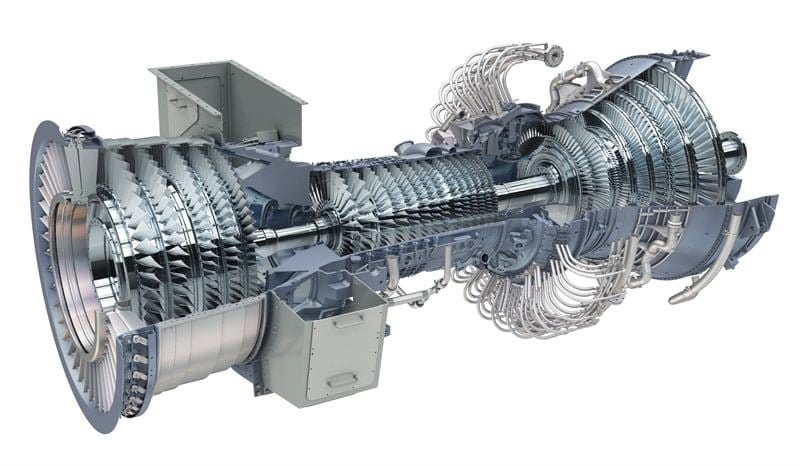
Did you know that up to 95% of the wear debris indicating a potential turbine failure is trapped within your filter media rather than circulating in your oil samples? This reality makes your choice of filtration one of the most critical decisions for any plant manager. It’s common to feel pressured by the rising costs of OEM replacement parts while fearing that an alternative might lead to varnish buildup or costly valve sticking. You need to know: Are interchange filters suitable for our turbine lube oil system?
We understand that maintaining system integrity is your top priority. This guide explores the technical risks and performance benchmarks required to prevent unplanned downtime. BioKem brings 70 years of specialist experience and a safety record of Zero Lost Time Injuries (LTI) since establishment in 2012 to this technical evaluation. We’ll outline how to assess ISO 16889-certified filtration to ensure it meets the rigorous demands of modern turbine standards. You’ll learn the specific criteria for a best of breed strategy that validates when an interchange is not only safe but a technically superior choice for your critical lubrication systems.
Key Takeaways
- Identify why physical dimensions are only the beginning of filter selection and how substandard elements risk pleat collapse or media migration.
- Determine if interchange filters are suitable for our turbine lube oil system by prioritizing ISO 16889-certified filtration and verified Beta ratios.
- Apply a structured decision framework to audit asset criticality and bypass settings, ensuring every replacement element maintains system integrity.
- Discover how a best of breed strategy, supported by 70 years of specialist experience, provides access to high-performance alternatives that often exceed original specifications.
- Mitigate the risk of varnish buildup and valve sticking by selecting filters with anti-static properties and superior water-resistance metrics.
Understanding Interchange Filters in Turbine Lubrication
Interchange filters are replacement elements engineered to integrate into filter housings manufactured by different companies. They provide a strategic alternative to original equipment manufacturer (OEM) sourcing, which is often plagued by high costs and restrictive supply chains. However, the decision to switch isn’t merely about physical compatibility. You must ask: Are interchange filters suitable for our turbine lube oil system? For critical assets, the traditional “fit, form, and function” rule is often insufficient. It overlooks the nuanced performance requirements of high-velocity lubrication environments.
Australian power plants and industrial facilities face significant economic pressure to optimize maintenance budgets. This drive for efficiency has moved the industry toward “best of breed” filtration strategies. This approach prioritizes performance over brand names, focusing on whether a filter is “OEM-equivalent” or, ideally, “OEM-exceeding.” When an alternative element offers superior dirt-holding capacity or better moisture resistance, it becomes a technical upgrade rather than just a cost-saving measure.
The Role of Filtration in High-Speed Rotational Assets
Turbines operate under extreme conditions that demand higher cleanliness standards than standard hydraulic machinery. Even microscopic particulates can cause surface fatigue or erosion on high-speed bearings. High-quality filtration acts as the primary barrier against this degradation. A foundational Understanding Oil Filters highlights how the media’s ability to maintain integrity under pressure is vital for asset longevity. To ensure these standards are met, we utilize rigorous oil analysis to verify that the filter media effectively maintains the required ISO cleanliness codes during operation.
Common Misconceptions About Third-Party Filters
One of the most persistent myths is that all filters with identical external dimensions perform the same. This is false. Internal differences in media pleat density, support structures, and bypass valve settings determine how a filter handles real-world stress. “Bargain” filters often have fewer pleats, which leads to a lower surface area and faster blinding. This increases the risk of pleat collapse during pressure spikes. When determining if interchange filters are suitable for our turbine lube oil system, one must evaluate the manufacturer’s commitment to quality. With 70 years of specialist experience, we’ve found that technical validation through ISO 16889-certified filtration is the only reliable way to debunk these misconceptions and protect mission-critical systems. Choosing the wrong element doesn’t just risk the filter; it risks the entire turbine’s uptime.
The Technical Risks of Substandard Replacement Elements
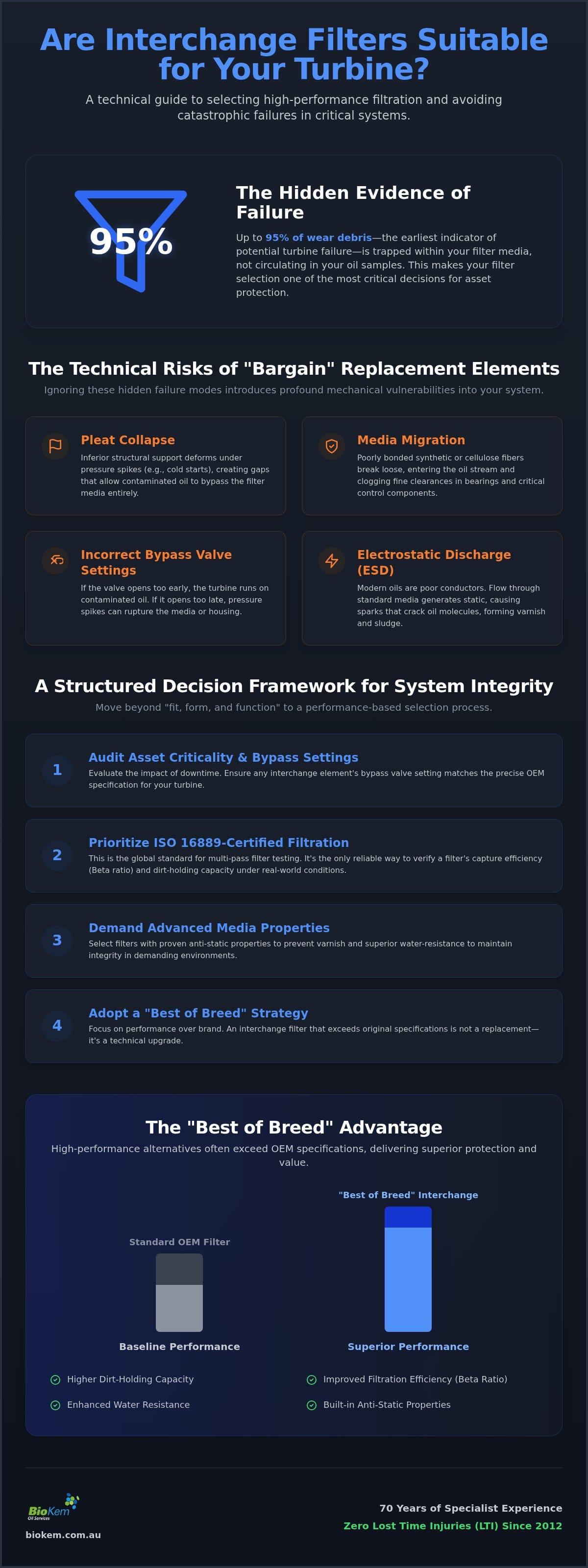
Substandard filters present more than just a filtration efficiency problem; they introduce profound mechanical vulnerabilities. Media migration occurs when inferior synthetic or cellulose fibers break loose from the element and enter the oil stream. These fibers can eventually clog fine clearances in bearings or critical control components. Pleat collapse is another failure mode often ignored during procurement. If the filter structure can’t withstand high differential pressure during cold starts or transient flow conditions, the media deforms. This deformation creates gaps that allow unfiltered, contaminated oil to bypass the element entirely, rendering the filtration system useless.
Incorrect bypass valve settings are frequently found in “budget” interchange elements. If the bypass valve opens at a lower pressure than specified by the original manufacturer, your turbine will spend a significant portion of its operating life running on contaminated oil. Conversely, if the valve is set too high, the resulting pressure spike can rupture the media or damage the filter housing. When operators ask, “Are interchange filters suitable for our turbine lube oil system?”, the answer depends heavily on the manufacturer’s ability to match these precise mechanical setpoints. Our team utilizes 70 years of specialist experience to identify these hidden failure modes before they manifest as unplanned downtime.
Electrostatic Discharge (ESD) and Sparking
Modern Group II and III base oils are highly refined but have very low conductivity. High flow rates through standard synthetic media generate significant static charges. Without specialized anti-static technology, this buildup results in internal sparking. These discharges crack the oil molecules, creating sub-micron carbon “soot” and accelerating the oxidation process. We’ve seen this phenomenon lead to scorched filter media and premature oil degradation in systems lacking specialized elements. Ensuring your interchange provider understands this mechanism is vital for maintaining long-term oil health and environmental responsibility.
Varnish Formation and Valve Sticking
Inadequate filtration directly accelerates varnish in lube oil. Fine particulates act as nucleation sites, allowing varnish precursors to precipitate out of the solution more easily. Once this varnish forms, it coats critical servo valves, leading to sluggish response or complete sticking. This often results in “ghost” alarms or catastrophic turbine trips that halt production. While varnish removal systems provide a vital secondary defense, your primary filtration must be robust enough to prevent the initial particulate buildup. We maintain a safety record of Zero Lost Time Injuries (LTI) since establishment in 2012 while helping plants solve these complex contamination challenges. If you’re concerned about your current filter performance, speak with our technical specialists to discuss a comprehensive filtration audit.
Performance Metrics: Evaluating Filters Beyond Dimensions
Evaluating the technical suitability of a filter requires looking past the physical dimensions. To answer the question, “Are interchange filters suitable for our turbine lube oil system?”, one must analyze the data derived from the ISO 16889 standard. This multi-pass test method provides a repeatable framework for measuring filtration efficiency and dirt-holding capacity (DHC) under controlled conditions. While physical fit is a prerequisite, it’s the performance under pressure that dictates asset reliability. A filter with low DHC will reach its terminal pressure drop quickly, leading to more frequent change-outs and increased labor costs. Furthermore, the chemical compatibility of the media with turbine additive packages is non-negotiable. Using 70 years of specialist experience, we verify that the synthetic fibers and resins in our filters won’t react with your oil to form harmful byproducts or contribute to additive depletion.
Beta Ratios and Efficiency Standards
A common pitfall is relying on “nominal” ratings. Nominal ratings are essentially an average that lacks a standardized definition, often capturing as little as 50 percent of particles at a given size. In contrast, turbine systems demand absolute ratings, typically expressed as a Beta Ratio. A rating of Beta(c) > 1000 at 5 microns indicates that for every 1000 particles of that size entering the filter, only one passes through. This represents 99.9 percent efficiency. BioKem utilizes ISO 16889-certified filtration to provide a standardized, multi-pass evaluation of filter efficiency and dirt-holding capacity, ensuring that every replacement element meets the rigorous demands of critical turbine assets. Comparing efficiency at 3, 5, and 10 microns allows us to tailor the filtration strategy to the specific sensitivities of your bearing clearances and servo-valves.
Differential Pressure and Cold Start Performance
Turbine oil viscosity fluctuates significantly with temperature. During a cold start, the oil is much thicker, creating higher differential pressure across the filter media. Substandard interchange elements may lack the structural reinforcement needed to prevent the bypass valve from opening or avoid pleat deformation. High-flow environments, such as those encountered during hot oil flushing services, put even more stress on the element. A filter must maintain its integrity during these high-velocity events to ensure that the system is truly clean before it’s commissioned. If an interchange element can’t handle the structural demands of commissioning, it isn’t suitable for long-term operation. We ensure that our high-performance elements are engineered to withstand these transient flow conditions without compromising the downstream cleanliness of the system.
Decision Framework: When to Use Interchange Filters
Implementing a new filtration component requires a structured approach to risk management. To determine if interchange filters are suitable for our turbine lube oil system, you must move beyond simple part-number matching. A logical decision framework ensures that any alternative media maintains or improves system cleanliness without introducing mechanical vulnerabilities. We recommend following these five technical steps:
- Step 1: Audit Asset Criticality. Differentiate between base-load turbines, where any downtime is catastrophic, and peaking units. While both require high standards, the margin for error on a primary generation asset demands the most rigorous validation.
- Step 2: Verify ISO 16889 Test Data. Request the full multi-pass test report for the specific interchange element. Ensure the Beta ratio and dirt-holding capacity match the operational requirements of your housing.
- Step 3: Assess Oil Chemistry. Identify if your system uses Group II or III base oils. These fluids often necessitate anti-static media to prevent electrostatic discharge and subsequent oil cracking.
- Step 4: Perform Debris Benchmarking. Conduct a filter debris analysis on your current element. This provides a baseline of the contaminants being captured and helps you select an interchange media that targets those specific particle sizes.
- Step 5: Consult Technical Specialists. Partner with a distributor like BioKem to leverage 70 years of specialist experience in turbine-specific contamination control.
OEM vs. High-Quality Interchange: A Comparison
High-performance interchanges from reputable manufacturers like Filters S.p.A. or Swift Filters are engineered to meet or exceed OEM specifications. These “best of breed” options often provide superior availability compared to OEM supply chains, which is vital for Australian facilities facing long international lead times. Concerns regarding equipment warranties are common; however, using a filter that meets the required technical performance standards is a standard industrial practice. The primary advantage of sourcing through an Australian distributor is the localized technical support. We maintain a safety record of Zero Lost Time Injuries (LTI) since establishment in 2012 while providing the onsite expertise needed to ensure a seamless transition between brands.
Verification Through Oil Analysis
Validation of a new filter element must be data-driven. After switching to an interchange, use ISO 4406 particle counts to monitor cleanliness levels over the first 500 hours of operation. You should also track the Membrane Patch Colorimetry (MPC) value to ensure that varnish potential remains low. Onsite patch analysis serves as an excellent proactive tool, allowing maintenance teams to visually confirm that the new media is effectively removing the target contaminants. If you are ready to optimize your filtration strategy with a technically validated alternative, contact our engineering team for a site-specific consultation.
BioKem’s High-Performance Filtration Solutions
BioKem provides the technical bridge between cost-efficiency and asset reliability. We answer the question, “Are interchange filters suitable for our turbine lube oil system?” by supplying replacement elements that meet or exceed original performance benchmarks. Our approach prioritizes technical validation over brand names, ensuring your critical assets are protected from the risks of varnish, moisture, and particulate contamination. We don’t just provide parts; we deliver engineered solutions that align with modern industrial standards and environmental responsibilities.
As the Australian distributor for Filters S.p.A. and Swift Filters, we bring “best of breed” technology to the local market. Our inventory includes high-dirt-holding elements and anti-static media specifically designed for the high-velocity environments of gas and steam turbines. Operating from our Queensland base, we offer national mobilization and rapid supply capabilities. This localized presence eliminates the long lead times often associated with international OEM orders, allowing you to maintain optimal system cleanliness without delay.
Expert Consultation and Technical Support
Navigating the interchange market requires more than a cross-reference chart. It demands a deep understanding of fluid dynamics and oil chemistry. BioKem leverages 70 years of specialist experience to help clients identify the most suitable filtration strategy for their specific assets. We analyze your operational data and asset criticality to recommend ISO 16889-certified filtration that guarantees performance under real-world conditions. This technical expertise ensures that every switch to an interchange element is a calculated, low-risk improvement to your maintenance program.
Our commitment to excellence extends to our onsite execution. We provide comprehensive lubrication oil filtration services that integrate premium consumables with professional technical support. Safety remains our highest priority; we have maintained Zero Lost Time Injuries (LTI) since establishment in 2012. This record reflects our disciplined approach to solving complex industrial challenges in high-risk environments. For specialized filter advice or to discuss a customized filtration program for your facility, contact Mike Smith at 0413 951 112.
Securing Long-Term Reliability for Your Turbine Assets
Choosing a filtration solution is a technical commitment to asset longevity. You’ve learned that suitability depends on exceeding OEM standards through ISO 16889-certified filtration and addressing specific risks like electrostatic discharge and varnish formation. By prioritizing performance metrics over brand labels, you can reduce maintenance costs without sacrificing system integrity. When asking, “Are interchange filters suitable for our turbine lube oil system?”, the answer lies in technical validation and data-driven selection.
BioKem serves as the Australian distributor for world-class brands like Filters S.p.A. and Swift Filters, backed by 70 years of specialist experience. Our safety record of Zero Lost Time Injuries (LTI) since establishment in 2012 ensures that your maintenance program is supported by responsible, expert partners who value operational safety as much as technical performance. We provide the localized expertise needed to navigate the complexities of modern turbine lubrication.
Contact the BioKem specialists for a technical filter audit today to validate your current strategy and protect your critical infrastructure. We look forward to helping you achieve a cleaner, more efficient, and more reliable operation.
Frequently Asked Questions
Are interchange filters as good as OEM filters for turbine systems?
High-quality interchange filters from reputable brands like Filters S.p.A. can meet or even exceed OEM specifications. BioKem leverages 70 years of specialist experience to ensure these alternatives match the technical requirements of your system. The focus is on sourcing “best of breed” technology that provides equivalent or superior protection. This approach allows Australian facilities to maintain high standards of reliability while optimizing their maintenance budgets and improving their overall supply chain resilience.
Will using an interchange filter void my turbine manufacturer warranty?
Generally, no. Using a filter that meets or exceeds the OEM’s technical specifications should not void a warranty. It’s important to document that the replacement element matches the required Beta ratio and efficiency standards. We provide ISO 16889-certified filtration options to ensure your maintenance practices remain compliant with industry standards. This ensures your asset health remains the priority while allowing for the use of high-performance international equipment sourced locally.
What technical specifications should I check before buying an interchange filter?
You must verify the Beta ratio, dirt-holding capacity, and the collapse pressure rating. It’s also vital to check if the bypass valve settings on the replacement element align with your housing’s requirements. When asking, “Are interchange filters suitable for our turbine lube oil system?”, these metrics provide the technical evidence needed to make a safe decision. These specifications ensure the element can handle the high-velocity flow and pressure spikes typical in turbine environments.
Do turbine lube oil systems require special anti-static filters?
Yes, modern Group II and III base oils often require anti-static filters to prevent electrostatic discharge. Standard synthetic media can generate static charges that lead to internal sparking and oil degradation. We supply specialized anti-static options designed to eliminate these risks. This ensures your lubrication system remains stable and free from the soot or varnish precursors caused by sparking events, which is critical for maintaining the longevity of high-speed rotational assets.
How can I verify if an interchange filter is meeting ISO cleanliness codes?
Verification is achieved through regular oil analysis and onsite patch analysis. By comparing ISO 4406 particle counts before and after installation, you can confirm that the new element is effectively removing contaminants. BioKem offers comprehensive condition monitoring and analysis services to help you track these metrics accurately. This data-driven approach ensures your “best of breed” filtration strategy is delivering the expected results for your critical turbines and other high-speed industrial machinery.
What are the risks of using a low-cost interchange filter in a gas turbine?
Low-cost filters often suffer from pleat collapse, media migration, or incorrect bypass settings. These failures allow unfiltered oil to reach critical bearings, leading to accelerated wear or unplanned downtime. In gas turbines, this also increases the risk of varnish buildup and sticking servo valves. Our commitment to safety is reflected in our Zero Lost Time Injuries (LTI) since establishment in 2012 while we help clients manage these complex mechanical risks.
Can BioKem provide equivalents for major OEM filter brands in Australia?
Yes, BioKem is the Australian distributor for world-class brands like Filters S.p.A. and Swift Filters. We provide high-performance equivalents for a wide range of major OEM brands used in the energy and mining sectors. Our national mobilization capabilities ensure these technical solutions are available to facilities across Australia. We leverage 70 years of specialist experience to help you select the right replacement elements for your specific turbine and compressor configurations.
How often should I perform oil analysis when switching to a new filter brand?
We recommend increasing the frequency of oil analysis for the first few months after a switch. Testing every 250 to 500 operating hours initially allows you to establish a performance baseline. This proactive approach helps you monitor particle counts and varnish potential. It ensures the interchange filters are suitable for our turbine lube oil system and meeting your specific asset health goals while providing early warning of any potential system issues.

Article by
James McAllister
James McAllister is an industry professional with BioKem Oil Services, specialising in lubrication reliability, oil filtration, contamination control and asset performance. Drawing on BioKem's extensive field experience across turbines, compressors, hydraulic systems and critical rotating equipment, James writes practical, insight-driven articles that help maintenance and reliability teams improve equipment performance, extend asset life and reduce operational risk.