


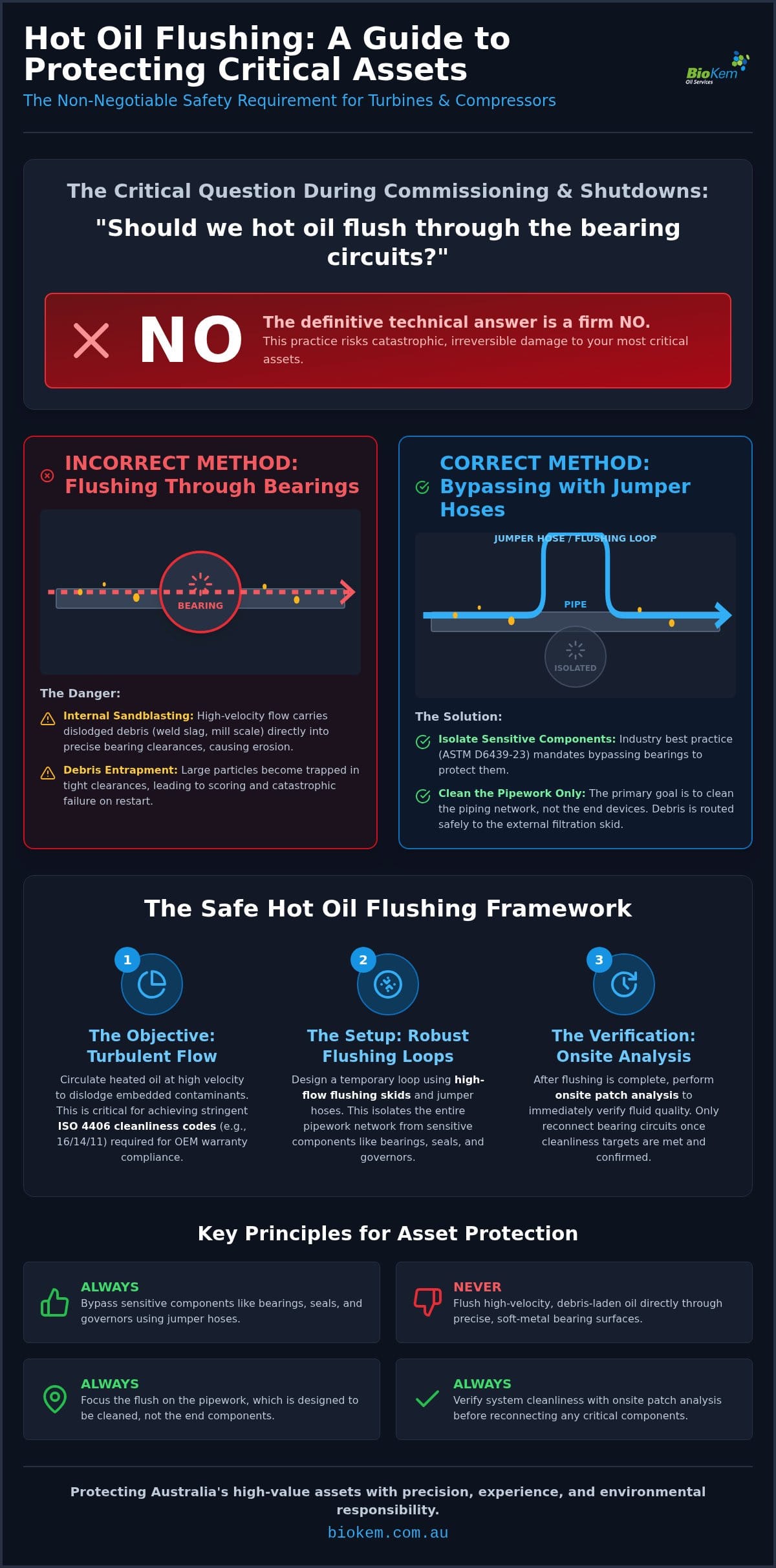
Subjecting your high-value turbine or compressor bearings to a high-velocity oil flush is effectively sandblasting your most critical assets from the inside out. While the goal is to eliminate the particulate contamination responsible for 80% of hydraulic system failures, the process intended to protect your equipment can easily destroy it. You likely feel the immense pressure to meet strict ISO 4406 cleanliness targets within a narrow shutdown window, yet the central question remains: Should we hot oil flush through the bearing circuits? The technical answer is a firm no.
Industry best practice dictates that bypassing sensitive components is a non-negotiable safety requirement to prevent mechanical erosion and debris entrapment. This article explores the technical justification for using jumper hoses to isolate bearings while maintaining the turbulent flow necessary for a successful clean. You’ll discover a proven framework for setting up safe flushing loops that satisfy OEM specifications and protect your long-term operational health. Drawing on 70 years of specialist experience, BioKem provides the technical clarity you need to manage these complex commissioning requirements with precision and environmental responsibility.
Key Takeaways
- Understand why high-velocity hot oil flushing is required to achieve turbulent flow and meet strict ISO 4406 cleanliness standards for critical rotational assets.
- Get a definitive answer to the question, “Should we hot oil flush through the bearing circuits?”, and learn why bypassing these precise surfaces is an essential safety requirement.
- Discover how to design robust flushing loops and battery limits that clean your entire pipework network without exposing bearings to dislodged debris.
- Learn the proper sequence for post-flush reconnection and how onsite patch analysis provides immediate verification of fluid quality before system restart.
- Gain insights into how BioKem applies 70 years of specialist experience to manage high-stakes commissioning and shutdown support throughout Australia.
The Fundamentals of Hot Oil Flushing in Bearing Circuits
Hot oil flushing is a specialized high-velocity cleaning procedure designed to establish or restore the internal cleanliness of lubrication and hydraulic piping systems. It involves circulating heated oil through the system at flow rates significantly higher than normal operating speeds. This process creates turbulent flow, which is essential for dislodging deeply embedded contaminants such as weld slag, mill scale, and atmospheric dust. The study of lubrication confirms that maintaining fluid purity is the single most effective way to ensure mechanical reliability and extend asset life.
The primary objective of this procedure is to clean the pipework, not the components themselves. During a typical project, a temporary flushing loop is established using high-flow flushing skids. This loop isolates the reservoir and piping from sensitive internal clearances. A common query during the planning phase of a plant turnaround or commissioning project is: Should we hot oil flush through the bearing circuits? While the intent is to clean the entire system, running high-velocity oil through precise bearing surfaces is a dangerous practice that often leads to irreversible mechanical damage.
The Criticality of Industrial Oil Cleanliness
In high-speed rotational assets like turbines and gas compressors, the margin for error is microscopic. These machines rely on a thin film of oil to prevent metal-on-metal contact. Even particles as small as 4 to 6 microns can breach this film, causing abrasive wear or surface fatigue. Industry experts utilize ISO 4406 cleanliness codes to quantify these contaminants. Achieving a target like 16/14/11 is often mandatory for OEM warranty compliance. Without professional intervention, these microscopic threats lead to catastrophic bearing failure and prolonged unscheduled downtime. BioKem leverages 70 years of specialist experience to ensure these targets are met with scientific precision and transparency.
When is a Hot Oil Flush Necessary?
Thermal and mechanical stresses eventually degrade even the highest quality lubricants. A hot oil flush becomes essential during several key lifecycle stages:
- Commissioning: New installations often contain “built-in” debris like metal shavings, sand, and protective coatings that must be removed before the first start-up.
- Post-Shutdown Maintenance: After major component replacements or internal inspections, the risk of atmospheric contamination is high.
- Contamination Events: If a system shows clear signs of contaminated hydraulic oil or significant varnish buildup, a high-velocity flush is the only way to physically strip these deposits from the pipe walls.
By utilizing specialized equipment, operators can achieve the Reynolds numbers required to ensure a truly clean system while maintaining a safe operational environment. This proactive approach to fluid health is a cornerstone of modern industrial maintenance in Australia.
Why You Should Never Flush Through the Bearings
The question “Should we hot oil flush through the bearing circuits?” often arises during the planning of complex industrial commissioning or maintenance shutdowns. The definitive answer, supported by 70 years of specialist experience, is that you must always bypass these sensitive components. Bearing surfaces, particularly those lined with soft white metal or babbitt, are highly susceptible to mechanical erosion. When you introduce high-velocity oil laden with construction debris or mill scale, you are essentially sandblasting the very surfaces you intend to protect. These delicate clearances are not designed to withstand the abrasive force of dislodged particulates.
Proper flushing procedures, as outlined in the industry standard ASTM D6439-23, focus on cleaning the transport pipework rather than the end devices. The clearances within a bearing are simply too tight to accommodate the passage of the large contaminants dislodged during the high-velocity cleaning process. If these particles enter the bearing housing, they become trapped, leading to immediate scoring or catastrophic failure upon restart. Bypassing is the only way to ensure that debris is routed to the filtration skid and not into your critical assets.
The Physics of Turbulent Flow (Reynolds Number)
To effectively clean a lubrication system, the oil must reach a Reynolds Number greater than 4,000. This state of turbulent flow creates the chaotic movement necessary to lift and transport heavy particles to the filtration unit. This velocity is fundamentally incompatible with bearing tolerances, which are designed for the steady, predictable environment of laminar flow. During normal operation, oil moves in smooth layers to maintain a protective film. The violent energy of a turbulent flush would strip this film and drive abrasive particles directly into the metal grain.
Risks of Entrapment and Secondary Contamination
Bearing housings often feature internal geometries that inadvertently act as “settling tanks” during a flush. When flow velocity drops within these larger cavities, dislodged debris falls out of suspension and accumulates in corners, oil grooves, or dead legs. Removing these trapped particles once they have entered the circuit is nearly impossible without a full teardown. This creates a secondary contamination risk that can haunt the system for months after the flush is complete.
This risk extends to chemical contaminants as well. During a varnish flush, softened deposits can be pushed into tight clearances where they may re-solidify as the oil cools. This creates “stiction” in valves and restricts oil flow to the bearings. To ensure your assets remain protected throughout this process, you can consult with our technical team regarding the design of safe flushing loops. By isolating these critical components, you ensure that only clean, certified oil ever reaches your bearing surfaces.
Designing Effective Flushing Loops and Battery Limits
Designing an effective flushing loop is a precise engineering task that dictates the success of the entire cleaning operation. The goal is to create a closed circuit that encompasses every centimetre of supply headers, branch lines, and return piping. By establishing strategic entry and exit points, technicians ensure that the heated oil reaches the necessary velocity to lift contaminants from the pipe walls. To monitor this progress in real time, BioKem utilises paddle flushing screens. These screens are placed at critical points in the return line, providing a visual and physical representation of the debris being removed from the system.
When planning these circuits, engineers often ask: Should we hot oil flush through the bearing circuits? To protect the integrity of the machine, the loop must be designed to terminate at the final flange before the oil enters the bearing housing. By installing temporary jumper hoses, the flushing oil bypasses the sensitive internal clearances and returns directly to the filtration unit. This approach ensures that the high-velocity oil cleans the transport pipework without exposing the bearings to dislodged slag or mill scale.
Establishing Battery Limits for Your Contractor
Battery limits define the physical boundaries of the flushing operation. Clearly identifying these start and end points is essential for safety and operational efficiency. You must ensure that all sensitive components, including bearings, control valves, and main system pumps, are completely isolated from the loop. Documenting these isolation points and verifying them against commissioning checklists provides a transparent audit trail for OEM warranty compliance. This rigour prevents the accidental introduction of contaminants into cleaned zones and ensures that the flushing contractor remains accountable for the specified scope of work.
The Role of High-Flow Flushing Skids
Relying on the asset’s own lubrication pumps for a flush is a common mistake. Standard system pumps are designed for laminar flow and steady-state operation; they cannot generate the high Reynolds numbers required for turbulent cleaning. Instead, the use of external high flow flushing skids is mandatory. These specialised units are equipped with high-capacity heaters and pumps that maintain the oil at the optimal temperature and velocity throughout the entire circuit. Furthermore, these skids integrate ISO 16889-certified filtration technology, which captures particulates as small as 3 microns. This ensures that the oil returning to the reservoir is significantly cleaner than the oil leaving it, resulting in a system that meets or exceeds international cleanliness standards.
Post-Flush Procedures: Reconnecting the Bearing Circuits
Once the flushing loop successfully achieves the target ISO 4406 cleanliness code, the transition from cleaning to restoration begins. This phase requires the same level of technical rigour as the high-velocity flush itself. While the initial strategy addressed the question, “Should we hot oil flush through the bearing circuits?” by implementing a bypass, the final reconnection is where the risk of secondary contamination is highest. Every component must be restored to its operational configuration without compromising the newly established fluid purity.
Restoring the lubrication system is a delicate process. It’s not enough to simply remove the jumpers; the final connection points must be treated as sterile environments. Any atmospheric dust or lint introduced during this stage can bypass the main filtration and go directly into the bearing clearances. Technicians must follow a documented sequence to ensure the integrity of the system remains intact through to the first start-up.
Verifying Cleanliness Targets
Before removing any bypasses, technicians must verify that the oil meets the stringent requirements set by the OEM. Technicians don’t just rely on automated particle counters; they use onsite patch analysis to provide immediate, lab-grade results. By drawing a fluid sample and passing it through a 0.8-micron membrane, we can visually identify hard particulates, metallic shavings, or environmental dust. This is often supplemented by oil filter debris analysis. This process identifies the specific nature of any captured material, allowing us to confirm the system is truly free of construction debris or wear particles before the bearing circuits are re-engaged.
The Restoration and Final Filtration Phase
Restoring the system involves removing temporary jumper hoses and reconnecting the bearing supply lines. This must be performed under controlled conditions. Technicians clean every flange surface and replace seals with new, certified components. Once the physical connections are restored, the system enters the “final polish” phase. We often deploy vacuum dehydration units to remove any dissolved water or entrained gases that may have entered the system during the shutdown. This step is vital for Australian operators dealing with high humidity or temperature fluctuations that can cause condensation within the reservoir.
A final system walk-down is conducted to verify every connection point and ensure there aren’t any leaks. This methodical approach, backed by 70 years of specialist experience, guarantees your assets are protected from the moment of first start-up. To ensure your next shutdown meets these exacting standards, contact the BioKem team for a technical consultation.
Maximising Asset Health with BioKem Oil Services
BioKem provides turnkey hot oil flushing services across Australia, delivering the technical precision required for high-stakes industrial environments. With 70 years of specialist experience, we understand that the answer to the question, “Should we hot oil flush through the bearing circuits?”, is a definitive no. We have the engineering expertise to design and execute bypass loops that protect your most valuable rotational assets. Our safety-first culture is a core pillar of our operations, evidenced by a record of Zero Lost Time Injuries (LTI) since our establishment in 2012. Whether you require a full-service turnkey team or specialised equipment hire for contamination control, we provide the tools to reach and maintain ISO 4406 cleanliness targets.
Operating nationally, we serve as a reliable partner for the energy generation, gas compression, and mining sectors. We don’t just provide equipment; we provide scientific solutions to complex fluid challenges. By integrating high-flow flushing skids with onsite lab-based analysis, we ensure that every project is completed with transparency and efficiency. This commitment to technical excellence allows Australian operators to meet strict OEM specifications while minimising the risks associated with premature bearing failure.
Tailored Solutions for Heavy Industry
Our technical teams possess deep experience with the specific lubrication requirements of GE, Siemens, and Rolls Royce Bergen reciprocating engines. We offer national mobilisation capability, allowing us to provide rapid shutdown support to remote sites across the country. We’re also equipped to manage comprehensive varnish removal in high-temperature systems, effectively stripping away the soft contaminants that often lead to valve stiction and restricted flow. This targeted approach ensures that your system isn’t just clean, but restored to its optimal chemical and physical state.
The BioKem Advantage: Best of Breed Technology
We utilise internationally sourced, “best of breed” filtration hardware to ensure our clients receive the highest standard of contamination control. Every flush we perform is backed by comprehensive laboratory testing and analysis, including wear debris analysis and ferrogram reporting. This data-driven approach removes the uncertainty from commissioning. If you’re currently planning a shutdown and asking, “Should we hot oil flush through the bearing circuits?”, our engineers can help you develop a site-specific flushing strategy. Contact the BioKem team at Unit 4/34 Enterprise Street, Cleveland, Queensland 4163, or call 0413 951 112 to discuss your asset health requirements.
Securing Long-Term Reliability Through Precision Commissioning
The integrity of your high-speed rotational assets depends entirely on the cleanliness of their lubrication systems. Protecting these components requires more than just high-velocity filtration; it demands a strategic isolation of sensitive internal clearances. When addressing the question, “Should we hot oil flush through the bearing circuits?”, the technical justification for bypassing is clear. By utilizing temporary jumpers and high-flow flushing skids, you ensure that dislodged debris is captured by certified filtration rather than being driven into delicate babbitt surfaces.
BioKem combines 70 years of specialist experience with a commitment to operational safety that’s maintained a Zero LTI record since 2012. Our national service coverage ensures that energy, gas, and mining operations across Australia have access to industry-standard best practices and onsite lab-based verification. Implementing these rigorous protocols during your next shutdown prevents premature failures and satisfies strict OEM requirements. Ensuring your fluid health today is the most effective way to guarantee mechanical reliability tomorrow.
Contact BioKem for Expert Hot Oil Flushing Services to discuss a tailored contamination control strategy for your facility. Your equipment’s longevity is the direct result of the precision you apply today.
Frequently Asked Questions
Is it ever acceptable to flush through bearings if the oil is already “clean”?
No, it’s never acceptable to flush through bearings regardless of the oil’s initial appearance. The high-velocity turbulent flow required for an effective flush is designed to dislodge particulates from pipe walls. Even in a seemingly clean system, this process can mobilize hidden debris and force it into tight bearing clearances. This leads to mechanical erosion or “sandblasting” of delicate babbitt surfaces, which compromises the asset’s long-term reliability.
How do I know if my flushing loop has achieved the required Reynolds Number?
Technicians calculate the Reynolds Number by monitoring the oil’s viscosity, temperature, and flow rate relative to the pipe diameter. To achieve the turbulent flow necessary for cleaning, this value must exceed 4,000. BioKem utilizes high-flow flushing skids equipped with calibrated flow meters and heating elements to maintain these precise parameters. This ensures the oil has sufficient kinetic energy to physically lift and transport contaminants to the filtration unit.
What happens if debris is accidentally flushed into a bearing housing?
If debris enters a bearing housing, it often leads to immediate surface scoring or catastrophic failure upon equipment startup. Bearing housings act as settling tanks where flow velocity drops, causing particles to fall out of suspension and become trapped in oil grooves. Removing this contamination typically requires a full mechanical teardown and manual cleaning. This risk is why the answer to “Should we hot oil flush through the bearing circuits?” is always a firm no.
Can hot oil flushing remove varnish from bearing surfaces if I bypass them?
A high-velocity flush is primarily designed to clean the transport pipework rather than the internal surfaces of bypassed components. To address varnish on the bearings themselves, specialized varnish mitigation or chemical cleaning is required during normal operating cycles. Bypassing the bearings during the flushing phase protects them from dislodged particulates while the rest of the system is stripped of deposits and restored to the required OEM cleanliness specifications.
How long does a typical bearing circuit hot oil flush take?
The duration of a flush depends on the system’s total volume, complexity, and initial contamination levels. A typical project might range from 24 hours to several days of continuous circulation. The process only concludes once onsite patch analysis verifies that the fluid meets the target ISO 4406 cleanliness code. BioKem leverages 70 years of specialist experience to optimize these windows, ensuring that critical assets are returned to service within tight shutdown schedules.
Do I need to replace my bearings after a major system flush?
You don’t need to replace your bearings after a flush if the procedure was performed correctly. The goal of a professional hot oil flush is to preserve your existing assets by removing the contaminants that cause premature failure. By using jumper hoses to bypass the bearing circuits, you ensure that no abrasive debris enters the housings. This proactive maintenance strategy extends the operational life of your equipment and prevents costly, unscheduled replacements.
What is the difference between a high-velocity flush and a standard oil change?
A standard oil change only replaces the fluid in the reservoir, leaving up to 80% of contaminants trapped in the pipework and dead legs. In contrast, a high-velocity flush uses external pumps to create turbulent flow throughout the entire network. This physical energy strips slag, scale, and varnish from internal surfaces. It’s a comprehensive mechanical cleaning process rather than a simple fluid replacement, which is vital for maintaining system reliability.
Should I use a chemical cleaner in my bearing circuits before the hot oil flush?
Chemical cleaners should be used with extreme caution and only under expert technical supervision. While these agents can help dissolve stubborn varnish, they must be completely neutralized and flushed out to prevent lubricant degradation or seal damage. In most industrial applications, a high-velocity hot oil flush using the system’s intended lubricant is sufficient to achieve the required cleanliness without the chemical risks associated with aggressive additives or synthetic detergents.

Article by
James McAllister
James McAllister is an industry professional with BioKem Oil Services, specialising in lubrication reliability, oil filtration, contamination control and asset performance. Drawing on BioKem's extensive field experience across turbines, compressors, hydraulic systems and critical rotating equipment, James writes practical, insight-driven articles that help maintenance and reliability teams improve equipment performance, extend asset life and reduce operational risk.
Disclaimer
The information contained in this article is provided by BioKem Oil Services for general informational and educational purposes only. While every effort has been made to ensure the accuracy and relevance of the information at the time of publication, BioKem Oil Services makes no representations or warranties, express or implied, regarding its completeness, accuracy, reliability, suitability or availability.
Readers should seek professional advice before making maintenance, operational, engineering or investment decisions based on the content of this article. BioKem Oil Services accepts no liability for any loss, damage or consequential loss arising from the use of, or reliance upon, the information presented.
Unless otherwise stated, all content, including text, graphics, images and technical information, is the property of BioKem Oil Services and is protected by applicable copyright and intellectual property laws. No part of this publication may be reproduced, copied, distributed, republished, stored, transmitted, modified or used in any form without the prior written permission of BioKem Oil Services.
© BioKem Oil Services. All rights reserved.